14 Gauge Wire Amp Rating: Ampacity Chart and the 15 Amp Rule
Short answer
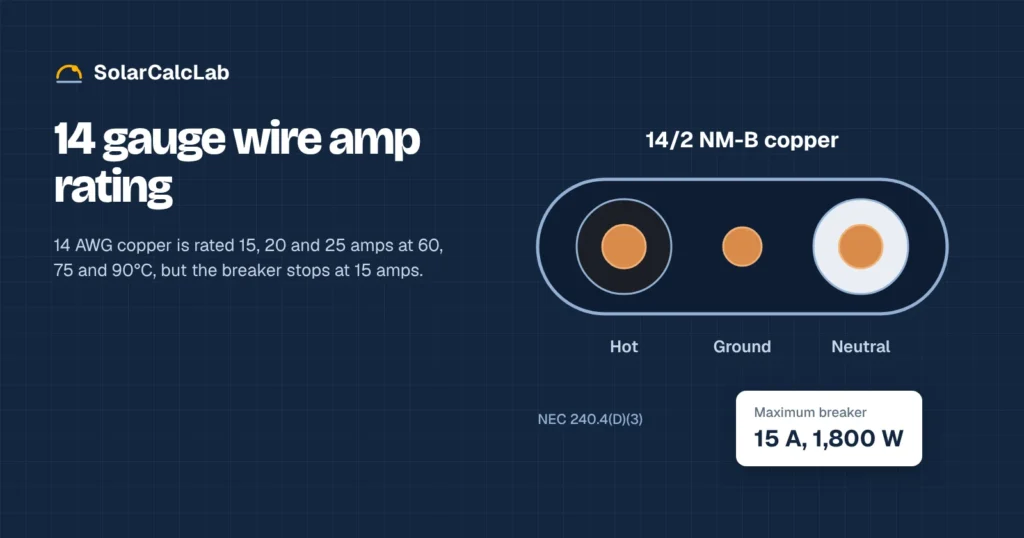
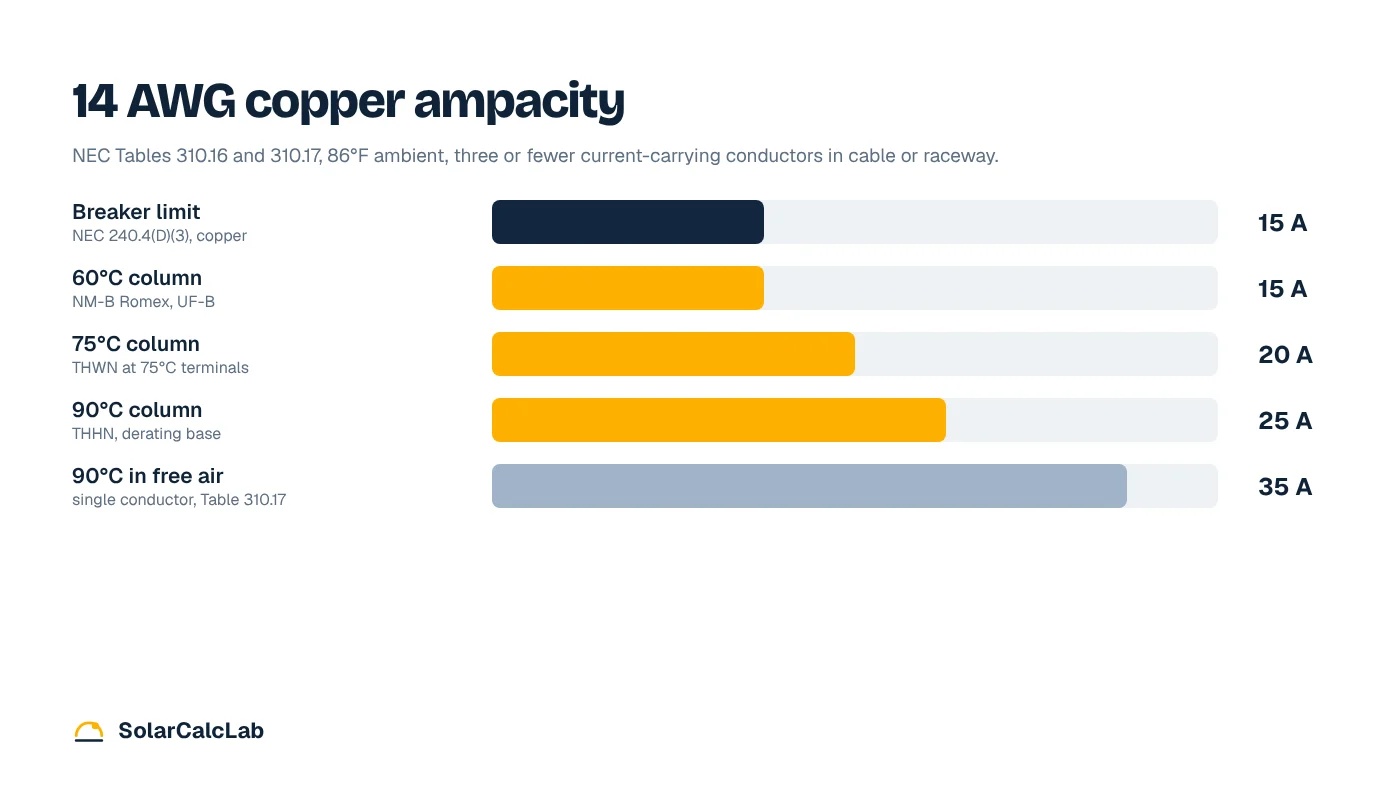
NEC Table 310.16 rates 14 AWG copper wire at 15 amps at 60°C, 20 amps at 75°C and 25 amps at 90°C. Section 240.4(D)(3) caps the breaker at 15 amps for general circuits, so in a home 14 gauge copper is a 15 amp wire. That gives 1,800 watts at 120 V, or 1,440 watts for a continuous load. Never put 14 gauge on a 20 amp breaker.
Fourteen gauge is the smallest wire allowed for most household branch circuits, and it is everywhere: bedroom receptacles, ceiling lights, bath fans and hallway circuits. It also shows up in RV and small solar DC wiring. The 14 gauge wire amp rating trips people up because a chart lists 15, 20 and 25 amps for the same copper conductor, while the breaker rule allows only one of them.
Code references below are to Tables 310.16 and 310.17 and Section 240.4 of NFPA 70, the National Electrical Code.
14 AWG wire ampacity chart
Ampacity is the current a conductor carries continuously without exceeding its insulation rating. Table 310.16 assumes 86°F (30°C) ambient and no more than three current-carrying conductors in a cable or raceway. Table 310.17 covers single conductors in free air, which run cooler and carry more.
| 14 AWG conductor | 60°C (140°F) | 75°C (167°F) | 90°C (194°F) |
|---|---|---|---|
| Copper, raceway or cable (310.16) | 15 A | 20 A | 25 A |
| Copper, single conductor in free air (310.17) | 25 A | 30 A | 35 A |
| Aluminum | Not listed; aluminum building wire starts at 12 AWG | ||
| Maximum breaker, Section 240.4(D)(3) | 15 A copper | ||
Solid and stranded 14 AWG carry identical ratings. Manufacturer tables such as the Cerrowire ampacity charts show the same copper values.
The 15 amp rule for 14 gauge wire
The single most important number for 14 AWG is not in the ampacity table. It is in Section 240.4(D)(3), which says that unless a specific exception applies, overcurrent protection for 14 AWG copper must not exceed 15 amps. The 20 and 25 amp values exist, but you use them only as a starting point for derating.
What each column means in practice
- 14/2 or 14/3 NM-B (Romex): Section 334.80 holds NM cable to the 60°C column, which is 15 amps. It belongs on a 15 amp breaker.
- 14 AWG THHN or THWN-2 in conduit: 20 amps at the 75°C terminals on most breakers and 25 amps for derating math, but still protected at 15 amps.
Why 14 gauge on a 20 amp breaker is dangerous
A 20 amp breaker lets 20 amps flow indefinitely and tolerates short overloads well above that. NM cable rated 15 amps inside an insulated wall can run hotter than its insulation allows long before that breaker trips. Inspectors often find it where someone swapped a tripping 15 amp breaker for a 20. The fix is to put the 15 amp breaker back or rewire with 12 AWG, covered in the 12 gauge wire amp rating guide.
The equipment exceptions
Section 240.4(G) lifts the small conductor limit for motor circuits (Article 430) and air conditioning and refrigeration equipment (Article 440), because those units carry their own overload protection. If a unit’s nameplate shows a minimum circuit ampacity under 15 A and a 20 A maximum overcurrent device, 14 AWG copper may go on that 20 A breaker. Outside nameplate cases like that, 14 gauge stays at 15 amps.
How many watts can 14 gauge wire handle?
Multiply volts by the breaker size, then hold any load that runs three hours or longer to 80% of the breaker.
120 V, 15 A breaker: 120 × 15 = 1,800 W maximum, 120 × 12 = 1,440 W continuous
240 V, 15 A breaker: 240 × 15 = 3,600 W maximum, 240 × 12 = 2,880 W continuous
| Circuit | Breaker | Maximum load | Continuous load (80%) |
|---|---|---|---|
| 120 V, 14 AWG copper | 15 A | 1,800 W | 1,440 W |
| 240 V, 14 AWG copper | 15 A | 3,600 W | 2,880 W |
| 12 V DC, 14 AWG copper | 15 A fuse | 180 W | 144 W |
| 24 V DC, 14 AWG copper | 15 A fuse | 360 W | 288 W |
Check your own appliance ratings in the watts to amps calculator, or work backward with the amps to watts calculator.
Typical loads on a 15 amp, 14 AWG circuit
| Load at 120 V | Typical watts | Current | Fits on 14 AWG? |
|---|---|---|---|
| Twenty 10 W LED bulbs | 200 W | 1.7 A | Yes, easily |
| TV, router and game console | 400 W | 3.3 A | Yes |
| Window AC unit, 8,000 BTU | 700 W | 5.8 A | Yes |
| Microwave, 1,000 W cooking power | 1,500 W input | 12.5 A | Only with little else running |
| Portable space heater on high | 1,500 W | 12.5 A | Above the 12 A continuous figure; better on 20 A |
Section 210.23(A)(1) limits a single cord-and-plug load on a 15 amp circuit to 12 amps. A heater plus a hair dryer on one bedroom circuit is the classic trip.
Where you cannot use 14 gauge wire
Section 210.11(C) requires 20 amp branch circuits in several places, and a 20 amp circuit needs at least 12 AWG copper. That rules out 14 gauge for:
- The two or more small appliance circuits serving kitchen countertops, pantry and dining areas.
- The laundry receptacle circuit.
- The bathroom receptacle circuit.
- Garage receptacles, which need a dedicated 20 amp circuit under the 2020 and later editions of the NEC.
Bedrooms, living rooms, hallways, closets and general lighting may all use 15 amp circuits on 14 AWG. Confirm the code edition your area has adopted. For heavier loads, the 10 gauge wire amp rating guide covers 30 amp circuits.
Derating 14 AWG for heat and bundling
Put more than three current-carrying conductors in one raceway, or run wire through a hot attic, and Section 310.15 lowers the allowed ampacity. For 90°C THHN, start from 25 amps and multiply by each factor.
| Condition (14 AWG copper THHN, 90°C base 25 A) | Factor | Adjusted ampacity | 15 A breaker OK? |
|---|---|---|---|
| 4 to 6 current-carrying conductors | 0.80 | 20.0 A | Yes |
| 7 to 9 current-carrying conductors | 0.70 | 17.5 A | Yes |
| 10 to 20 current-carrying conductors | 0.50 | 12.5 A | No |
| Ambient 97°F to 104°F (36°C to 40°C) | 0.91 | 22.8 A | Yes |
| Ambient 115°F to 122°F (46°C to 50°C) | 0.82 | 20.5 A | Yes |
| 106°F to 113°F and 4 to 6 conductors | 0.87 × 0.80 | 17.4 A | Yes |
Example: 25 A × 0.87 × 0.80 = 17.4 A, which still covers a 15 A breaker
With the 15 amp cap far below the 25 amp base, 14 AWG THHN survives most derating. Only 10 or more current-carrying conductors push it under 15 amps.
Voltage drop on 14 gauge wire at 120 V
Thin wire also loses voltage over distance. An informational note in the NEC suggests about 3% for a branch circuit. NEC Chapter 9, Table 8 lists solid uncoated 14 AWG copper at 3.07 ohms per 1,000 feet, roughly 60% more than 12 AWG.
| One-way distance | 8 A load | 12 A load | 15 A load |
|---|---|---|---|
| 25 ft | 1.2 V (1.0%) | 1.8 V (1.5%) | 2.3 V (1.9%) |
| 50 ft | 2.5 V (2.0%) | 3.7 V (3.1%) | 4.6 V (3.8%) |
| 75 ft | 3.7 V (3.1%) | 5.5 V (4.6%) | 6.9 V (5.8%) |
| 100 ft | 4.9 V (4.1%) | 7.4 V (6.1%) | 9.2 V (7.7%) |
Example: 2 × 50 ft × 12 A × 0.00307 Ω/ft = 3.7 V, or 3.1% of 120 V
How far can you run 14 gauge wire?
At 120 V, 14 AWG copper stays within 3% up to about 49 feet at a 12 A continuous load and about 39 feet at a full 15 A. On a 240 V circuit those limits double to about 98 and 78 feet. Light loads can run much farther. For a long run to an outbuilding, use 12 AWG on the same 15 amp breaker; that is always allowed. Test any length in the voltage drop calculator.
14 AWG wire for 12 V, 24 V and 48 V DC
On low-voltage DC, voltage drop rather than heat sets the limit for 14 gauge. A 10 A load 10 feet from a 12 V battery loses 2 × 10 × 10 × 0.00307 = 0.61 V, which is 5.1% of 12 V. The same run at 24 V is 2.6%, and at 48 V it is 1.3%.
Maximum one-way distance for 3% drop
| System voltage | 5 A load | 10 A load | 15 A load |
|---|---|---|---|
| 12 V | 11.7 ft | 5.9 ft | 3.9 ft |
| 24 V | 23.5 ft | 11.7 ft | 7.8 ft |
| 48 V | 46.9 ft | 23.5 ft | 15.6 ft |
For sensitive 12 V electronics where 2% is the target, the 12 V distances shrink to 7.8, 3.9 and 2.6 feet. So 14 AWG suits RV lighting, USB outlets and small pumps, not a distant 12 V fridge or inverter. The wire size calculator picks a larger gauge when distance demands it.
Small solar panels on 14 gauge
A typical 100 W panel has a short circuit current near 6.5 A. Section 690.8 multiplies that by 1.25 twice, giving 6.5 × 1.25 × 1.25 = 10.2 A, well inside the 35 A free air rating of 14 AWG at 90°C. A long run to a charge controller can still lose more than 3%, though. The solar cable size calculator checks ampacity and drop together. If the volt and amp math feels unfamiliar, start with volts vs amps.
Frequently asked questions
How many amps can 14 gauge wire handle?
14 AWG copper is rated 15 amps at 60°C, 20 amps at 75°C and 25 amps at 90°C in NEC Table 310.16. Section 240.4(D)(3) limits its breaker to 15 amps for general circuits, so 14 gauge copper is treated as a 15 amp wire.
Can 14 gauge wire handle 20 amps?
Not on a normal branch circuit. Although 14 AWG THHN shows 20 amps at 75°C, the NEC caps its overcurrent protection at 15 amps. A 20 amp breaker on 14 gauge is a code violation and a fire risk, except for nameplate-rated motor and air conditioning equipment.
How many watts can 14 gauge wire carry at 120 volts?
On a 15 amp breaker, 14 gauge copper carries up to 1,800 watts at 120 V. For a load running three hours or more, stay at 80%, which is 1,440 watts. At 240 V the figures are 3,600 and 2,880 watts.
What is the amp rating of 14/2 Romex?
14/2 NM-B is rated 15 amps. Section 334.80 limits NM cable to the 60°C column of Table 310.16, which is 15 amps for 14 AWG copper, matching the 15 amp breaker limit.
Is 14 gauge wire OK for 12 volt DC?
Yes, for short runs and modest loads. At 12 V, 14 AWG copper keeps voltage drop under 3% for about 11.7 feet at 5 amps, 5.9 feet at 10 amps and 3.9 feet at 15 amps, measured one way. Longer runs need thicker wire.


