20kW Solar System: Yearly Output, Panels Needed and 2026 Cost
Short answer
A 20kW solar system makes about 22,000 to 32,000 kWh a year in most of the US, or roughly 60 to 88 kWh a day. With 4.5 peak sun hours it produces about 26,300 kWh a year, close to 2.4 times what an average American home uses. It takes about 47 panels at 430 W, roughly 1,000 square feet of panel area, and typically costs $46,000 to $64,000 installed in late 2026.
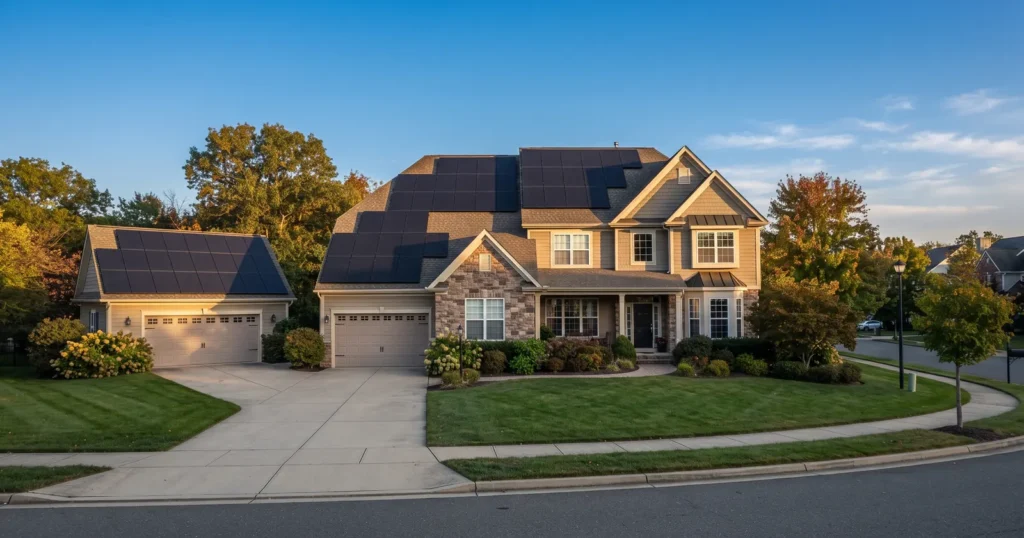
A 20kW solar system is twice the size of a typical rooftop array. It suits large homes, all-electric households with an EV and a heat pump, small farms and small businesses. At this size, details that barely matter on a 7 kW roof, such as inverter splitting, service panel capacity and utility size limits, start to shape the whole project.
This guide works through the real numbers: output by city, how many panels you need, the space they take, what a 20 kW solar power system costs now that the homeowner tax credit has ended, how long payback takes, and how to pair it with inverters and batteries.
How much electricity does a 20kW solar system produce?
The 20 kW rating is the combined lab rating of the panels. Real systems lose output to heat, wiring, dust and inverter conversion, so this site plans with 80% system efficiency. Daily energy then depends on peak sun hours: the number of hours per day equal to full-strength sunlight at your location.
Example: 20 kW × 4.5 hours × 0.80 × 365 = 26,280 kWh per year (about 72 kWh a day)
Across most of the US, 1 kW of panels makes 1,100 to 1,600 kWh a year. Multiply by 20 and a 20 kilowatt solar system lands between 22,000 and 32,000 kWh a year. Desert sites can beat that range.
| Location | Peak sun hours | Per day | Per month | Per year |
|---|---|---|---|---|
| Phoenix, AZ | 6.3 | 100.8 kWh | 3,066 kWh | 36,792 kWh |
| Los Angeles, CA | 5.5 | 88.0 kWh | 2,677 kWh | 32,120 kWh |
| Denver, CO | 5.3 | 84.8 kWh | 2,579 kWh | 30,952 kWh |
| Dallas, TX or Miami, FL | 5.0 | 80.0 kWh | 2,433 kWh | 29,200 kWh |
| US middle value | 4.5 | 72.0 kWh | 2,190 kWh | 26,280 kWh |
| New York, NY or Chicago, IL | 4.4 | 70.4 kWh | 2,141 kWh | 25,696 kWh |
| Seattle, WA | 3.7 | 59.2 kWh | 1,801 kWh | 21,608 kWh |
Sun hours are approximate annual averages for panels facing south at a tilt near the local latitude. Monthly figures are the yearly total divided by 12, so expect summer months well above the table and winter months well below it. For a site-specific estimate using hourly weather data, run your address through the NREL PVWatts calculator, or plug your own sun hours into the solar panel output calculator.
How many solar panels are in a 20kW system?
Divide 20,000 watts by the panel rating and round up. With the 430 W panels common on homes today, you need 47 panels.
Example: 20,000 ÷ 430 = 46.5, so 47 panels (20.21 kW)
| Panel rating | Panels needed | Actual system size | Approx. panel area at 21% efficiency |
|---|---|---|---|
| 400 W | 50 | 20.00 kW | about 1,025 sq ft |
| 430 W | 47 | 20.21 kW | about 1,035 sq ft |
| 450 W | 45 | 20.25 kW | about 1,040 sq ft |
Higher-wattage panels save little space because they are physically larger, but fewer panels means less racking and labor. The how many solar panels calculator works this out for any panel size and target output.
How much roof or ground space does a 20kW solar system need?
Panel area depends on efficiency. Modern monocrystalline panels convert about 21% to 22% of sunlight, so 20 kW of panels covers roughly 980 to 1,030 square feet.
Example: 20,000 ÷ (1,000 × 0.21) = 95.2 m², about 1,025 sq ft
On a roof
Fire code setbacks, ridge clearances and pathways usually add 20% or more, so plan for about 1,200 to 1,400 square feet of usable, unshaded roof. Many 20 kW projects split panels across several roof planes or a garage. The solar panel roof area calculator checks whether your roof fits.
On a ground mount
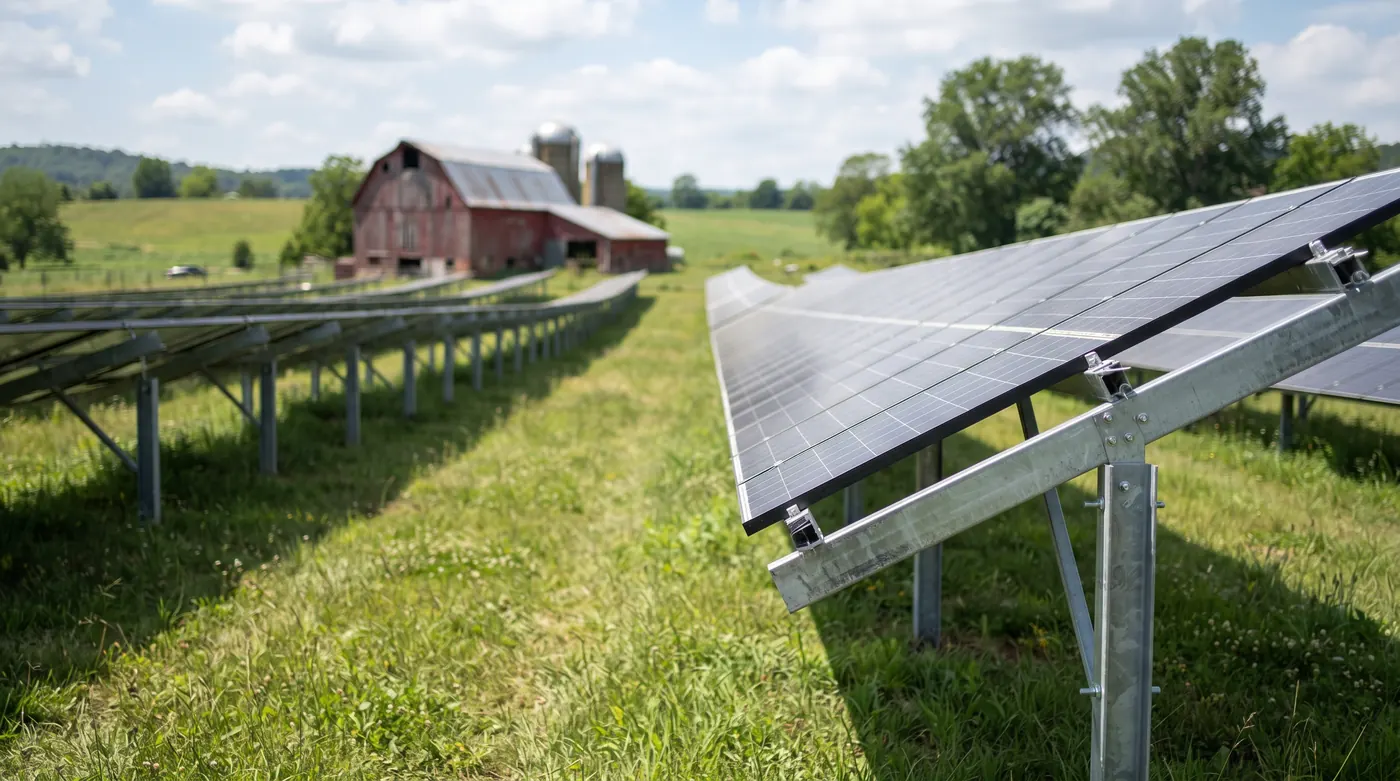
A 20 kW ground mount solar system is common on rural lots and farms. Rows must be spaced so the front row does not shade the one behind it in winter. A planning assumption is that panels cover 40% to 50% of the land under the array, so 1,025 square feet of panels needs about 2,050 to 2,560 square feet of ground. Ground mounts cost more but allow ideal tilt and no roof penetrations.
Who needs a 20 kW solar system?
The average US household bought about 10,791 kWh of electricity in 2022, according to the US Energy Information Administration. A 20 kW array at 4.5 sun hours makes 26,280 kWh, which is about 2.4 times that. So a 20kW system is oversized for an average home and right-sized for homes that use 2,000 kWh a month or more.
Here is how a large, all-electric household could add up to that figure. The added loads are examples built from stated assumptions, not averages:
| Load | Assumption | Energy per year |
|---|---|---|
| Average US home | EIA figure | 10,800 kWh |
| Two electric vehicles | 12,000 miles each at 0.30 kWh per mile | 7,200 kWh |
| Heat pump heating | 2.5 kW average draw, 8 hours a day, 150 days | 3,000 kWh |
| Pool pump | 1.5 kW, 8 hours a day, 180 days | 2,160 kWh |
| Workshop or home office | about 6 kWh a day | 2,190 kWh |
| Total | 25,350 kWh |
That nearly matches a 20 kW array at 4.5 sun hours. Small farms and small businesses are other common fits. Always size from your own 12 months of bills.
How much does a 20kW solar system cost?
Larger systems cost less per watt because permitting, design and crew mobilization are spread over more panels. Typical US ranges in late 2026 for a professionally installed, grid-tied system before any incentives:
- Installed price per watt: about $2.30 to $3.20.
- 20 kW system total: about $46,000 to $64,000.
- Ground mount: often at the upper end or above, because of racking, foundations and trenching.
- With battery storage: battery and hybrid inverter costs come on top.
The 30% federal residential clean energy credit (Section 25D) ended for homeowner-owned systems installed after December 31, 2025, so it does not apply to a new 20 kW home system. Some states and utilities still offer rebates or performance payments. Businesses and farms may qualify for different federal programs, but the rules are separate and change often, so confirm with a tax adviser before counting on them. The solar panel cost calculator builds an estimate from your own price per watt.
What is the payback period for a 20kW solar system?
Payback depends on the price you pay, how much you produce, and what each kWh is worth to you. The EIA forecasts an average US residential rate of about 18.2 cents per kWh for 2026, so this example uses $0.18.
Example: 26,280 kWh × $0.18 = $4,730 a year; $55,000 ÷ $4,730 = 11.6 years
That assumes every kWh offsets power at the full retail rate, which only happens with full net metering. If your utility credits exports at a lower rate, the math changes:
| Scenario ($55,000 system, 26,280 kWh/yr) | Yearly savings | Simple payback |
|---|---|---|
| Full net metering, all kWh at $0.18 | $4,730 | 11.6 years |
| 70% used on site at $0.18, 30% exported at $0.06 | $3,784 | 14.5 years |
Higher local rates, a lower installed price or a sunnier location all shorten payback. Run your own numbers in the solar payback calculator.
What inverter does a 20kW solar system need?
Most homes have single-phase 240 V service, and many single-phase string and hybrid inverters top out somewhere around 10 to 15 kW AC. That is why a 20 kW array is often split across two inverters, for example two 10 kW units or one 11.4 kW and one 7.6 kW unit.
- String inverters: lowest cost per watt, and two units keep producing if one fails.
- Microinverters: one per panel, about 45 to 50 units. Best for shaded roofs with several planes.
- Hybrid inverters: run panels and a battery from one box, for backup now or storage later.
- Three-phase inverters: farms and businesses with three-phase service can often use one 20 kW unit.
Many installers size the total inverter capacity a little below the panel rating, a DC to AC ratio of about 1.1 to 1.3, because panels rarely hit their full rating. That puts total inverter capacity around 15 to 18 kW for a 20 kW array. The inverter size calculator checks the ratio for you.
Check your service panel
At 240 V, 18 kW of inverter output is 75 A, and electrical code sizes the backfed breaker at 125% of that, about 94 A. Under the common 120% busbar rule, a 200 A panel with a 200 A main breaker allows only 40 A of solar backfeed. A system this size usually needs a supply-side connection, a main breaker derate or a panel upgrade, so budget for it.
Grid-tie vs off-grid: 20kW solar with battery storage
Most 20 kW systems are grid-tied, with the grid acting as storage where net metering allows. Without batteries, a grid-tied system shuts down during an outage for line worker safety.
Adding batteries for backup
A 20kW solar system with battery storage keeps essential loads running when the grid is down and can shift daytime solar into the evening where export rates are low. You rarely need to back up the whole home. A backup panel with the fridge, lights, well pump, internet and furnace fan may use 10 to 20 kWh a day.
Example: 20 kWh × 1 day ÷ 0.90 = 22.2 kWh of battery
20kW off grid solar
Off-grid is a different design problem. The battery must carry the whole home through nights and cloudy spells, and the array must be sized for the darkest month, not the yearly average. If a large off-grid home uses 60 kWh a day and wants two days of autonomy, it needs about 133 kWh of battery (60 × 2 ÷ 0.90). Most off-grid owners also keep a generator for long winter storms. Size the bank against your real loads with the battery calculator.
Will your utility approve a 20 kW system?
Every grid-tied system needs an interconnection agreement before it switches on. Some utilities cap residential systems at a fixed size or at a percentage of your past annual usage. Larger systems may also leave the simplified review track, adding fees, engineering review or wait time, and some net metering programs pay little for surplus beyond your yearly use. Rules vary by utility and state, so read the interconnection handbook before you sign a contract.
Frequently asked questions
How many kWh does a 20kW solar system produce per day?
About 60 to 88 kWh a day in most of the US, using 80% system efficiency. Multiply 20 kW by your peak sun hours and by 0.8. At 4.5 sun hours that gives 72 kWh a day, and sunny desert sites like Phoenix can reach about 100 kWh on an average day.
How many solar panels are needed for a 20kW system?
About 47 panels at 430 W, 50 panels at 400 W or 45 panels at 450 W. Divide 20,000 watts by the panel rating and round up. Higher-wattage panels reduce the panel count but not the total area much, because each panel is physically larger.
How much does a 20kW solar system cost?
Typical US installed prices in late 2026 run about $2.30 to $3.20 per watt, or roughly $46,000 to $64,000 for 20 kW before incentives. Ground mounts and battery storage add to that. The 30% federal homeowner credit ended for systems installed after 2025, so do not include it in your budget.
Is a 20kW solar system too big for a house?
For an average home using about 10,800 kWh a year, yes, since 20 kW typically makes 22,000 to 32,000 kWh. It fits large homes, all-electric homes with EVs and heat pumps, and properties with pools, workshops or farm loads. Check your utility’s size limits and export rates before oversizing.
How much space does a 20000 watt solar system need?
About 980 to 1,030 square feet of panel area with modern 21% to 22% efficient panels. On a roof, allow 1,200 to 1,400 square feet for setbacks and pathways. A ground mount with row spacing needs roughly 2,000 to 2,600 square feet of land.
Can a 20kW solar system run a house off grid?
Yes, if it is paired with a large battery bank and sized for winter. A home using 60 kWh a day with two days of autonomy needs about 133 kWh of battery. Most off-grid owners also add a backup generator for long cloudy periods.


