1000 Watt Solar Panel: Output, Size and Cost
Short answer
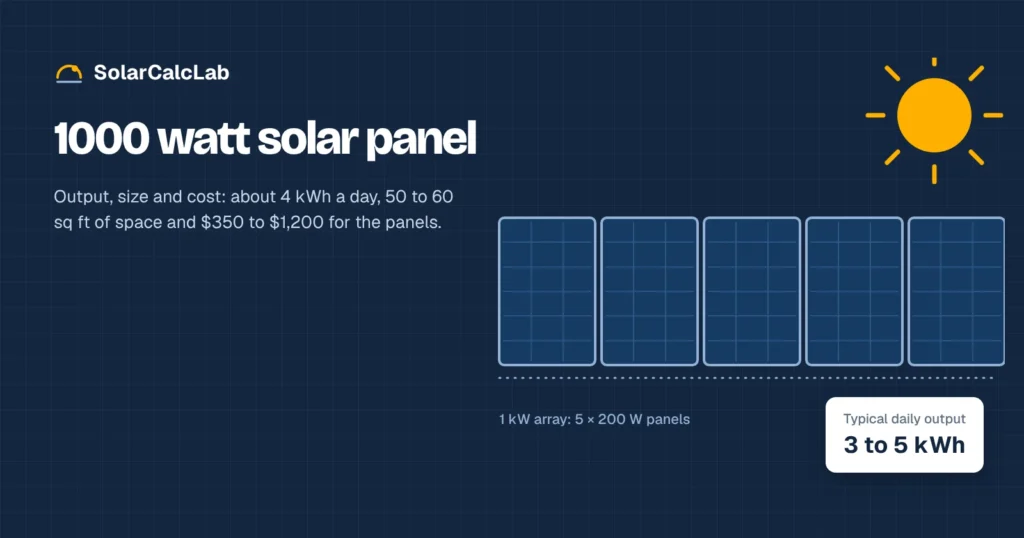
A 1000 watt solar panel setup makes about 3 to 5 kWh of electricity a day in most of the US, or roughly 90 to 150 kWh a month. It is almost always several panels wired together, such as five 200 W panels or two to three residential panels, and it needs about 50 to 60 square feet of space. The panels alone cost roughly $350 to $1,200, while an installed grid-tied kilowatt runs about $2,600.
A 1000 watt solar panel array, often called a 1 kW system, is the point where solar stops being a phone charger and starts running real appliances. It is a popular size for RVs, cabins, sheds, backup power and small off-grid homes, and it is also the unit installers use to price rooftop systems.
This guide shows how much energy 1,000 watts of panels really produce in different parts of the country, how much roof or ground space they take, what they cost, and which parts you need to turn panel power into usable electricity.
Is there a single 1000 watt solar panel?
Not for homes or RVs. Residential panels today are typically rated 400 to 450 watts, and the largest utility-scale modules reach about 700 watts. Those big modules are more than 7 feet long and weigh over 80 pounds, so they are built for solar farms, not roofs. When you see a “1000 watt solar panel” for sale, it is a kit of several panels with a combined rating of 1,000 watts.
Common ways to reach 1 kW:
| Combination | Total rating | Typical panel size | Total area | Best for |
|---|---|---|---|---|
| 10 × 100 W | 1,000 W | about 41 × 21 in | about 60 sq ft | RV roofs with odd gaps, small batteries |
| 5 × 200 W | 1,000 W | about 58 × 26 in | about 52 sq ft | Vans, sheds, 12 V and 24 V systems |
| 3 × 350 W | 1,050 W | about 69 × 40 in | about 57 sq ft | Ground mounts and cabins |
| 2 × 500 W | 1,000 W | about 86 × 43 in | about 52 sq ft | Large ground mounts, 48 V systems |
Dimensions vary by brand, so always check the spec sheet before you plan a roof layout. Fewer, larger panels mean fewer connections and less racking, while smaller panels fit around vents, hatches and air conditioners.
How much power does a 1000 watt solar panel produce?
The 1,000 watt rating is measured in lab conditions: full sunlight of 1,000 watts per square meter and a cell temperature of 77°F (25°C). On a real roof, heat, dust, wiring and the inverter all take a share. A realistic planning figure is 75% to 85% of the rated output, so this guide uses 80%.
Daily energy then depends on peak sun hours, the number of hours per day that equal full-strength sunlight at your location:
Example: 1 kW × 5 hours × 0.80 = 4.0 kWh per day
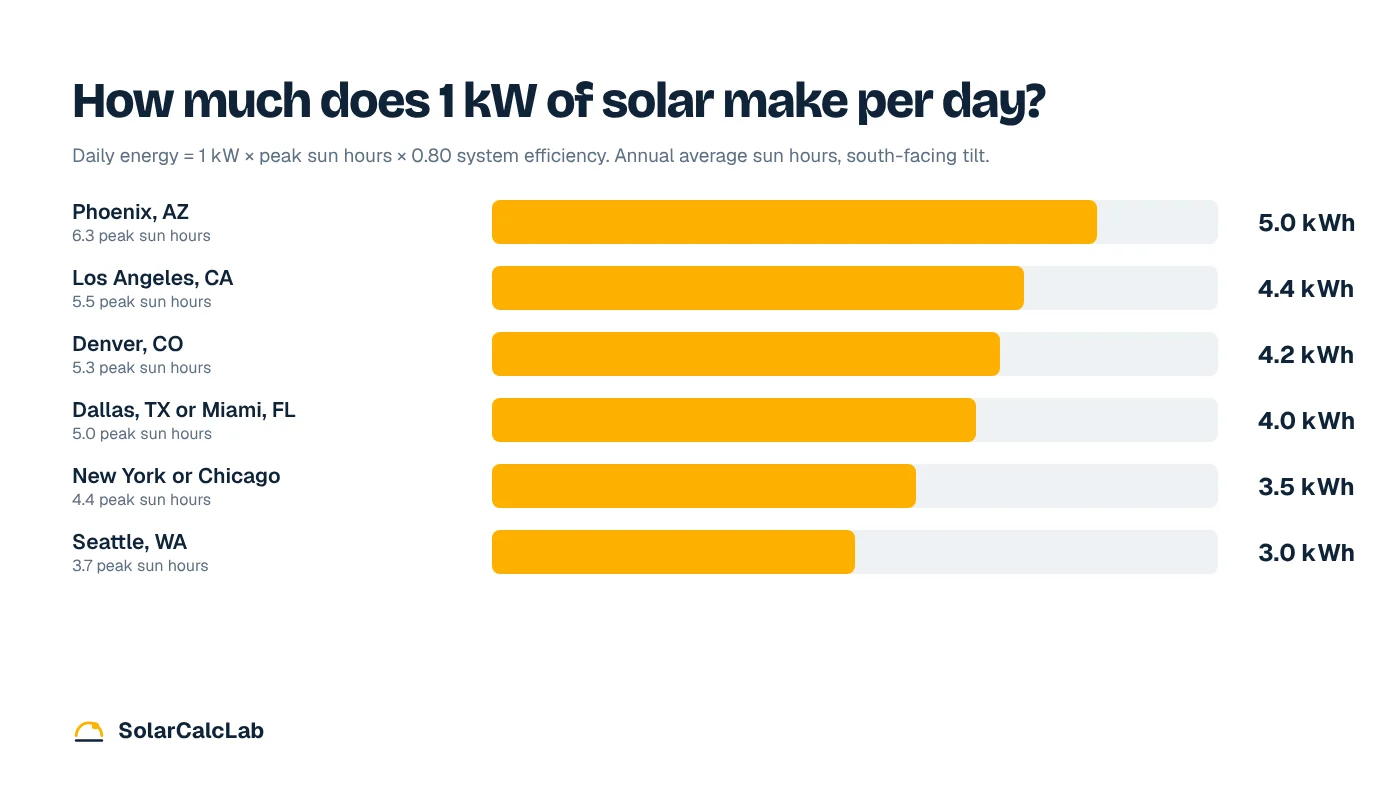
The table below uses approximate annual average sun hours for panels tilted near the local latitude and facing south. Winter output will be lower and summer output higher.
| Location | Peak sun hours | Per day | Per month | Per year |
|---|---|---|---|---|
| Phoenix, AZ | 6.3 | 5.0 kWh | 151 kWh | 1,840 kWh |
| Los Angeles, CA | 5.5 | 4.4 kWh | 132 kWh | 1,606 kWh |
| Denver, CO | 5.3 | 4.2 kWh | 127 kWh | 1,548 kWh |
| Dallas, TX or Miami, FL | 5.0 | 4.0 kWh | 120 kWh | 1,460 kWh |
| New York, NY or Chicago, IL | 4.4 | 3.5 kWh | 106 kWh | 1,285 kWh |
| Seattle, WA | 3.7 | 3.0 kWh | 89 kWh | 1,080 kWh |
For a figure based on your exact address, roof angle and direction, the free NREL PVWatts calculator models hourly weather data from the National Renewable Energy Laboratory. You can also look up your sun hours with the peak sun hours calculator and turn them into kWh with the solar panel output calculator.
Output per hour
At solar noon on a clear, cool day, a 1 kW array may deliver 750 to 850 watts. Early morning and late afternoon output falls to a fraction of that. This is why sun hours, not daylight hours, are the right way to estimate daily energy: ten hours of daylight might add up to only four or five peak sun hours.
How much space does a 1000 watt solar system need?
Modern monocrystalline panels convert about 21% to 22% of sunlight into electricity. At that efficiency, 1,000 watts of panels covers about 4.6 to 4.8 square meters, or 49 to 51 square feet. Older or cheaper panels near 18% efficiency need about 60 square feet.
1,000 W ÷ (1,000 × 0.21) = 4.76 m², about 51 sq ft
Leave room for gaps between panels, roof setbacks and racking. On a home roof, local fire codes often require clear pathways around the array, which can add 20% or more to the footprint. On a ground mount, rows must be spaced so one row does not shade the next in winter.
How much does a 1000 watt solar panel cost?
Price depends on what you buy. These are typical US ranges in late 2026:
- Panels only, full-size residential modules: about $350 to $700 for 1,000 watts, or $0.35 to $0.70 per watt, from a solar distributor.
- Panels only, small 100 W to 200 W RV panels: about $600 to $1,200, since small panels cost more per watt.
- Off-grid kit with panels, charge controller, inverter and battery: roughly $1,500 to $4,000, driven mostly by battery size.
- Professionally installed grid-tied solar: about $2,600 per kilowatt before incentives, based on EnergySage marketplace quotes. Real home systems are usually 5 to 10 kW, and small systems cost more per watt because permits and labor do not shrink with size.
The 30% federal residential clean energy credit ended for homeowner-owned systems installed after December 31, 2025, so do not count on it when budgeting a new purchase. Some states and utilities still offer rebates. For a quote-style estimate with your own numbers, use the solar panel cost calculator.
What can a 1000 watt solar system run?
About 4 kWh a day is enough for the essentials of a cabin, an RV or a backup circuit. Here is how a typical day could look:
| Appliance | Use per day | Energy per day |
|---|---|---|
| Energy Star refrigerator | 24 hours, cycling | about 1.2 kWh |
| LED lights, 6 bulbs at 9 W | 5 hours | 0.27 kWh |
| Laptop at 60 W | 6 hours | 0.36 kWh |
| 50 inch LED TV at 80 W | 4 hours | 0.32 kWh |
| Wi-Fi router at 10 W | 24 hours | 0.24 kWh |
| Ceiling fan at 50 W | 8 hours | 0.40 kWh |
| Microwave at 1,100 W | 15 minutes | 0.28 kWh |
| Total | about 3.1 kWh |
That leaves a little headroom on an average day in most states. What 1 kW will not do is run central air conditioning, an electric water heater or an electric range for long. An average US home uses close to 30 kWh a day, so 1 kW of panels covers roughly 10% to 15% of a typical household bill on a grid-tied roof.
What else do you need with 1000 watts of panels?
Charge controller
Off-grid and RV systems need a charge controller between the panels and the battery. Divide the array watts by the battery voltage, then add 25% headroom:
| Battery voltage | Charging current | With 25% headroom | Typical MPPT size |
|---|---|---|---|
| 12 V | 83 A | 104 A | 100 A, or two 60 A units |
| 24 V | 42 A | 52 A | 60 A |
| 48 V | 21 A | 26 A | 30 A |
Higher battery voltages need far smaller controllers and thinner cables, which is why 24 V or 48 V is the better choice at 1 kW. Also check that the panels’ combined open-circuit voltage on the coldest morning stays below the controller’s input limit. The charge controller calculator checks both current and voltage.
Battery
To store one full day of output, plan for about 4 to 5 kWh of usable battery capacity. A 48 V, 100 Ah lithium iron phosphate (LiFePO4) battery holds about 5.1 kWh, while at 12 V the same energy takes roughly 400 Ah. Size yours to your overnight loads with the battery calculator.
Inverter
The inverter is sized to your loads, not your panels. A pure sine wave inverter of 1,500 to 2,000 watts covers a fridge, a microwave and electronics at the same time. Use the inverter size calculator to add up your appliances and their startup surges.
Tips to get the most from a 1 kW array
- Face the panels south in the Northern Hemisphere and tilt them close to your latitude for the best year-round output.
- Avoid shade. Even a vent pipe shadow across one cell can cut a whole panel’s output. Microinverters or optimizers reduce the damage on rooftops.
- Keep them cool. Panels lose roughly 0.3% to 0.4% of output for every degree Celsius above 25°C, so leave an air gap under roof-mounted panels.
- Clean them a few times a year in dusty or low-rain areas.
- Use the right wire size between the array, the controller and the battery so you do not lose output to voltage drop.
Frequently asked questions
How many kWh does a 1000 watt solar panel produce per day?
About 3 to 5 kWh in most of the US. Multiply your peak sun hours by 0.8 to estimate it. With 5 peak sun hours, a 1 kW array makes about 4 kWh a day, and in a sunny desert climate it can reach 5 kWh or more.
How many solar panels make 1000 watts?
It depends on the panel rating. You need ten 100 W panels, five 200 W panels, three 350 W panels or two 500 W panels. Residential 400 W panels reach 1,200 W with three panels, which gives you a little extra margin.
Can a 1000 watt solar system run a refrigerator?
Yes. An efficient full-size refrigerator uses about 1 to 1.5 kWh a day, well within the 3 to 5 kWh a 1 kW array produces. Off grid, you also need a battery to run it at night and an inverter large enough for the compressor’s startup surge.
How much does a 1000 watt solar system cost?
Panels alone cost about $350 to $1,200 depending on type and size. A complete off-grid kit with a battery, controller and inverter costs roughly $1,500 to $4,000. Professionally installed grid-tied solar averages about $2,600 per kilowatt before incentives.
How much space do 1000 watts of solar panels need?
About 49 to 60 square feet of panel area, depending on efficiency. Allow extra room for gaps, roof setbacks and racking. Modern 21% to 22% efficient panels need the least space.


