12kW Solar System: Yearly Output, Panels Needed and 2026 Cost
Short answer
A 12kW solar system makes about 13,200 to 19,200 kWh a year in most of the US, or roughly 36 to 53 kWh a day. At 4.5 peak sun hours it produces about 15,800 kWh a year. You need about 28 panels at 430 W, roughly 590 square feet of panel area, and typically $26,400 to $38,400 installed in late 2026.
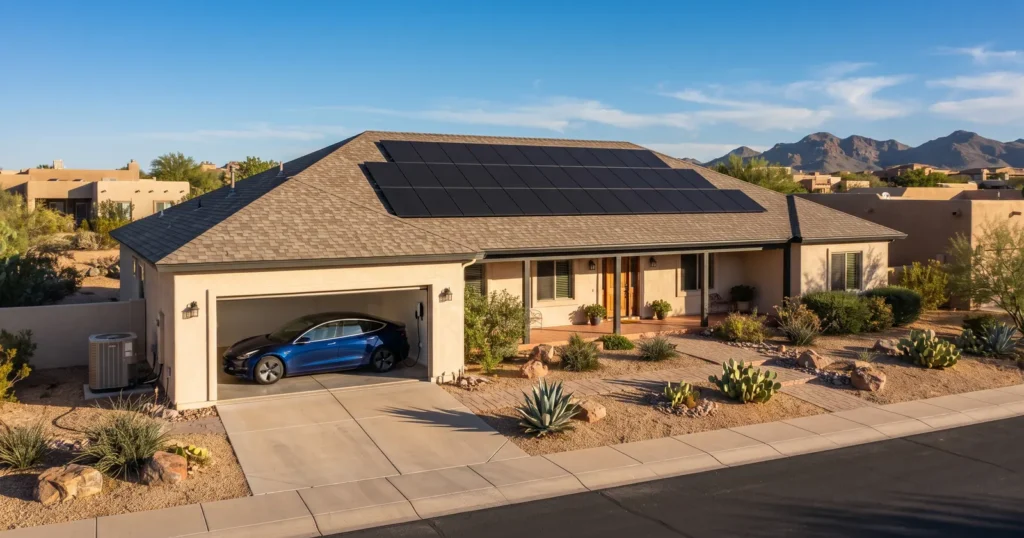
Twelve kilowatts is the size installers often land on for a large house in Texas, Arizona, Florida or Louisiana where central air runs for months, or for an all-electric home that has just added one electric car.
The hard part is rarely the output. It is whether 28 panels fit on the roof, whether your electrical panel can accept the inverter, and whether the extra 2 kW over a 10 kW system actually pays. This guide works through each of those with real numbers.
How much power does a 12kW solar system make in a hot, sunny climate?
A 12kW solar system has 12,000 watts of panel capacity under lab conditions. Heat, wiring, dust and inverter conversion take a share, so this site plans with 80% system efficiency and multiplies by local peak sun hours.
Example in Dallas: 12 × 5.0 × 0.80 = 48 kWh a day, or 17,520 kWh a year
Hot southern states rank among the highest for household electricity use. The US Energy Information Administration puts the national average at 10,791 kWh a year per home and Louisiana, the highest state, at 14,774 kWh. The last column shows how a 12 kW array compares with that Louisiana figure.
| Location | Peak sun hours | kWh per day | kWh per year | Share of 14,774 kWh |
|---|---|---|---|---|
| Phoenix, AZ | 6.3 | 60.5 | 22,075 | 149% |
| Los Angeles, CA | 5.5 | 52.8 | 19,272 | 130% |
| Dallas, TX or Miami, FL | 5.0 | 48.0 | 17,520 | 119% |
| US middle value | 4.5 | 43.2 | 15,768 | 107% |
| Chicago, IL | 4.4 | 42.2 | 15,418 | 104% |
| Seattle, WA | 3.7 | 35.5 | 12,965 | 88% |
Sun hours are approximate yearly averages for south-facing panels. In most of the country, 1 kW of panels makes 1,100 to 1,600 kWh a year, which gives the 12 kW planning range of 13,200 to 19,200 kWh. For your exact address and roof angle, NREL’s free PVWatts calculator uses local weather data, and our solar panel output calculator gives a quick daily and monthly figure.
How many panels does a 12000 watt solar system take, and will they fit?
Divide 12,000 W by the panel rating and round up. With 430 W residential panels you need 28, which makes a 12.04 kW array.
| Panel rating | Panels | Array size | Panel area |
|---|---|---|---|
| 400 W (about 20% efficient) | 30 | 12.0 kW | about 646 sq ft |
| 430 W (about 22% efficient) | 28 | 12.04 kW | about 589 sq ft |
| 450 W (about 22% efficient) | 27 | 12.15 kW | about 595 sq ft |
Example: 12,000 ÷ (1,000 × 0.22) = 54.5 m², about 587 sq ft
Fire-code pathways, ridge setbacks, plumbing vents and skylights mean the usable roof needs to be larger than the panel area. Plan on roughly 700 to 850 square feet of clear roof facing south, east or west. The solar panel roof area calculator checks a layout against your roof dimensions.
When the roof only fits 20 to 24 panels
Large Sun Belt homes often have hip roofs cut into small planes. If only 22 panels at 430 W fit, that is 9.46 kW, not 12. The usual ways to close the gap:
- Use the west plane. West-facing panels produce less over the year than south-facing ones, but they push output into late afternoon, when AC load peaks.
- Add a solar carport or patio cover. In a hot climate it also shades a car or a seating area.
- Use a ground mount if the lot allows it.
- Accept 10 kW. The comparison further down shows when that is the smarter choice anyway.
Which households are a good match for 12 kW?
Work backward from yearly use. The required size is your yearly kWh divided by what 1 kW makes where you live.
Example: 16,700 kWh ÷ (5.0 × 0.80 × 365) = 16,700 ÷ 1,460 = 11.4 kW
That 16,700 kWh comes from an example all-electric house near Dallas with one EV. The AC and household figures are assumptions for illustration, so replace them with 12 months of your own bills.
| Load | Basis | kWh per year |
|---|---|---|
| Central air (assumed) | 3,500 W × 1,600 running hours | 5,600 |
| One electric vehicle | 12,000 miles × 0.30 kWh per mile | 3,600 |
| Rest of the house (assumed) | electric water heater, range, dryer, fridge, lights, electronics | 7,500 |
| Total | 16,700 |
Location changes the answer. In Phoenix it needs about 9.1 kW (16,700 ÷ 1,840). At the US middle value of 4.5 sun hours it needs about 12.7 kW (16,700 ÷ 1,314). Remove the EV and the Dallas figure drops to 9.0 kW, which shows how one car moves a home from a 9 kW to a 12 kW quote.
As a quick rule, a 12 kW array fits homes using roughly 1,100 to 1,600 kWh a month, depending on sun. If your bills run near 2,000 kWh a month because you also have a pool or a second EV, the 15kW solar system guide is the closer match.
12kW or 10kW: which should you choose?
Most buyers at this size are choosing between these two. The table uses 4.5 peak sun hours, 430 W panels and a middle installed price of $2.60 per watt.
| 10 kW | 12 kW | Difference | |
|---|---|---|---|
| Panels at 430 W | 24 | 28 | 4 more |
| Panel area | about 490 sq ft | about 590 sq ft | about 100 sq ft |
| Yearly output | 13,140 kWh | 15,768 kWh | 2,628 kWh |
| Installed cost at $2.60/W | $26,000 | $31,200 | $5,200 |
| Inverter AC size (ratio 1.1 to 1.3) | 7.7 to 9.1 kW | 9.2 to 10.9 kW | about 1.5 kW |
What the extra 2,628 kWh is worth
If the extra energy replaces power you would buy at $0.17 per kWh, it saves 2,628 × $0.17 = $447 a year, so the extra $5,200 pays back in about 11.6 years. If your utility credits exports at $0.06 and the extra output is mostly exported at midday, it saves only $158 a year and takes about 33 years. Fixed costs such as permits do not grow with the extra panels, so a real quote for the step up may be lower.
The electrical panel can decide it for you
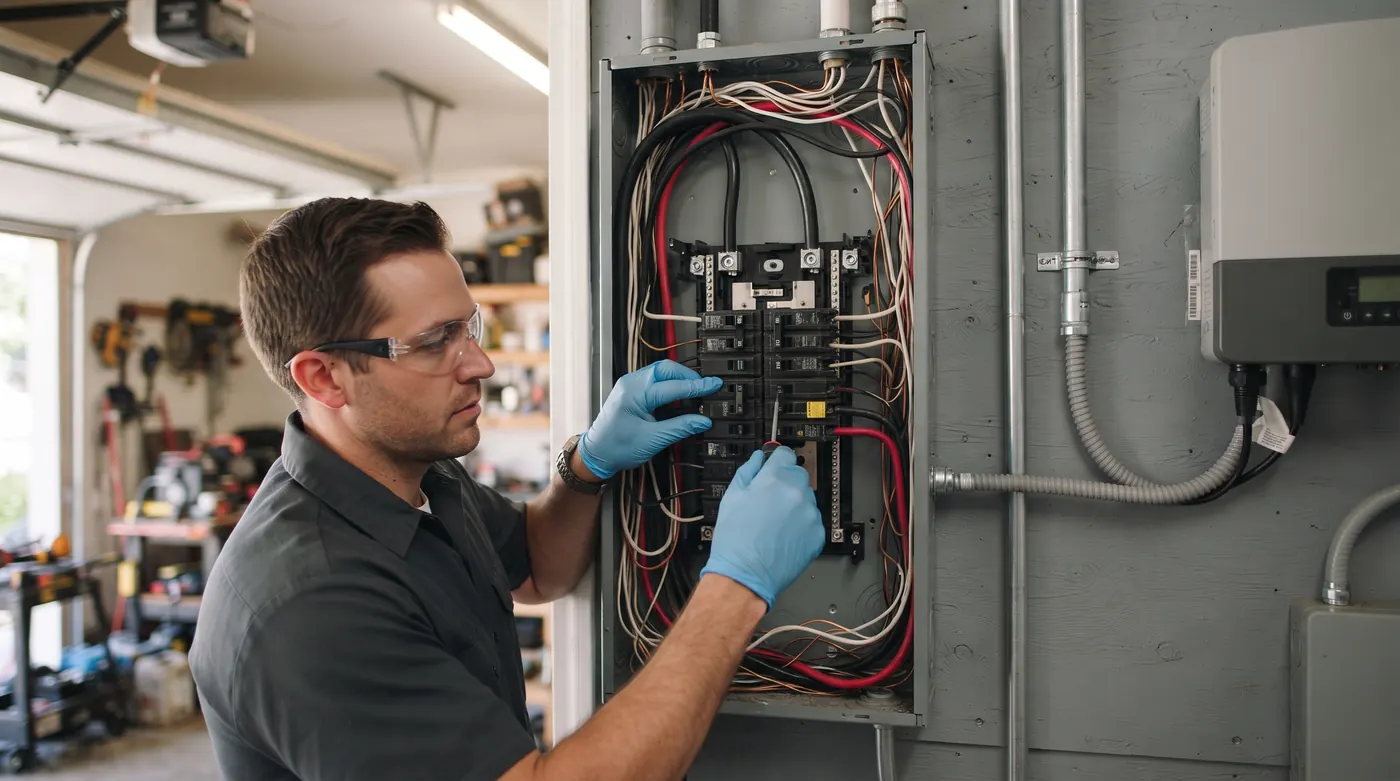
Many homes have a 200 A panel with a 200 A main breaker. Under the National Electrical Code 120% rule, that allows a 40 A solar breaker on the busbar. A 7.6 kW inverter draws 31.7 A at 240 V, and with the 125% continuous factor it needs exactly a 40 A breaker. Paired with a 10 kW array, that is a 1.32 ratio, at the top of the normal range.
A 12 kW array on the same 7.6 kW inverter would be a 1.58 ratio, which clips a lot of midday output. The better match is a 10 kW inverter, which needs a 60 A breaker (41.7 A × 1.25 = 52 A, next standard size 60 A). That exceeds the 40 A limit, so expect a line-side tap, a main breaker reduced to 175 A (which raises the allowance to 65 A), or a panel upgrade.
Pick 12 kW when your bills already justify it, exports earn close to retail, or an EV or heat pump is coming soon. Pick 10 kW when roof space is tight, exports earn little, or the panel work would add a large cost.
What does a 12kW solar system cost in 2026?
Typical US installed prices in late 2026 run about $2.20 to $3.20 per watt before state or utility incentives.
| Price per watt | 12kW solar system cost | Typical situation |
|---|---|---|
| $2.20 | $26,400 | One simple roof plane, competitive market |
| $2.60 | $31,200 | Middle of the market |
| $3.20 | $38,400 | Tile roof, several planes, premium panels |
The 30% federal residential clean energy credit ended for homeowner-owned systems placed in service after December 31, 2025, so budget the full price. Leases and power purchase agreements follow business tax rules, so confirm any credit built into those contracts with a tax adviser.
Payback for the Dallas example, using a $31,200 system and 17,520 kWh a year:
Example: 17,520 × $0.17 = $2,978 a year; $31,200 ÷ $2,978 = 10.5 years
| Scenario | Yearly savings | Payback |
|---|---|---|
| Full net metering at $0.17 | $2,978 | 10.5 years |
| Full net metering at $0.13 | $2,278 | 13.7 years |
| 60% used at home at $0.17, 40% exported at $0.06 | $2,208 | 14.1 years |
These figures leave out rate rises and degradation. Run your own tariff through the solar payback calculator.
Which 12kW solar inverter setup makes sense?
For a grid-tied US home, three setups are common:
- One 10 kW split-phase string inverter (ratio 1.2). The simplest choice for one or two clean roof planes.
- A 12 kW hybrid inverter with 240 V split-phase output and a battery port. A ratio near 1.0 gives little clipping, and it is the usual route if you want whole-home backup later. At 240 V it needs a 70 A breaker (50 A × 1.25 = 62.5 A).
- Microinverters, one per panel. They suit chopped-up hip roofs with several orientations, which are common on large Sun Belt homes.
The inverter size calculator checks the DC-to-AC ratio and output current for any of these.
Does heat cut a 12kW system’s output?
Yes, at midday in summer. Panels lose power as cells warm above 25 °C, the test temperature. Datasheets list this as a temperature coefficient, often around -0.30% to -0.40% per °C on modern panels.
Example: (65 °C – 25 °C) × 0.35% = 14%, so a 12 kW array delivers about 1.7 kW less at that moment
The 80% system efficiency used on this page already allows for typical heat losses over a year, so the yearly totals above are not cut again. Heat mostly shows up as a flatter afternoon peak. A lower coefficient and good airflow behind the panels both help. Test your own panel spec with the solar panel temperature loss calculator.
Do you need a battery with a 12kW system?
In hot climates the heaviest AC hours often run past sunset. Suppose the AC uses 3.5 kW for four evening hours plus 4 kWh for everything else. That is 18 kWh, and at 90% usable capacity you need 18 ÷ 0.90 = 20 kWh of battery, about two of the units described in our 10kWh battery guide.
The EV changes the picture. A 30-mile commute at 0.30 kWh per mile needs 9 kWh. Charging it at midday from the array, on weekends or work-from-home days, is much cheaper than charging it overnight from a battery.
Frequently asked questions
How many kWh does a 12kW solar system produce per month?
About 1,100 to 1,600 kWh a month on average in most of the US. At 4.5 peak sun hours, 12 kW × 4.5 × 0.80 = 43.2 kWh a day, or about 1,296 kWh in a 30-day month. Summer months in Phoenix or Dallas run well above that, and winter months run below it.
Can a 12kW solar system run central air conditioning?
Yes, on a grid-tied home it covers AC energy over the year. In the Dallas example, central air assumed at 5,600 kWh a year is about a third of the 17,520 kWh a 12 kW array makes there. Running AC during an outage is different: that needs a hybrid inverter and battery sized for the compressor’s starting surge and evening hours.
Is 12 kW enough for a house with an electric car?
Often, yes. One EV driven 12,000 miles a year at 0.30 kWh per mile adds about 3,600 kWh. In the Dallas example, a home using 13,100 kWh before the EV needs about 9 kW, and about 11.4 kW after it. Two EVs, or an EV plus a pool, usually push the need toward 15 kW.
How much roof space does a 12.0 kW system need?
The 28 panels at 430 W cover about 590 square feet. With fire-code pathways and setbacks, plan on roughly 700 to 850 square feet of clear roof facing south, east or west. If the roof is short, a west plane, a solar carport or a ground mount can carry the remaining panels.
What inverter size suits a 12kW solar system?
Usually 9.2 to 10.9 kW AC, from a DC-to-AC ratio of 1.1 to 1.3, so a 10 kW split-phase string inverter is a common US match. A 12 kW hybrid inverter suits buyers who want batteries. The 10 kW unit needs a 60 A solar breaker and the 12 kW unit a 70 A one, either of which can trigger panel work on a 200 A service.


