15kWh Battery: How Long It Lasts and What It Powers
Short answer
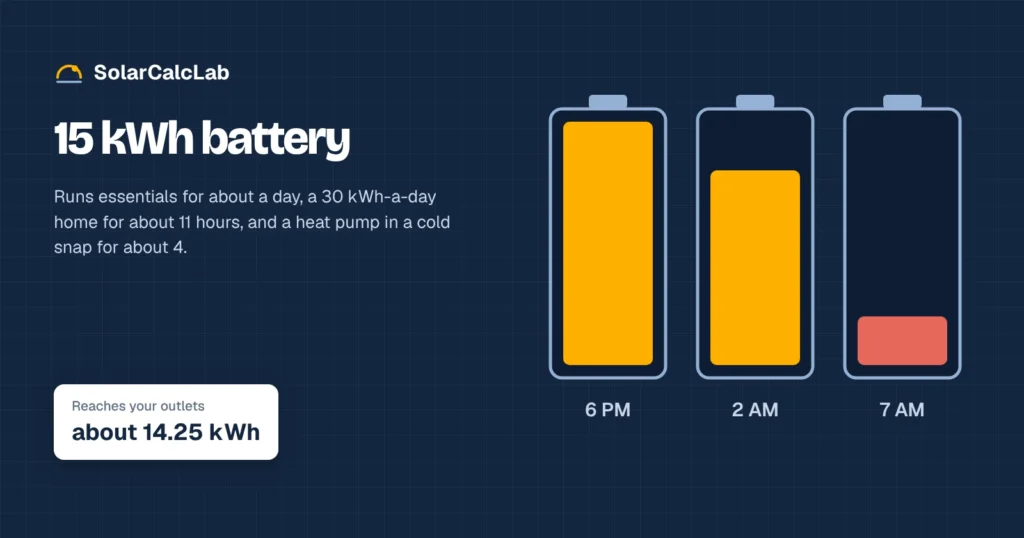
A 15 kWh battery with 15 kWh of usable capacity delivers about 14.25 kWh to your outlets after inverter losses. That runs fridge, lights, Wi-Fi and a furnace fan (about 0.5 kW) for roughly 28 hours, a home that uses 30 kWh a day for about 11 hours, and a heat pump in a cold snap for only about 4. In sunny months, nine 400 W panels can refill it in one day.
Fifteen kilowatt-hours is the size you see when a quote lands between a single Powerwall-class unit and a two-battery stack. It is also a real product size, not just a rounded number: FranklinWH sells a single 15 kWh cabinet, and three Enphase IQ Battery 5P units add up to the same figure. This guide works through what that capacity does on an ordinary evening, during an outage, and over the warranty, using the same figures our calculators use.
Which batteries actually come in 15 kWh?
You can reach 15 kWh with one cabinet, with three modules, or with a do-it-yourself rack. The capacity matches, but the power each setup can deliver at once does not, and that decides what you can run.
| Setup | Usable energy | Continuous power | Notes |
|---|---|---|---|
| FranklinWH aPower 2 (one unit) | 15 kWh | 10 kW | LFP, AC coupled, up to 15 kW surge |
| Enphase IQ Battery 5P × 3 | 15 kWh | 11.52 kW (3.84 kW each) | LFP, 90% AC round-trip efficiency |
| Three 51.2 V, 100 Ah rack modules | 15.36 kWh | Set by your inverter | Common DIY and off-grid route |
| Tesla Powerwall 3 (for comparison) | 13.5 kWh | 11.5 kW | The size most quotes are measured against |
EnergySage’s FranklinWH aPower 2 review lists the 15 kWh usable capacity, 10 kW continuous output and a 15-year warranty to 70% capacity with a 60 MWh throughput cap. Keep that last number in mind. It matters more than most buyers expect, as the warranty section below shows.
Amp hours, if you are building a rack
Rack batteries are sold in amp hours, so convert before you compare. At a 51.2 V nominal pack voltage, 15,000 Wh ÷ 51.2 V = about 293 Ah. Three 100 Ah modules give 300 Ah, or 15.36 kWh. The battery calculator handles the conversion for other voltages.
Runtime: one formula, six real loads
15 kWh × 0.95 = 14.25 kWh at the outlets
14.25 kWh ÷ 1.25 kW = 11.4 hours
The 0.95 factor covers conversion from battery DC to household AC. It assumes the full 15 kWh is available. If you keep a backup reserve, subtract it first.
| Load | Average draw | Runtime from full |
|---|---|---|
| Essentials: fridge, lights, Wi-Fi, gas furnace fan | 0.5 kW | 28.5 hours |
| Essentials plus well pump and chest freezer | 0.8 kW | 17.8 hours |
| Work-from-home day with a window AC | 1.2 kW | 11.9 hours |
| Whole home using 30 kWh a day | 1.25 kW | 11.4 hours |
| Ducted heat pump during a cold snap | 3.5 kW | 4.1 hours |
| Level 2 EV charger | 7.7 kW | 1.9 hours |
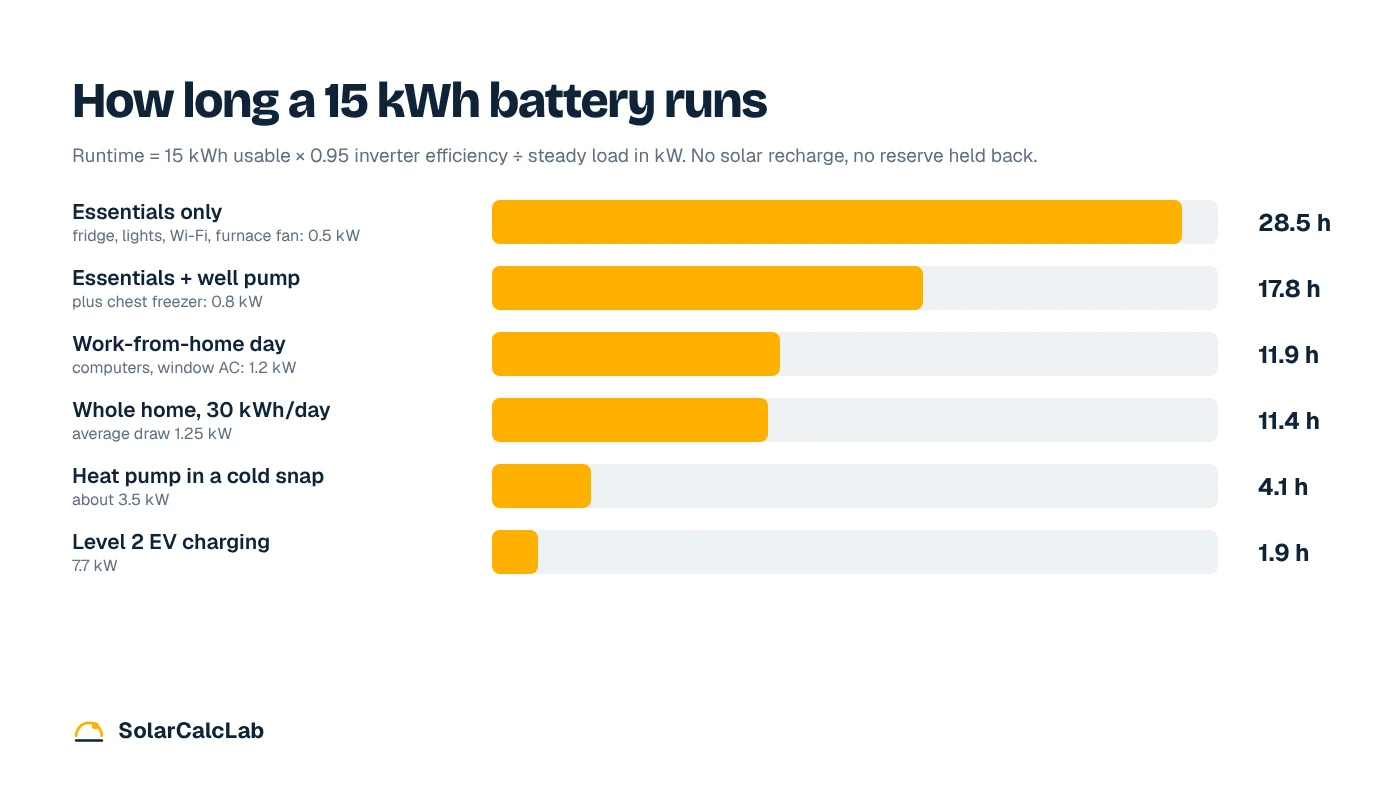
Two rows deserve a second look. The heat pump row is why a 15 kWh battery feels big in May and small in January. And the EV row is mostly a warning: you can charge a car from a home battery, but you would empty it in under two hours to add roughly 40 to 50 miles of range.
For your own appliance list, the battery backup calculator adds up watts and hours and returns the runtime with your reserve setting included.
A normal evening on time-of-use rates
Most batteries spend far more days shifting solar into the evening than riding out outages. Here is how 15 kWh splits between those two jobs in a home that draws about 2 kW from 4 PM to 9 PM, a common peak window.
- Peak-window use: 2 kW × 5 hours = 10 kWh.
- Backup reserve set at 20%: 15 × 0.20 = 3 kWh held back for outages.
- Energy available for the evening: (15 − 3) × 0.95 = 11.4 kWh at the outlets.
- Left over after 9 PM: 11.4 − 10 = 1.4 kWh, plus the 3 kWh reserve.
So a 15 kWh battery covers the whole peak window for this home and still keeps a reserve. A 10 kWh battery could not do both. That margin is the practical case for 15 kWh over smaller sizes: you can run bill savings every day without leaving the house exposed if the grid drops overnight.
Whether that daily shift pays back is a separate question. Our home battery savings calculator compares your peak and off-peak rates with your export credit and shows the yearly gain.
Warranty throughput: the limit people miss
Battery warranties usually run for a number of years or a total amount of energy, whichever comes first. With a 60 MWh cap on a 15 kWh battery, the math is short:
One full cycle a day: 4,000 ÷ 365 = about 11 years
10 kWh a day: 60,000 ÷ 10 ÷ 365 = about 16.4 years
If you cycle the battery fully every day, the energy cap ends coverage around year 11, well before the 15-year term. At a more typical 10 kWh a day, the 15-year term runs out first. This is one reason not to drain the battery to zero nightly just to export a few extra kWh. The battery cycle life calculator runs the same check for any capacity and daily depth.
What each stored kWh really costs
EnergySage’s 2026 battery cost data puts a typical 13.5 kWh installation at $15,647 before incentives, and FranklinWH quotes average $1,177 per kWh, or about $17,655 for 15 kWh. Spread $17,655 across 60,000 kWh of warranted throughput and each kWh you push through the battery costs about 29 cents, before efficiency losses.
That number is a useful filter. If the gap between your peak rate and what you would otherwise earn for that solar is well under 29 cents, the battery is mainly buying backup, not profit. Homeowners who buy outright in 2026 also no longer get the federal 25D tax credit, which ended for systems installed after 2025, so state and utility programs carry more weight. Our battery storage sizing guide covers when backup alone justifies the spend.
How much solar refills 15 kWh?
To put 15 kWh back in, the panels need to send about 15.8 kWh, since charging loses roughly 5%. That energy has to come on top of what the house uses during the day.
| Peak sun hours | One 400 W panel per day | Panels just for the battery |
|---|---|---|
| 5.5 (sunny summer month) | 1.76 kWh | 9 |
| 3.0 (cloudy or winter month) | 0.96 kWh | 17 |
Panel output here is 0.4 kW × sun hours × 0.80 system efficiency. A typical 7 to 8 kW array (18 to 20 panels) refills the battery and covers daytime use comfortably in summer. In December in the northern states, the same array may only half-fill it on a gray day. Check your own winter sun hours with the peak sun hours calculator before counting on daily refills.
Why the app shows less than 15 kWh
Owners often report a “missing” few kWh. Before calling the installer, check these in order.
- Backup reserve. A 20% reserve hides 3 kWh from daily use. The app may show only what is above the reserve.
- Nominal versus usable. Some listings quote nominal capacity. Usable can be 5% to 10% lower. The products in the table above are rated usable.
- AC versus DC figures. An app that reports energy at the outlets will show about 5% less than the battery’s DC rating.
- Cold. Lithium batteries limit charging in freezing temperatures, so a garage unit may not reach 100% in winter.
- State-of-charge drift. If the battery never reaches full, its estimate can wander. A full charge every few weeks usually resets it.
Is 15 kWh the right size for you?
It usually fits when
- Your evening peak use is 8 to 11 kWh and you want a reserve on top.
- You heat with gas, so winter outages mean fans and pumps, not resistance or heat-pump loads.
- You have about 7 kW of solar or more to refill it.
Go smaller or bigger when
- You only need the fridge, internet and lights for one night: a 12 kWh battery costs less and does the job.
- You heat with a heat pump, run a well pump and want multi-day cover: look at a 20 kWh battery or larger.
- Your main goal is charging an EV from stored solar: battery capacity is the wrong tool; shift charging to midday instead.
Check power as well as capacity. A setup with less than 10 kW continuous output may not start a 4-ton central AC and a well pump together, even with plenty of energy stored. The inverter size calculator sums running and surge watts.
Frequently asked questions
Will a 15 kWh battery run a well pump during an outage?
Usually, yes. A 1 HP well pump runs at about 1 kW but can draw roughly three times that for a second at start-up. Both FranklinWH’s 10 kW unit and three Enphase 5P batteries can handle that surge. The pump only runs when the pressure tank calls for water, so it adds a few kWh a day at most.
How many amp hours is a 15 kWh battery?
It depends on voltage. At 51.2 V, the common rack voltage, 15 kWh is about 293 Ah. At 12.8 V it would be about 1,172 Ah, which is why whole-home batteries run at 48 V class voltages or higher.
Is one 15 kWh battery enough for a whole house?
For a night, often. A home using 30 kWh a day runs about 11 hours on 15 kWh. For a multi-day outage with no solar, no. You would need to trim loads to essentials or add a second battery.
Can I add capacity to a 15 kWh battery later?
Most modular systems allow it. FranklinWH supports multiple aPower units on one system and Enphase lets you add more 5P units. Mixing very old and new modules can limit performance, so expand within the first few years if you can.
Does a 15 kWh battery work without solar panels?
Yes. It can charge from the grid and act as pure backup, or charge off-peak and discharge at peak if your utility allows it. Without solar, though, a multi-day outage ends when the battery is empty.