20kWh per Day Solar System: How Many Panels and What Size You Need
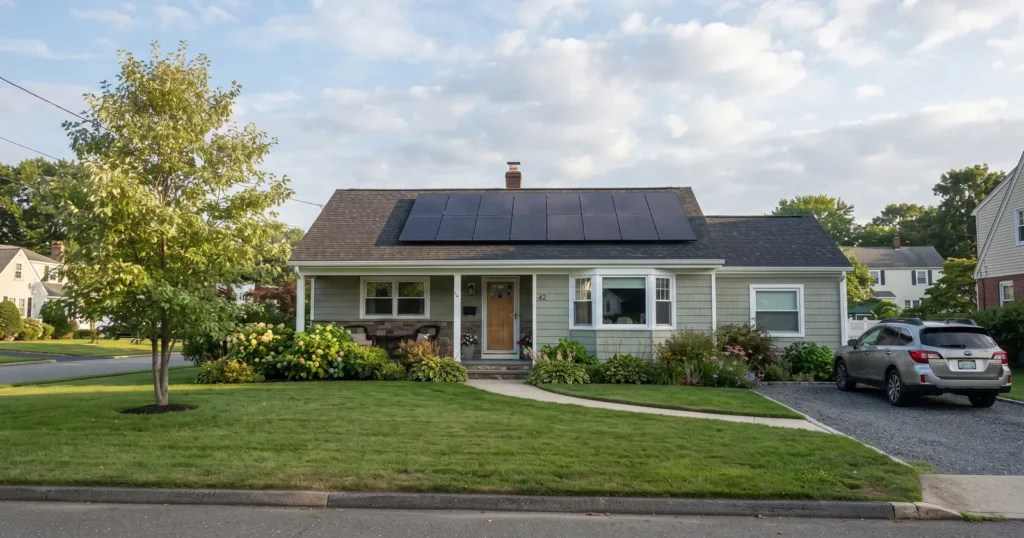
Short answer
To make 20 kWh a day you need about a 5.6 kW solar system at 4.5 peak sun hours, which is 13 panels at 430 W. Sunny Phoenix needs only about 4 kW, while cloudy Seattle needs nearly 6.8 kW. The array covers roughly 275 to 300 square feet of panels and makes about 7,300 kWh a year, or around 600 kWh a month.
Twenty kWh a day is a common target because it is roughly what a smaller or efficient home uses: an apartment, a townhouse, a house with gas heat, or a family that has already cut its usage. It is about two thirds of what the average American household buys from the grid.
This guide starts from your electric bill and works forward to a system size, a panel count and a roof layout. It also covers the gap between summer and winter output, what changes if you want power at night, and the common mix-up between producing 20 kWh a day and owning a 20 kWh battery.
What size solar system makes 20 kWh per day?
Solar output depends on two things: how many kilowatts of panels you install and how many peak sun hours your site gets. One peak sun hour equals one hour of full-strength sunlight (1,000 watts per square meter). Real systems also lose energy to heat, wiring, dust and the inverter, so this site plans with 80% system efficiency.
Flip the usual output formula around and you can solve for the system size:
Example at the US middle value: 20 ÷ (4.5 × 0.80) = 20 ÷ 3.6 = 5.56 kW
That 5.6 kW figure is the answer for an average US location. Your own number can be much smaller or larger, which is why the sun hours input matters more than anything else on the page. If you do not know your value, the peak sun hours calculator gives a planning figure for your area.
System size by peak sun hours
The table runs the formula for every half hour of sun from 3 to 7 hours. Panel counts are rounded up, so the finished array always lands at or slightly above the target.
| Peak sun hours | System size needed | 400 W panels | 430 W panels | 450 W panels |
|---|---|---|---|---|
| 3.0 | 8.33 kW | 21 | 20 | 19 |
| 3.5 | 7.14 kW | 18 | 17 | 16 |
| 4.0 | 6.25 kW | 16 | 15 | 14 |
| 4.5 | 5.56 kW | 14 | 13 | 13 |
| 5.0 | 5.00 kW | 13 | 12 | 12 |
| 5.5 | 4.55 kW | 12 | 11 | 11 |
| 6.0 | 4.17 kW | 11 | 10 | 10 |
| 6.5 | 3.85 kW | 10 | 9 | 9 |
| 7.0 | 3.57 kW | 9 | 9 | 8 |
Notice how fast the requirement climbs at the low end. Going from 4.5 to 3.0 sun hours adds 50% more panels for the same 20 kWh, because the panels simply see less light.
How many kW do you need for 20 kWh a day in your city?
Here is the same calculation for several US cities, using approximate annual average sun hours for south-facing panels tilted near the local latitude. The last two columns check the result: the rounded-up array, multiplied back out, should give at least 20 kWh on an average day.
| City | Peak sun hours | Size needed | 430 W panels | Actual array | Average day |
|---|---|---|---|---|---|
| Phoenix, AZ | 6.3 | 3.97 kW | 10 | 4.30 kW | 21.7 kWh |
| Los Angeles, CA | 5.5 | 4.55 kW | 11 | 4.73 kW | 20.8 kWh |
| Denver, CO | 5.3 | 4.72 kW | 11 | 4.73 kW | 20.1 kWh |
| Dallas, TX | 5.0 | 5.00 kW | 12 | 5.16 kW | 20.6 kWh |
| US middle value | 4.5 | 5.56 kW | 13 | 5.59 kW | 20.1 kWh |
| Chicago, IL | 4.4 | 5.68 kW | 14 | 6.02 kW | 21.2 kWh |
| Seattle, WA | 3.7 | 6.76 kW | 16 | 6.88 kW | 20.4 kWh |
A Seattle home needs six more panels than a Phoenix home to hit the same daily total. Shade, a roof facing east or west, or a flat mount will push your number higher still. For an address-level estimate built on hourly weather data, run your roof through NREL’s PVWatts calculator and compare its yearly total with 7,300 kWh.

How do you find your daily kWh on an electric bill?
Before you commit to 20 kWh, check that it really matches your home. Your bill lists the kWh used in the billing period, usually near the meter readings or the usage chart. Divide that by the number of days in the period.
Example: 612 kWh ÷ 30 days = 20.4 kWh per day
One month can mislead you, because air conditioning and electric heating swing usage by season. A better method:
- Find the 12-month usage history. Many bills print a bar chart, and most utility websites let you download the numbers.
- Add up all 12 months.
- Divide by 365. A home using 7,300 kWh a year averages exactly 20 kWh a day.
- Note your highest and lowest months. If July is 900 kWh and April is 400 kWh, your daily need ranges from about 13 to 30 kWh.
Some quick conversions help when reading bills: 20 kWh a day is about 600 kWh in an average month and 7,300 kWh a year. If your bill shows 600 kWh, this page is your size.
Is 20 kWh a day a lot?
Not for a US home. The US Energy Information Administration puts the average residential customer at 10,791 kWh a year in 2022, about 899 kWh a month or roughly 30 kWh a day. So 20 kWh a day is below average. Here is one way a day could add up to that total. Every line is an example built from its stated assumption, not a national average:
| Load | Assumption | kWh per day |
|---|---|---|
| Central air conditioning | 3 kW for 2 hours | 6.0 |
| Electric water heater | 4.5 kW element for 1 hour | 4.5 |
| Washer and electric dryer | about 3 kW for 50 minutes | 2.5 |
| Lights, TV, computers, Wi-Fi | spread across the day | 2.5 |
| Electric range and oven | 2 kW for 1 hour | 2.0 |
| Refrigerator | a typical modern model | 1.5 |
| Dishwasher | one cycle | 1.0 |
| Total | 20.0 |
Your mix will differ, and that is fine: only the daily total matters for sizing the panels. Adding an electric car or a heat pump would push most homes well past 20 kWh, so size for the loads you plan to add in the next few years.
Will a 20 kWh per day system make 20 kWh every day?
No. The sizing above gives 20 kWh on an average day across the year. Summer days are longer and the sun is higher, so output rises. Winter days are short and often cloudy, so output drops. Cloudy days in any season can produce a fraction of the average.
The swing is easy to see with an example. The monthly sun hours below are illustrative assumptions for a northern city with a 4.4 annual average, not measured data:
| 6.02 kW array (Chicago-size) | Assumed sun hours | Output per day | Versus 20 kWh need |
|---|---|---|---|
| Summer month | 5.5 | 26.5 kWh | 6.5 kWh surplus |
| Annual average | 4.4 | 21.2 kWh | 1.2 kWh surplus |
| Winter month | 2.0 | 9.6 kWh | 10.4 kWh shortfall |
On a grid-tied system with net metering, that is fine: summer surplus earns credits that offset winter shortfalls, and the yearly total balances out. If your utility pays little for exports, the summer surplus is worth less and the winter shortfall is bought at full price, so you may want to size up slightly or shift loads into sunny hours.
To cover 20 kWh even in a 2.0 sun hour month, the array would need 20 ÷ (2.0 × 0.80) = 12.5 kW, more than double the annual-average size. That is the trade-off off-grid owners face, covered below. PVWatts shows real monthly figures for your address, which is better than any assumption.
How much roof space does a 20 kWh per day system need?
Modern residential panels convert about 21% to 22% of sunlight, so each kilowatt takes roughly 49 to 51 square feet of panel surface.
Example: 5,590 W ÷ (1,000 × 0.21) × 10.764 = about 287 sq ft
- 13 panels at 430 W (5.59 kW): about 275 to 290 sq ft of panels.
- 14 panels at 400 W (5.6 kW): about the same area, one more panel to mount.
- 13 panels at 450 W (5.85 kW): about 285 to 300 sq ft, with a little extra output.
Fire code pathways and ridge setbacks usually add 20% or more, so plan for about 350 to 400 square feet of clear, unshaded roof, ideally facing south, east or west. In a low-sun city like Seattle, 16 panels need closer to 410 to 450 square feet. Check the fit with the solar panel roof area calculator.
Do you need a battery to use 20 kWh at night?
A grid-tied array produces nothing after sunset. Without a battery, the grid supplies your evening and overnight power, and net metering credits from the day pay for it. A battery makes sense when export credits are low, when you want backup during outages, or when you live off grid.
Size a grid-tied battery to your nighttime use, not the full 20 kWh. Look at how much of your day happens after dark. This site assumes 90% usable battery capacity.
Example: 40% of 20 kWh used after sunset = 8 kWh ÷ 0.90 = 8.9 kWh of battery
That is why a single 10 kWh battery is a common pairing with a 20 kWh per day array. The 10 kWh battery guide covers what one runs and for how long.
Off-grid: why 20 kWh a day needs much more
Off grid there is no utility to fill gaps, so two things grow. First, the battery must carry you through cloudy stretches, not just one night:
Example: 20 kWh × 2 days ÷ 0.90 = 44.4 kWh of battery
Second, the array has to be sized for the darkest month, not the yearly average. Using the winter example above, that means about 12.5 kW instead of 6 kW, or a smaller array plus a generator for winter. Many off-grid homes also cut daily use well below 20 kWh by switching water heating and cooking to propane. Work through the full design with the off-grid solar calculator.
20 kWh per day vs a 20 kWh battery vs a 20 kW system
These three phrases get mixed up in searches, and they describe very different things:
- 20 kWh per day is energy produced or used daily. This page sizes the panels for it: about 5.6 kW at 4.5 sun hours.
- A 20 kWh battery stores energy. It holds about 18 kWh usable at 90% and makes no power on its own. Refilling it from empty each day takes roughly a 5.6 kW array at the same sun hours, on top of whatever the house uses in daylight. Size one to your loads with the battery calculator.
- A 20 kW system is the panel rating, and it makes roughly 72 kWh a day at 4.5 sun hours. That is a large home or farm system, covered in our 20kW solar system guide.
If you are still working out panel counts for a different daily target, the how many solar panels calculator runs the same formula for any kWh figure.
Frequently asked questions
How many solar panels do I need for 20 kWh per day?
About 13 panels at 430 W with 4.5 peak sun hours and 80% system efficiency. That is a 5.6 kW array. Sunny areas like Phoenix need about 10 panels, while Seattle needs about 16. Divide 20 by your sun hours times 0.8 to get kW, then divide by the panel size in kW and round up.
How many kWh per month is 20 kWh a day?
About 600 kWh in an average month and 7,300 kWh a year. If your electric bill shows roughly 600 kWh per billing cycle, a system sized for 20 kWh a day will cover your average use. Check 12 months of bills, because summer and winter usage can differ a lot.
What size solar system produces 20 kWh a day?
A 5.6 kW system at 4.5 peak sun hours, using 20 ÷ (4.5 × 0.80). The range across the US runs from about 4 kW in the desert Southwest to about 6.8 kW in the cloudy Pacific Northwest. Shade or a poor roof angle raises the size needed.
Can a 5 kW solar system make 20 kWh a day?
Only in places with at least 5 peak sun hours, such as Dallas or southern California. A 5 kW array makes 5 × 5.0 × 0.80 = 20 kWh on an average day there. At the US middle value of 4.5 hours, it averages 18 kWh a day, and less in winter.
How big a battery do I need with a 20 kWh per day solar system?
For a grid-tied home, size it to your nighttime use. If 8 kWh of the 20 is used after dark, about 8.9 kWh of battery covers it at 90% usable capacity. Off grid with two days of backup, you need about 44 kWh plus a larger array for winter.


