30kWh per Day Solar System: How Many Panels and What Size You Need
Short answer
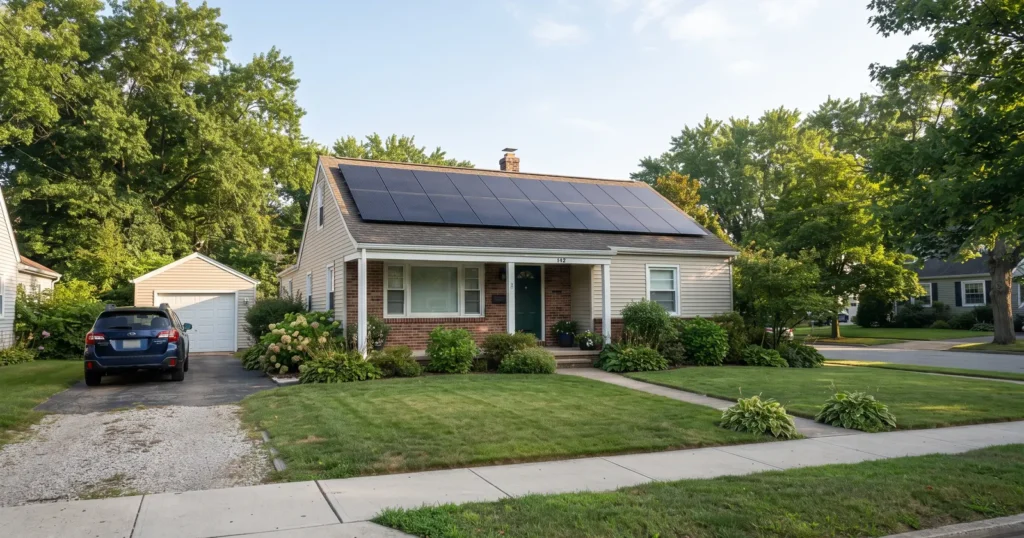
To make 30 kWh a day you need about an 8.3 kW solar system at 4.5 peak sun hours, which is 20 panels at 430 W (8.6 kW). Sunny Phoenix needs only about 6 kW, while Seattle needs about 10 kW. Grid-tied, that costs roughly $21,500 to $30,100 installed in late 2026. Off-grid, add 67 to 100 kWh of battery for two to three days of autonomy.
Thirty kilowatt-hours a day is not a random target. It is almost exactly what a typical American household buys from its utility, so a 30 kWh solar system is really the question “how much solar does an average home need?” If your bill shows around 900 kWh a month, this is your size.
This guide sizes the system from that daily figure. It shows how the answer changes with your city’s sun hours, how many panels it takes, why output swings between summer and winter, what batteries you need for backup or a fully off-grid home, and what the whole thing costs.
Is 30 kWh a day an average home?
Yes, very close to it. According to the US Energy Information Administration, the average US residential customer bought 10,791 kWh of electricity in 2022, about 899 kWh a month. Divided by 365 days, that is 29.6 kWh a day.
Example: 912 kWh ÷ 30.4 days = 30.0 kWh a day (about 10,950 kWh a year)
Before you size anything, add up the kWh on your last 12 bills and divide by 365. A single month can mislead you, because summer air conditioning or winter electric heating can push one bill far above the yearly average.
Where 30 kWh a day goes
The split below is an example built from stated assumptions, not a measured average. It shows a home with central air and an electric water heater, which is how many households reach 30 kWh.
| Load | Assumption | kWh per day |
|---|---|---|
| Central AC or heat pump | 3 kW average draw for 4 hours | 12.0 |
| Electric water heater | Family of three or four | 4.0 |
| Clothes dryer | 3 kW for 1 hour | 3.0 |
| Lighting, TV, computers, router | Mixed small loads | 3.0 |
| Always-on and miscellaneous loads | Standby, chargers, fans | 3.0 |
| Electric range and oven | One cooked meal a day | 2.0 |
| Refrigerator | Modern full-size model | 1.5 |
| Dishwasher and washing machine | One load each | 1.5 |
| Total | 30.0 |
Notice that heating and cooling make up 40% of this example. That is why the same home can use 22 kWh on a mild April day and 40 kWh in a heat wave.
What size solar system do you need for 30 kWh a day?
Work backward from the energy you want. This site plans with 80% system efficiency to cover heat, wiring, dust and inverter losses, and with peak sun hours: the hours per day that equal full-strength sunlight where you live.
Example: 30 ÷ (4.5 × 0.80) = 30 ÷ 3.6 = 8.33 kW
As a cross-check, 1 kW of panels makes about 1,100 to 1,600 kWh a year in most of the US, or 3 to 5 kWh a day. Dividing 30 kWh by that range gives roughly 6 to 10 kW, which matches the city results below.
| Location | Peak sun hours | System size for 30 kWh/day | 430 W panels | Actual size |
|---|---|---|---|---|
| Phoenix, AZ | 6.3 | 5.95 kW | 14 | 6.02 kW |
| Los Angeles, CA | 5.5 | 6.82 kW | 16 | 6.88 kW |
| Denver, CO | 5.3 | 7.08 kW | 17 | 7.31 kW |
| Dallas, TX or Miami, FL | 5.0 | 7.50 kW | 18 | 7.74 kW |
| US middle value | 4.5 | 8.33 kW | 20 | 8.60 kW |
| New York, NY or Chicago, IL | 4.4 | 8.52 kW | 20 | 8.60 kW |
| Seattle, WA | 3.7 | 10.14 kW | 24 | 10.32 kW |
Sun hours are approximate annual averages for south-facing panels tilted near the local latitude. A roof facing east or west, or one with afternoon shade, needs more panels. Find your own figure with the peak sun hours calculator, or model your exact address and roof angle in the free NREL PVWatts calculator.
How many solar panels make 30 kWh a day?
At the US middle value of 4.5 sun hours, a 30kWh solar system needs 20 panels rated 430 W. Divide the system size in watts by the panel rating and always round up, because rounding down leaves you short every day of the year.
Example: 8,333 W ÷ 430 W = 19.4, so 20 panels (8.6 kW, about 31 kWh a day)
| Panel rating | Panels at 4.5 sun hours | Actual size | Average daily output |
|---|---|---|---|
| 370 W | 23 | 8.51 kW | 30.6 kWh |
| 400 W | 21 | 8.40 kW | 30.2 kWh |
| 430 W | 20 | 8.60 kW | 31.0 kWh |
| 450 W | 19 | 8.55 kW | 30.8 kWh |
Higher-wattage panels cut the count but not the roof area by much, since each panel is physically larger. The how many solar panels calculator runs the same math for any panel and any sun hours.

Why a 30 kWh system makes more in July than in January
An array sized on the yearly average will not make 30 kWh every day. Short winter days, a low sun angle and snow cut output, while long summer days push it well past target. Your use moves too, but not always in the same direction.
The example below takes a 20-panel, 8.6 kW array in a northern city with 4.4 annual sun hours. The seasonal sun hours and home loads are illustrative assumptions to show the pattern, not measured data for any one city.
| Season | Assumed sun hours | Solar output per day | Assumed home use | Daily balance |
|---|---|---|---|---|
| Winter | 2.5 | 17.2 kWh | 32 kWh | 14.8 kWh short |
| Spring and fall | 4.5 | 31.0 kWh | 24 kWh | 7.0 kWh surplus |
| Summer | 5.8 | 39.9 kWh | 36 kWh | 3.9 kWh surplus |
A grid-tied home covers the winter gap with power from the utility and, under net metering, with credits banked during spring and summer. Over a full year the books roughly balance. The net metering calculator shows what those credits are worth under your utility’s export rate.
An off-grid home has no such bank. That 14.8 kWh daily shortfall must come from a larger array, a generator or cutting loads, which is why off-grid systems are sized for the darkest month instead of the yearly average.
Grid-tied or off-grid: how much battery does 30 kWh a day need?
Battery size depends on what you want the battery to do. A grid-tied home only needs to ride through outages or shift solar into the evening. An off-grid home needs the battery to carry everything through nights and cloudy spells. This site assumes 90% of a battery’s rated capacity is usable.
Example: 30 kWh × 2 days ÷ 0.90 = 66.7 kWh
| Goal | Energy covered | Battery needed | 10 kWh units |
|---|---|---|---|
| Grid-tied, essentials during an outage | 12 kWh for 1 day | 13.3 kWh | 2 |
| Grid-tied, whole home for 1 day | 30 kWh for 1 day | 33.3 kWh | 4 |
| Off-grid, 2 days of autonomy | 30 kWh for 2 days | 66.7 kWh | 7 |
| Off-grid, 3 days of autonomy | 30 kWh for 3 days | 100 kWh | 10 |
Grid-tied with backup
Most average homes do not back up all 30 kWh. A protected subpanel with the fridge, lights, internet, furnace fan and a few outlets often uses 10 to 15 kWh a day, which one or two batteries can handle. Our guide to the 10kWh battery shows what a single unit runs and for how long.
Off-grid with two to three days of autonomy
Running an average home fully off-grid is a much bigger project. Two to three days of storage, 67 to 100 kWh, lets the home get through a cloudy stretch before a generator starts. The array also has to grow. Using the winter example above with 2.5 sun hours, 30 ÷ (2.5 × 0.80) gives 15 kW, about 35 panels at 430 W, nearly double the grid-tied size.
Many off-grid owners settle on a middle path: a 10 to 12 kW array, two days of storage, and a generator for the worst weeks. Trimming the AC and water heating loads from the example table makes the whole system far cheaper. Test different combinations in the off-grid solar calculator, then size the bank against your real loads with the battery calculator.
What does a 30 kWh per day solar system cost?
Mid-size residential systems usually cost a little more per watt than large ones, because permits, design and crew time are spread over fewer panels. Typical US ranges in late 2026 for a professionally installed, grid-tied system, before any state or utility incentives:
- Price per watt: about $2.50 to $3.50.
- 8.6 kW, 20 panels: about $21,500 to $30,100.
- Batteries: installed home batteries run roughly $800 to $1,400 per kWh, so the 66.7 kWh off-grid bank alone works out to about $53,000 to $93,000.
- Off-grid extras: the larger winter array, an off-grid inverter and a generator add more on top.
The 30% federal residential clean energy credit (Section 25D) ended for homeowner-owned systems installed after December 31, 2025, so do not count it in your budget. Some states and utilities still offer rebates.
Payback for an average home
Example: 10,950 kWh × $0.17 = $1,862 a year; $26,000 ÷ $1,862 = 14.0 years
That example assumes an electricity rate of $0.17 per kWh and full retail net metering. If your utility pays less for exported power, payback stretches. At a higher local rate or a lower installed price, it shrinks.
Will a 30 kWh solar system fit on an average roof?
Usually, yes. Modern panels convert about 21% of sunlight, so 8.6 kW of panels covers roughly 440 square feet.
Example: 8,600 ÷ (1,000 × 0.21) = 41 m², about 441 sq ft
Fire code setbacks and pathways add 20% or more, so plan on about 530 to 600 square feet of unshaded, south, east or west facing roof. Many single-family homes have that on one or two planes. Seattle-area homes needing 24 panels will want closer to 700 square feet.
Inverter size
For a grid-tied 8.6 kW array, installers often choose an inverter a little smaller than the panel rating, a DC to AC ratio of about 1.1 to 1.3. That points to roughly 6.6 to 7.8 kW of inverter, and a 7.6 kW single-phase unit is a common match. An off-grid inverter is sized differently: it must cover your largest combined load plus motor surge, such as the AC compressor and well pump starting together.
When 30 kWh a day is not enough
Adding an electric vehicle driven 12,000 miles a year at 0.30 kWh per mile adds about 9.9 kWh a day. A home heading toward 45 to 50 kWh a day is better served by our 15kW solar system guide. If an EV or heat pump is likely within a few years, ask your installer to leave roof space and inverter headroom now.
Frequently asked questions
How many kWh a month is 30 kWh a day?
About 912 kWh a month, using the average month length of 30.4 days, or roughly 10,950 kWh a year. That is very close to the average US household, which bought 10,791 kWh in 2022 according to the EIA. Check your own 12 months of bills before sizing a system.
Can a 5kW solar system produce 30 kWh a day?
Only on the sunniest days in the sunniest places. At 80% efficiency, 5 kW needs 7.5 peak sun hours to make 30 kWh, which is above the annual average in every major US city. In Phoenix, a 5 kW array averages about 25 kWh a day.
Will my 30 kWh solar system cover my bill in winter?
Probably not day by day. Winter output can fall to half of the annual average in northern states. Under net metering, surplus credits from spring and summer offset winter shortfalls, so the yearly bill can still come close to zero, apart from fixed utility charges.
How many batteries do I need to go off-grid on 30 kWh a day?
Plan on 67 to 100 kWh of battery capacity for two to three days of autonomy, with 90% usable capacity. That equals about seven to ten 10 kWh batteries. You will also need a larger array sized for winter sun and, in most climates, a backup generator.
Is it better to size for 30 kWh a day or a little more?
A small margin of 5% to 10% is sensible, because panels lose a little output each year and your use may grow. Going far beyond your use rarely pays if your utility credits extra exports at a low rate or caps system size at your past annual consumption.


