50kW Solar System: Yearly Output, Panels Needed and 2026 Cost
Short answer
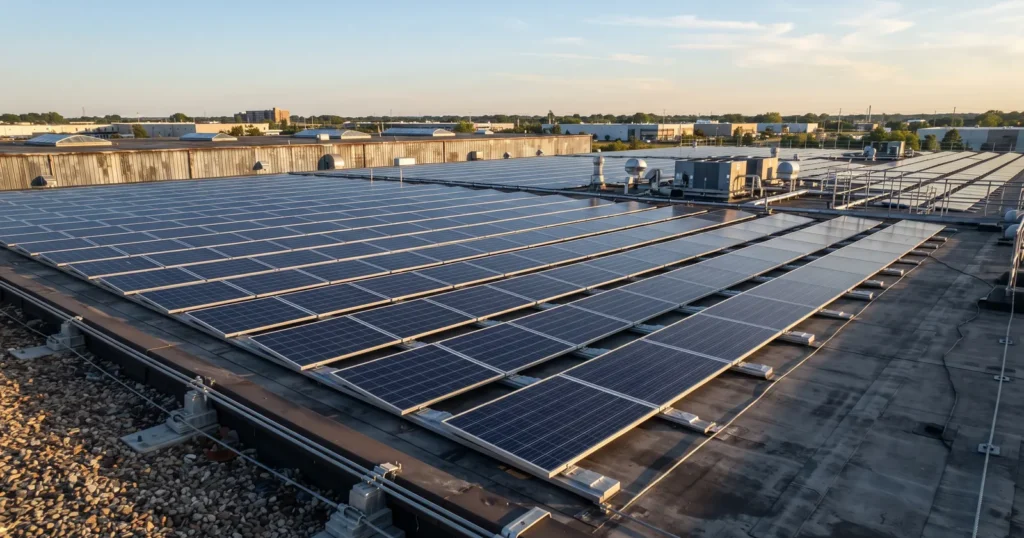
A 50kW solar system makes about 55,000 to 80,000 kWh a year in most of the US, or roughly 150 to 220 kWh a day, and up to about 92,000 kWh in the sunniest desert areas. It takes about 117 panels at 430 W, around 2,500 square feet of panel area, and typically costs $100,000 to $150,000 installed for small commercial projects in late 2026.
A 50kW solar system is a small commercial array. It is too big for nearly any single house, but it is a common size for a shop, a farm, a small warehouse, a school building or an apartment block. At this size you move from residential equipment and rules into three-phase inverters, utility interconnection studies and business tax treatment.
This guide works through the numbers: yearly and daily output by US city, how many panels you need at different wattages, the roof or land area, typical 2026 cost, payback at a commercial electricity rate, and what you need to plan for with the utility.
Who uses a 50 kW solar system?
A 50 kW array produces about 65,700 kWh a year at the US middle value of 4.5 peak sun hours. An average US home uses about 10,500 to 10,800 kWh a year, so 50 kW covers the electricity of roughly six typical homes. That is why it suits buildings with steady daytime loads rather than single households:
- Small businesses: restaurants, auto shops, stores and offices using about 5,000 kWh or more a month.
- Farms: irrigation pumps, dairy cooling, grain drying and barns with plenty of open ground or large roofs.
- Warehouses and light industry: lighting, compressors, refrigeration and forklift charging.
- Apartment buildings: common area loads, laundry, elevators and hallway lighting, or a shared array where state rules allow it.
- Schools, churches and community buildings: large flat roofs and mostly daytime use.
How much electricity does a 50kW solar system produce?
The 50 kW rating is measured in lab conditions. On a real roof, heat, dust, wiring and inverter losses reduce output, so SolarCalcLab uses 80% system efficiency for planning. Daily energy then depends on your peak sun hours:
Example: 50 kW × 4.5 hours × 0.80 = 180 kWh a day, or 65,700 kWh a year
The table below uses approximate annual average sun hours for panels tilted near the local latitude and facing south. Monthly figures are the yearly total divided by 12, so summer months will be higher and winter months lower.
| Location | Peak sun hours | Per day | Per month | Per year |
|---|---|---|---|---|
| Phoenix, AZ | 6.3 | 252 kWh | 7,665 kWh | 91,980 kWh |
| Los Angeles, CA | 5.5 | 220 kWh | 6,692 kWh | 80,300 kWh |
| Denver, CO | 5.3 | 212 kWh | 6,448 kWh | 77,380 kWh |
| Dallas, TX or Miami, FL | 5.0 | 200 kWh | 6,083 kWh | 73,000 kWh |
| US middle value | 4.5 | 180 kWh | 5,475 kWh | 65,700 kWh |
| New York, NY or Chicago, IL | 4.4 | 176 kWh | 5,353 kWh | 64,240 kWh |
| Seattle, WA | 3.7 | 148 kWh | 4,502 kWh | 54,020 kWh |
This lines up with the site’s standard rule of thumb: 1 kW of panels makes 1,100 to 1,600 kWh a year in most of the US, so 50 kW makes 55,000 to 80,000 kWh. Find your own sun hours with the peak sun hours calculator, then adjust for tilt, direction and shade in the solar panel output calculator.
Peak output in kilowatts
On a clear, cool day at solar noon, a 50 kW array may deliver around 38 to 42 kW. Many installers pair it with about 40 kW of inverter capacity, a DC to AC ratio near 1.2, because the panels rarely reach their full nameplate rating in the field.
How many panels does a 50 kW system need?
Divide 50,000 watts by the panel rating and round up. Commercial installers often use larger 540 W to 600 W modules on flat roofs and ground mounts because fewer panels mean less racking and labor.
Example: 50,000 ÷ 430 = 116.3, so 117 panels (50.3 kW)
| Panel rating | Panels needed | Actual array size | Typical panel area | Total panel area |
|---|---|---|---|---|
| 430 W (residential size) | 117 | 50.3 kW | about 21 sq ft | about 2,450 sq ft |
| 550 W (commercial size) | 91 | 50.1 kW | about 28 sq ft | about 2,520 sq ft |
| 600 W (large format) | 84 | 50.4 kW | about 30 sq ft | about 2,560 sq ft |
Total panel area barely changes with wattage, because modern panels have similar efficiency. The real difference is the number of pieces to mount and wire. In practice the final count is also set by string design: each inverter input needs strings of equal length, so a designer may land on 112 or 120 panels instead of exactly 117. The how many solar panels calculator runs this for any wattage.

How much roof or land does a 50kW solar system need?
Roof space
At about 21.5% panel efficiency, 50 kW of panels covers roughly 2,500 square feet:
50,000 ÷ (1,000 × 0.215) = 233 m², about 2,500 sq ft
The usable roof you need is larger. Fire code setbacks, walkways, HVAC units, skylights and roof edges usually push the requirement to about 3,000 to 4,000 square feet on a sloped roof. On a flat commercial roof with tilted rows, spacing between rows to avoid winter shading can take it to 4,000 to 5,000 square feet. Low-tilt ballasted systems pack tighter. The solar panel roof area calculator lets you test your own roof dimensions.
Have a structural engineer confirm the roof can carry the added load. Older warehouse roofs sometimes need reinforcement or a reroof first.
Ground mount acreage
For ground mounts, Lawrence Berkeley National Laboratory found that the median US fixed-tilt solar plant in 2019 used about 2.8 to 2.9 acres per MWdc, and single-axis tracking plants about 4.2 acres per MWdc. Scaled down to 50 kW:
| Mount type | Acres per MWdc | Land for 50 kW | Square feet |
|---|---|---|---|
| Fixed tilt | about 2.9 | about 0.15 acre | about 6,300 sq ft |
| Single-axis tracking | about 4.2 | about 0.21 acre | about 9,100 sq ft |
Those are utility-scale medians. A small array carries proportionally more edge space for fencing, access lanes and equipment pads, so plan on roughly 0.2 to 0.35 acre for a 50 kW ground mount.
How much does a 50kW solar system cost in 2026?
The Department of Energy’s solar PV system cost benchmarks put a 250 kW commercial rooftop system at about $1.98 per watt in early 2025. A 50 kW project has the same permitting, engineering and interconnection steps spread over fewer watts, so it usually costs more per watt. Typical US ranges in late 2026:
| Installed cost per watt | 50 kW system cost | When you might see it |
|---|---|---|
| $2.00 | $100,000 | Simple ground mount or open flat roof, competitive market |
| $2.50 | $125,000 | Typical small commercial rooftop |
| $3.00 | $150,000 | Complex roof, utility upgrades, high-cost labor market |
Costs above this range usually come from roof repairs, trenching or utility upgrades. Run your own quote numbers through the solar panel cost calculator.
Business tax treatment
The 30% residential clean energy credit ended for homeowner-owned systems installed after December 31, 2025. Business-owned systems are handled under different federal rules: commercial investment and production credits and depreciation can still apply, but the 2025 tax law changed them. Solar projects that begin construction after July 4, 2026 generally must be placed in service by the end of 2027 to qualify for the federal credit, and new sourcing rules limit equipment from certain foreign entities. Depreciation rules for energy property also changed. Confirm eligibility, timing and depreciation with a tax adviser before you sign a contract.
What inverter does a 50 kW system use?
Most commercial buildings have three-phase service, typically 208 V or 480 V, so a 50 kW array normally feeds three-phase string inverters. Common layouts are:
- Two 20 kW to 25 kW three-phase string inverters, a popular choice for a 50 kWdc array.
- Three smaller units of roughly 12 kW to 15 kW, useful when roof faces point in different directions.
- One 40 kW to 50 kW inverter, which is cheaper per watt but stops all production if it fails.
Output current is what sets the breaker and cable size. For about 40 kW of AC output:
At 480 V: 40,000 ÷ (1.732 × 480) = 48 A. At 208 V: 40,000 ÷ (1.732 × 208) = 111 A
Higher voltage means smaller conductors and less loss, which is one reason many commercial systems connect at 480 V.
What approvals does a 50 kW system need?
Interconnection
Any grid-tied system must be approved by the utility before it switches on. Most utilities treat systems up to tens of kilowatts with a simplified review, but at 50 kW you may face a more detailed screen, especially if the local transformer or feeder is small. Expect an application fee, a one-line electrical diagram, a possible study and sometimes a cost for utility upgrades. Approval can take weeks to months.
Net metering and net billing for commercial customers
Export rules for business customers vary more than for homes. Some states cap net metering by system size, by a share of the customer’s past usage, or by a statewide program limit. Others have moved to net billing, where exported energy earns a lower credit than the retail rate. Many commercial tariffs also include demand charges, based on your highest power use in the month, which solar alone often does not reduce much. Read your utility’s tariff and model it with the net metering calculator.
What is the payback on a 50kW solar system?
The US average commercial electricity price was 14.53 cents per kWh in July 2026, according to the EIA Electric Power Monthly. This example uses that rate, the US middle output of 65,700 kWh a year, all energy used on site, and about $1,000 a year for maintenance:
Simple payback = system cost ÷ net yearly savings
| System cost | Payback, no credit | Payback if a 30% business credit applies |
|---|---|---|
| $100,000 | 11.7 years | 8.2 years |
| $125,000 | 14.7 years | 10.3 years |
| $150,000 | 17.6 years | 12.3 years |
Higher local rates shorten payback quickly. At $0.20 per kWh, net savings rise to about $12,140 a year, and a $125,000 system pays back in about 10.3 years with no credit. Depreciation can shorten it further, while low export credits can lengthen it. This simple estimate ignores rate increases and panel degradation, so test your own figures in the solar payback calculator.
How much maintenance does a 50 kW system need?
NREL’s commercial PV cost data puts fixed operation and maintenance at about $21 per kW per year, or roughly $1,000 a year for 50 kW. That budget usually covers:
- Monitoring: checking daily production against expected output so a tripped inverter or failed string is caught within days.
- Cleaning: once or twice a year in dusty, dry or agricultural areas, less often where rain is regular.
- Inspections: annual checks of connectors, conduit, racking bolts and roof penetrations.
- Inverter replacement reserve: string inverters often need replacing once during the 25 to 30 year life of the panels.
Frequently asked questions
How many kWh does a 50kW solar system produce per day?
About 150 to 220 kWh a day in most of the US, and up to about 250 kWh in desert climates. Multiply 50 kW by your peak sun hours and by 0.8. With 4.5 sun hours, that gives 180 kWh a day, or about 65,700 kWh a year.
How many solar panels are in a 50 kW system?
About 117 panels at 430 W, 91 panels at 550 W or 84 panels at 600 W. Divide 50,000 by the panel wattage and round up. The final count may change slightly so every inverter input gets strings of equal length.
How much does a 50 kW solar system cost?
Typical small commercial installations cost about $2.00 to $3.00 per watt in late 2026, or $100,000 to $150,000 for 50 kW before incentives. Roof repairs, trenching and utility upgrades can raise that. Business owners should confirm federal credit and depreciation eligibility with a tax adviser.
How much land does a 50 kW ground mount need?
Scaling national solar plant data gives about 0.15 acre for fixed tilt and 0.21 acre for tracking. Small arrays need extra room for fencing, access and equipment, so plan on about 0.2 to 0.35 acre. Northern sites need wider row spacing.
Is a 50 kW solar system too big for a house?
For almost every home, yes. It makes about six times what an average US home uses in a year. Utilities may also limit residential net metering by system size or past usage. Most homes need 6 to 12 kW, while 50 kW suits businesses, farms and multi-unit buildings.


