7kW Solar System: Yearly Output, Panels Needed and 2026 Cost
Short answer
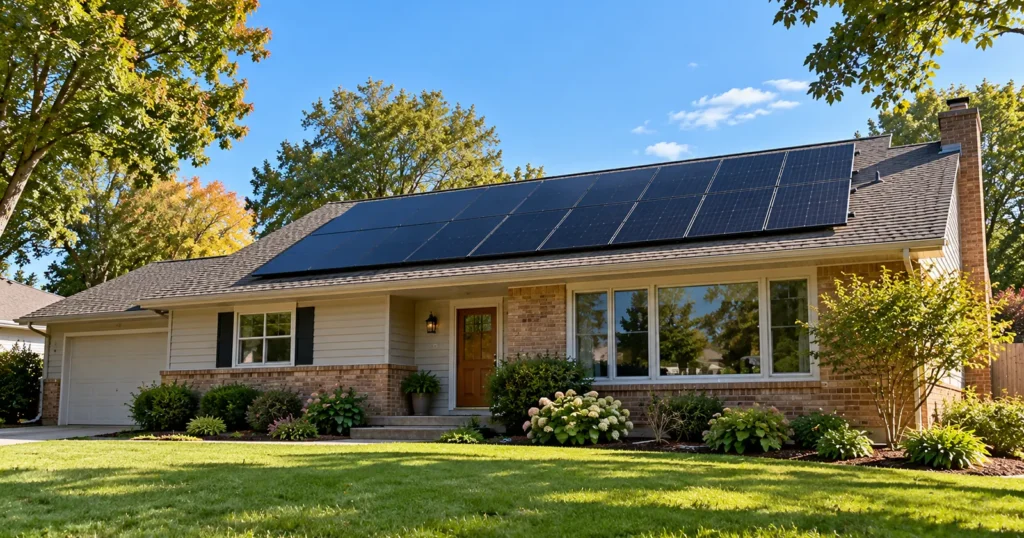
A 7kW solar system makes about 7,700 to 11,200 kWh a year in most of the US, or roughly 21 to 31 kWh a day. At 4.5 peak sun hours that is about 9,200 kWh, enough for a home using 750 to 800 kWh a month. It takes 16 to 17 panels at 430 W and typically costs $15,400 to $22,400 installed in late 2026.
Seven kilowatts is the size that fits a smaller family home: two or three bedrooms, roughly 1,200 to 1,800 square feet, gas or heat pump heating and a monthly bill a little under the national average.
Below: how to check 7 kW against your bill, what it makes in six cities and across the seasons, the panel count, 2026 cost, and why the 6 kW versus 7.6 kW inverter choice matters at this size.
Is 7 kW the right size for your bill?
Start with 12 months of usage, not square footage. Add up the kWh on your bills, then divide by what one kilowatt of panels makes where you live. This site uses 4.5 peak sun hours as a US middle value and 80% system efficiency for wiring, heat, dust and inverter losses.
Example: a home using 750 kWh a month buys 9,000 kWh a year; 9,000 ÷ (4.5 × 0.80 × 365) = 9,000 ÷ 1,314 = 6.8 kW
The table runs the same sum for other monthly bills.
| Monthly use | Yearly use | System needed at 4.5 sun hours | Is 7 kW a fit? |
|---|---|---|---|
| 550 kWh | 6,600 kWh | 5.0 kW | Oversized unless you add an EV or heat pump |
| 650 kWh | 7,800 kWh | 5.9 kW | Slightly large, useful headroom |
| 750 kWh | 9,000 kWh | 6.8 kW | Good match |
| 850 kWh | 10,200 kWh | 7.8 kW | Covers about 90% |
| 950 kWh | 11,400 kWh | 8.7 kW | Covers about 80% |
For comparison, the US Energy Information Administration reports that the average residential customer bought 10,791 kWh a year, about 899 kWh a month. A 7 kW system therefore suits homes that use 10% to 25% less than average. If your bill is close to or above 900 kWh a month, our 8kW solar system guide is the better starting point. To run the sum with your own usage and sun hours, use the solar panel calculator.
How much does a 7kW system produce in different US cities?
The same 7 kW array makes far more in the desert Southwest than in the cloudy Northwest. The table uses approximate annual peak sun hours for south-facing panels tilted near latitude, multiplied through with the 80% efficiency factor.
Example for Atlanta: 7 × 4.8 × 0.80 = 26.9 kWh a day; 26.88 × 365 = 9,811 kWh a year
| City | Peak sun hours (approx.) | Per day | Per month (average) | Per year |
|---|---|---|---|---|
| Las Vegas, NV | 6.2 | 34.7 kWh | 1,056 kWh | 12,673 kWh |
| Miami, FL | 5.2 | 29.1 kWh | 886 kWh | 10,629 kWh |
| Atlanta, GA | 4.8 | 26.9 kWh | 818 kWh | 9,811 kWh |
| Kansas City, MO | 4.7 | 26.3 kWh | 801 kWh | 9,607 kWh |
| Boston, MA | 4.3 | 24.1 kWh | 732 kWh | 8,789 kWh |
| Portland, OR | 3.8 | 21.3 kWh | 647 kWh | 7,767 kWh |
| US middle value | 4.5 | 25.2 kWh | 767 kWh | 9,198 kWh |
Roof direction, tilt and shade shift these figures. The peak sun hours calculator gives a value for your own location to drop into the formula.
Winter and summer months are very different
A yearly average hides a big seasonal swing. Here is a 7 kW array at a mid-latitude location, using assumed sun hours of 2.5 in December, 4.5 in spring or fall and 6.5 in June:
| Month type | Sun hours (assumed) | Per day | Per month | Share of a 750 kWh bill |
|---|---|---|---|---|
| December | 2.5 | 14.0 kWh | 434 kWh | 58% |
| April or October | 4.5 | 25.2 kWh | 756 kWh | 101% |
| June | 6.5 | 36.4 kWh | 1,092 kWh | 146% |
A system sized to 100% of your yearly use will run a surplus in summer and a shortfall in winter. Whether the summer surplus pays for the winter gap depends on how your utility credits exports, which the payback section covers.
How many panels and how much roof does 7 kW need?
Divide 7,000 watts by the panel rating. At 430 W the answer is 16.3, so installers choose either 16 panels (just under 7 kW) or 17 panels (just over).
| Panel rating | Panels | Array size (DC) | Yearly output at 4.5 sun hours |
|---|---|---|---|
| 400 W | 18 | 7.20 kW | 9,461 kWh |
| 430 W | 16 | 6.88 kW | 9,040 kWh |
| 430 W | 17 | 7.31 kW | 9,605 kWh |
| 450 W | 16 | 7.20 kW | 9,461 kWh |
Roof area depends on panel efficiency, not wattage. Higher-watt panels are simply bigger. Current residential modules convert about 20% to 22% of sunlight.
Example: 7,310 ÷ (1,000 × 0.21) = 34.8 m², about 375 sq ft. At 20% it is about 393 sq ft; at 22%, about 358 sq ft
Fire-code walkways, ridge setbacks and vents push the usable roof you need to about 420 to 500 square feet.
Should a 7kW array use a 6 kW or 7.6 kW inverter?
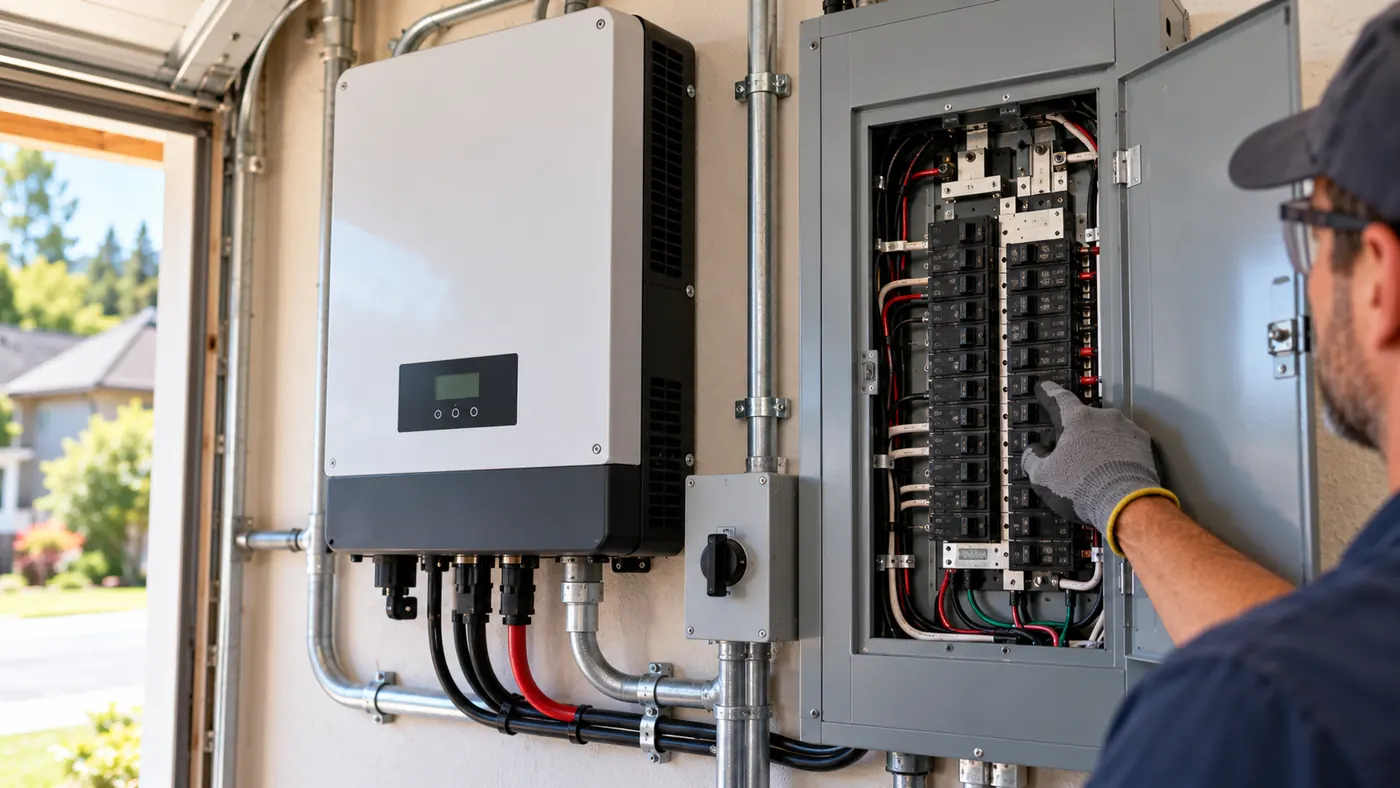
This is the one decision that is genuinely specific to a 7 kW system. Residential string and hybrid inverters come in fixed AC sizes, commonly 3.8, 5.7 or 6.0, 7.6, 10 and 11.4 kW. A 7.31 kW array sits between the two middle options, and both are reasonable.
| Inverter | DC-to-AC ratio with 17 × 430 W | Breaker needed (240 V) | Best when |
|---|---|---|---|
| 6.0 kW | 7.31 ÷ 6.0 = 1.22 | 25 A × 1.25 = 31.3 A, so 35 A | Lower cost, tight main panel, no plans to expand |
| 7.6 kW | 7.31 ÷ 7.6 = 0.96 | 31.7 A × 1.25 = 39.6 A, so 40 A | Room to add panels later, very sunny site |
Is clipping a problem with the 6 kW option?
Clipping happens when the panels produce more DC power than the inverter can convert, so the peak is flattened. Because real arrays usually deliver only 80% to 85% of their rated DC power, 7.31 kW of panels rarely push past about 6.2 kW. A 6 kW inverter clips only on the clearest, coolest midday hours, so the yearly loss is small. The inverter size calculator checks the ratio for other panel counts.
What your main electrical panel allows
Smaller homes are more likely to have a 100 A or 150 A main panel, and that can decide the inverter for you. Under the 120% busbar rule in NEC 705.12, the solar breaker plus the main breaker may total up to 120% of the busbar rating when the solar breaker sits at the far end of the bus.
Example for a 150 A panel: (150 × 1.2) − 150 = 30 A; 30 ÷ 1.25 = 24 A continuous × 240 V = 5.76 kW of inverter
| Busbar / main breaker | Largest solar breaker | Largest inverter that fits |
|---|---|---|
| 100 A / 100 A | 20 A | 3.8 kW |
| 150 A / 150 A | 30 A | 5.7 kW |
| 200 A / 200 A | 40 A | 7.6 kW |
| 225 A / 200 A | 70 A | Above 11 kW |
So a 150 A home cannot take a 6.0 kW inverter on a plain load-side breaker, but a 5.7 kW unit fits, with a little more clipping. A 100 A home needs a supply-side tap, a derated main breaker or a panel upgrade for any 7 kW option. Your installer and local inspector make the final call.
How much does a 7kW solar system cost in 2026?
Typical US installed prices in late 2026 run about $2.20 to $3.20 per watt before any state or utility rebate. Large marketplaces report 7 kW averages in the middle of that band, around $2.60 per watt.
| Price per watt | 7.0 kW | 7.31 kW (17 × 430 W) | Typical situation |
|---|---|---|---|
| $2.20 | $15,400 | $16,082 | Simple single roof face, competitive market |
| $2.60 | $18,200 | $19,006 | Middle of the market |
| $3.20 | $22,400 | $23,392 | Steep or split roof, premium panels, high-cost metro |
The 30% federal Residential Clean Energy Credit is gone for homeowners. The IRS states the credit is not available for property placed in service after December 31, 2025, so budget the full price. Ignore cost guides that still show “after tax credit” prices. Leases and power purchase agreements follow business tax rules, so ask a tax adviser about any credit a contract mentions. You can test a quote with the solar panel cost calculator.
How long does a 7kW system take to pay back?
The examples use an $18,200 system making 9,198 kWh a year and the 2024 US average residential price of about 16.5 cents per kWh from EIA data.
Example with full net metering: 9,198 × $0.165 = $1,518 a year; $18,200 ÷ $1,518 = 12.0 years
| Billing scenario | Yearly savings | Simple payback |
|---|---|---|
| Full net metering at $0.165 | $1,518 | 12.0 years |
| Half used at home at $0.165, half exported at $0.06 | $1,035 | 17.6 years |
| Full net metering at $0.30 | $2,759 | 6.6 years |
| Half used at home at $0.32, half exported at $0.08 | $1,840 | 9.9 years |
The 50/50 split assumes someone is home part of the day. Rate rises, degradation and maintenance are left out. For a fuller picture with your own rates, use the solar payback calculator.
Does a smaller home need a battery with 7 kW of panels?
Only if your utility pays little for exports or you want outage backup. A home using 750 kWh a month averages about 24.7 kWh a day. If 40% of that falls after sunset, the evening need is about 9.9 kWh, and at 90% usable capacity that points to roughly an 11 kWh battery.
On an average 4.5 sun-hour day the array makes 25.2 kWh. After about 14.8 kWh of daytime use, around 10.4 kWh is left to charge the battery, a close match. A 10 kWh class battery, explained in our 10kWh battery guide, is the natural pairing.
Can a 7kW system grow with your household?
Plan for the next five years. An electric car driven 12,000 miles a year at about 0.30 kWh per mile adds roughly 3,600 kWh. A 9,000 kWh home becomes 12,600 kWh, which needs 12,600 ÷ 1,314 = 9.6 kW at the US middle value.
- With a 7.6 kW inverter: at a 1.25 DC-to-AC ratio it supports about 9.5 kW of panels, roughly 22 panels at 430 W. That leaves space for 5 more panels if the inverter datasheet and your roof allow.
- With a 6 kW inverter: adding panels means a second inverter or microinverters on the new panels, which costs more per added watt.
If an EV is certain within a year or two, installing the larger system now usually beats bringing a crew back.
Frequently asked questions
How many kWh does a 7kW solar system produce per month?
About 640 to 930 kWh a month averaged over the year in most of the US, based on 7,700 to 11,200 kWh a year. At the US middle value of 4.5 peak sun hours it is about 767 kWh. December can fall near 430 kWh while June can exceed 1,000 kWh.
How many solar panels do I need for a 7kW system?
Sixteen to seventeen panels at 430 W, eighteen at 400 W, or sixteen at 450 W. Seventeen 430 W panels give 7.31 kW, slightly above 7 kW, which is normal. The count changes with panel wattage, but the roof area stays similar because it depends on panel efficiency.
Is a 7kW solar system enough for a 1,500 square foot house?
Often, if the home uses about 700 to 800 kWh a month. Floor area is a weak guide on its own: a 1,500 square foot home with electric resistance heat or a pool pump can use far more. Divide your yearly kWh by 1,314 to get the size you need at 4.5 sun hours.
What size inverter does a 7kW solar system need?
Most installers pick a 6 kW or 7.6 kW inverter. A 6 kW unit gives a DC-to-AC ratio of about 1.22 with seventeen 430 W panels and clips only on rare peak hours. A 7.6 kW unit needs a 40 A breaker, which fits a standard 200 A panel and leaves room to add panels.
Can a 7kW solar system charge an electric car?
Yes, but not on top of a full household load. A typical EV driven 12,000 miles a year needs about 3,600 kWh, roughly 40% of what 7 kW makes at 4.5 sun hours. A home that adds an EV usually needs about 9 to 10 kW to stay near 100% coverage.
How much roof space does a 7kW system need?
The panels themselves cover about 360 to 395 square feet, depending on efficiency. Allow about 420 to 500 square feet of usable roof once fire-code walkways, ridge setbacks and vents are added. A single south, east or west roof face of that size keeps the wiring and inverter choice simple.


