Do Solar Panels Work During a Power Outage?
Short answer
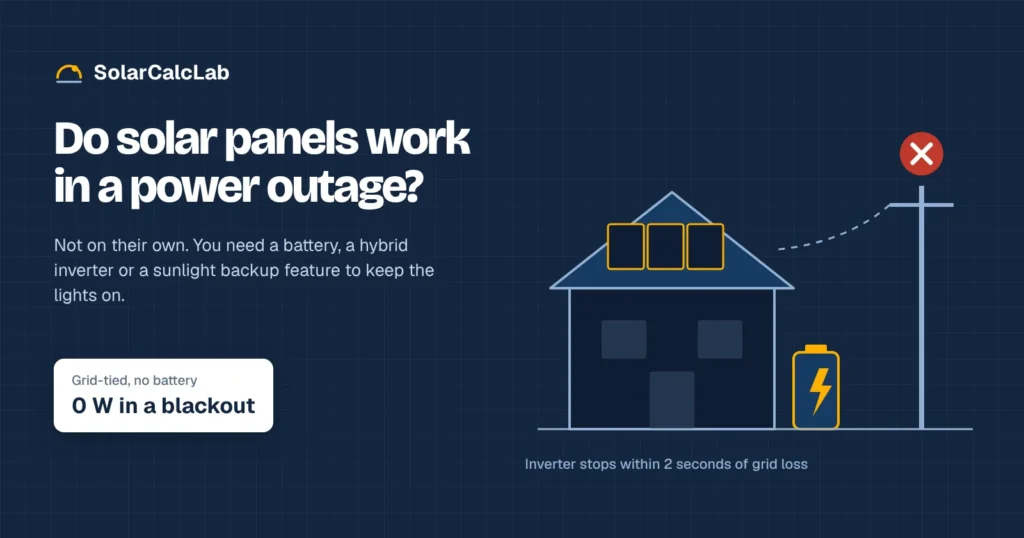
Most home solar systems do not work during a power outage. A standard grid-tied inverter is required to shut off within 2 seconds of losing grid power, even on a sunny day, so the panels sit idle while the house is dark. Solar keeps working in a blackout only if the system has a battery with automatic transfer, a hybrid inverter that can isolate the home, or a sunlight-only backup feature such as SMA’s Secure Power Supply outlet or Enphase Sunlight Backup.
This surprises a lot of new owners: sun on the roof, lights still off. Nothing is broken. The system is doing what the electrical code and the utility interconnection agreement require.
Below we explain why the shutdown happens, what each backup option can and cannot run, how much an outage actually costs you in lost production, and what to check when your system stays offline after the grid comes back.
Why grid-tied solar shuts off when the grid goes down
When a utility line goes dead, crews treat it as de-energized while they repair it. If thousands of rooftop inverters kept pushing power into that line, a worker could be hit by electricity flowing backward from homes. The term for this hazard is “islanding”: a section of the grid kept alive by local generators after the utility has disconnected it.
The 2-second rule
Inverters sold for grid connection are tested to IEEE 1547, which requires an unintended island to be detected and the inverter to stop energizing the line within 2 seconds. The National Electrical Code backs this up in Section 705.40: when the utility source is lost, interconnected power production equipment must disconnect automatically, and a listed interactive inverter must stop exporting.
Why the inverter cannot simply power your house instead
A standard string inverter or microinverter is “grid-following.” It syncs its output to the voltage and frequency the grid supplies. With no grid signal, it has nothing to follow, so it cannot form a stable 120/240 V supply on its own. The U.S. Department of Energy puts it plainly in its solar and resilience overview: grid-tied systems generally depend on the grid to produce power, and running independently takes a properly configured inverter plus storage.
Throwing your main breaker does not fix this, because the inverter still sees no grid. Isolating the home safely takes listed transfer equipment, which is what a battery gateway or backup controller provides.
Four setups, four very different outages
Whether solar helps in a blackout depends entirely on the equipment between the panels and your loads. Here is how the common options compare.
| Setup | Daytime in an outage | Night in an outage | What limits it |
|---|---|---|---|
| Grid-tied only (no battery) | Nothing | Nothing | Anti-islanding shutdown |
| SMA Sunny Boy with Secure Power Supply | One outlet, up to 2,000 W | Nothing | Sunlight on the array at that moment |
| Enphase IQ8 with Sunlight Backup (no battery) | Selected circuits | Nothing | About 30% of array output recommended for loads |
| Battery with backup gateway or hybrid inverter | Backed-up circuits, plus recharging | Backed-up circuits until the battery runs low | Battery kWh and inverter kW |
SMA Secure Power Supply: one outlet, sun only
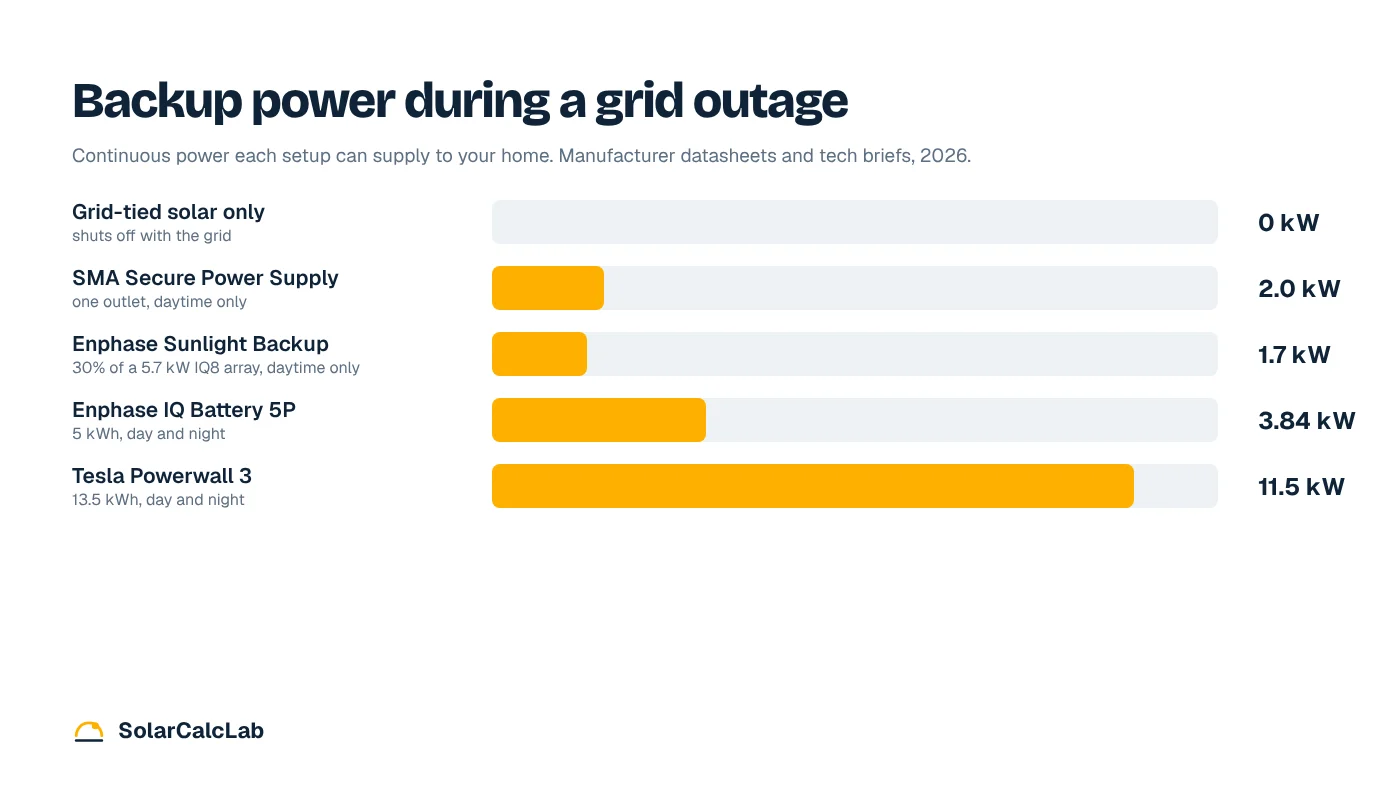
SMA builds a backup outlet into its Sunny Boy US inverters from 3.0 to 7.7 kW. When the grid fails, you switch the inverter to Secure Power Supply and a dedicated outlet delivers up to 2,000 W, according to SMA’s datasheet. That is enough to keep a refrigerator, a freezer and phone chargers going on a clear afternoon. It is not enough for a well pump, and output falls whenever clouds pass. After sunset it stops.
Enphase Sunlight Backup: circuits, but light loads
Homes with IQ8 microinverters can run without a battery if they add an IQ System Controller 2, a load controller and a shutdown switch. Enphase’s own tech brief recommends keeping backup loads at or below 30% of the array’s output, because a cloud can cut production in seconds and there is no battery to fill the gap.
Example: 24 IQ8 microinverters = 5.7 kW AC, so 5.7 × 0.30 = 1.71 kW of loads
A sample list that fits: refrigerator (150 W running), chest freezer (80 W), router (20 W), six LED bulbs (60 W), laptop and phone charging (60 W) and a sump pump (800 W). That totals 1,170 W, under the 1.71 kW guideline. A 3,500 W central air conditioner does not fit, and Enphase does not support whole-home backup in this mode.
Battery systems: the only option that works at night
A battery with a backup gateway disconnects your home from the grid, then its inverter creates a local 240 V supply that your solar inverter can sync to. Tesla says Powerwall takes over “in a fraction of a second,” far faster than a typical standby generator. A Powerwall 3 stores 13.5 kWh and supplies up to 11.5 kW continuously, while a smaller Enphase IQ Battery 5P stores 5 kWh and supplies 3.84 kW. The kW figure decides what can start, and the kWh figure decides how long it lasts. Our battery storage sizing guide walks through both. Choosing the hardware itself? Our grid tie vs hybrid inverter comparison explains which inverter type can form that local supply and which cannot.
How much solar do you lose during an outage?
People often worry about the wasted sunshine. In dollar terms it is small. Take a 6 kW grid-tied system in a sunny region:
Value at 18.2¢ per kWh = 26.4 × $0.182 = about $4.80
A full day of sunny outage costs that household under $5 in lost credit. The real cost of an outage is the spoiled food, the flooded basement when the sump pump stops, or the lost workday. Backup planning should start with the loads you cannot lose.
How often does it actually matter?
According to the U.S. Energy Information Administration, the average customer went without power for about 11 hours in 2024, the most in a decade. Nearly 9 of those hours came from major events, mostly hurricanes, while routine interruptions average about 2 hours a year. So most homes face a few short outages and, in some regions, a rare multi-day one. A short outage rarely justifies a battery on its own. A region with hurricanes, wildfire shutoffs or ice storms often does.
Which backup option fits your situation?
- Outages are rare and short, and you mainly want lower bills. A grid-tied system without backup is the cheapest path.
- You want to save a fridge and charge phones during long daytime outages. An SMA inverter with Secure Power Supply covers this at almost no extra cost, if you are buying an inverter anyway.
- You have IQ8 microinverters and a few light essential circuits. Sunlight Backup can add daytime power without buying storage. Expect nothing after dark.
- You have a sump pump, medical equipment, a well pump or a home office that cannot go down. You need a battery. Check that its continuous and surge kW can start your largest motor.
- You face multi-day outages from storms or utility shutoffs. A battery plus solar can recharge each day. Pair it with a generator if winter sun is weak where you live.
Cost matters here. EnergySage reports an average quote of about $15,647 for a 13.5 kWh battery in the first half of 2026, roughly $1,159 per kWh before incentives. The federal 25D credit no longer applies to systems placed in service after December 31, 2025, so 2026 buyers should check state and utility rebates instead. Our solar tax credit guide explains what changed.
Troubleshooting: why is my solar still off?
The grid is back but the inverter shows “grid fault” or no production
Wait a few minutes. After the grid returns, inverters check that voltage and frequency stay stable before reconnecting. The default delay in common interconnection settings is about 5 minutes. If production does not return within half an hour, check the AC disconnect and the solar breaker in your panel, since a surge can trip them.
My battery system shut off in the middle of the outage
Two causes are common. The battery may have run down overnight, or a large load such as an AC compressor or electric dryer tripped the inverter’s overload protection. Turn off big loads, then restart the system per the manufacturer’s steps. Plug your real loads into the battery backup calculator to see how many hours your reserve setting actually gives you.
The sun is out but my battery is not charging
If the battery is full, the system deliberately throttles the panels. Off-grid, Powerwall raises the frequency of its local supply, which signals the solar inverter to reduce or stop output. That is normal. Run a dishwasher or charge a car at midday to use the surplus.
Before you add backup: three numbers to get first
- Essential load in watts. Add up the running watts of everything you want on. The solar load calculator builds this list for you.
- Largest starting load. Motors can draw several times their running watts for a moment. That figure decides the inverter or battery kW, and the inverter size calculator checks it.
- Nightly energy in kWh. Running watts times hours from sunset to sunrise. This decides battery capacity.
If the battery would also shift evening use under time-of-use or net billing rates, the home battery savings calculator shows whether those daily savings help cover the cost. Export rules matter here, and our net metering explainer covers how your utility credits exported power.
Frequently asked questions
Can I use my solar panels during a blackout if I turn off the main breaker?
No. A standard grid-tied inverter needs a live grid signal to run, so it stays off even with the main breaker open. Safe islanding requires listed equipment, such as a battery gateway or backup controller, that separates the home from the utility automatically.
Do solar panels work during the day in a power outage?
Only with backup-capable equipment. A plain grid-tied system shuts down within 2 seconds of the outage, sun or no sun. An SMA Secure Power Supply outlet or Enphase Sunlight Backup can supply limited daytime power without a battery.
Will a battery automatically switch on during an outage?
Yes, if it was installed with a backup gateway or transfer switch and backup mode is enabled. The switch is fast enough that most lights and electronics keep running. A battery installed only for bill savings, without backup wiring, will not power the house.
Can solar recharge my battery during a multi-day outage?
Yes. Once the battery forms a local grid, the solar inverter syncs to it and charges the battery during daylight. Winter sun and cloudy days limit how much you get back, so reduce loads on poor solar days.
Is it dangerous to run a portable generator with solar panels?
It is safe when a generator connects through a listed transfer switch or interlock, so it can never feed the utility line, and when the solar circuit is wired so the inverter cannot push power into the generator. Have an electrician plan both, since a generator backfeed can injure line crews.