How Many Watts Does a Window AC Use?

Short answer
Most window air conditioners use 450 to 1,500 watts while the compressor runs. A small 5,000 BTU unit draws about 450 W, a 10,000 BTU unit about 850 to 900 W and an 18,000 BTU 230 V unit about 1,500 W. On 115 V that is roughly 4 to 11 amps. Because the compressor cycles, a 10,000 BTU unit running 8 hours on a hot day typically uses 4 to 7 kWh.
Window units are the easiest air conditioners to measure, because everything you need is printed on the spec sheet or the sticker on the side of the chassis. The catch is that the sticker gives you a maximum, not what the unit averages over an evening. That difference decides whether a unit trips a bedroom breaker, how much it adds to your bill and how big a battery or solar setup you need to run it.
This article uses published specs from current US models, then works through circuits, running cost and off-grid power. For central air, mini splits and portable units, see our broader guide on how many watts an air conditioner uses, and the appliance wattage chart puts a window unit next to 32 other household loads.
Real window AC wattage from manufacturer specs
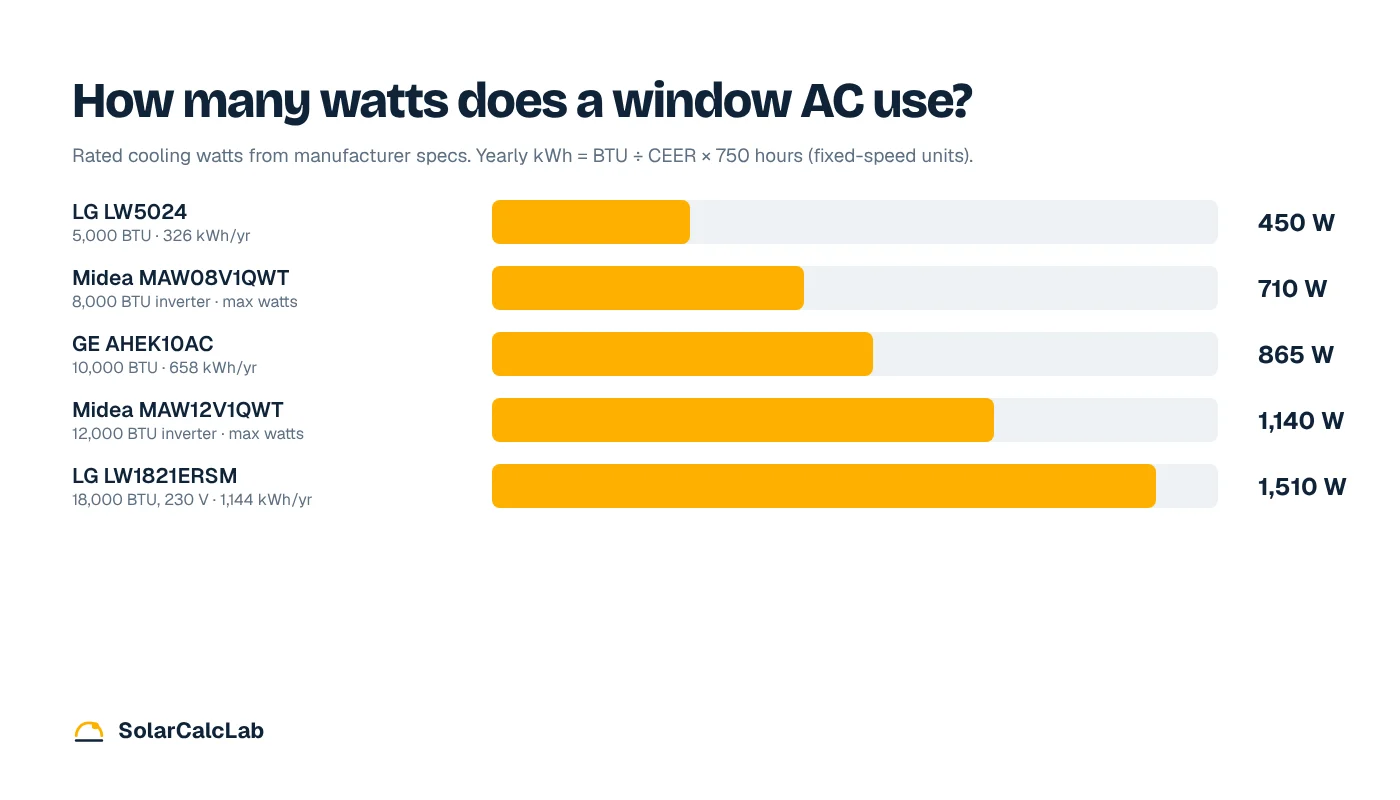
These figures come from the published specifications of models sold in the US. “Cooling watts” is the rated or maximum electrical input while cooling.
| Model | Capacity | Type | Cooling watts | Rated amps | CEER | Plug |
|---|---|---|---|---|---|---|
| LG LW5024 | 5,000 BTU | Fixed speed, 115 V | 450 W | 4.2 A | 11.5 | NEMA 5-15P |
| Midea MAW08V1QWT | 8,000 BTU | Inverter, 115 V | 710 W max | 8.78 A | 15 | NEMA 5-15P |
| GE AHEK10AC | 10,000 BTU | Fixed speed, 115 V | 865 W | 7.8 A | 11.4 | NEMA 5-15P |
| Midea MAW12V1QWT | 12,000 BTU | Inverter, 115 V | 1,140 W max | 12.17 A | 15 | NEMA 5-15P |
| LG LW1821ERSM | 18,000 BTU | Fixed speed, 230 V | 1,510 W | 6.9 A at 230 V | 11.8 | NEMA 6-15P |
Notice that the 18,000 BTU unit draws fewer amps than the 10,000 BTU unit. It runs on 230 V, so the same power needs about half the current. That is why most window units above about 15,000 BTU need a 230 V outlet with a different plug shape.
Three ways to find your own unit’s watts
1. Read the nameplate
The rating sticker sits on the side or back of the chassis, often visible once you remove the front grille. Look for “cooling input” or “rated power” in watts. If only amps are listed, the next method gets you close.
2. Multiply amps by volts
Example: 4.2 A × 115 V = 483 W (LG LW5024 lists 450 W)
The result runs a little high because motors have a power factor below 1, so the current is slightly more than watts divided by volts. The GE AHEK10AC shows the same thing: 865 W ÷ 115 V = 7.5 A, while its rated current is 7.8 A. For breaker sizing the amps figure is the one that matters; for energy and cost, use watts. The watts to amps calculator converts either way.
3. Divide BTU by the efficiency rating
If the sticker is gone, the yellow EnergyGuide label or the product listing gives capacity and CEER (combined energy efficiency ratio, in BTU per watt-hour).
Example: 10,000 ÷ 11.4 = 877 W. Inverter example: 12,000 ÷ 15 = 800 W
For fixed-speed units this lands close to the nameplate. Inverter units are different: the Midea 12,000 BTU model lists 1,140 W as its maximum, but at its rated output the CEER points to about 800 W, and once the room is cool it slows down further.
Running watts are not the whole story: cycling and kWh
A fixed-speed window unit has one setting for its compressor: on or off. When the room reaches the thermostat setting, the compressor stops and only the fan runs, which uses a small fraction of the power. On a very hot afternoon in a sunny room it may run 80% of the time or more. On a mild evening, much less.
Example: 865 W × 8 h × 0.60 ÷ 1,000 = 4.15 kWh
At the EIA’s August 2026 US average residential rate of 18.16 cents per kWh, those 4.15 kWh cost about 75 cents a day, or $22.62 over 30 days. A 5,000 BTU unit with the same habits costs about $11.77 a month. Plug in your own rate and hours with the electricity cost calculator.
Why inverter window units use less
Inverter models (the U-shaped Midea units and LG’s Dual Inverter line, for example) vary compressor speed instead of switching it on and off. The efficiency rating captures the difference. The yearly kWh on an EnergyGuide label is based on 750 hours of use, so you can compare two 10,000 BTU units directly:
| 10,000 BTU unit | CEER | Yearly energy at 750 hours | Yearly cost at 18.16 ¢/kWh |
|---|---|---|---|
| Fixed speed | 11.4 | 658 kWh | $119.47 |
| Inverter | 15 | 500 kWh | $90.80 |
That is 24% less energy for the same cooling, worth about $29 a year at average rates and more in states with high rates or long cooling seasons. The ENERGY STAR listing for Midea’s 8,000 BTU inverter unit (MAW08V1UWT) shows the same arithmetic: 8,000 ÷ 15 × 750 hours = 400 kWh a year. You can compare certified models side by side in the ENERGY STAR room air conditioner finder.
Outlet and breaker: will it trip?
Window units are cord-and-plug appliances, and the National Electrical Code limits how much of a circuit they may use in NEC 440.62:
- Alone on the circuit: the unit’s marked rating may not exceed 80% of the breaker. That is 12 A on a 15 A circuit and 16 A on a 20 A circuit.
- Sharing the circuit with lights or other outlets: the limit drops to 50%, so 7.5 A on 15 A and 10 A on 20 A.
Many bedrooms are on a shared 15 A circuit. A 5,000 or 6,000 BTU unit fits under 7.5 A easily. The GE 10,000 BTU unit at 7.8 A is just over the shared-circuit limit, and the 12,000 BTU inverter units at 10.8 to 12.2 A belong on a dedicated circuit. If a breaker trips when the compressor kicks on, count what else is running on that circuit before blaming the AC.
Two more rules from the manufacturers’ instructions: plug directly into the wall outlet, not an extension cord or power strip, and never swap the plug. A NEMA 6-15P or 6-20P plug means a 230 V outlet of that rating is required.
Running a window AC on solar or a battery
Window units are one of the more realistic cooling loads for off-grid cabins, RVs and home backup, because their power is modest and their demand peaks when the sun is strongest.
Overnight on a battery or power station
Take the 8,000 BTU inverter unit at its rated average of about 533 W (8,000 ÷ 15). Over an 8-hour night:
Example: 533 W × 8 h ÷ 0.90 = 4,738 Wh, or about 4.7 kWh
A 2 kWh power station would last about 3.4 hours at that rate (2,000 × 0.90 ÷ 533). Cooler night air means less compressor work, so real runtime is usually somewhat better, but plan on a 5 kWh or larger battery for a full night. Fixed-speed units also draw a brief surge each time the compressor starts, so the inverter should be rated well above the running watts. Check both numbers with the battery backup calculator and the inverter size calculator.
Daytime on solar panels
The 10,000 BTU example above needs about 4.15 kWh across an 8-hour afternoon. A 400 W panel in Dallas averages about 1.96 kWh a day in June, based on our breakdown of how much power a solar panel produces per day. That points to three 400 W panels (4.15 ÷ 1.96 = 2.1, rounded up with margin) just for the AC, plus a battery or grid connection for cloudy hours. The appliance solar panel calculator runs this for your own location and unit.
When a window AC uses more power than it should
- Dirty filter or coils. A clogged filter cuts airflow, so the unit runs longer for the same cooling. Most filters slide out and rinse in minutes.
- Air leaks around the unit. Gaps beside the accordion panels let hot air in. Foam strips cost a few dollars.
- Afternoon sun on the cabinet. A unit on a west wall in full sun works harder. An awning or shade over the outside part helps.
- Wrong size. An undersized unit runs nonstop. An oversized one cools fast and shuts off before it removes much humidity, so the room feels clammy.
- Very low setpoint. Each degree lower means more compressor hours. The DOE suggests 78°F when you are home, and a ceiling fan makes that feel cooler.
Frequently asked questions
How many amps does a window AC use?
Most 115 V window units draw about 4 to 12 amps. Published specs range from 4.2 A for a 5,000 BTU LG unit to 12.17 A for a 12,000 BTU Midea inverter model. Larger 230 V units draw fewer amps for the same power, for example 6.9 A for an 18,000 BTU LG.
Can I plug a window AC into a regular outlet?
Units with a NEMA 5-15P plug fit a standard 115 V outlet. Check the circuit, though: on a 15 A circuit shared with other outlets and lights, the code limit for the AC is 7.5 A. Larger units with a 6-15P or 6-20P plug need a dedicated 230 V outlet.
How much does it cost to run a window AC per month?
A 10,000 BTU unit drawing 865 W, running 8 hours a day with the compressor on 60% of the time, uses about 124 kWh a month. At 18.16 cents per kWh that is about $22.62. Double the hours or move to a high-rate state and the cost rises in proportion.
Can a 1,000 watt generator run a window AC?
Only a small one. A 5,000 BTU unit at 450 W running can work on a 1,000 W inverter generator if its startup surge stays within the generator’s peak rating. A 10,000 BTU fixed-speed unit at 865 W running leaves almost no margin, so a 2,000 W generator is the safer choice.
Does a window AC use more power than a fan?
Far more. A box or ceiling fan uses about 15 to 75 W, while even a 5,000 BTU window unit draws around 450 W. A fan cools you by moving air; the AC removes heat and humidity from the room.