Microinverters vs Power Optimizers: Cost, Shade Performance and Which to Choose
Short answer
Solar panels with micro inverters built in (AC panels) turn DC into AC on every panel, so shade or a fault on one panel never drags down the rest. Power optimizers also work panel by panel but still feed one central inverter. Micros usually cost about $0.25 to $0.45 per watt more than a plain string inverter, optimizers less. Pick micros for complex or shaded roofs, optimizers for larger systems, a string inverter for simple, sunny roofs.
Every grid-tied solar system needs something to turn the panels’ direct current into the alternating current your home uses. There are three ways to do it on a house: one central string inverter, a central inverter with a power optimizer on each panel, or a microinverter on each panel. Some panels now ship with the microinverter already attached at the factory.
The choice affects what you pay, how much energy a partly shaded roof makes, how you add a battery, and what happens when a part fails in year 14. This guide compares all three with worked numbers for a typical 20-panel home system.
What are solar panels with micro inverters built in?
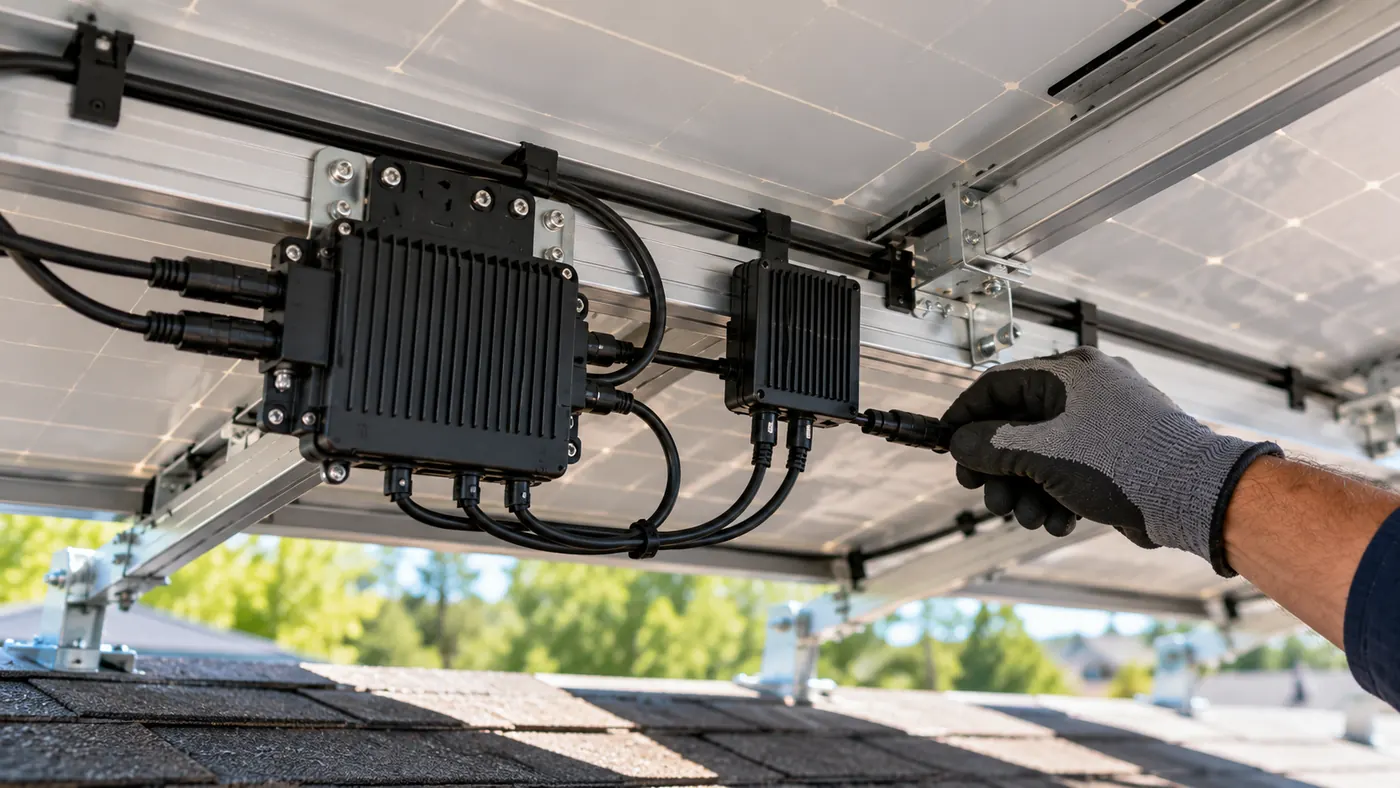
An AC solar panel (also called an AC module) is a normal panel with a microinverter mounted on the back at the factory. Its output cable carries 240 V AC instead of DC, so the panels plug into each other and run as a single AC circuit to your main panel.
The other route is a field-attached microinverter: the installer bolts a separate micro to the racking under each panel and connects the panel’s DC leads to it. Electrically the two setups are the same. The differences are practical:
- Factory-attached: fewer parts to handle on the roof and one combined product, but you are tied to the inverter the panel maker chose, and a failed micro may mean dealing with the panel brand rather than the inverter brand.
- Field-attached: you can pair any compatible panel with any micro, and a failed unit is swapped without touching the panel’s warranty paperwork.
Either way, check that the micro’s continuous rating suits the panel. Enphase’s base IQ8 model, for example, is rated 240 VA continuous with 97.0% CEC weighted efficiency, which is meant for smaller panels. A 430 W panel needs a higher-rated model from the same family, or it will clip a lot of its midday output.
How do microinverters, optimizers and string inverters differ?
In a string inverter system, panels are wired in series into strings that can reach several hundred volts DC, and one wall-mounted inverter converts it all. The U.S. Department of Energy notes that with this design, shading or a problem on one panel can reduce the output of the whole string, while microinverters keep each panel independent at a higher price.
A power optimizer is a small DC-to-DC converter on each panel. It tracks that panel’s best operating point, then sends conditioned DC down the string to a central inverter built to work with optimizers. You get panel-level tracking and monitoring, but the central inverter is still a single point of failure.
A microinverter does the whole conversion at the panel. There is no central inverter and no high-voltage DC run through the house.
| Feature | String inverter | String + optimizers | Microinverters |
|---|---|---|---|
| Where DC becomes AC | One central unit | One central unit | At every panel |
| Panel-level tracking | No | Yes | Yes |
| Monitoring | Whole system or per string | Per panel | Per panel |
| Peak efficiency (typical) | 95% to 98% | About 99% inverter, up to 99.5% optimizer | About 97% |
| Typical warranty | 5 to 12 years | 25 years optimizers, about 12 years inverter | 20 to 25 years |
| Expected life | 10 to 15 years | Inverter 10 to 15 years | 20 to 25 years |
| If one part fails | Whole array stops | Inverter: whole array stops. Optimizer: one panel | One panel stops |
| Rooftop rapid shutdown | Needs added devices | Built in | Built in |
Warranty, life and efficiency figures are typical published values from manufacturer datasheets and 2026 industry price guides.
Why does rapid shutdown push most US roofs toward panel-level electronics?
Section 690.12 of the National Electrical Code requires rooftop PV systems to drop to safe voltages quickly so firefighters are not working around live DC. Under the 2017 NEC, conductors outside the array boundary (1 foot from the array) must fall to 30 V within 30 seconds, and since January 1, 2019, conductors inside the boundary must fall to 80 V within 30 seconds. The 2023 edition keeps the same limits, as the inspectors’ association IAEI explains in its rapid shutdown overview.
A 10-panel string can sit at 400 V or more, so a plain string inverter cannot meet the 80 V limit on its own. Installers either add a rapid shutdown device under each panel, use a listed array system, or choose optimizers or micros, which shut down at the panel by design. That is why the “cheap” string option on a US roof often ends up with module-level hardware anyway, which narrows the price gap.
Ground mounts and arrays not on buildings are generally outside 690.12, which is one reason plain string inverters stay popular there. Your local inspector decides which edition applies.
How much more do microinverters and optimizers cost?
2026 industry price guides put a residential string inverter at about $1,000 to $3,000 and microinverters at about $150 to $250 per panel. They estimate micros at roughly $0.25 to $0.45 per watt more than a string system, and optimizer systems at about $0.15 to $0.25 per watt more. These are typical US ranges in late 2026, and installer quotes vary.
Example: 8,600 W × $0.25 to $0.45 = $2,150 to $3,870 more for microinverters
Here is that math for a typical family system of 20 panels at 430 W (8.6 kW). Using the site’s assumptions of 4.5 peak sun hours and 80% system efficiency, it makes about 31 kWh a day, or roughly 11,300 kWh a year. Installed solar averages about $2,600 per kW before incentives, so the whole system lands near $22,400.
| 8.6 kW system, 20 panels | String inverter | String + optimizers | Microinverters |
|---|---|---|---|
| Added cost vs plain string | $0 (plus rapid shutdown devices on a roof) | $1,290 to $2,150 | $2,150 to $3,870 |
| Share of a $22,400 system | Base | About 6% to 10% | About 10% to 17% |
| Likely inverter replacements in 25 years | 1, sometimes 2 | 1 central inverter | Usually none planned |
| Replacement cost each time | $350 to $3,500 with labor | $350 to $3,500 with labor | Per failed unit, often warranty |
The 25-year view is closer than the upfront view. A string or optimizer system will very likely need a new central inverter at some point, which can eat most of the micro premium. Note also that the 30% federal residential clean energy credit ended for homeowner-owned systems installed after December 31, 2025, so the full premium now comes out of your pocket. Run your own quote through the solar panel cost calculator to see the totals.
How much energy do they recover on a shaded roof?
Each panel has bypass diodes, usually three, that let current skip a shaded section. So a vent-pipe shadow on one corner of one panel rarely kills a whole string on a modern system. The losses grow when shade moves across several panels during the day, when panels in one string face different directions, or when some panels are dirtier or older than others. Panel-level electronics stop one weak panel from setting the pace for the rest.
Field results vary widely, so rather than trust one headline figure, test what a gain would be worth to you:
Example: 11,300 kWh × 5% × $0.17 = about $96 a year
| Energy recovered by panel-level electronics | Value per year at $0.17/kWh | Years to repay a $2,150 premium | Years to repay a $3,870 premium |
|---|---|---|---|
| 2% (open, unshaded roof) | $38 | 57 | about 100 |
| 5% (some shade, two roof faces) | $96 | 22 | 40 |
| 10% (trees, chimneys, three or more faces) | $192 | 11 | 20 |
| 15% (heavy, moving shade) | $288 | 7 | 13 |
The $0.17 per kWh rate is an assumption; use your own bill rate. The lesson is clear: on an open, south-facing roof, extra energy alone rarely pays for microinverters. What pays for them there is rapid shutdown compliance, longer warranties and avoiding a mid-life inverter swap. Feed your recovered kWh into the solar payback calculator to see the effect on your whole system.
Roofs with several directions
East and west faces peak at different times of day. In one string they fight each other, so string designs usually need a separate input per face. Micros and optimizers let you put a few panels on a small west face without a dedicated string. Check how much each face produces with the solar panel orientation calculator before you decide.
Which works better with a home battery?
This is the factor people forget until they want backup power. Microinverters are AC-coupled: a battery connects on the AC side through its own inverter and a system controller, which makes adding a battery years later fairly simple. Optimizer systems are usually DC-coupled through a hybrid inverter from the same brand, which converts power fewer times and suits a battery planned from day one, but retrofitting a different brand is harder.
Neither type keeps your lights on in a grid outage by itself. Grid-tied inverters shut off when the grid fails unless the system has a battery or a backup controller that can isolate the house. If backup matters, choose the battery plan first and the inverter type second. The battery backup calculator shows how many hours a given battery covers.
What goes wrong, and how hard is it to fix?
The failure patterns are opposite. A central inverter fails rarely, but when it does, the whole array stops until it is replaced, usually on a wall at ground level within a few hours of the technician arriving. With 20 microinverters you have 20 small devices on a hot roof. Individual failures are more likely to happen at some point, but each takes only one panel offline, and replacing it means pulling that panel.
Optimizers sit in between: a dead optimizer takes one panel down, a dead inverter takes all of them down. Before you sign, ask the installer three questions:
- Does the warranty cover the labor to get on the roof, and for how many years?
- Does monitoring alert me automatically when a panel stops reporting?
- Is there a monitoring subscription fee after the first years?
Which should you choose for your roof?
| Your situation | Best fit | Why |
|---|---|---|
| One south-facing roof, no shade, tight budget | String inverter with rapid shutdown devices | Lowest cost, panel-level tracking adds little |
| Two or more roof faces, scattered shade | Microinverters | Each panel works alone, easy to add panels later |
| Larger home system, about 10 kW and up, some shade | String + optimizers | Panel-level benefits at a lower cost per watt as size grows |
| Battery planned on day one with one brand | Optimizers with a hybrid inverter | DC-coupled storage, fewer conversions |
| Battery maybe later, or growing the system in stages | Microinverters | AC-coupled, add panels and storage in steps |
| Ground mount or barn roof, open site | String inverter | Often outside rooftop rapid shutdown rules, easy inverter access |
Whichever you pick, the inverter capacity still has to match the array. Check the AC rating against your panel watts with the inverter size calculator, and if you go with a string or optimizer design, the solar string size calculator keeps cold-morning voltage inside the inverter’s limit.
Frequently asked questions
Are microinverters worth the extra cost?
On shaded roofs or roofs with several faces, usually yes, because each panel works independently and the units carry 20 to 25 year warranties. On a simple, unshaded south roof, the extra energy rarely repays a $0.25 to $0.45 per watt premium, though avoiding a mid-life inverter replacement narrows the gap over 25 years.
Do microinverters or optimizers work during a power outage?
Not on their own. Grid-tied systems shut down when the grid fails so they do not send power to utility workers. To run during an outage you need a battery or a backup controller that disconnects the house from the grid. Some newer microinverters can then run in daylight without a battery, but only with that controller installed.
How long do microinverters last compared with string inverters?
Microinverters are typically expected to last 20 to 25 years and often carry 25-year warranties. Central string inverters usually last 10 to 15 years with 5 to 12 year warranties, so most string and optimizer systems need at least one inverter replacement over the life of the panels.
Can you mix microinverters and optimizers on one system?
Not in the same circuit. Optimizers must feed a compatible central inverter, while microinverters output AC directly. You can, however, add a separate microinverter array next to an existing string system and connect both to your main panel, as long as the panel’s busbar and breaker limits allow it.
Is it easier to add panels later with microinverters?
Yes. Each new panel brings its own microinverter, so you only need room on an AC branch circuit and approval from your utility. With a string or optimizer system, new panels must fit the inverter’s capacity and string voltage limits, which often means a second inverter once the first is full.


