Monocrystalline vs Polycrystalline Solar Panels: Efficiency, Cost and Which to Buy
Short answer
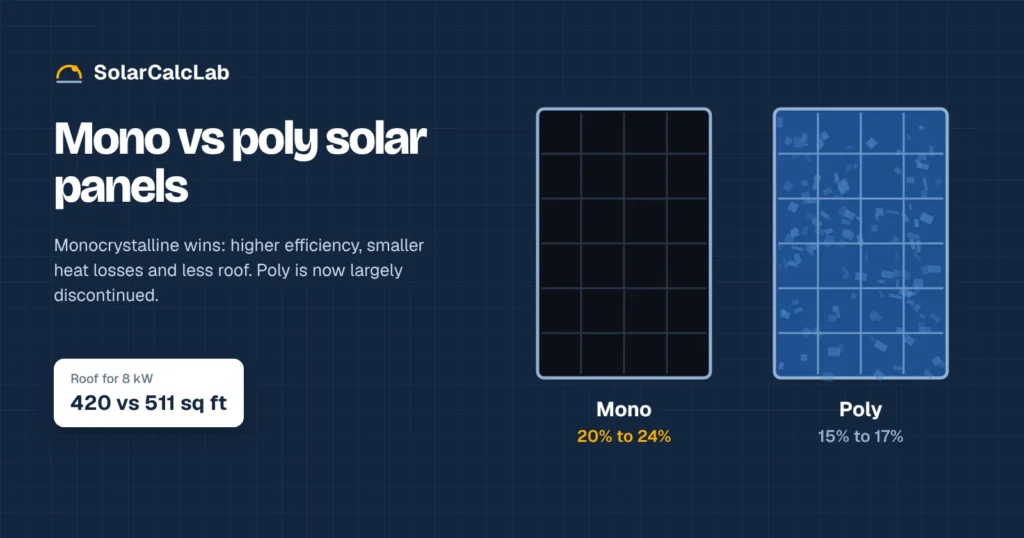
Monocrystalline panels are the better buy for almost every home in 2026. They convert 20% to 24% of sunlight into electricity, against roughly 15% to 17% for polycrystalline, they lose less power in the heat and they need roughly 18% to 20% less roof for the same system size. Polycrystalline is now largely discontinued for US residential use, so the real choice is between mono PERC and newer n-type TOPCon or heterojunction panels.
Ten years ago, monocrystalline vs polycrystalline was a genuine trade-off. Mono was more efficient, poly was cheaper, and many installers chose poly to keep a quote down. That gap has closed. Mono wafers became so cheap to make that the major manufacturers stopped building polycrystalline lines, and today almost every panel on a US quote is some form of monocrystalline silicon.
This guide compares the two on the numbers that still matter: efficiency, heat losses, looks, cost per watt and how much roof each needs for the same kW. It also covers thin film and the cell names you will see on modern datasheets.
Monocrystalline vs polycrystalline at a glance
The difference starts with the silicon. A monocrystalline cell is cut from a single, continuous crystal grown as a cylindrical ingot. A polycrystalline (also called multicrystalline) cell is cut from a block where many small crystals were melted and cooled together. The boundaries between those crystals slow down electrons, which is why poly cells convert less light into power.
| Feature | Monocrystalline | Polycrystalline |
|---|---|---|
| Module efficiency | 20% to 24%+ | 15% to 17% (best about 18%) |
| Temperature coefficient (Pmax) | -0.24% to -0.35% per °C | -0.39% to -0.43% per °C |
| Typical residential panel | 400 to 450 W | 270 to 330 W (legacy) |
| Appearance | Uniform black | Blue with a speckled, flaky pattern |
| Annual degradation | About 0.25% to 0.55% | About 0.6% to 0.7% |
| US residential availability | Standard on nearly every quote | Mostly discontinued, leftover stock and small off-grid panels |
Efficiency: how much power per square foot
Module efficiency is the share of incoming sunlight a panel turns into electricity under standard test conditions (1,000 W per square meter of light at 25°C). A higher figure means more watts from the same footprint, not more energy per watt.
Monocrystalline efficiency ranges
Mono panels now come in three broad tiers. Older p-type PERC panels sit around 20% to 21.5%. Mainstream n-type TOPCon panels reach 22% to 23.5%, and premium heterojunction and back-contact panels reach 22.5% to 24% or more. The industry roadmap ITRPV puts the current average for TOPCon and heterojunction modules at about 23.5%, with back-contact modules near 24%.
Polycrystalline efficiency ranges
Polycrystalline panels topped out at roughly 17% to 18% for the best products, and most residential poly panels sold in the late 2010s were rated 15% to 17%. Because manufacturers stopped investing in poly, those numbers have not moved in years, while mono kept climbing. You can check any panel’s efficiency from its watts and dimensions with the solar panel efficiency calculator.
Example: 400 W ÷ (1.722 m × 1.134 m × 1,000) = 400 ÷ 1,953 = 20.5%
Temperature coefficient: performance in the heat
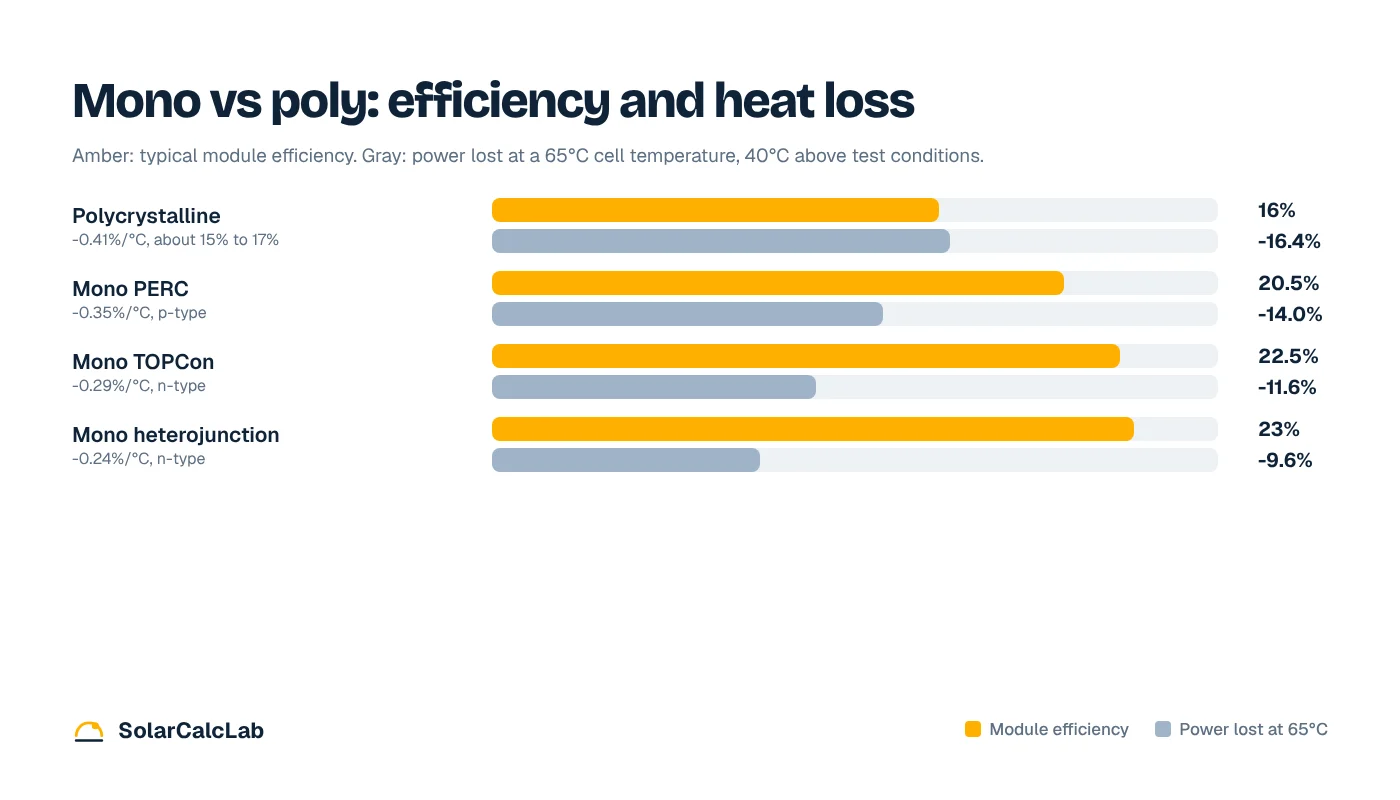
Solar panels lose output as they get hotter. The temperature coefficient of Pmax tells you how much power drops for each degree Celsius above 25°C. On a sunny summer roof, cells often run at 60°C to 65°C, so this number matters a lot in hot states like Arizona, Texas and Florida.
| Panel type | Typical coefficient | Power loss at 65°C cell temperature |
|---|---|---|
| Polycrystalline | -0.41% per °C | 16.4% |
| Mono PERC (p-type) | -0.35% per °C | 14.0% |
| CdTe thin film | -0.32% per °C | 12.8% |
| Mono TOPCon (n-type) | -0.29% per °C | 11.6% |
| Mono heterojunction | -0.24% per °C | 9.6% |
Worked example: a hot afternoon
At 65°C the cells are 40°C above the 25°C test condition. A 400 W poly-style rating at -0.41% per °C loses 40 × 0.41 = 16.4%, delivering about 334 W. The same 400 W rating with a heterojunction coefficient of -0.24% per °C loses 9.6% and delivers about 362 W. That gap repeats every hot afternoon. Run your own climate numbers through the solar panel temperature loss calculator.
Appearance: black vs blue
Looks are the easiest way to tell the two apart. Monocrystalline cells are a uniform dark black. Older mono panels showed small white diamonds where the rounded cell corners left gaps, but modern full-square and half-cut cells have mostly removed them. Many residential mono panels now ship as all-black modules with a black frame and black backsheet, which blend into dark shingle roofs.
Polycrystalline cells are blue with a visible shimmer of crystal fragments, a bit like metal flakes in paint. Some homeowners never minded the look, but HOAs and buyers who care about curb appeal usually prefer all-black mono panels.
Cost per watt in 2026
Price used to be poly’s main selling point. Today the gap has effectively disappeared because poly is barely manufactured, and the module is now a small part of what you pay.
Panel prices
In the first quarter of 2026, US module prices tracked by Anza had a median of about $0.28 per watt, with TOPCon panels at about $0.285 per watt and US-made cells near $0.46 per watt, as reported by pv magazine USA. Leftover poly stock, where you can still find it, sells at roughly $0.20 to $0.30 per watt, so the saving is a few cents per watt at most.
Installed system prices
EnergySage puts the average installed cost of a home system at about $2.60 per watt before incentives. On that figure, panels at $0.28 per watt are only about 11% of the total. Labor, inverters, racking, permits and installer overhead make up the rest, and many of those costs scale with the number of panels. A poly system needs more panels, more racking and more labor for the same kW, which cancels out any small saving on the modules. Estimate a full system price with the solar panel cost calculator.
Space needed for the same kW: worked example
Efficiency matters most when roof space is tight. Here is an 8 kW system built three ways, using real panel sizes.
| Panel | Size | Efficiency | Panels for 8 kW | Panel area |
|---|---|---|---|---|
| Poly 60-cell, 280 W | 65 × 39 in (17.6 ft²) | 17.1% | 29 (8.12 kW) | 511 ft² |
| Mono PERC, 400 W | 68 × 45 in (21.0 ft²) | 20.5% | 20 (8.0 kW) | 420 ft² |
| Mono TOPCon, 440 W | 69 × 45 in (21.5 ft²) | 22.0% | 19 (8.36 kW) | 409 ft² |
Example: 8,000 W ÷ 280 W = 28.6, so 29 poly panels covering 29 × 17.6 ft² = 511 ft²
The poly array needs about 90 more square feet of panel area than mono PERC, and nine more panels to mount, wire and maintain. Real roofs also need fire setbacks and gaps between rows, so the usable space you need is larger than the panel area alone. Check your own roof with the solar panel roof area calculator, or work out the panel count first with the how many solar panels calculator.
PERC, TOPCon and HJT: what the cell names mean
Since almost every panel is now monocrystalline, the useful comparison has moved to the cell design. These are the names you will see on 2026 datasheets.
PERC (p-type mono)
Passivated Emitter and Rear Cell technology added a reflective layer to the back of the cell. It dominated from about 2018 to 2023 and is still sold, but ITRPV reports its share fell to about 14% in 2025 and expects it to disappear over the next decade. PERC panels suffer slightly more light-induced degradation in year one.
TOPCon (n-type mono)
Tunnel Oxide Passivated Contact cells use n-type silicon, which resists light-induced degradation, and reach higher efficiency with a better temperature coefficient. TOPCon is now the industry’s dominant technology and is what most installers quote by default. Many TOPCon panels are also bifacial, a design explained in our guide to bifacial solar panels.
HJT and back contact
Heterojunction cells sandwich crystalline silicon between thin amorphous silicon layers. They have the best heat performance of any common panel, with coefficients near -0.24% per °C. Back-contact cells move all the wiring to the rear, which raises efficiency and gives a very clean all-black look. Both cost more per watt and suit small or hot roofs where every watt counts.
Where thin film fits
Thin-film panels deposit a very thin light-absorbing layer onto glass or a flexible backing instead of using silicon wafers. Cadmium telluride (CdTe) modules from First Solar are the main thin-film product today, at about 19% efficiency with a -0.32% per °C coefficient, but they are large utility-scale panels rarely sold for homes. Flexible amorphous and CIGS panels show up on RVs and boats, where weight matters more than efficiency. For a standard house roof, crystalline mono silicon is the practical choice.
Which should you buy?
- For a home rooftop system: choose monocrystalline. An n-type TOPCon panel offers the best value in 2026.
- For a small or hot roof: pay a little more for heterojunction or back-contact panels with a coefficient of -0.30% per °C or better.
- For a cheap off-grid project with plenty of space: a used or surplus poly panel is fine if the price is right, but check its age and output first.
- When comparing quotes: look at the efficiency, temperature coefficient, degradation rate and warranty, not the “mono” label, since nearly every quote will be mono anyway.
Frequently asked questions
Is monocrystalline better than polycrystalline?
Yes, for nearly every buyer. Monocrystalline panels are 20% to 24% efficient against about 15% to 17% for polycrystalline, they lose less power in hot weather, they degrade more slowly and they need roughly 18% to 20% less roof space for the same system size.
Are polycrystalline solar panels still sold?
Barely. The major manufacturers stopped launching new polycrystalline residential panels years ago, and almost all US home systems now use monocrystalline. You can still find leftover stock, used panels and small off-grid poly panels from some sellers.
Is polycrystalline cheaper than monocrystalline?
Only slightly per watt at the panel level, roughly $0.20 to $0.30 per watt for leftover poly stock against about $0.28 per watt for mainstream TOPCon in 2026. Because poly needs more panels, racking and labor for the same kW, the installed system usually costs about the same or more.
How can I tell if a solar panel is mono or poly?
Look at the cells. Monocrystalline cells are a uniform dark black, while polycrystalline cells are blue with a speckled, flaky pattern. The datasheet will also list the cell type, and an efficiency above 19% almost always means monocrystalline.
Do mono panels work better in hot weather?
Yes. Typical poly panels lose about 0.41% of their power for every degree Celsius above 25°C, while mono TOPCon panels lose about 0.29% and heterojunction panels about 0.24%. At a 65°C cell temperature that is a 16.4% loss for poly against 9.6% to 11.6% for modern mono.


