400 Watt Solar Panel Output: kWh Per Day, Amps and Wiring
Short answer
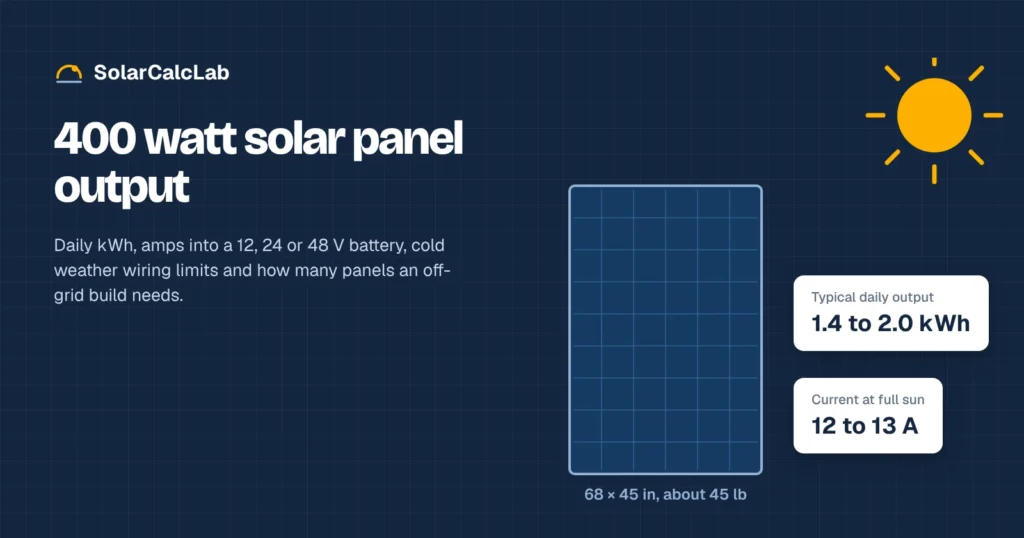
A 400 watt solar panel produces about 1.4 to 2.0 kWh a day averaged over the year in most of the US, or roughly 525 to 710 kWh a year. In December that can fall to 0.8 kWh in Chicago and 1.6 kWh in Phoenix. At full sun it puts out about 12 to 13 amps at 31 to 34 volts, which an MPPT controller turns into roughly 27 amps of charging current for a 12 V battery or 14 amps for a 24 V bank.
The 400 W panel is now a default size for home roofs and bigger off-grid builds. The label number, though, only tells you what the panel does in a test lab. What matters for a real system is its voltage, its current, how it behaves in cold weather and how much energy it delivers in the worst month you plan to live with.
This guide works through those numbers with three real 400 W spec sheets, then shows how many panels common off-grid loads need in winter. If you only want city-by-city daily output, our article on how much a solar panel produces per day has the full table for a 400 W panel.
What a 400 W spec sheet actually says
Most 400 W panels sold in the US use 108 half-cut cells in a frame of about 68 by 45 inches. Their electrical figures differ more than you might expect, and that decides which controller you can use.
| Rating at STC | Renogy RSP400DCT | Rich Solar MEGA 400 | SolarEver 400M-108N |
|---|---|---|---|
| Voltage at max power (Vmp) | 34.0 V | 31.0 V | 31.06 V |
| Current at max power (Imp) | 11.76 A | 12.9 A | 12.88 A |
| Open-circuit voltage (Voc) | 39.42 V | 37.1 V | 36.83 V |
| Short-circuit current (Isc) | 13.06 A | 13.7 A | 13.76 A |
| Voc temperature coefficient | -0.26%/°C | -0.26%/°C | -0.29%/°C |
| Size | 67.8 × 44.7 in | 67.9 × 44.7 in | 67.87 × 44.64 in |
| Weight | 45.4 lb | 45.2 lb | 47.4 lb |
The figures come from each maker’s published datasheet, including the Renogy RSP400DCT datasheet. Two numbers do most of the work later in this article: Voc sets your series limit, and Isc sets your fuse and wire sizing.
The NOCT column is closer to a sunny afternoon
STC means 1,000 W/m² of sunlight with the cells held at 77°F. Outdoors, cells run 30 to 40 degrees hotter. The SolarEver sheet also lists NOCT figures (800 W/m², 68°F air, light wind): 28.90 V at 10.39 A, which works out to about 300 W. That is why a healthy 400 W panel on a clear day often reads 280 to 330 watts on a controller display.
400 watt solar panel amps: panel side vs battery side
“How many amps” has two answers, and mixing them up leads to the wrong controller.
Amps leaving the panel
On the panel side, current equals Imp: about 11.8 to 12.9 A at full sun for the three panels above. Heat lowers voltage, not current.
Amps going into the battery
An MPPT controller trades the panel’s higher voltage for more current at the battery’s lower voltage.
12 V LiFePO4 at full STC power: 400 × 0.95 ÷ 14.0 = 27.1 A
Same battery on a typical bright day (320 W): 320 × 0.95 ÷ 14.0 = 21.7 A
| Battery bank | Charging voltage used | Current at 400 W | Current at 320 W (real sun) | Smallest sensible MPPT |
|---|---|---|---|---|
| 12 V | 14.0 V | 27.1 A | 21.7 A | 30 A |
| 24 V | 28.0 V | 13.6 A | 10.9 A | 15 to 20 A |
| 48 V | 56.0 V | 6.8 A | 5.4 A | 10 A |
Run your own panel and battery through the charge controller calculator before you buy.
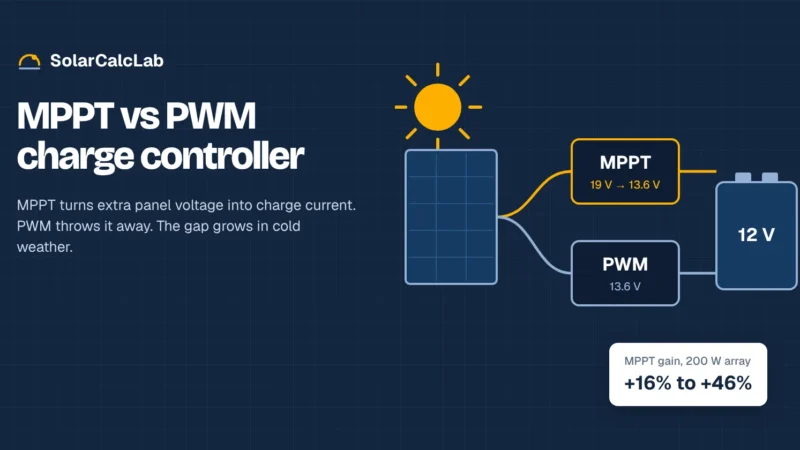
Why a PWM controller wastes half of it
A PWM controller simply connects the panel to the battery, so the panel is dragged down to battery voltage. It still delivers roughly its Imp of about 13 A, but at 14 V that is only about 180 W. A panel built to work near 31 to 34 V is a poor match for a 12 V PWM controller. The full trade-off is covered in our MPPT vs PWM comparison.
Wiring two or three 400 W panels together
With 400 W panels the series limit arrives fast, because Voc climbs as the panel gets colder.
Renogy at -20°C (-4°F): 39.42 × (1 + (-0.0026) × (-45)) = 44.03 V per panel
| Coldest morning | Renogy, 2 in series | Renogy, 3 in series | Rich Solar, 2 in series | Rich Solar, 3 in series |
|---|---|---|---|---|
| 14°F (-10°C) | 86.0 V | 129.0 V | 81.0 V | 121.4 V |
| -4°F (-20°C) | 88.1 V | 132.1 V | 82.9 V | 124.3 V |
| -22°F (-30°C) | 90.1 V | 135.2 V | 84.8 V | 127.2 V |
Two panels in series fit a common 100 V controller even on a -22°F morning. Three in series never do, so a three-panel string needs a 150 V controller. The solar string size calculator runs this check for any panel and any low temperature.
Parallel strings and fuses
All three panels list a 25 A maximum series fuse. If one panel shorts, the others push current back into it. With two in parallel, the healthy panel can feed back about 1.25 × 13.76 = 17.2 A, which is under 25 A, so no string fuses are needed. With three, two panels can feed back about 34.4 A, so each string needs its own fuse rated no higher than 25 A.
How many 400 watt panels for an off-grid system?
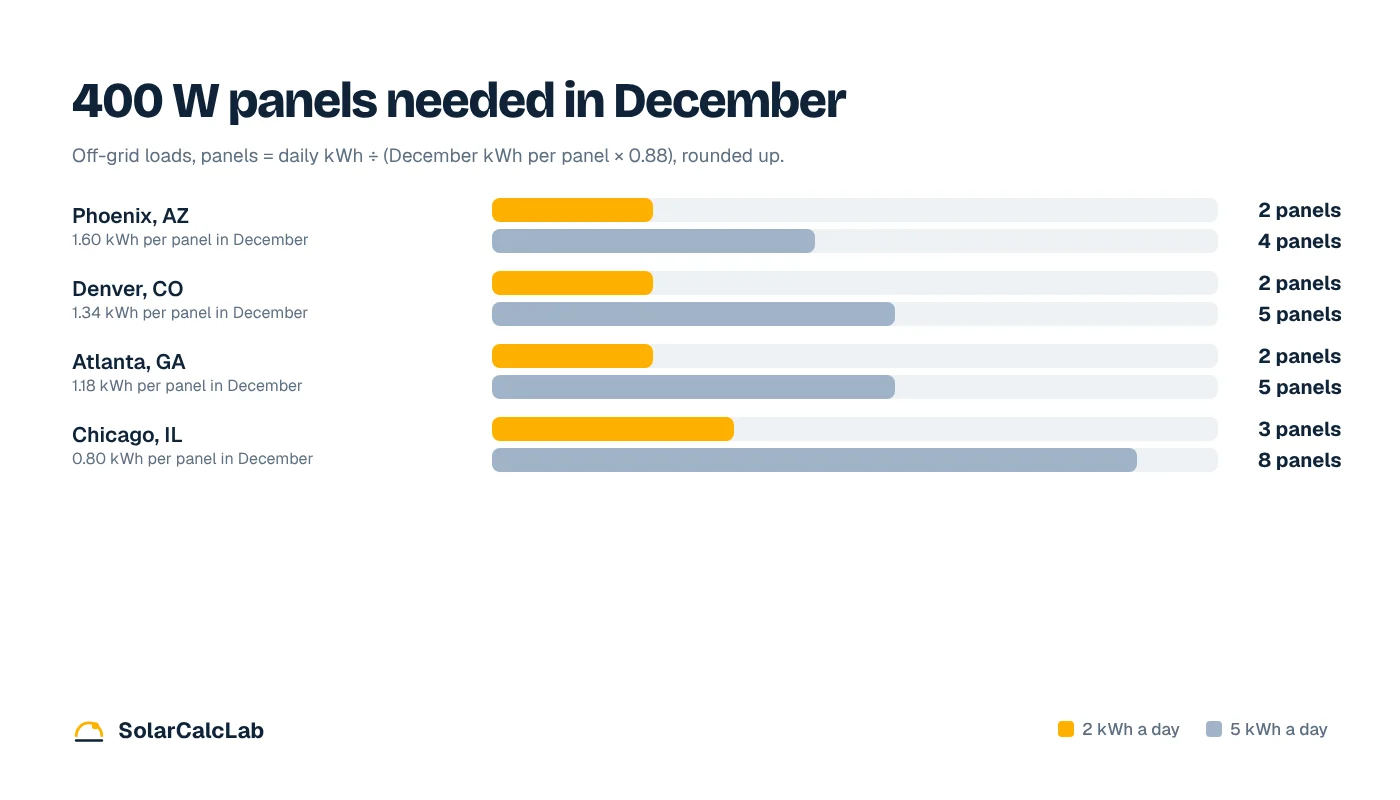
Grid-tied homes can size panels on the yearly average because the grid covers the dark months. Off-grid systems cannot, so size for December. Start from the December output of one panel and take off about 12% more for the battery round trip and the inverter.
| Daily load | Phoenix (1.60 kWh/panel in Dec) | Denver (1.34) | Atlanta (1.18) | Chicago (0.80) |
|---|---|---|---|---|
| 1 kWh | 1 | 1 | 1 | 2 |
| 2 kWh | 2 | 2 | 2 | 3 |
| 3 kWh | 3 | 3 | 3 | 5 |
| 5 kWh | 4 | 5 | 5 | 8 |
Treat any result that rounds up by less than 10% as tight. In Atlanta, 1 kWh a day uses 96% of one panel’s December capacity, which leaves nothing for a cloudy stretch. Add a panel or a generator plan in that case.
Worked example: a weekend cabin outside Denver
Say the cabin runs a 120 V fridge at 1.2 kWh a day, a 12 V water pump at 0.3 kWh, and lights, a router and a laptop at 0.5 kWh. That is 2.0 kWh a day.
- December capacity of one panel after off-grid losses: 1.34 × 0.88 = 1.18 kWh
- Panels needed: 2.0 ÷ 1.18 = 1.70, so two panels
- Two in series on a 24 V bank: about 88 V on a -4°F morning, fine for a 100 V MPPT
- Peak charging current at full rating: 800 × 0.95 ÷ 28 = 27.1 A, so pick a 30 A controller
Two panels cover it with a thin margin, and a third adds room for overcast stretches. The off-grid solar calculator sizes the battery to match, and the off-grid solar system guide walks through the rest of the build.
Using 400 W panels on a house
On a grid-tied roof the yearly figure is the one that counts. One 400 W panel makes roughly 525 kWh a year in New York and 710 kWh in Phoenix. A home using 900 kWh a month, or 10,800 kWh a year, needs about 16 panels in Phoenix and 21 in New York. The how many solar panels calculator runs the same math with your own bill and location.
If the roof is small, a larger panel does not always help. A 600 W module is about 86 by 51 inches and around 70 pounds, which is awkward on many pitched roofs. Our 600 watt solar panel guide covers where those bigger panels make sense.
Size, weight and roof space
Each panel covers about 21 square feet, and two mounted end to end take about 136 inches of roof length. That matters on a van or trailer crowded with fans and vents, where two or three 200 W panels often fit around fixtures better. For a sense of what a much smaller panel can handle, see what a 100 watt solar panel will run.
What a 400 watt panel costs
In late November 2026, US retailers list 400 W panels from about $270 to $340 each when bought in packs of two to ten. That is roughly $0.67 to $0.84 per watt. For example, Rich Solar’s MEGA 400 sells in packs of eight or more. Freight can add a lot, since these panels usually ship by truck on a pallet.
When a 400 W panel is the wrong pick
- 12 V system with a PWM controller you want to keep: a 400 W panel will deliver well under half its rating. Use 12 V nominal panels or switch to MPPT.
- Partial shade from a rack, vent or tree: several smaller panels let you work around shade.
- A controller with a low voltage limit: some small MPPT units cap PV input at 75 V, which allows only one of these panels in series.
Frequently asked questions
How many amps does a 400 watt solar panel produce?
About 11.8 to 12.9 amps at its maximum power voltage of 31 to 34 V in full sun, based on current US spec sheets. Through an MPPT controller into a 12 V battery, that becomes up to about 27 amps of charging current at full rating, and closer to 22 amps on a typical bright day.
Can I connect a 400 watt solar panel to a 12 V battery?
Yes, through an MPPT charge controller rated at least 30 A. Never wire the panel straight to the battery. A PWM controller works but wastes more than half of the panel’s output, because it holds the panel near 14 V.
Can a 400 watt solar panel charge a 100Ah battery in one day?
For a 12.8 V, 100 Ah lithium battery (1.28 kWh), yes on an average day in most of the southern and western US. In northern states in December, one panel delivers around 0.8 kWh a day, so a full recharge from empty takes about two days.
Why does my 400 watt panel only show about 300 watts?
Heat is the main reason. The 400 W rating assumes 77°F cells, and real cells run much hotter. Spec sheets that list NOCT values show about 300 W under typical outdoor conditions. Also check for shade, dirt and a PWM controller.
How many 400 watt panels can go in series on a 100 V controller?
Two. Two panels with a Voc of 37 to 39.4 V reach about 81 to 88 V on a -4°F morning. Three would pass 120 V even in mild winter weather, which needs a 150 V controller.