Best Roof Pitch for Solar Panels: Output Loss by Angle, Flat to Steep
Short answer
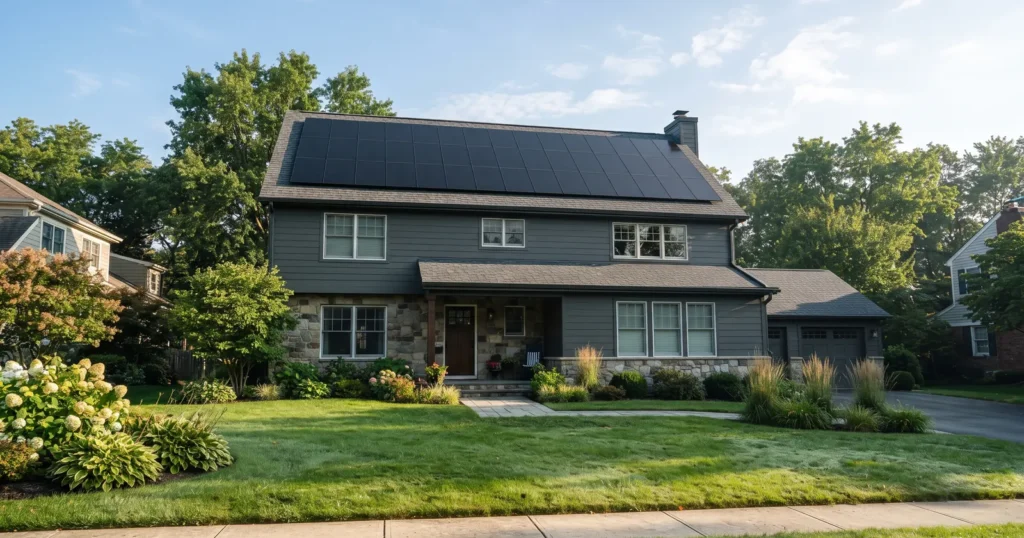
At about 40°N, the best roof pitch for solar panels is roughly 8/12 to 10/12 (34° to 40°), but almost any south-facing pitched roof is close enough. A 4/12 roof loses about 5% of yearly output, a 6/12 roof about 2%, and a 12/12 roof under 1%. Panels laid flat lose about 18% to 20%, which is why flat roofs use 5° to 15° tilt racks.
Pitched roof solar works well on far more roofs than people expect. The output curve is flat near the top, so a roof that is 10° or 15° away from the ideal angle gives up only a few percent of its yearly energy. Direction, shade and roof space usually matter more than pitch.
This guide converts common roof pitches to degrees, shows the modeled output loss at each pitch for a south-facing array near 40°N, and covers east and west roofs, flat roof solar panels, steep roofs and the cases where adding tilt is worth it.
How do you convert roof pitch to degrees?
US roofers describe pitch as rise over a 12 inch run. A 6/12 roof rises 6 inches for every 12 inches across. Solar tools, including tilt calculators and production models, use degrees from horizontal, so you need to convert.
Example: 6/12 roof: arctan(6 ÷ 12) = arctan(0.5) = 26.6°
| Roof pitch | Angle | Common name |
|---|---|---|
| Flat (0/12) | 0° | Flat roof (real flat roofs have a slight drainage slope) |
| 1/12 | 4.8° | Low slope |
| 2/12 | 9.5° | Low slope |
| 3/12 | 14.0° | Low slope |
| 4/12 | 18.4° | Low slope (upper limit) |
| 5/12 | 22.6° | Conventional |
| 6/12 | 26.6° | Conventional |
| 7/12 | 30.3° | Conventional |
| 8/12 | 33.7° | Conventional |
| 9/12 | 36.9° | Steep |
| 10/12 | 39.8° | Steep |
| 11/12 | 42.5° | Steep |
| 12/12 | 45.0° | Steep |
For fall protection rules, OSHA treats a roof with a slope of 4 in 12 or less as low slope, and anything steeper as a steep roof. That line matters for installation, as covered further down.
How much output do you lose at each roof pitch?
To put numbers on it, we modeled a south-facing array with the open-source pvlib library, using typical meteorological year (TMY) hourly weather from the EU PVGIS service for Philadelphia (39.95°N) and Denver (39.74°N). The model uses the Perez sky model for diffuse light, glass reflection losses, cell temperature effects and a ground reflectance of 0.2. It does not include shade, snow cover or dirt.
Results are shown as a share of the yearly output at the best fixed angle for each city, which came out at 37° in Philadelphia and 39° in Denver. Treat them as approximate. A different weather file or model will move each figure by a point or so, but the shape of the curve holds.
| Roof pitch | Angle | Output vs best, Philadelphia | Output vs best, Denver | Approximate loss |
|---|---|---|---|---|
| Flat | 0° | 82% | 80% | 18% to 20% |
| 1/12 | 4.8° | 87% | 85% | 13% to 15% |
| 2/12 | 9.5° | 90% | 89% | 10% to 11% |
| 3/12 | 14.0° | 93% | 92% | 7% to 8% |
| 4/12 | 18.4° | 95% | 95% | about 5% |
| 5/12 | 22.6° | 97% | 97% | about 3% |
| 6/12 | 26.6° | 99% | 98% | about 2% |
| 7/12 | 30.3° | 99% | 99% | about 1% |
| 8/12 | 33.7° | 100% | 100% | under 1% |
| 9/12 | 36.9° | 100% | 100% | none |
| 10/12 | 39.8° | 100% | 100% | none |
| 11/12 | 42.5° | 100% | 100% | under 1% |
| 12/12 | 45.0° | 99% | 100% | under 1% |
The pattern is clear. Every pitch from 6/12 to 12/12 lands within about 2% of the best angle. Losses only start to add up below about 4/12, and they climb fastest in the last few degrees toward flat.
What that means in kilowatt-hours
Using this site’s standard assumptions of 4.5 peak sun hours and 80% system efficiency, 1 kW of panels at the best angle makes about 1,314 kWh a year. For an 8 kW system, that is about 10,512 kWh.
Example: 8 kW × 4.5 × 0.80 × 365 × 0.95 (4/12 roof) = about 9,990 kWh
On a 6/12 roof the same system makes about 10,350 kWh, and on a 12/12 roof about 10,440 kWh. The gap between an average pitched roof and a perfect one is a few hundred kWh a year. Run your own numbers with the solar panel output calculator.
Does roof direction matter more than pitch?
Usually, yes. In the same model, we turned a 6/12 (26.6°) array away from due south. The results below are again shown as a share of the best south-facing output.
| Direction at 6/12 pitch | Philadelphia | Denver | Approximate loss vs best |
|---|---|---|---|
| South | 99% | 98% | about 2% |
| Southeast | 97% | 97% | about 3% |
| Southwest | 89% | 87% | 11% to 13% |
| East | 84% | 84% | about 16% |
| West | 74% | 71% | 26% to 29% |
In theory east and west faces are mirror images. In these weather files, afternoons were cloudier than mornings, so the west and southwest results came out lower. Other locations can show a smaller gap or the reverse, so read the east and west rows as a range of about 15% to 30% loss rather than a fixed rule.
Direction also changes the best pitch. On a south roof, steeper is better up to about 37° to 40° at this latitude. On east and west roofs, lower pitches did slightly better in the model, because a flatter panel catches more midday sun when it cannot face south. A 4/12 east roof lost less than a 12/12 east roof.
West panels still earn their place in some homes. If your utility pays more for late afternoon power, or you use most of your electricity in the evening, west output can be worth more per kWh. The solar panel orientation calculator estimates the loss for any compass direction.
What is the ideal solar panel tilt for your latitude?
The long-standing rule of thumb is to tilt fixed panels close to your latitude for the most yearly energy. Our model fits that rule, with one refinement: the best angle came out at or a few degrees below latitude (37° to 39° at about 40°N). Long summer days and diffuse light from cloudy skies both favor a slightly flatter panel, which pulls the yearly optimum down a little.
Seasonal targets are very different. In Philadelphia, the best fixed tilt for December to February was 62°, while June to August peaked at 14°. That is why a fixed roof array is always a compromise, and why latitude tilt is the right target for yearly totals.
Use the solar panel angle calculator to get the best yearly, winter and summer angles for your own latitude.
Are flat roof solar panels worth it?
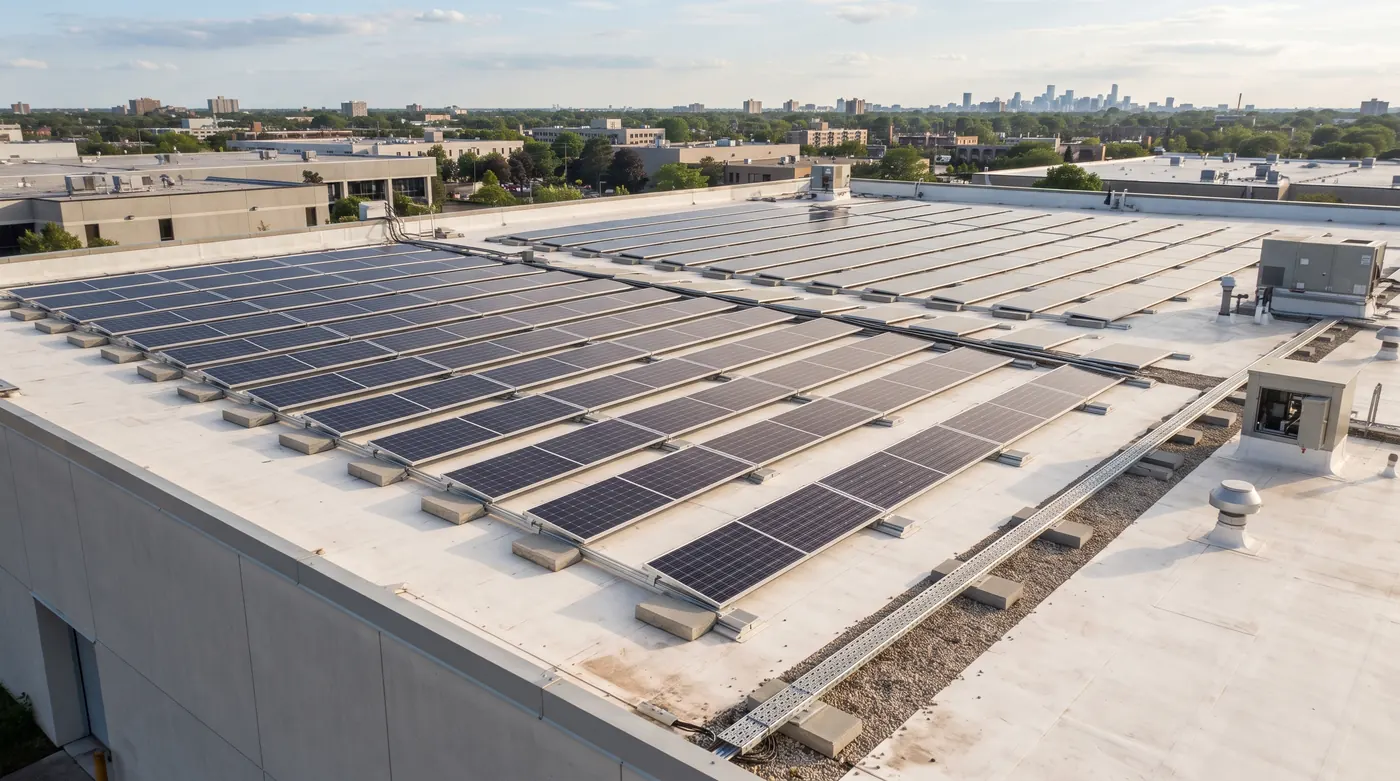
Yes, but flat roof PV panels are rarely laid completely flat. A panel at 0° loses about 18% to 20% of its yearly output at 40°N in the model, and in the darkest months the gap is far wider: flat panels in Philadelphia received about 55% of the December and January sunlight that a 37° panel received.
Tilt racks of 5° to 15°
Most flat roof systems use low racks that tilt panels between 5° and 15°. Those angles recover much of the loss while keeping wind loads and row spacing manageable.
- 5° tilt: about 87% of best output, up from 82% flat.
- 10° tilt: about 90% of best output.
- 15° tilt: about 94% of best output.
Some commercial roofs use east-west racks instead, with pairs of low panels leaning back to back. Each panel produces less, but the rows can sit almost touching, so more kilowatts fit on the same roof.
Ballast or attachment
Flat roof racks are held down by concrete ballast blocks, by roof attachments, or by a mix of both. Ballast avoids drilling through the membrane but adds dead load, so a structural check of the roof is normally required. Higher tilt catches more wind, which means more ballast or more anchors. Wind zone, roof height and the racking maker’s engineering tables decide the final design.
Self-cleaning and snow
A panel with some tilt lets rain run off and carry dust with it. A flat panel holds puddles, and dirt collects along the lower frame edge. Snow also slides off tilted panels more readily. Our model ignores dirt and snow, so real losses for truly flat panels are often larger than the table shows.
Row spacing
Tilted rows cast shadows on the row behind. A common design target is no shading between 9 a.m. and 3 p.m. on the winter solstice. At 40°N, the sun at 9 a.m. solar time on December 21 sits about 14.3° high and about 41.6° east of due south.
Row gap = height rise × cos(41.6°) ÷ tan(14.3°)
Example: 45 in deep panel at 10°: rise = 7.8 in, gap = 7.8 × 0.748 ÷ 0.255 = about 23 in
| Rack tilt | Rise, 45 in deep panel | Clear gap between rows | Rise, 68 in deep panel | Clear gap between rows |
|---|---|---|---|---|
| 5° | 3.9 in | about 11 in | 5.9 in | about 17 in |
| 10° | 7.8 in | about 23 in | 11.8 in | about 35 in |
| 15° | 11.6 in | about 34 in | 17.6 in | about 52 in |
The 45 inch depth assumes a typical 430 W panel mounted landscape, and 68 inches the same panel in portrait. Steeper racks gain output per panel but need wider gaps, so fewer panels fit. The solar panel roof area calculator helps check how many fit once setbacks and walkways are included.
Are steep roofs good for solar panels?
For output, yes. A south-facing 12/12 roof at 40°N sits almost exactly on the best yearly angle and does better than average in winter. Steep roofs also shed snow faster, so panels clear sooner after a storm.
The challenges are practical:
- Safety: above 4/12, crews need fall protection systems, roof anchors and often staging, which adds labor time.
- Snow below: snow sliding off steep panels can land on walkways, decks or gutters. Snow guards below the array help.
- Roof space: steep roofs are often cut up by dormers and valleys, leaving fewer clear rectangles for panels.
Why most pitched roofs are close enough
The output curve is broad at the top. In the model, every south-facing pitch from 5/12 to 12/12 produced at least 96% of the best yearly energy.
So on a pitched roof, panels are almost always mounted flush, parallel to the shingles. Flush mounts are cheaper, catch less wind and look better. Spending money on tilt brackets to gain 2% or 3% rarely pays back.
When should you add tilt?
- Flat or near-flat roofs: below about 2/12, a 10° to 15° rack recovers roughly 4 to 11 percentage points of output and helps with rain cleaning.
- Off-grid systems sized for winter: if the darkest month sets your system size, a steep ground mount near latitude plus 15° or more can shrink the array and battery you need.
- Heavy snow areas: steeper panels clear faster, which can matter more than the yearly modeled loss.
- Ground mounts: with no roof to follow, setting the tilt near latitude costs little extra.
Before you commit, compare both options with your own sun hours using the solar calculator or NREL’s PVWatts calculator, which lets you enter any tilt and direction for your address.
Frequently asked questions
What is the best roof pitch for solar panels?
For a south-facing roof near 40°N, about 8/12 to 10/12 (34° to 40°) gives the most yearly output. In practice, any pitch from 5/12 to 12/12 gets at least 96% of the best figure in our model, so a normal pitched roof is close enough and panels can be mounted flush.
How much output do solar panels lose on a 4/12 roof?
About 5% of yearly output compared with the best angle, for a south-facing array near 40°N. A 4/12 roof is 18.4°, which is low but still well inside the broad top of the output curve. An 8 kW system would make roughly 500 kWh less a year than at the ideal tilt.
Can you put solar panels flat on a flat roof?
You can, but flat panels lose about 18% to 20% of yearly output at 40°N and much more in winter. They also collect dirt and hold snow. Most flat roof installs use racks that tilt panels 5° to 15°, held down by ballast, roof attachments or both.
Are east and west facing roofs good for solar?
They work, but expect about 15% to 30% less yearly energy than the best south-facing angle at mid-US latitudes, depending on local weather. Lower pitches suit east and west roofs better than steep ones. West panels can still be valuable where evening power is worth more.
Is a 12/12 roof too steep for solar panels?
Not for output. A south-facing 12/12 roof is 45°, within about 1% of the best yearly angle at 40°N, and it sheds snow quickly. It is harder and slower to work on, so installation can cost more, and some installers set a maximum pitch they will cover.


