12 Gauge Wire Amp Rating: How Many Amps Can 12 AWG Carry?

Short answer
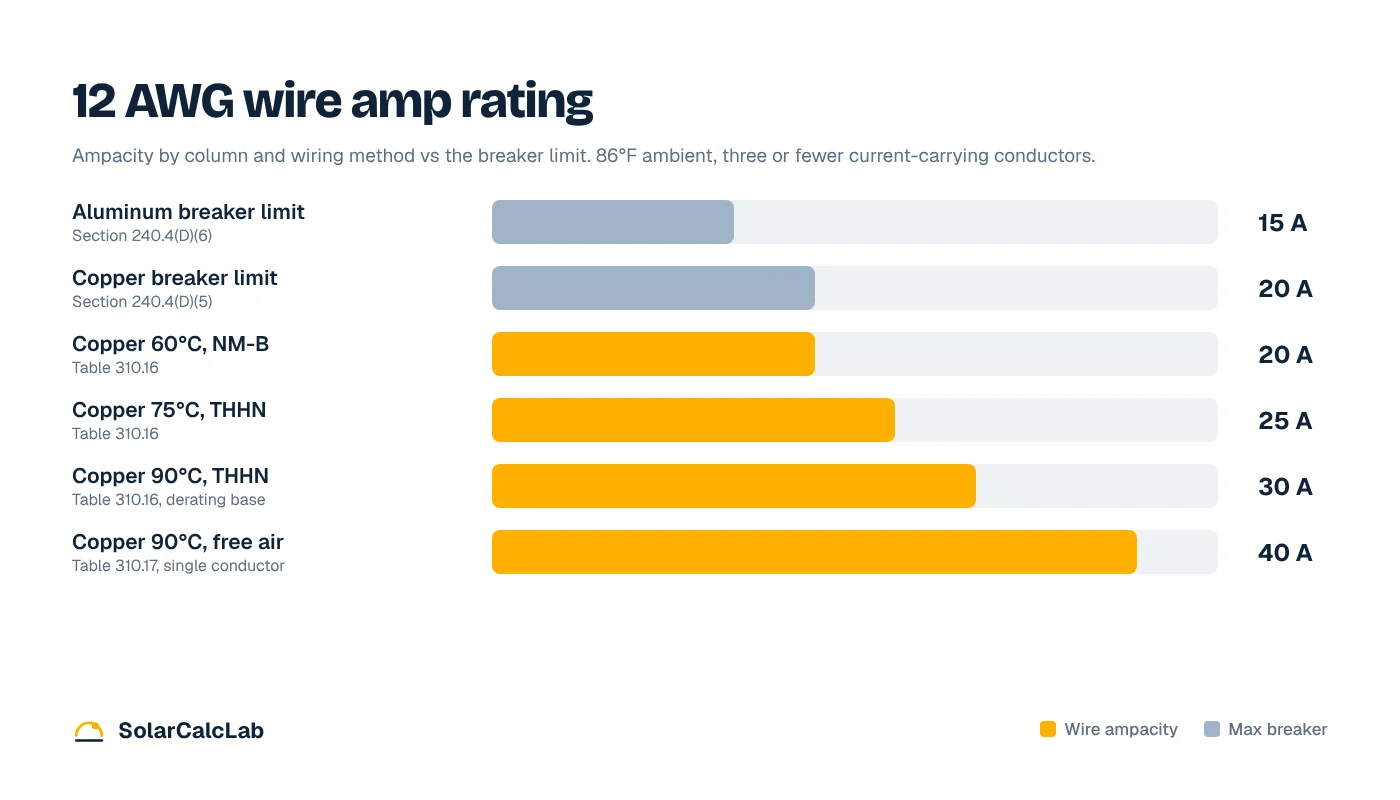
Under NEC Table 310.16, 12 AWG copper wire is rated 20 amps at 60°C, 25 amps at 75°C and 30 amps at 90°C. Section 240.4(D) still caps the breaker at 20 amps for most circuits, so in a house 12 gauge copper is a 20 amp wire. That works out to 2,400 watts at 120 V, or 1,920 watts for a continuous load. 12 AWG aluminum is limited to a 15 amp breaker.
Twelve gauge is the workhorse of US homes. It feeds kitchens, bathrooms, laundry rooms and garages. Yet the 12 gauge wire amp rating looks confusing at first, because charts list three different numbers for the same copper conductor, and none is the number you use to pick a breaker.
This guide explains why 12 AWG carries 20, 25 or 30 amps on paper, why the breaker almost always stops at 20, how many watts that gives you, and how far you can run it before voltage drop matters. Values come from Tables 310.16 and 310.17 and Section 240.4 of NFPA 70, the National Electrical Code.
12 AWG wire ampacity chart
Ampacity is the current a conductor can carry continuously without going over its insulation temperature rating. The first two rows assume no more than three current-carrying conductors in a raceway or cable and an ambient temperature of 86°F (30°C). The free air rows apply to single conductors not in a raceway, such as PV wire running under a solar array.
| 12 AWG conductor | 60°C (140°F) | 75°C (167°F) | 90°C (194°F) |
|---|---|---|---|
| Copper, raceway or cable (310.16) | 20 A | 25 A | 30 A |
| Aluminum, raceway or cable (310.16) | 15 A | 20 A | 25 A |
| Copper, single conductor in free air (310.17) | 30 A | 35 A | 40 A |
| Aluminum, single conductor in free air (310.17) | 25 A | 30 A | 35 A |
| Maximum breaker, Section 240.4(D) | 20 A copper, 15 A aluminum | ||
Solid and stranded 12 AWG share the same rating. The copper figures match the tables wire makers publish, such as the Cerrowire ampacity chart.
Why 12 gauge wire is a 20 amp wire
If 12 AWG THHN is rated 30 amps at 90°C, why can’t you put it on a 30 amp breaker? Because the NEC has a separate rule for small conductors. Section 240.4(D)(5) says that, unless a specific exception applies, the overcurrent protection for 12 AWG copper must not exceed 20 amps. Section 240.4(D)(6) sets the limit for 12 AWG aluminum and copper-clad aluminum at 15 amps.
The higher table values still matter as the starting point for derating, covered below.
The common cases work out like this:
- 12/2 or 12/3 NM-B (Romex): Section 334.80 limits NM cable to the 60°C column, which is exactly 20 amps. It goes on a 20 amp breaker.
- 12 AWG THHN or THWN-2 in conduit: rated 25 amps at 75°C, but still protected at 20 amps. The extra headroom lets it survive derating.
- 12 AWG aluminum: rare in new homes, and limited to a 15 amp breaker.
When 12 AWG can go on a bigger breaker
Section 240.4(G) lists equipment where the small conductor limit does not apply, because the equipment has its own overload protection. The main ones are motor circuits under Article 430 and air conditioning and refrigeration equipment under Article 440. A condenser whose nameplate says “Minimum circuit ampacity 18 A, Maximum overcurrent protection 30 A” can legally be wired with 12 AWG copper on a 30 amp breaker, because the wire only has to meet the 18 A minimum.
For ordinary receptacle and lighting circuits, the answer stays the same: 12 gauge copper means a 20 amp breaker or smaller. For larger loads, see what size wire a 40 amp breaker needs or the 6 AWG wire amp rating guide.
How many watts can 12 gauge wire handle?
Watts equal volts times amps. Use the breaker size, not the table ampacity, and apply the 80% guideline for loads that run three hours or more.
120 V, 20 A breaker: 120 × 20 = 2,400 W maximum, 120 × 16 = 1,920 W continuous
240 V, 20 A breaker: 240 × 20 = 4,800 W maximum, 240 × 16 = 3,840 W continuous
| Circuit | Breaker | Maximum load | Continuous load (80%) |
|---|---|---|---|
| 120 V, 12 AWG copper | 20 A | 2,400 W | 1,920 W |
| 240 V, 12 AWG copper | 20 A | 4,800 W | 3,840 W |
| 120 V, 12 AWG aluminum | 15 A | 1,800 W | 1,440 W |
A 1,500 W space heater draws 12.5 A at 120 V, so it fits. Two on one circuit draw 25 A and trip the breaker. Convert your own appliance ratings with the watts to amps calculator or go the other way with the amps to watts calculator.
Where the NEC requires 12 gauge, 20 amp circuits
Section 210.11(C) requires dedicated 20 amp branch circuits in several places in a dwelling, and 12 AWG copper is the standard wire for each:
- Kitchen countertops and dining areas: at least two 20 amp small appliance circuits.
- Laundry: at least one 20 amp circuit for the laundry receptacles.
- Bathrooms: at least one 20 amp circuit for the bathroom receptacles.
- Garages: since the 2020 NEC, at least one 20 amp circuit for the garage receptacles in an attached garage, or a detached garage with power.
Many electricians run 12 AWG for every general receptacle circuit too. Check which code edition your jurisdiction has adopted.
Derating 12 AWG for heat and crowded conduit
Table values assume 86°F and three or fewer current-carrying conductors. When you bundle more wires or run through a hot attic, Section 310.15 reduces the allowed ampacity. For THHN you start from the 90°C value of 30 amps.
| Condition (12 AWG copper THHN, 90°C base 30 A) | Factor | Adjusted ampacity | 20 A breaker OK? |
|---|---|---|---|
| 4 to 6 current-carrying conductors in one conduit | 0.80 | 24 A | Yes |
| 7 to 9 current-carrying conductors | 0.70 | 21 A | Yes |
| Ambient 97°F to 104°F (36°C to 40°C) | 0.91 | 27.3 A | Yes |
| Ambient 115°F to 122°F (46°C to 50°C) | 0.82 | 24.6 A | Yes |
| 106°F to 113°F and 4 to 6 conductors | 0.87 × 0.80 | 20.9 A | Yes, just |
Example: 30 A × 0.87 × 0.80 = 20.9 A, which still covers a 20 A breaker
With 10 or more current-carrying conductors (factor 0.50), 12 AWG THHN drops to 15 A and needs a 15 amp breaker or a larger wire.
Voltage drop: how far can you run 12 gauge wire?
Ampacity protects the wire from overheating. It does not account for the voltage lost on a long run. The NEC suggests, in an informational note, keeping branch circuit voltage drop to about 3%. Using the resistance of solid uncoated 12 AWG copper from NEC Chapter 9, Table 8 (1.93 ohms per 1,000 feet), a 120 V circuit looks like this:
| One-way distance | 12 A load | 16 A load | 20 A load |
|---|---|---|---|
| 25 ft | 1.2 V (1.0%) | 1.5 V (1.3%) | 1.9 V (1.6%) |
| 50 ft | 2.3 V (1.9%) | 3.1 V (2.6%) | 3.9 V (3.2%) |
| 75 ft | 3.5 V (2.9%) | 4.6 V (3.9%) | 5.8 V (4.8%) |
| 100 ft | 4.6 V (3.9%) | 6.2 V (5.1%) | 7.7 V (6.4%) |
Example: 2 × 50 ft × 16 A × 0.00193 Ω/ft = 3.1 V, or 2.6% of 120 V
At 120 V, 12 AWG copper stays under 3% up to about 58 feet at a 16 A continuous load and about 47 feet at a full 20 A. At 240 V the distances double, to about 117 and 93 feet. For a long run to a shed or a detached garage, step up to 10 AWG. Enter your own numbers in the voltage drop calculator, or let the wire size calculator choose a gauge for ampacity and drop together.
12 AWG wire in solar and 12 V DC systems
In a low-voltage DC system, voltage drop limits 12 gauge long before ampacity does. A 15 A load running 10 feet one way from a 12 V battery on 12 AWG copper loses 2 × 10 × 15 × 0.00193 = 0.58 V. That is 4.8% of 12 V, well above the 2% to 3% most installers target. At 5 feet it falls to 0.29 V, or 2.4%.
On the PV side, 12 AWG PV wire is common for module jumpers and home runs on smaller arrays. Section 690.8 sizes PV source circuits at 125% of the module’s short circuit current, then applies another 125% for continuous duty. A panel with an 11.5 A short circuit current gives 11.5 × 1.25 × 1.25 = 18.0 A, which 12 AWG PV wire in free air (40 A at 90°C) covers easily, even after rooftop temperature correction. The solar cable size calculator applies those factors and voltage drop in one step.
Installation tips for 12 gauge circuits
- Do not mix 14 AWG into a 20 amp circuit. One short 14 gauge pigtail or extension in a 20 amp run makes the whole circuit noncompliant.
- Use 20 amp rated devices where needed. A single receptacle on a 20 amp individual branch circuit must be rated 20 amps. Duplex 15 amp receptacles are allowed on 20 amp circuits with more than one outlet.
- Pull a permit for new circuits, and hire a licensed electrician if any step is unclear.
Frequently asked questions
How many amps can 12 gauge wire handle?
12 AWG copper is rated 20 amps at 60°C, 25 amps at 75°C and 30 amps at 90°C under NEC Table 310.16. Section 240.4(D) limits the breaker to 20 amps for general circuits, so in practice 12 gauge copper is a 20 amp wire.
Can 12 gauge wire handle 30 amps?
Not on a normal branch circuit. Even though 12 AWG THHN has a 30 amp rating at 90°C, the NEC caps its breaker at 20 amps. The only exceptions are listed equipment such as air conditioners and motors, where the nameplate maximum overcurrent protection may allow a larger breaker.
Can I use 12 gauge wire on a 15 amp breaker?
Yes. A wire can always be protected by a smaller breaker than its rating. 12 AWG on a 15 amp breaker is common on long runs where the thicker wire reduces voltage drop. The circuit is then a 15 amp circuit and must be treated as one.
How many watts can 12 gauge wire carry at 120 volts?
On a 20 amp breaker, 12 gauge copper carries up to 2,400 watts at 120 V. For a continuous load lasting three hours or more, keep it at 80%, which is 1,920 watts. On a 240 V circuit the limits are 4,800 and 3,840 watts.
What is the amp rating of 12/2 Romex?
12/2 NM-B (Romex) is rated 20 amps. Section 334.80 holds NM cable to the 60°C column of Table 310.16, which is 20 amps for 12 AWG copper, and that matches the 20 amp breaker limit in Section 240.4(D).


