4 Gauge Wire Amp Rating: How Many Amps Can 4 AWG Carry?

Short answer
Under NEC Table 310.16, 4 AWG copper wire is rated 70 amps at 60°C, 85 amps at 75°C and 95 amps at 90°C. In a home, 4/2 or 4/3 NM-B (Romex) is limited to the 60°C column, so it is a 70 amp cable on a 70 amp breaker. 4 AWG THHN copper in conduit with 75°C terminals carries 85 amps and normally goes on an 80 amp breaker. 4 AWG aluminum is rated 65 amps at 75°C.
Four gauge is the size where house wiring turns into feeder wiring. It feeds 60 and 70 amp subpanels, 60 amp EV circuits, tankless heaters, welders and, under the dwelling service rule, a whole 100 amp service. It is also a common 12 V inverter cable. The 4 gauge wire amp rating you can actually use depends on the cable type, the terminals at each end and where the wire runs.
Below is the full 4 AWG ampacity chart, the breaker sizes it protects, derating, voltage drop and DC use. Values come from Tables 310.16 and 310.17 in NFPA 70, the National Electrical Code.
4 AWG wire ampacity chart
Ampacity is the current a conductor carries continuously without exceeding its temperature rating. The raceway rows assume no more than three current-carrying conductors and an ambient temperature of 86°F (30°C). The free air rows apply to single conductors not in a raceway, such as PV wire on a rack or battery cables in open air.
| 4 AWG conductor | 60°C (140°F) | 75°C (167°F) | 90°C (194°F) |
|---|---|---|---|
| Copper, raceway or cable (310.16) | 70 A | 85 A | 95 A |
| Aluminum, raceway or cable (310.16) | 55 A | 65 A | 75 A |
| Copper, single conductor in free air (310.17) | 105 A | 125 A | 140 A |
| Aluminum, single conductor in free air (310.17) | 80 A | 100 A | 110 A |
The copper raceway figures match wire makers’ published tables, including the Cerrowire ampacity chart. Solid and stranded 4 AWG share the same rating.
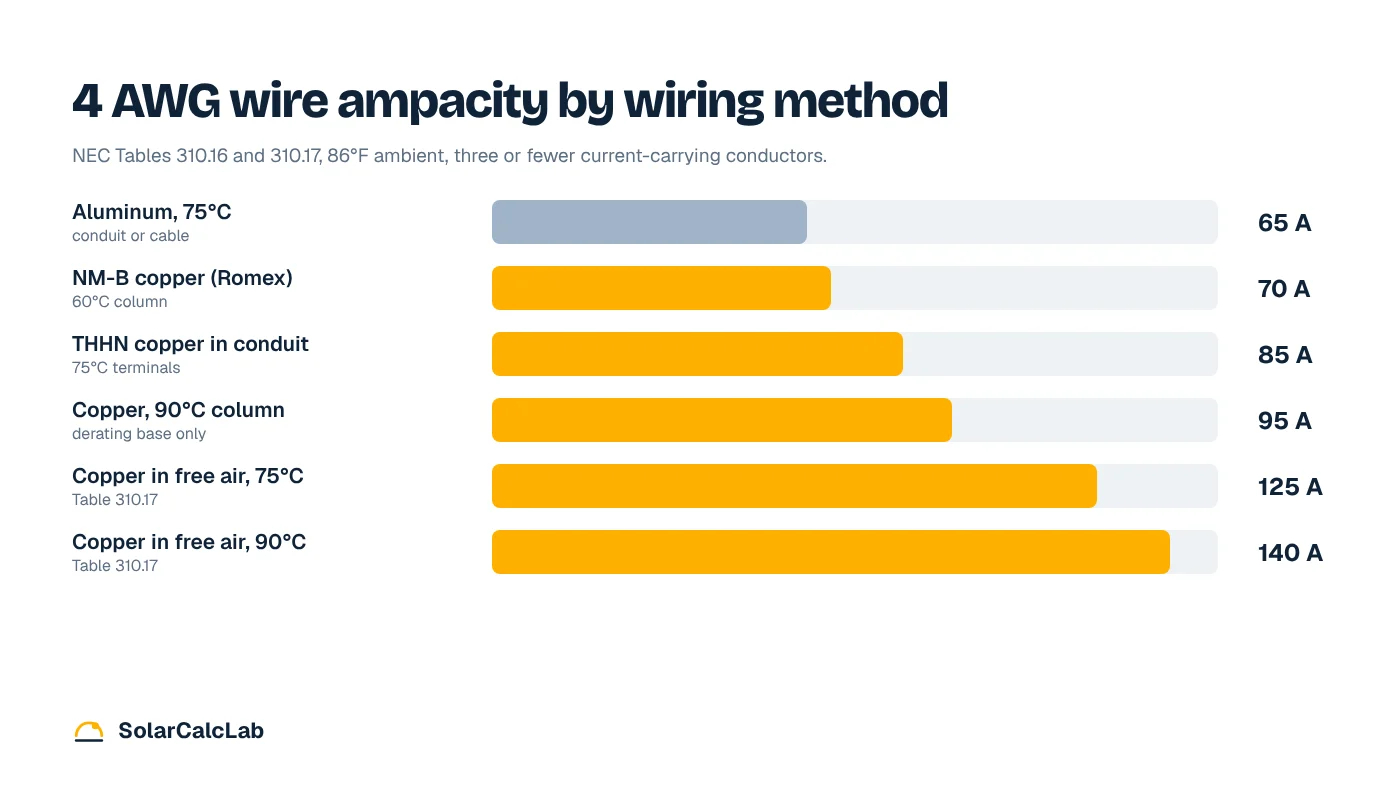
Which 4 AWG rating applies to you?
A circuit is limited by its weakest part: insulation, cable type or lugs.
- 4/2 or 4/3 NM-B (Romex): Section 334.80 limits NM cable to the 60°C ampacity, so it is a 70 amp cable even though the conductors inside carry 90°C insulation. UF-B follows the same 60°C limit.
- 4 AWG THHN or THWN-2 copper in conduit: Section 110.14(C) allows the 75°C column when both the breaker and the equipment lugs are marked 75°C, which almost all modern gear is. That makes it an 85 amp conductor.
- The 90°C value of 95 amps is only a starting point for derating. You can apply correction factors to 95 A, but the final number can never exceed the 85 A termination limit.
- 4 AWG aluminum is a 65 amp conductor at 75°C, about the same as 6 AWG copper. The full aluminum wire ampacity chart covers the larger sizes used for feeders.
What breaker size goes with 4 gauge wire?
Section 240.4 requires the breaker to protect the conductor at its ampacity. Section 240.4(B) lets you round up to the next standard breaker size when the ampacity falls between sizes, the breaker is 800 A or less and the circuit does not feed multiple receptacles for cord-and-plug loads.
| Wire type | Ampacity | Usual breaker | Typical loads |
|---|---|---|---|
| 4/2 or 4/3 NM-B copper | 70 A | 70 A | 60 A subpanel, 48 A EV charger, tankless heater |
| 4 AWG THHN copper, 75°C terminals | 85 A | 80 A (90 A under 240.4(B)) | 80 A subpanel, large welder, heat strips |
| 4 AWG aluminum, 75°C terminals | 65 A | 60 A (70 A under 240.4(B)) | 60 A feeder to a shed or garage |
Section 310.12 adds one special case. For the main service or main feeder that carries the entire load of a single-family dwelling, Table 310.12 allows 4 AWG copper or 2 AWG aluminum for a 100 amp service. That rule does not apply to subpanels or branch circuits, so do not use it to put 4 AWG on a 100 amp breaker feeding a garage. For comparison, 6 AWG copper is rated 55, 65 and 75 amps; see the 6 AWG wire amp rating guide for the next size down.
How many watts can 4 AWG wire carry?
Power equals volts times amps, so the wattage limit depends on circuit voltage. The 80% guideline for continuous loads keeps you inside the breaker rating.
4/3 NM-B on a 70 A breaker at 240 V: 240 × 70 = 16,800 W maximum, 240 × 56 = 13,440 W continuous
4 THHN on an 80 A breaker at 240 V: 240 × 80 = 19,200 W maximum, 240 × 64 = 15,360 W continuous
At the raw table ampacity, 4 AWG copper carries 16,800 W at 70 A, 20,400 W at 85 A and 22,800 W at 95 A on a 240 V circuit. Check your loads with the amps to watts calculator.
Worked example: 4 gauge wire for a 60 amp EV circuit
EV charging counts as a continuous load, so Section 625.41 requires the circuit to be sized at 125% of the charger’s output.
48 A charger: 48 × 1.25 = 60 A, so a 60 A breaker
6/3 NM-B (55 A) is too small; 4/3 NM-B (70 A) works
A 48 A charger at 240 V delivers 11.5 kW, roughly 30 to 45 miles of range per hour for most cars. An 80 A charger needs a 100 A circuit, which is beyond 4 AWG copper in any wiring method (85 A, rounded up to 90 A at most). Estimate the charge time for your battery with the EV charging time calculator.
Derating 4 AWG for heat and crowded conduit
A hot attic, a sunny rooftop or a packed conduit lowers the allowed current. For THHN you start from the 90°C column and apply the factors in Section 310.15.
| Condition (4 AWG copper THHN, 90°C base 95 A) | Factor | Adjusted ampacity |
|---|---|---|
| 4 to 6 current-carrying conductors in one conduit | 0.80 | 76 A |
| 7 to 9 current-carrying conductors | 0.70 | 66.5 A |
| Ambient 97°F to 104°F (36°C to 40°C) | 0.91 | 86.45 A, capped at 85 A |
| Ambient 106°F to 113°F (41°C to 45°C) | 0.87 | 82.65 A |
| 106°F to 113°F and 4 to 6 conductors | 0.87 × 0.80 | 66.1 A |
At 76 A with six conductors in one conduit, 4 AWG THHN can no longer sit on an 80 A breaker. Split the conduit or step up to 3 AWG.
Voltage drop on long 4 gauge runs
Ampacity ignores voltage lost over distance. An NEC informational note suggests keeping branch circuit drop to about 3%. Using the resistance of uncoated stranded 4 AWG copper from NEC Chapter 9, Table 8 (0.308 ohms per 1,000 feet), a 240 V circuit looks like this:
| One-way distance | 50 A load | 60 A load | 70 A load |
|---|---|---|---|
| 50 ft | 1.5 V (0.6%) | 1.8 V (0.8%) | 2.2 V (0.9%) |
| 100 ft | 3.1 V (1.3%) | 3.7 V (1.5%) | 4.3 V (1.8%) |
| 150 ft | 4.6 V (1.9%) | 5.5 V (2.3%) | 6.5 V (2.7%) |
| 200 ft | 6.2 V (2.6%) | 7.4 V (3.1%) | 8.6 V (3.6%) |
| 250 ft | 7.7 V (3.2%) | 9.2 V (3.9%) | 10.8 V (4.5%) |
Example: 2 × 150 ft × 60 A × 0.000308 Ω/ft = 5.5 V, or 2.3% of 240 V
At 240 V, 4 AWG copper stays under 3% up to about 234 feet at 50 A, 195 feet at 60 A and 167 feet at 70 A. On 120 V the distances are half as long. Run your own numbers in the voltage drop calculator, or let the wire size calculator pick a gauge for both ampacity and drop.
4 gauge wire for 12 V inverters and battery banks
In low-voltage DC systems, 4 AWG is usually chosen for current and kept very short. A 1,000 W inverter on a 12 V battery at 90% efficiency draws about 1,000 ÷ (12 × 0.90) = 93 A. That is inside the 125 A free air rating of 4 AWG copper at 75°C, but voltage drop limits the length:
- 5 ft cable run (10 ft round trip): 0.29 V, or 2.4% of 12 V. Acceptable.
- 10 ft cable run: 0.57 V, or 4.8%. The inverter may trip on low voltage under surge.
- 2,000 W inverter, 185 A: already above the free air rating, so move to 2 AWG or 1/0.
The same 4 AWG cable carrying 60 A from a charge controller over 20 feet loses 0.74 V. That is 6.2% at 12 V but only 1.5% at 48 V. If you are building a bank, see how batteries in series vs parallel change the system voltage, then size the inverter with the inverter size calculator. For PV circuits, Section 690.8 applies its own 125% factors; the solar cable size calculator handles those.
Installation tips for 4 gauge circuits
- Check the terminal marking. Use the 75°C column only when both ends are marked 75°C. Older or unmarked equipment drops 4 AWG copper to 70 A.
- Torque every lug to the value printed on the breaker or panel. Section 110.14(D) requires a calibrated torque tool where a value is marked.
- Use AL-rated lugs for aluminum and keep NM-B out of wet locations.
- Pull a permit. Feeders and 60 amp or larger circuits are permit work in most US jurisdictions. Hire a licensed electrician if unsure.
Frequently asked questions
How many amps can 4 gauge wire carry?
4 AWG copper is rated 70 amps at 60°C, 85 amps at 75°C and 95 amps at 90°C under NEC Table 310.16. In practice, 4 gauge NM-B cable is a 70 amp cable and 4 AWG THHN in conduit with 75°C terminals is an 85 amp conductor.
Can I use 4 gauge wire on a 100 amp breaker?
Only for the main service or main feeder of a single-family dwelling, where NEC Table 310.12 allows 4 AWG copper for 100 amps. Elsewhere it is an 85 amp conductor, so 90 amps is the largest breaker under Section 240.4(B). Use 3 AWG copper or 1 AWG aluminum for a 100 amp subpanel.
Is 4/3 Romex good for 70 amps?
Yes. 4/3 NM-B is rated 70 amps at the 60°C column, so it can be protected by a 70 amp breaker. For a continuous load such as an EV charger, the load itself must stay at or below 56 amps on that circuit.
How many amps can 4 AWG aluminum wire carry?
4 AWG aluminum is rated 55 amps at 60°C, 65 amps at 75°C and 75 amps at 90°C. With 75°C terminals listed for aluminum it is used as a 65 amp conductor, which is about what 6 AWG copper carries.
How far can I run 4 gauge wire?
On a 240 V circuit, 4 AWG copper keeps voltage drop under 3% up to about 234 feet at 50 amps, 195 feet at 60 amps and 167 feet at 70 amps. On a 120 V circuit the distances are half as long.


