Inverter Clipping: What It Is and How Much Energy You Really Lose
Short answer
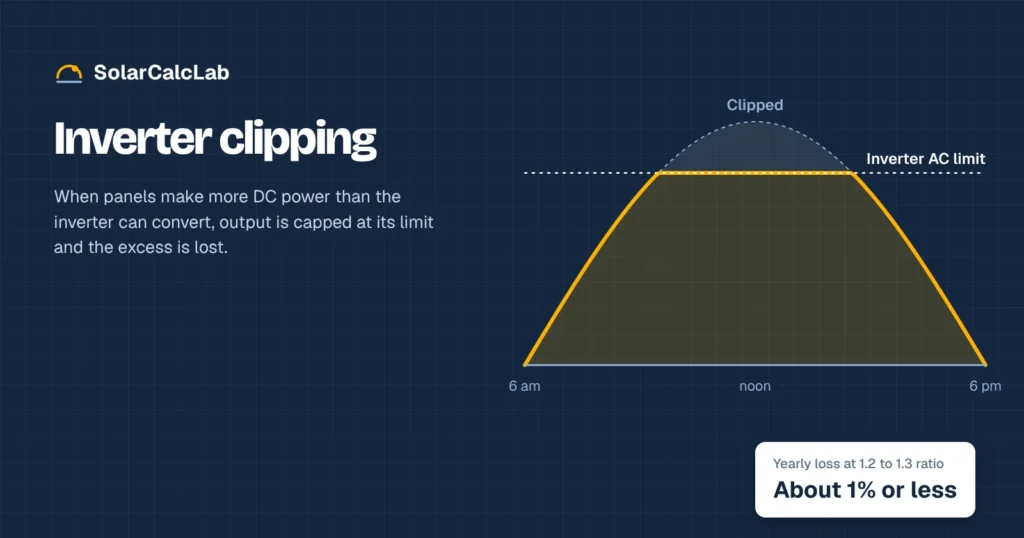
Inverter clipping happens when your solar panels can produce more DC power than the inverter is rated to convert to AC, so the inverter caps its output at its limit and the extra is lost. With a DC to AC ratio of 1.2 to 1.3, clipping usually costs about 1% of yearly energy or less, while the larger array adds far more energy than it loses.
If your solar app shows the production curve going flat across the middle of a clear spring day, you are looking at inverter clipping. It looks like a problem, but in most systems it is a deliberate design choice, not a fault.
Below: why clipping happens, how to work out your DC to AC ratio, how much energy you lose at common ratios, and when it is worth fixing.
What is inverter clipping?
Solar panels produce direct current (DC). Your home and the grid use alternating current (AC). The inverter converts one to the other, and every inverter has a maximum continuous AC output, for example 6.0 kW for a 6 kW string inverter or roughly 290 W for a common residential microinverter.
When sunlight is strong enough that the array could deliver more than that limit, the inverter does not fail or shut down. It moves the panels away from their maximum power point, which raises the string voltage and lowers the current, until the DC input matches what it can convert. Output holds steady at the rated value. Any power above the line is “clipped,” which is where the name comes from: the top of the bell-shaped daily curve is shaved off.
Installers also call this solar clipping, inverter saturation or power limiting. It is the same thing in every case.
Why installers oversize the array on purpose
Panel ratings are measured at Standard Test Conditions (STC): 1,000 W/m² of sunlight and a cell temperature of 25°C (77°F). On a real roof, panels almost never see those conditions together. Cells in the sun usually run 20 to 35°C hotter than the air, and every degree above 25°C cuts output. A panel with a temperature coefficient of -0.35% per °C running at 55°C loses about 10.5% of its rated power from heat alone.
Add wiring losses, soil, mismatch and panel aging, and an array typically delivers 80 to 90% of its nameplate DC rating even at the brightest moment of the day. You can estimate the heat loss for your own panels with the solar panel temperature loss calculator.
With an equal-sized array, the inverter would sit partly idle all year. A slightly larger array fills that headroom, adds energy in the morning, evening and on cloudy days, and only clips when conditions are close to ideal. The U.S. Energy Information Administration notes that inverter loading ratios for individual systems are usually between 1.13 and 1.30.
How to calculate your DC to AC ratio
The DC to AC ratio, also called the inverter loading ratio (ILR), compares the array’s STC rating with the inverter’s AC rating.
Example: 20 panels × 400 W = 8.0 kW DC; 8.0 kW ÷ 6.0 kW inverter = 1.33
For microinverters, run the same math per panel. A 400 W panel on a microinverter rated for 290 W of continuous AC output has a ratio of 400 ÷ 290 = 1.38. The inverter size calculator does this for any array and suggests an inverter size that keeps the ratio in a sensible range.
| DC to AC ratio | What it means | Typical clipping |
|---|---|---|
| 1.00 to 1.10 | Inverter is as large as the array or larger | Almost none |
| 1.15 to 1.30 | Common residential range | Under about 1% of yearly energy |
| 1.30 to 1.40 | Aggressive, common where sun is strong | About 1 to 3% |
| 1.50 and above | Heavy oversizing, used in some utility and battery designs | About 5% or more |
The exact percentage depends on climate, tilt, orientation and panel temperature. A west-facing array peaks lower than a south-facing one, so it clips less at the same ratio.
How much energy does clipping actually lose?
A widely cited simulation published by Aurora Solar modeled a 100 kW inverter on a south-facing, 20° tilt ground mount in North Carolina with three array sizes. The results show why moderate oversizing pays off.
| DC to AC ratio | Yearly AC output | Lost to clipping | Output vs 1.0 ratio |
|---|---|---|---|
| 1.0 | 163.06 MWh | 0 MWh (0%) | Baseline |
| 1.3 | 193.86 MWh | 1.8 MWh (0.9%) | +18.9% |
| 1.5 | 217.24 MWh | 11.0 MWh (4.8%) | +33.2% |
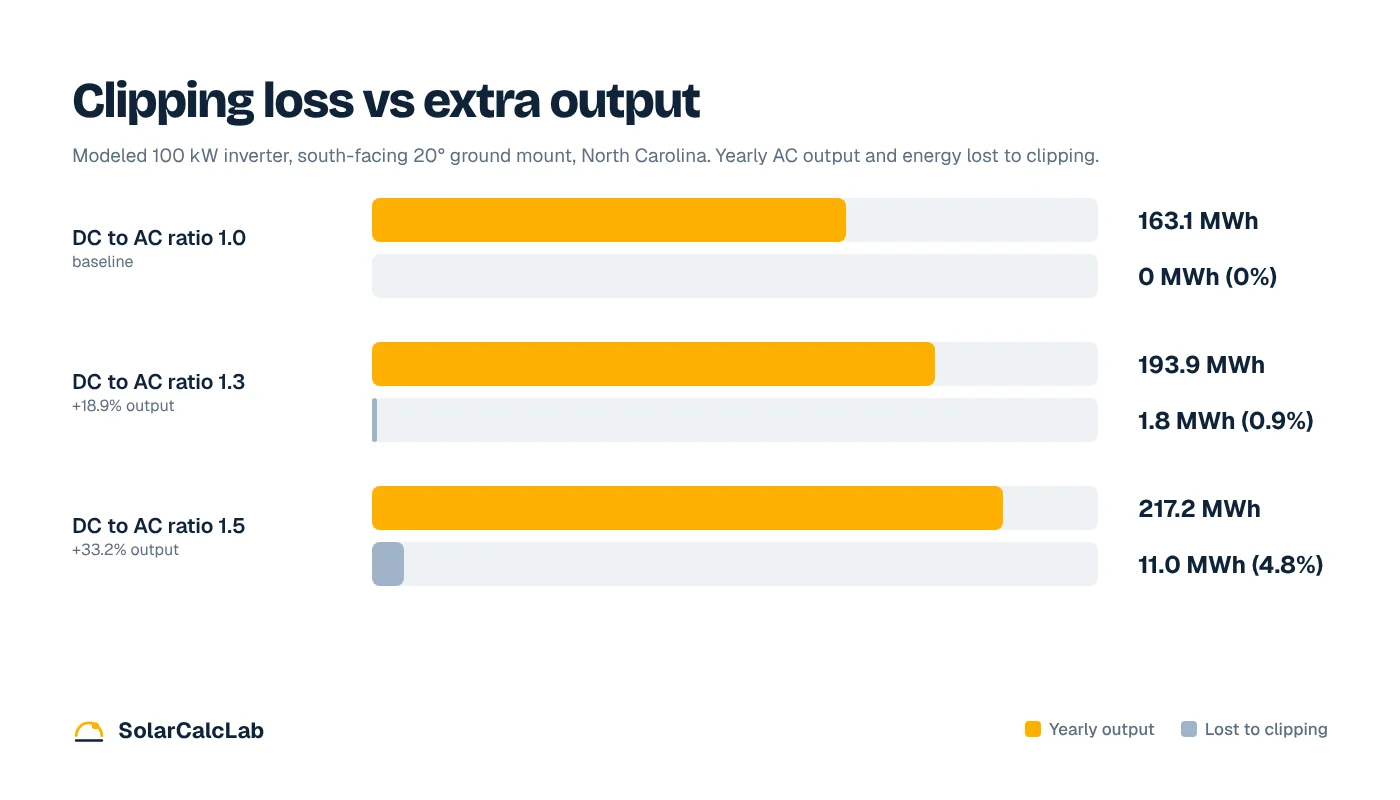
At a 1.3 ratio the system lost 1.8 MWh to clipping but produced 30.8 MWh more than the 1.0 design. Even at 1.5, where clipping reached 4.8%, the extra panels still delivered 54.2 MWh more per year. The real question is not whether you clip, but whether the extra panels cost less than the energy they add.
Worked example: a 7.8 kW array on a 6 kW inverter
Take 7.8 kW of panels on a 6.0 kW string inverter, a DC to AC ratio of 1.30. On a cool, clear day at solar noon, assume the array delivers 88% of its nameplate after heat and wiring losses, and the inverter converts at 96%.
Clipped power = 6.59 kW − 6.00 kW = 0.59 kW at the peak
Only the top 0.59 kW is cut, and only around midday. The same assumptions over a full clear day give these results for a 6 kW inverter:
| Array size | DC to AC ratio | Peak AC available | Clipped on a clear day | Hours at the limit |
|---|---|---|---|---|
| 6.6 kW | 1.10 | 5.58 kW | 0 kWh (0%) | 0 |
| 7.2 kW | 1.20 | 6.08 kW | 0.07 kWh (0.2%) | 1.3 |
| 7.8 kW | 1.30 | 6.59 kW | 1.28 kWh (2.5%) | 3.3 |
| 8.4 kW | 1.40 | 7.10 kW | 3.13 kWh (5.8%) | 4.3 |
| 9.0 kW | 1.50 | 7.60 kW | 5.36 kWh (9.2%) | 5.1 |
These are best-day numbers. Hazy, hot and winter days stay under the limit and clip nothing, which is why the yearly loss at a 1.3 ratio ends up near 1% even though a perfect day can lose 2 to 3%. To see how many strong sun hours your location gets, use the peak sun hours calculator.
When clipping is worse than usual
A few situations push clipping above the typical range:
- Cold, bright climates. Panels run cooler, so they get closer to their STC rating. High-altitude sites in Colorado, Utah or New Mexico can clip noticeably more than the same design in Georgia.
- Cloud edges and snow. Light reflected off bright cloud edges or snow can briefly push irradiance above 1,000 W/m².
- Single orientation arrays. All panels peak at once. Splitting panels between east and west roof faces spreads the peak and reduces clipping.
- Export limits. If your utility caps how much you can send to the grid, the inverter may limit output below its own rating. That loss looks like clipping on the curve but has a different cause.
Does clipping damage the inverter?
No, as long as the system stays within the inverter’s input limits. Clipping is a normal operating mode and the inverter is designed to hold its rated output. What matters is the datasheet: every inverter lists a maximum DC input voltage, a maximum input current per MPPT channel and usually a maximum recommended DC input power. The array’s cold-weather open-circuit voltage must stay under the voltage limit in all conditions, because that one can damage equipment. Check your string with the solar string size calculator.
Long hours at full output do mean more heat, so an inverter in direct afternoon sun may also derate for temperature. A shaded, vented location helps.
How to tell if your system is clipping
Open your monitoring app and look at a clear day in April, May or a cool, sunny fall day. A clipped curve rises normally in the morning, then runs flat at almost exactly the inverter’s rating for one to several hours, then falls normally in the afternoon. If the flat top sits at the inverter’s AC rating, that is clipping. If it sits lower, look at export limits, inverter overheating or a fault.
To compare your yearly result with a typical system, divide annual kWh by array kW. The kWh per kWp calculator gives you that yield figure, and the solar panel output calculator estimates what your array should produce before any clipping.
Should you fix clipping?
For most homes with a ratio of 1.3 or less, no. The lost energy is small and the cost of a larger inverter rarely pays back. It is worth a closer look if:
- Your ratio is 1.4 or higher and you are in a cool, sunny climate with a south-facing array.
- You are adding panels to an existing system. The added array may push an older inverter well past a sensible ratio.
- You are adding a battery. A DC-coupled hybrid inverter can send energy that would be clipped straight into the battery instead of losing it.
- You use microinverters with high-wattage panels. Newer 430 W and larger panels on smaller microinverters can reach ratios above 1.4. The microinverters vs power optimizers guide covers how each handles this.
Otherwise, a flat-topped curve on sunny days simply means the inverter you paid for is fully used.
Frequently asked questions
What is a good DC to AC ratio for a home solar system?
Most residential systems use a DC to AC ratio between about 1.15 and 1.30. In that range clipping usually costs under 1% of yearly energy, while the extra panels raise total production. Cool, sunny locations often stay closer to 1.2, and hot or cloudy ones can go a little higher.
How much energy is lost to inverter clipping?
It depends on the ratio and climate. In one widely cited simulation, a 1.3 ratio lost 0.9% of yearly energy to clipping and a 1.5 ratio lost 4.8%. On individual clear days the loss can be higher, but many days clip nothing at all.
Is inverter clipping bad for my inverter?
No. Clipping is a normal operating mode where the inverter holds its rated output. It is safe as long as the array stays within the inverter’s maximum DC input voltage, current and power limits shown on the datasheet. Exceeding those limits can damage equipment or affect the warranty.
Why does my solar production graph look flat in the middle of the day?
A flat top at almost exactly your inverter’s rated output on a clear day is inverter clipping. If the flat line sits below the rating, the cause is more likely a utility export limit, the inverter reducing output because it is too hot, or a fault worth checking.
Can a battery capture clipped solar energy?
Yes, with a DC-coupled system. A hybrid inverter can route the DC power that exceeds its AC limit directly into the battery before conversion, so it is stored instead of lost. An AC-coupled battery cannot recover clipped energy because it only sees power after the inverter.


