Solar True-Up Bill: What It Is and How to Lower It

Short answer
A solar true-up bill is the annual settlement under net metering. For 12 months your utility carries forward energy charges and export credits instead of collecting them, then adds them up on one statement. If you imported more value than you exported, you pay the balance in one lump sum. If you exported more, leftover credits are wiped out or paid at a low wholesale rate, about 2 to 4 cents per kWh at PG&E. Fixed monthly charges are billed separately and are not part of the netting.
The first true-up surprises many solar owners. Monthly statements showed small amounts, often just a fixed charge, and then a single bill arrives asking for several hundred dollars. Nothing went wrong. The charges were there all along, recorded as a running balance rather than billed.
Below we build a full 12-month ledger for a sample home, show the month where its credit balance flips into a charge, and list the fixes that cut the final number. California utilities are used as the main example because they publish the most detail, but the same logic applies to any utility that settles net metering once a year.
How a true-up statement is put together
Your solar bill has two separate streams, and only one of them gets netted.
| Item | When you pay it | Can solar credits offset it? |
|---|---|---|
| Energy charges for kWh drawn from the grid | Carried forward, settled at true-up (NEM 1 and NEM 2) | Yes |
| Export credits for kWh sent to the grid | Carried forward to offset energy charges | Not applicable |
| Base Services Charge (PG&E, from March 2026) | Every month | No |
| Non-bypassable charges on grid kWh (NEM 2) | Shown on your statements | No |
| Gas service, if any | Every month | No |
PG&E’s solar bill guide explains that monthly net energy charges and credits are carried forward for 12 billing cycles, reconciled on the annual true-up statement, and that by law any remaining credits are reset to zero before the next cycle. The same page says net surplus compensation is set by the state utility commission at roughly $0.02 to $0.04 per kWh.
The monthly fixed charge changed in 2026
On March 1, 2026, PG&E replaced the old Minimum Electric Charge with the Base Services Charge. Most residential customers pay around $24 a month, CARE customers about $6 and FERA customers about $12. It is billed per day, so the exact amount moves with the length of each billing period, and solar credits cannot cover it. Over a full cycle that is about $288 a year you pay outside the true-up, whatever your panels produce.
A 12-month ledger, month by month
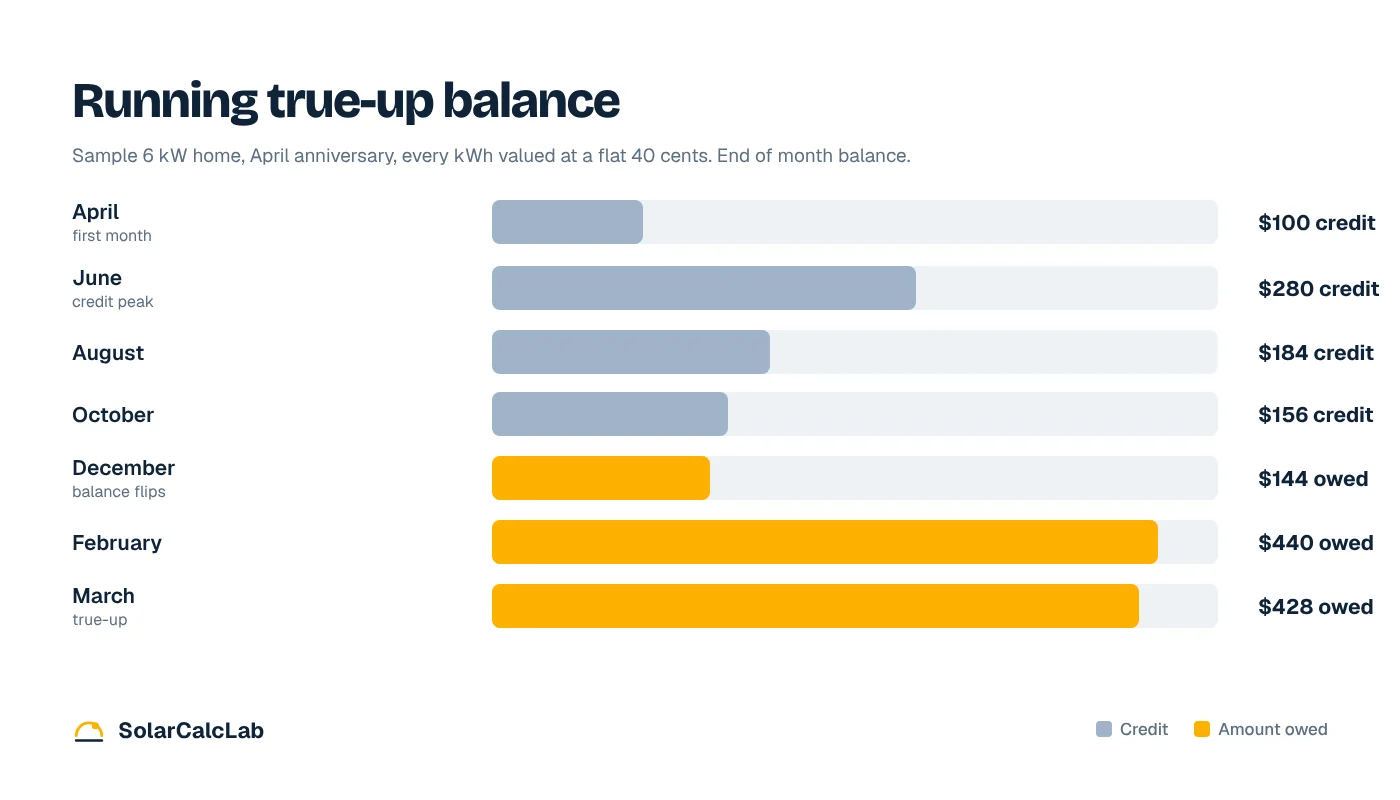
Here is a sample home with a 6 kW system and a true-up anniversary in April. Its monthly production and use are illustrative but follow a typical California pattern: strong spring output, summer AC, short winter days. To keep the arithmetic readable, every kWh is valued at a flat 40 cents. Real time-of-use rates make summer evening imports cost more and midday exports earn more, but the shape of the year stays the same.
| Month | Use (kWh) | Solar (kWh) | Net (kWh) | Month’s charge or credit | Running balance |
|---|---|---|---|---|---|
| Apr | 650 | 900 | -250 | -$100 | -$100 |
| May | 700 | 1,000 | -300 | -$120 | -$220 |
| Jun | 900 | 1,050 | -150 | -$60 | -$280 |
| Jul | 1,150 | 1,060 | 90 | $36 | -$244 |
| Aug | 1,150 | 1,000 | 150 | $60 | -$184 |
| Sep | 950 | 880 | 70 | $28 | -$156 |
| Oct | 700 | 700 | 0 | $0 | -$156 |
| Nov | 750 | 520 | 230 | $92 | -$64 |
| Dec | 950 | 430 | 520 | $208 | $144 |
| Jan | 950 | 450 | 500 | $200 | $344 |
| Feb | 800 | 560 | 240 | $96 | $440 |
| Mar | 750 | 780 | -30 | -$12 | $428 |
| Year | 10,400 | 9,330 | 1,070 | $428 due |
(10,400 − 9,330) × $0.40 = 1,070 kWh × $0.40 = $428
Look at June. The account shows a $280 credit and the owner reasonably thinks the year is going well. Between July and March the account adds a net $708 in charges, so the credit is gone by December. A credit balance in the middle of a cycle is not a forecast.
Why is my true-up so high? A checklist
When the bill is bigger than expected, work down this list before assuming the installer oversold the system.
Your use went up
New loads are the most common cause. An EV that adds 250 kWh a month from November through March adds $500 to the sample home’s true-up at 40 cents. Heat pumps, hot tubs and a home office do the same. Compare this year’s use line with last year’s on the true-up statement.
Your production went down
Check the inverter app for days at zero. A tripped breaker or a failed microinverter can go unnoticed for weeks. Shade from a tree that grew, dust in a dry summer and snow cover all show up here. Compare the actual annual kWh with the estimate in your contract, or with the solar panel output calculator for your system size and location.
Timing works against you
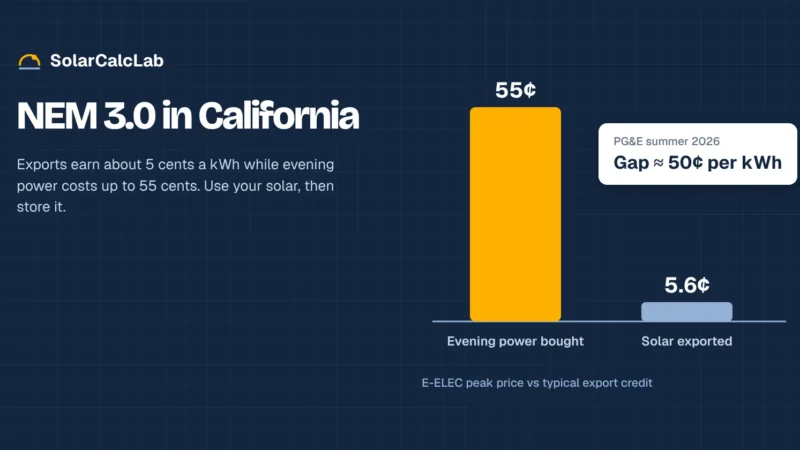
Under time-of-use rates, a kWh exported at noon can be worth less than a kWh imported at 7 p.m. A household that exports most of its solar and uses most of its power in the evening can show a balanced kWh count and still owe money.
You are on a CCA
If a community choice aggregator supplies your generation, PG&E bills delivery and the CCA bills generation, with its own credits and its own rules for surplus. A CCA may not pay net surplus compensation at all, while some add their own bonus. Redwood Coast Energy Authority, for example, pays out NEM credit balances by check each May once they reach $100. Read both parts of the bill.
How to lower your next true-up
- Set money aside each month. Divide last year’s balance by 12. For the sample home, $428 ÷ 12 = about $35.67 a month. Monthly statements show year-to-date charges, so you can track how close you are.
- Move flexible loads into solar hours. Run the dishwasher, laundry and EV charging during the day. The self-consumption calculator shows how much more of your own solar you use when you do.
- Fix lost production first. Restoring a failed inverter string is cheaper than any upgrade.
- Consider a battery for the evening peak. Stored midday solar can cover the costly evening hours. Test the payback in the home battery savings calculator before you buy.
- Add panels with care. About 1 kW more on the sample home would add roughly 1,555 kWh a year, worth about $622 at 40 cents. That more than covers the gap, but expanding an older net metering system can move it to a newer tariff. Ask your utility first.
Do not overbuild to chase a zero bill
Surplus is paid at wholesale value. If the sample home produced 650 kWh more than it used, that surplus would earn about $13 to $26 at 2 to 4 cents, against $260 if the same kWh had been used at home. Aim to land close to zero, not well past it. The net metering calculator helps you test a target system size.
True-up under net billing (NEM 3.0)
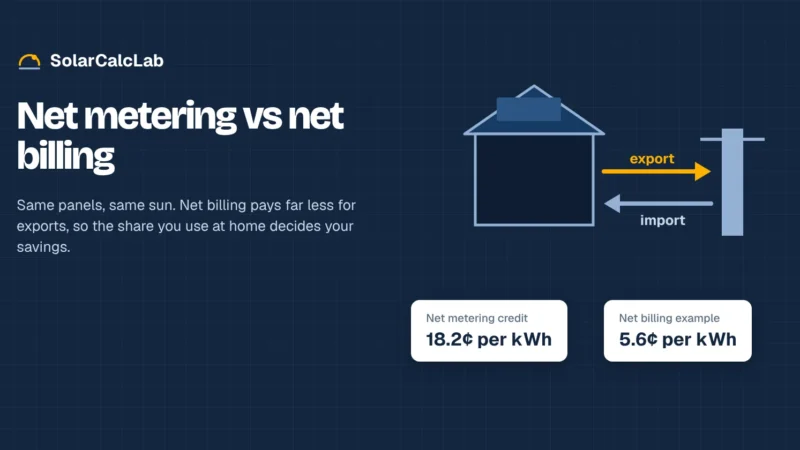
Newer California customers on the Solar Billing Plan see something different. Residential customers get monthly bills plus an annual true-up statement, so most charges are paid as you go rather than in one lump. Export credits are valued at hourly avoided-cost rates, roll forward month to month, and are reconciled at true-up. The true-up still matters, but it is rarely the big surprise it is under NEM 2. Our net metering vs net billing comparison shows the full-year difference for one house, and the NEM 3.0 guide covers export rates in detail.
Outside California, many states still use annual settlement, while others reset credits monthly or pay a fixed export rate. Our net metering explainer covers those models and how to look up your state’s rules.
Frequently asked questions
Why do I owe money at true-up when my bills showed credits for months?
Credits from sunny months are used up by charges from darker months. A balance that looked like a credit in June can turn into a charge by December, and the full total is due only at true-up.
Is the Base Services Charge included in my true-up?
No. PG&E bills it every month, and solar credits cannot offset it at any point in the cycle. It is about $24 a month for most residential customers.
How do I find my true-up month?
It falls on the anniversary of the date your account started on net metering, which is usually close to when the utility gave permission to operate. Your online account or the utility’s customer service can confirm the exact date.
Will a battery lower my true-up bill?
It can, if you are on time-of-use rates. A battery charged by midday solar and discharged in the evening replaces expensive grid kWh. On a flat rate the savings are small, because a stored kWh is worth the same as an exported one.
Do CCA customers get two true-ups?
Usually there are two settlements. PG&E settles delivery charges and the CCA settles generation charges and credits under its own rules. Their payout rules and timing can differ, so check the CCA’s solar page.