NEM 3.0 in California: What It Means for Solar Owners
Short answer
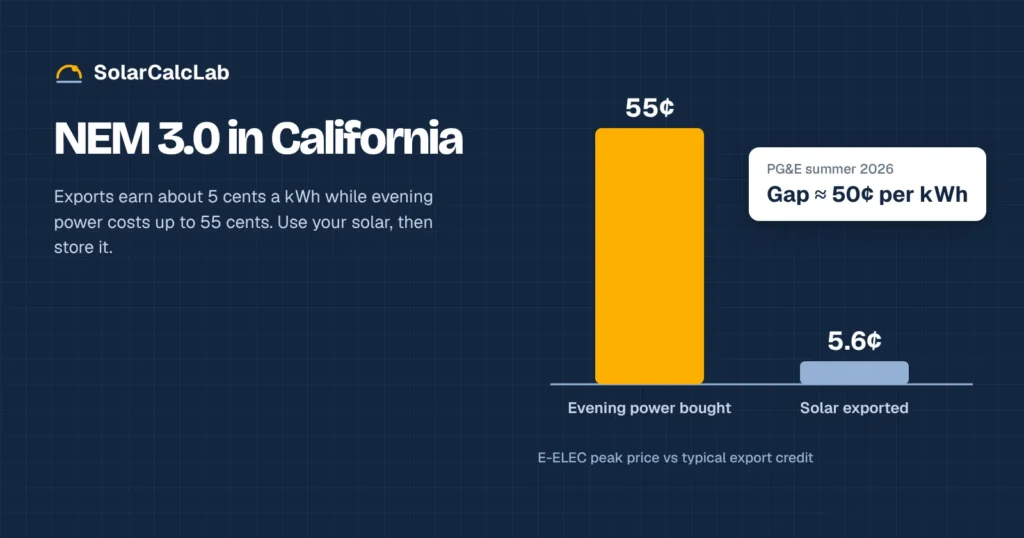
NEM 3.0 is the nickname for California’s Net Billing Tariff, which applies to PG&E, SCE and SDG&E customers who applied to connect solar on or after April 15, 2023. Exported power now earns export credits averaging roughly 5 cents per kWh, while the evening power you buy back on PG&E’s required E-ELEC plan cost about 55 cents in summer 2026. That gap is why most new California systems are sold with a battery.
If you went solar in California before mid-April 2023, you are probably on NEM 2.0 and most of this does not change your bill yet. If you are shopping now, or buying a home with panels, the rules below decide whether a quote’s savings figure is real.
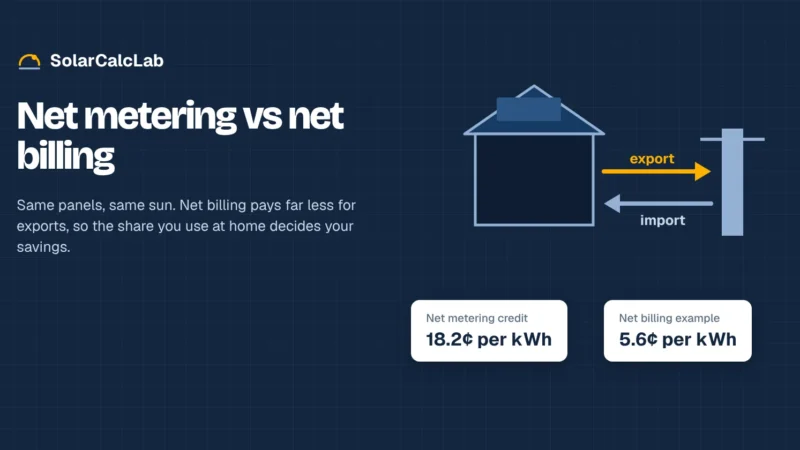
We cover the general difference between net metering and net billing in a separate comparison. This guide stays in California and works through the 2026 numbers: the rate plan you are put on, the export adder, the new fixed charge, and what a battery is worth on a real PG&E day.
Which California plan are you on?
Your plan depends on when your interconnection application was submitted, not when the panels went up.
| NEM 1.0 / NEM 2.0 | Net Billing Tariff (NEM 3.0) | |
|---|---|---|
| Who | Applied before April 15, 2023 | Applied on or after April 15, 2023 |
| Export credit | Close to the retail rate | Hourly avoided-cost value, usually far below retail |
| How long it lasts | 20 years from interconnection | Export values locked 9 years |
| Rate plan | Time-of-use plan required for NEM 2.0 | Required electrification rate: E-ELEC (PG&E), TOU-D-PRIME (SCE), EV-TOU-5 (SDG&E) |
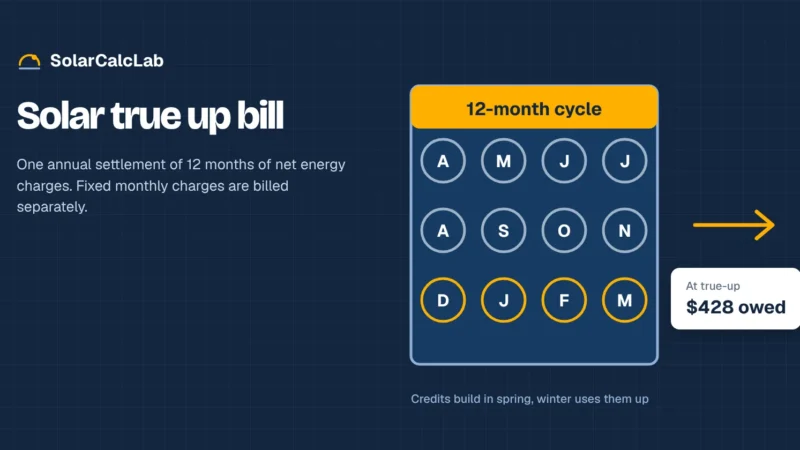
| Billing | Annual true-up | Monthly bills, credits roll over to an annual true-up |
The California Public Utilities Commission summarizes these rules on its net billing information page. Your utility may call the program the “Solar Billing Plan.”
What a kWh is worth under NEM 3.0
Under the Net Billing Tariff, every kWh your panels make ends up in one of three places, and each has a different value:
- Used in the home as it is produced: worth the retail rate you avoid paying.
- Exported to the grid: worth the export credit for that hour.
- Stored in a battery and used later: worth the retail rate at the time you use it, minus about 10% lost in charging.
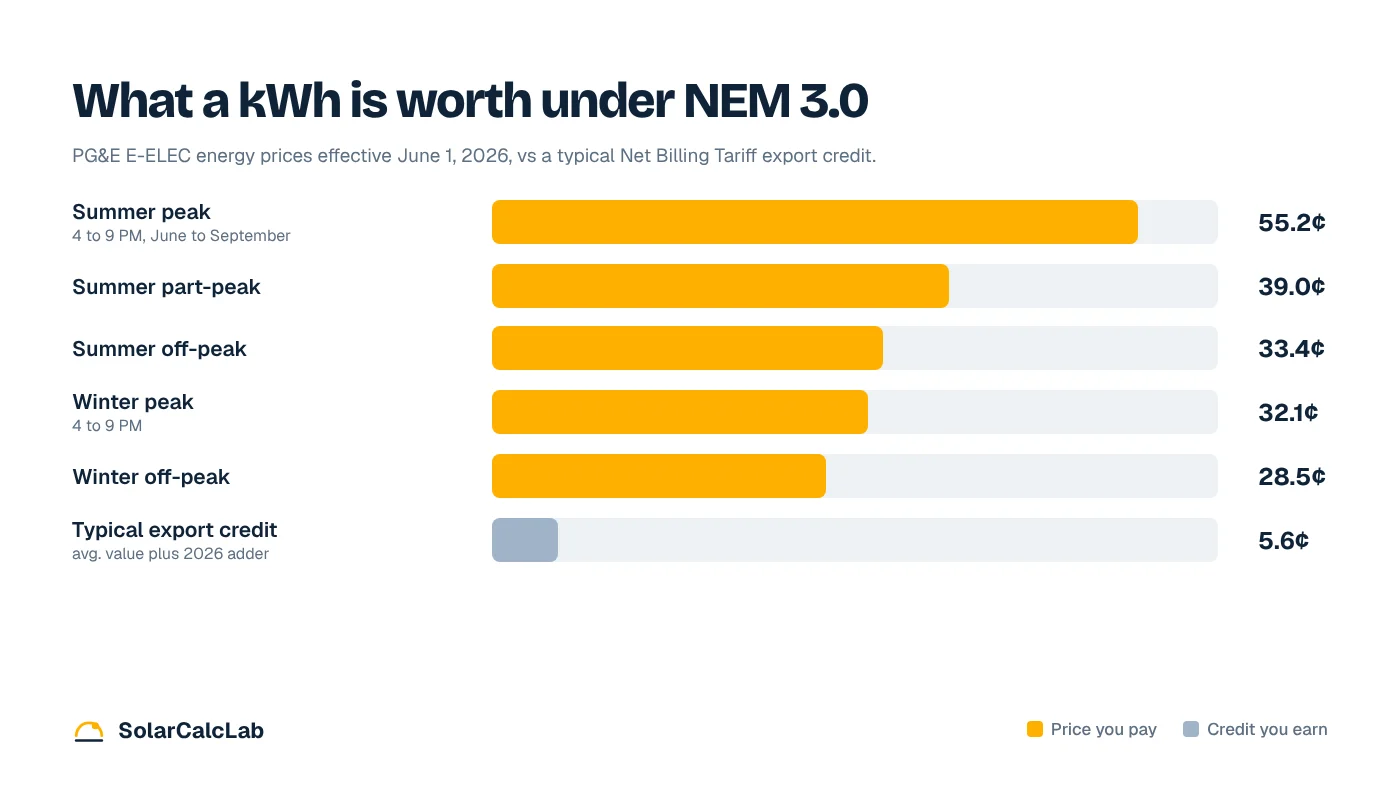
Here are PG&E’s E-ELEC energy prices effective June 1, 2026, from the utility’s E-ELEC tariff sheet, next to a typical export credit.
| Period | Summer (Jun to Sep) | Winter |
|---|---|---|
| Peak, 4 to 9 PM | 55.2¢ | 32.1¢ |
| Part-peak | 39.0¢ | 29.9¢ |
| Off-peak | 33.4¢ | 28.5¢ |
| Typical export credit (annual average plus 2026 adder) | about 5.6¢ | |
The export figure combines SolarReviews’ estimate of a 4.7 cent average PG&E export value with the 0.88 cent adder for 2026 applicants. Real credits swing by hour. Tesla’s published PG&E example shows an August hour between 7 and 8 PM worth about $1.03 per kWh, while spring middays are worth only pennies.
Summer evening example: 55.2¢ − 5.6¢ = 49.6¢ per kWh
Even a summer midday kWh used in the house saves about 27.8 cents more than exporting it (33.4¢ off-peak minus 5.6¢). That is the core idea of NEM 3.0: use your solar, do not sell it.
The ACC Plus adder shrinks every year
Residential PG&E and SCE customers get a small extra credit, called the ACC Plus adder, on top of the export value. It is fixed for nine years, but the amount depends on the year you applied. SDG&E customers do not receive it. PG&E’s tariff lists these residential amounts:
| Application year | Adder per exported kWh | Nine-year value on 3,000 kWh of exports a year |
|---|---|---|
| 2023 | 2.2¢ | $594 |
| 2024 | 1.76¢ | $475 |
| 2025 | 1.32¢ | $356 |
| 2026 | 0.88¢ | $238 |
| 2027 | 0.44¢ | $119 |
The adder is too small to drive a buying decision in 2026. Do not let a sales deadline built around it rush you.
The fixed charge solar cannot touch
Since March 1, 2026, PG&E bills include an income-graduated Base Services Charge of about $6, $12 or $24 a month. SCE and SDG&E added theirs in late 2025. In exchange, per-kWh prices dropped, by about 4.7 cents at PG&E’s summer peak. For solar owners this cuts both ways: the fixed charge applies however much you generate, and every kWh you offset is now worth a little less.
Worked example: a summer day in PG&E territory
Take a 6 kW system in the Central Valley on a clear July day, on E-ELEC:
Used in the house while the sun is up: 10 kWh, so 23.6 kWh exported
Evening use from 4 to 9 PM: 10 kWh
| Without a battery | With a 13.5 kWh battery | |
|---|---|---|
| Exported | 23.6 kWh | 12.5 kWh (11.1 kWh goes to the battery) |
| Export credit at 5.58¢ | $1.32 | $0.70 |
| Evening peak purchase at 55.2¢ | $5.52 | $0 |
| Net cost for the day | $4.20 | −$0.70 (a credit) |
The battery is worth about $4.90 on that summer day. On a winter day with the same usage and enough sun to fill it, the gain drops to about $2.59 because the peak price is lower. If it cycled fully every day, that adds up to roughly $1,226 a year (122 summer days and 243 winter days). Against EnergySage’s average 2026 quote of $15,647 for a 13.5 kWh battery, simple payback is about 12.8 years. Winter cloud means many days will not fill the battery, so treat that as a best case. Enter your own numbers in the home battery savings calculator.
How NEM 3.0 changes the way systems are designed
Size for what you use, not what you could export
Under NEM 2.0, installers sized arrays to wipe out the annual bill. Under net billing, the extra panels mostly export at about 5 cents. Run your usage through the solar self-consumption calculator and compare two array sizes before signing.
Batteries became standard
According to the CPUC, nearly 70% of Net Billing Tariff customers had paired solar with storage by the end of 2024. Our battery storage guide shows how to size one for evening use rather than for backup alone.
Move flexible loads into daylight
Charging an EV, heating water or running a pool pump at noon turns a 5.6 cent export into a 33 cent saving. Timers cost little and need no new equipment.
Buying a house that already has solar
- NEM 2.0 transfers with the home. The 20-year term runs from the original interconnection date, so a system connected in 2019 keeps NEM 2.0 until 2039. A 2025 bill, AB 942, originally would have moved homes to net billing at sale, but the Senate Energy Committee stripped that provision in July 2025.
- Expanding can cost you NEM 2.0. PG&E’s guidance allows growth of up to 10% or 1 kW, whichever is larger. Bigger additions put legacy status at risk, so ask the utility in writing first.
- Check who owns the panels. A lease or PPA has to be transferred to the buyer, and its payments belong in your budget.
Federal incentives in 2026
The 30% residential credit under Section 25D is gone for systems completed after December 31, 2025, per IRS guidance. Leased and PPA systems can still use the business credit under Section 48E if construction began by July 4, 2026 or the system is placed in service by the end of 2027. That is why many 2026 California quotes push third-party ownership. Compare the full cost of each option with the solar finance calculator, and see our solar tax credit guide for the details.
Is NEM 3.0 here to stay?
Yes, for now. A state appeals court upheld the Net Billing Tariff in March 2026, and the California Supreme Court declined to review the case that June. Export values for future applicants still change as the CPUC updates its Avoided Cost Calculator, so a 2027 quote may use different numbers than a 2026 one. For background on how true-ups and credits work in general, see our net metering explainer.
Frequently asked questions
Does NEM 3.0 apply to me if I already have solar?
Not if your interconnection application was submitted before April 15, 2023. Those customers stay on NEM 1.0 or NEM 2.0 for 20 years from their interconnection date, and the term carries over if the home is sold.
Is solar still worth it under NEM 3.0?
Often yes, but the case depends on using most of your solar at home. With PG&E peak prices above 50 cents in summer, a system with a battery or strong daytime use can still save over $1,000 a year. A large array exporting most of its output pays back slowly.
Can I go solar under NEM 3.0 without a battery?
Yes. Without one, size the array close to your daytime use and shift loads to midday. Expect a longer payback than a neighbor on NEM 2.0, since evening power is bought at full price.
What happens to extra credits at the annual true-up?
Monthly credits roll forward for 12 months. Any surplus left at the true-up is paid at a wholesale rate, typically a few cents per kWh, and the ACC Plus adder is not included in that payout.
Do SCE and SDG&E customers get the same export credits as PG&E?
No. Each utility has its own hourly export values and its own required rate plan. SCE customers get an ACC Plus adder like PG&E’s, while SDG&E customers do not.