Solar Loan vs Lease: Which Costs Less Over 25 Years?
Short answer
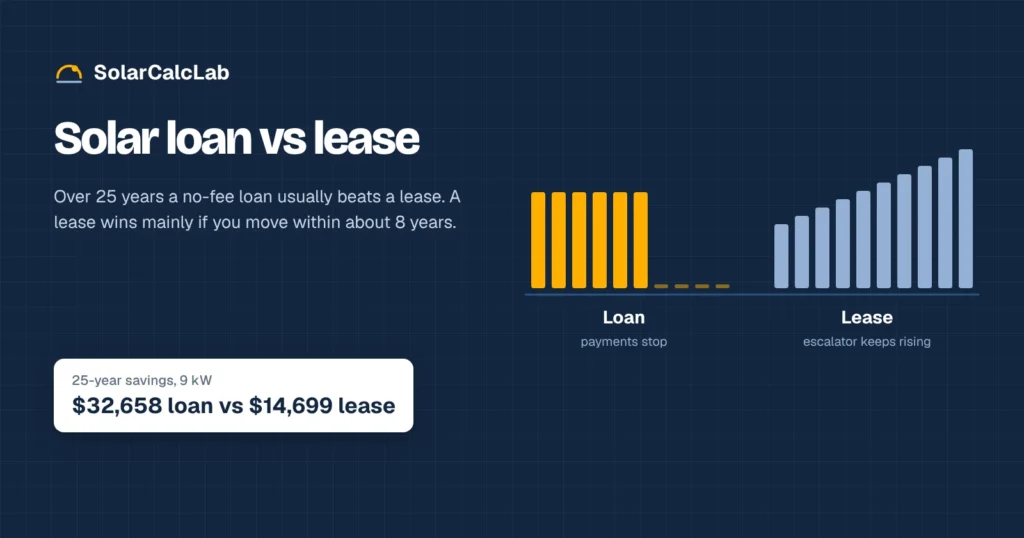
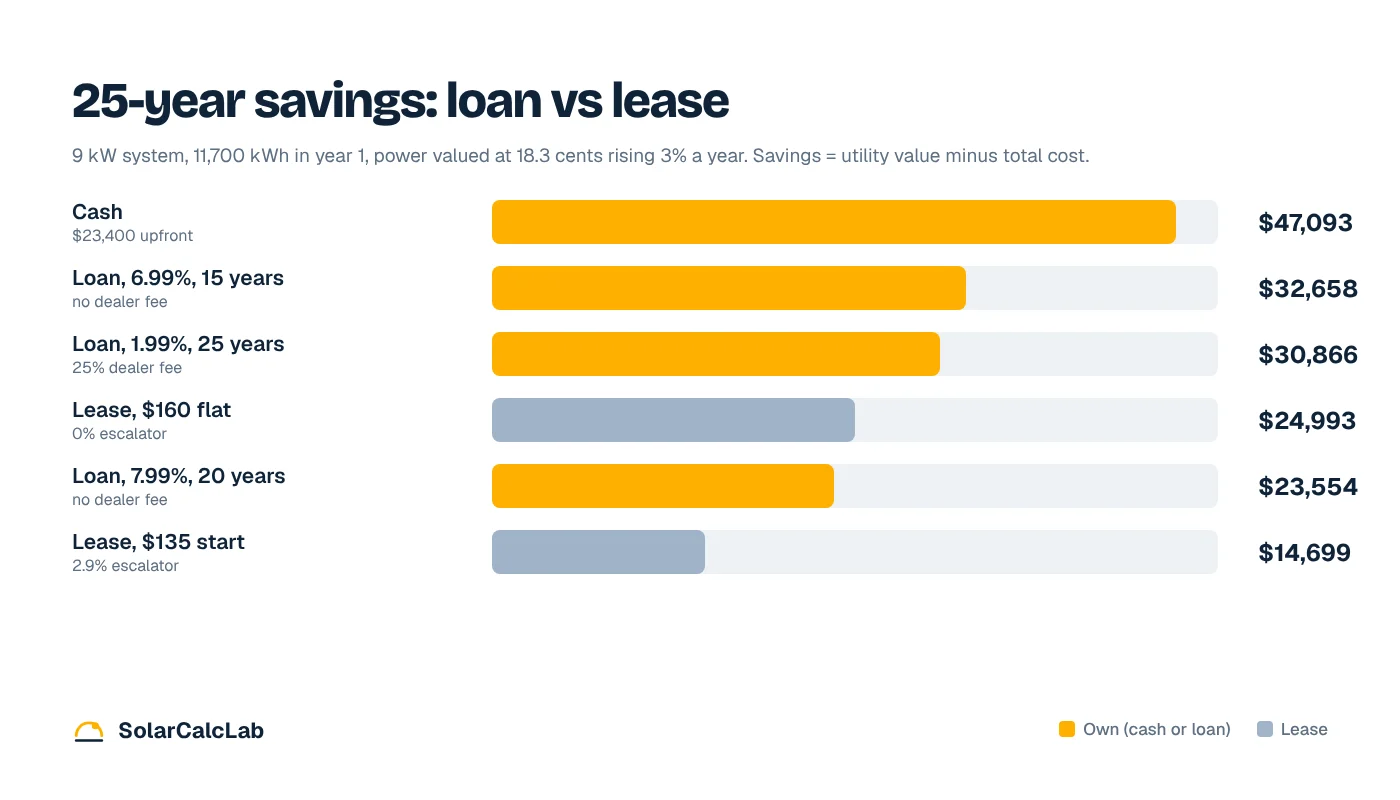
Over 25 years, a solar loan usually costs less than a lease, because loan payments stop and the panels keep producing. In our 9 kW example, a 15-year loan at 6.99% costs about $40,300 in total and saves about $32,700 against the utility, while a lease starting at $135 a month with a 2.9% escalator costs about $58,300 and saves about $14,700. A lease can still win if you have weak credit, expect to move within about eight years, or face rate growth slower than the lease escalator.
Loan and lease quotes often show nearly the same monthly number in year one, which is exactly why they are hard to compare. The real difference shows up later: what the payment does each year, who pays for repairs, what happens when you sell the house, and what you own when the paperwork ends.
This article runs one system through both options over a full 25-year panel life, then shows where the answer flips. If you also want to weigh a power purchase agreement, our PPA vs lease comparison covers that contract type in depth.
What changed in 2026
The federal tax picture now tilts toward leases. The 30% homeowner credit under Section 25D ended for systems installed after December 31, 2025, so a loan or cash buyer gets no federal credit in 2026. A leasing company is a business, and it can still claim the Section 48E credit. As EnergySage explains, third-party-owned systems stay eligible if construction began before July 4, 2026 or the system is placed in service by December 31, 2027.
That means a lease signed today may be priced with a tax credit built in, while a loan is not. Whether the company passes that saving on to you is a separate question, and it is the first thing to ask a salesperson. Our solar tax credit guide covers who still qualifies.
The 25-year example
Assumptions
- System: 9 kW at $2.60 per watt, so a cash price of $23,400.
- Production: 1,300 kWh per kW, so 11,700 kWh in year 1, falling 0.5% a year. Total over 25 years: about 275,600 kWh.
- Electricity value: 18.3 cents per kWh in year 1, close to the June 2026 US residential average from the EIA, rising 3% a year. Every kWh is valued at retail, which assumes full net metering.
- Owner repairs: one $2,500 inverter replacement during the 25 years for any loan or cash buyer. The leasing company covers repairs.
Under those assumptions, the electricity the system makes would cost about $72,993 from the utility over 25 years. That is the value each option is buying.
The options
| Option | Terms | Monthly payment | 25-year total cost | Net savings | Cost per kWh |
|---|---|---|---|---|---|
| Cash | $23,400 upfront | none | $25,900 | $47,093 | 9.4 cents |
| Loan A | 6.99%, 15 years, no dealer fee | $210.20 | $40,335 | $32,658 | 14.6 cents |
| Loan B | 1.99%, 25 years, 25% dealer fee | $132.09 | $42,127 | $30,866 | 15.3 cents |
| Loan C | 7.99%, 20 years, no dealer fee | $195.58 | $49,440 | $23,554 | 17.9 cents |
| Lease A | $160 a month, 0% escalator | $160 flat | $48,000 | $24,993 | 17.4 cents |
| Lease B | $135 a month, 2.9% escalator | $135 rising to $268 | $58,295 | $14,699 | 21.2 cents |
Loan totals include the $2,500 inverter. Cost per kWh divides each total by 275,600 kWh, which is the cleanest way to compare a loan, a lease and the utility on one scale.
Loan A: $23,400 × 0.005825 ÷ (1 − 1.005825^−180) = $210.20
Why the escalating lease falls behind
A 2.9% escalator looks small. Compounded over 24 increases, it nearly doubles the payment from $135 to about $268 a month. The utility comparison rises too, but production slips 0.5% a year, so the lease’s advantage narrows slowly:
| Year | Lease B payment | Monthly value of the solar power | Lease savings per month |
|---|---|---|---|
| 1 | $135.00 | $178.42 | $43.42 |
| 10 | $174.61 | $222.54 | $47.93 |
| 15 | $201.44 | $251.59 | $50.15 |
| 20 | $232.39 | $284.45 | $52.06 |
| 25 | $268.10 | $321.59 | $53.49 |
Savings hold at about $43 to $53 a month for the whole term. A loan does something different: the household pays more than the lease early on, then the payment drops to zero after year 15 or 20 while the panels keep making power worth $250 to $320 a month.
When rate growth is slower
The lease only works if utility prices rise faster than the escalator. If rates rise 2% a year instead of 3%, the same electricity is worth about $64,287 over 25 years and Lease B saves only about $6,000. Back at 3% growth, a net billing plan that values the output at, say, 70% of retail makes it worth about $51,095, and Lease B costs about $7,200 more than doing nothing. A flat lease or a lower escalator protects you from that risk. Test your own rate with the net metering calculator.
The dealer fee question
Loan B shows the trap and the nuance. Low-rate solar loans at 0.99% or 1.99% are usually paid for with a dealer fee that installers add to the price. EnergySage reports these fees run about 15% to 30% of the loan amount. Here, a 25% fee turns a $23,400 system into a $31,200 loan.
Hidden fee = $31,200 − $23,400 = $7,800
Over a full 25 years, that loan is not a disaster. Its $132.09 payment matches a no-fee 25-year loan at about 4.65% APR, and a no-fee 20-year loan at about 3.2%. If your credit union offers less than those rates with no fee, take the credit union.
The real damage comes if you sell early. After 8 years, the dealer fee loan still owes about $22,846, against about $18,078 on Loan C. You prepaid a fee designed to be earned back over decades, and the payoff at closing comes out of your sale proceeds.
Watch for tax credit balloon structures
Before 2026, many solar loans assumed you would put your tax credit toward the principal around month 18. If you did not, the payment jumped. Homeowners buying in 2026 have no federal credit to apply, so any loan quote showing a lower “introductory” payment that resets after 12 to 18 months deserves a hard look. Ask for the payment with no prepayment assumed.
Selling your house with a loan or a lease
This is where many comparisons stop too early.
- Loan: you own the system. Pay off the balance at closing, or have the lender release its lien. Owned solar can be priced into the sale, though appraisals vary by market.
- Lease: the buyer must qualify and agree to take over the contract, or you may need to buy it out or prepay it. A buyer facing a $230 escalating payment in year 20 may push back on price.
Using the same example, someone who sells after 8 years has paid about $14,355 on Lease B and about $18,776 on Loan C, against about $18,695 of electricity value. The lease customer is roughly $4,300 ahead. The loan customer is about even on payments but still owes about $18,078 at closing, which only pays off if buyers value the owned panels that highly. Short ownership is the main case where a lease is the cheaper option.
What happens if the solar company fails?
Leasing ties you to one company for two decades. Sunnova, one of the largest residential lessors, filed for Chapter 11 bankruptcy in June 2025. In cases like that, lease contracts and their payment streams are generally sold to another owner, and payments continue. What can weaken is service: response times for repairs and how production guarantees are honored. With a loan, the lender can fail and you still own the panels and the manufacturer warranties.
Which should you choose?
| Your situation | Usually better | Why |
|---|---|---|
| Staying 12+ years, good credit | Loan with no dealer fee | Payments end; free power for the remaining panel life |
| Likely to move within 8 years | Lease or cash | Avoids paying off a front-loaded loan balance |
| Credit score under the loan cutoff | Lease | Lease approvals are often easier than unsecured loans |
| Utility with weak export credits | Loan, smaller system | An escalating lease can cost more than it saves |
| No interest in maintenance | Lease with low escalator | Repairs, monitoring and inverter replacement included |
Start with an honest price. Our solar panel cost guide lists 2026 prices by state, and the solar panel cost calculator sizes a quote for your home. Then enter each offer, including dealer fees and escalators, into the solar finance calculator to see total cost rather than monthly payment. The solar payback calculator shows how long an owned system takes to repay itself.
Frequently asked questions
Is it cheaper to lease or finance solar panels?
Over 25 years, financing usually costs less because the loan ends and you keep the panels. In our 9 kW example, a 15-year loan at 6.99% saved about $32,700 versus about $14,700 for a lease with a 2.9% escalator. A lease can come out ahead if you sell within roughly 8 years.
Do I get the solar tax credit with a loan in 2026?
No. The homeowner credit under Section 25D ended for systems installed after December 31, 2025, whether paid with cash or a loan. Leasing companies can still claim the business credit for qualifying systems, which may lower lease pricing.
What is a normal solar lease escalator?
Lease escalators commonly fall between 0% and 3.9% a year. Over 25 years, 2.9% nearly doubles the payment. Compare the escalator with how fast your utility’s rates have actually risen, and ask for a 0% option.
Are 0.99% solar loans a good deal?
Only if you plan to keep the loan for most of its term. The low rate is usually funded by a dealer fee of about 15% to 30% added to the loan. Ask for the cash price and compare it with the financed amount.
Can I buy out a solar lease early?
Most leases include a buyout schedule, often at set years or when you sell the house. The price is usually based on the system’s remaining value or remaining payments. Request the schedule in writing before signing.