Net Metering vs Net Billing: How Solar Export Credits Differ
Short answer
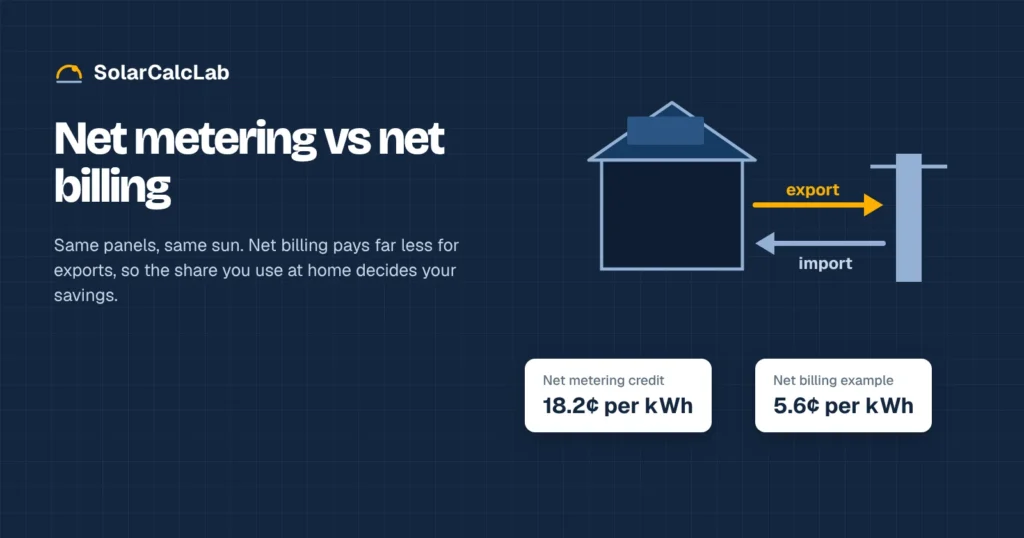
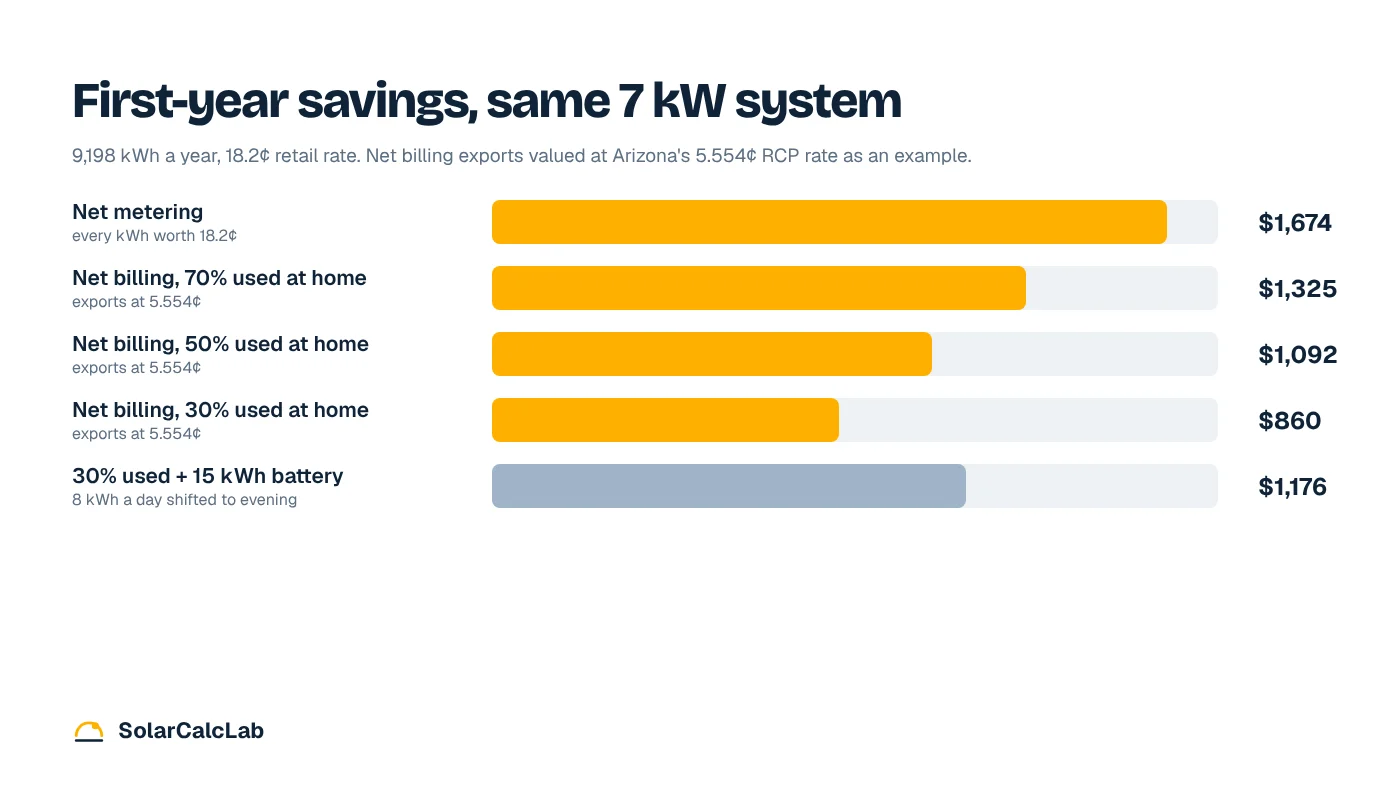
Under net metering, each kWh your panels send to the grid cancels a kWh you buy later, so exports are worth about the full retail rate. Under net billing, imports are still billed at retail, but exports earn a separate, lower credit, often a third or less of retail. For the same 7 kW system, that can cut first-year savings from about $1,674 to between $860 and $1,325, depending on how much solar you use at home.
Both programs use the same meter and the same panels. The difference is the price tag the utility puts on the energy you export. If you are new to the basics, our net metering explainer covers true-ups and meters. This article picks up from there and answers the money question: how much does net billing change your savings, and what should you change in response?
The one number that changes
Your solar output splits two ways. Some is used in the house as it is produced. The rest flows to the grid. The two programs value those two streams like this:
Net billing savings = (self-used kWh × retail rate) + (exported kWh × export rate)
Under net metering, the split does not matter much, because both halves earn retail. Under net billing, the split is everything. Every kWh you move from “exported” to “used at home” gains the difference between the two rates.
Same house, two tariffs: a worked year
Take a 7 kW system at 4.5 peak sun hours and 80% system efficiency:
The home uses 10,800 kWh a year, so it never produces more than it consumes over the year. For the retail rate we use 18.2 cents, the 2026 US residential average projected in the EIA’s Short-Term Energy Outlook. For the export rate we use 5.554 cents, the Resource Comparison Proxy rate the Arizona Corporation Commission set for new APS and UNS Electric solar customers from September 1, 2026. It is a real, current export credit, which makes it a fair stand-in, but your utility’s figure will differ.
| Scenario | Used at home | Exported | First-year savings | Share of net metering value |
|---|---|---|---|---|
| Net metering | All 9,198 kWh credited at 18.2¢ | $1,674 | 100% | |
| Net billing, 70% used at home | 6,439 kWh | 2,759 kWh | $1,325 | 79% |
| Net billing, 50% used at home | 4,599 kWh | 4,599 kWh | $1,092 | 65% |
| Net billing, 30% used at home | 2,759 kWh | 6,439 kWh | $860 | 51% |
A household that is out from morning to evening might use around 30% of its solar directly. In this example, that household loses about half its savings when it moves from net metering to net billing. A home with someone working from home, a pool pump and midday EV charging can push self-use toward 60% or 70% and keep most of the value.
What it does to payback
At $2.62 per watt, the 7 kW system costs $18,340. Simple payback is about 11 years under net metering, about 14 years at 70% self-use under net billing, and about 21 years at 30% self-use. That last case is close to the panels’ warranty life, which is why export rules now decide more solar deals than panel prices do. Our solar payback period guide adds rising rates and panel aging to these simple figures.
How the export rate is set
Avoided cost, hour by hour
California’s Net Billing Tariff values exports with the state’s Avoided Cost Calculator. SCE explains on its export pricing page that credits are set for each hour of the day, by month, with separate weekday and weekend values, and that customers lock those prices for nine years. A midday spring export can be worth very little, while a late-summer evening export can be worth more than retail.
A flat rate that steps down
Arizona’s Resource Comparison Proxy is simpler: one flat export rate, reset each year, and the cut is capped at 10% a year. The rate fell from 6.171 cents to 5.554 cents in September 2026. A new customer keeps the rate in force when they applied to interconnect for up to 10 years, so applying before a reset can matter.
Netting interval: a hidden version of net billing
Some programs still use retail rates but measure in short intervals. Michigan’s distributed generation program, for example, meters inflow and outflow separately, so energy you export at noon cannot offset energy you buy at 7 PM, and outflow is credited below the full retail rate. Monthly netting is friendlier: a sunny afternoon can cancel a cloudy evening in the same month. If a quote says “net metering,” ask how often netting happens.
How to tell which one you would be on
- Ask the installer for the tariff or rider name, not just “net metering.” A schedule code you can look up beats a sales summary.
- On a sample bill or the utility’s solar page, look for words like “export credit,” “outflow,” “buyback rate” or “avoided cost.” Those signal net billing.
- Check whether the export rate is locked and for how long. Nine or ten years is common for successor programs.
- Confirm whether your interconnection application date or your permission-to-operate date sets your rate.
- Read the true-up rules. Under net billing, leftover credits at the end of the year are often paid at a low wholesale rate or not at all.
What to change if you are on net billing
Size the system to daytime use, not the annual bill
Under net metering, covering 100% of annual use made sense. Under net billing, the last few kWh of a big array are mostly exported at a low rate. Run your load pattern through the solar self-consumption calculator and compare a smaller array with the full-offset size.
Move flexible loads to midday
Each kWh shifted from evening to noon is worth the gap between retail and export, 12.6 cents in our example. Timers on a water heater, dishwasher, pool pump or EV charger cost little, and the net metering calculator shows what each shifted kWh is worth under your export rate.
Test a battery against the rate gap
A battery stores midday exports and releases them in the evening. In the chart, a 15 kWh battery shifting 8 kWh a day at 90% round-trip efficiency lifts the 30% self-use home from $860 to about $1,176, a gain of about $316 a year. Against a $17,000 battery, that alone does not pay back. It works when the evening rate is much higher than the export credit, as on time-of-use plans, or when backup is worth money to you. See our battery storage sizing guide before you add one.
Consider panel direction
West-facing panels make less energy in total but more in late afternoon, when homes use more and some export rates are higher. Under hourly export pricing, that trade can pay off.
Common mistakes in solar quotes
- Valuing all production at the retail rate when the utility pays an export credit.
- Using last year’s export rate in a state that resets it each year.
- Assuming 50% or more self-use for a household that is out from 8 to 6.
- Leaving out fixed monthly charges that solar cannot offset under either program.
- Comparing a quote with a neighbor’s savings when the neighbor is on an older, grandfathered tariff.
Our solar cost guide shows typical prices per watt by state so you can sanity-check the system price at the same time.
Frequently asked questions
Is net billing always worse than net metering?
For almost every household, yes, because exports earn less. The exception is hourly pricing that pays more than retail at some hours, such as some late-summer evenings in California. A battery or west-facing panels can capture part of that.
Can I switch from net billing back to net metering?
Usually not. Successor programs apply to new interconnection applications, and the older tariff closes to new customers. Existing customers on the old tariff typically keep it for a set number of years.
Do I still get an annual true-up under net billing?
Many programs keep one. Credits from exports reduce your bill each month, and any balance is settled once a year. Leftover credits are usually paid at a low rate, so a large surplus is a sign the system may be oversized.
What export rate should a quote use?
The current published rate for your utility and tariff, locked for the period the program allows. If the rate steps down each year, as in Arizona, the quote should use the rate you would actually be assigned.
Does net billing make solar not worth it?
Not by itself. It lengthens payback, often by several years, but homes with high retail rates or high daytime use can still come out well ahead. Run your numbers with your own export rate before deciding.