25kW Solar System: Yearly Output, Panels Needed and 2026 Cost
Short answer
A 25kW solar system makes about 27,500 to 40,000 kWh a year in most of the US, or 75 to 110 kWh a day. At 4.5 peak sun hours and 80% efficiency it produces about 32,850 kWh a year, roughly three times an average home’s use. It needs about 59 panels at 430 W, around 1,250 square feet of panel area, and typically costs $55,000 to $77,500 installed in late 2026.
At 25 kilowatts, a solar project sits right on the line between a large home system and a small commercial one. The array is big enough that utility size caps, interconnection review and service panel limits shape the design as much as the roof does.
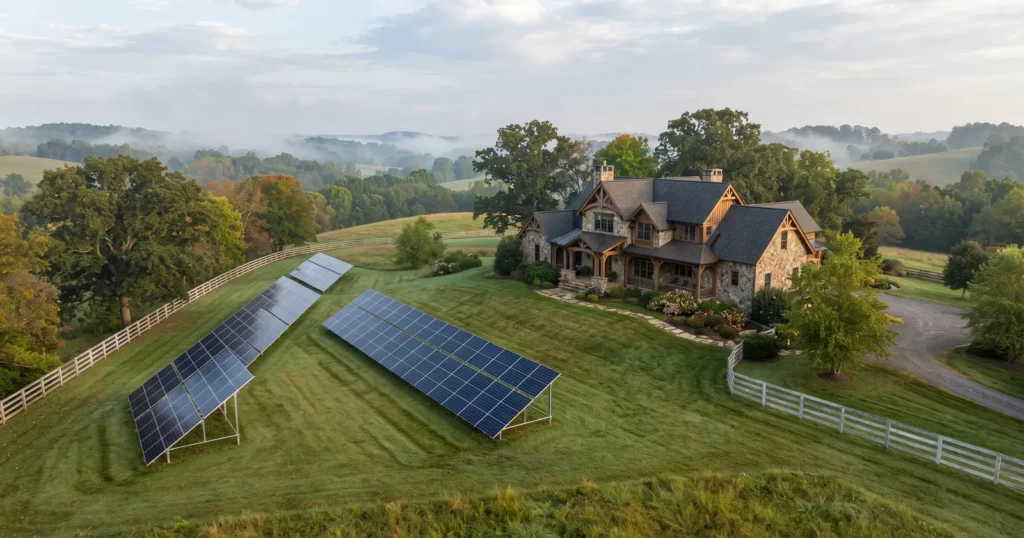
The people who buy a 25kW solar system tend to have unusual properties: country estates, homesteads with a barn and shop, or a small business on its own meter. This guide covers what that size produces, who it fits, how it is laid out on the ground, why it almost always uses two inverters, and what it costs.
Who actually needs a 25kW solar system?
The US Energy Information Administration puts the average residential customer at 10,791 kWh a year (2022 data). A 25 kW array at the site’s middle value of 4.5 sun hours makes 32,850 kWh, so it is far too large for a typical house. It makes sense for three groups:
- Estates and very large homes: 6,000 square feet or more, often with a pool, a guest house, heat pumps and several EVs.
- Homesteads and small farms: a farmhouse plus a barn, well, workshop and seasonal loads such as irrigation or heated stock tanks.
- Small commercial sites: a shop, office, clinic or light workshop on a commercial meter, where daytime use lines up well with solar output.
Worked example: a homestead with a barn and shop
The loads below are example assumptions for one all-electric property, not averages. Your own 12 months of bills are the only reliable starting point.
| Load | Assumption | Energy per year |
|---|---|---|
| Farmhouse with heat pump | about 1,330 kWh a month | 16,000 kWh |
| One EV or farm truck | 12,000 miles at 0.30 kWh per mile | 3,600 kWh |
| Workshop tools, welder, compressor | 8 kWh a day, 300 days | 2,400 kWh |
| Barn lights and ventilation fans | 1 kW for 6 hours a day | 2,190 kWh |
| Irrigation pump | 3 kW for 4 hours a day, 120 days | 1,440 kWh |
| Well pump | 1.5 kW for 2 hours a day | 1,095 kWh |
| Heated livestock waterers | 1 kW for 8 hours a day, 120 winter days | 960 kWh |
| Two chest freezers | about 400 kWh each | 800 kWh |
| Total | 28,485 kWh |
Where you live decides whether this property needs 25 kW. Divide yearly use by what 1 kW of panels makes at your sun hours:
Example: 28,485 ÷ (4.5 × 0.80 × 365) = 21.7 kW at 4.5 sun hours, but 28,485 ÷ (3.7 × 0.80 × 365) = 26.4 kW at 3.7 sun hours
So the same homestead fits a 22 kW array in a sunny state and needs 25 kW or more in a cloudy northern one. Try your own figures in the solar panel size calculator. If your use is closer to 20,000 to 25,000 kWh a year in a sunny area, our 20kW solar system guide is the better fit.
How many kWh does a 25 kW solar system make by region?
Output scales with peak sun hours, the number of hours a day that equal full-strength sunlight. This site assumes 80% system efficiency to cover heat, wiring, dust and inverter losses. With 25 kW of panels, the math simplifies to 20 kWh per sun hour.
Example: 25 × 4.5 × 0.80 = 90 kWh a day, or 32,850 kWh a year
| Peak sun hours | Typical region | Per day | Per month | Per year |
|---|---|---|---|---|
| 3.5 | Pacific Northwest, cloudiest areas | 70 kWh | 2,129 kWh | 25,550 kWh |
| 4.0 | Northeast, Great Lakes | 80 kWh | 2,433 kWh | 29,200 kWh |
| 4.5 | US middle value | 90 kWh | 2,738 kWh | 32,850 kWh |
| 5.0 | Southeast, Texas | 100 kWh | 3,042 kWh | 36,500 kWh |
| 5.5 | Southern California, Colorado | 110 kWh | 3,346 kWh | 40,150 kWh |
| 6.0 | Desert Southwest | 120 kWh | 3,650 kWh | 43,800 kWh |
Monthly figures are yearly totals divided by 12, so summer months run well above them and winter months well below. Regions are broad guides only. For a production estimate based on your exact address, tilt and weather history, use the free NREL PVWatts calculator.
How many 25kW solar panels, and how much space?
A 25 kW array is about 59 residential panels at 430 W. Ground-mounted projects often use larger commercial modules to cut the panel count and the racking labor.
Example: 25,000 ÷ 430 = 58.1, so 59 panels (25.37 kW)
| Panel rating | Panels needed | Actual array size | Panel area at about 21% efficiency |
|---|---|---|---|
| 400 W | 63 | 25.20 kW | about 1,290 sq ft |
| 430 W | 59 | 25.37 kW | about 1,300 sq ft |
| 450 W | 56 | 25.20 kW | about 1,290 sq ft |
| 550 W (commercial size) | 46 | 25.30 kW | about 1,300 sq ft |
Panel area barely changes with wattage, because area follows efficiency: 25,000 W ÷ (1,000 W/m² × 0.21) is about 119 m², or roughly 1,280 square feet. At 22% efficiency it drops to about 1,220 square feet.
Few houses have that much unshaded, code-compliant roof, so many 25 kW systems go on a barn, a carport or the ground.

How do you lay out a 25kW ground mount?
Ground mounts suit this size: rural properties have open land and the tilt can be set for the location. The common layout is a fixed rack holding panels two high in portrait.
The example below assumes 60 panel positions, a 430 W panel of about 1,720 by 1,130 mm (common for 108-cell modules, but check your spec sheet), a 30 degree tilt and a site near 40 degrees north latitude.
Example: 3.44 m panel slope × sin 30° = 1.72 m; winter noon sun at 40° N is about 26.6°; 1.72 ÷ tan 26.6° = 3.4 m (about 11 ft)
| Layout (2 panels high, portrait) | Rack length | Depth including row gaps | Footprint |
|---|---|---|---|
| One rack, 30 columns | about 114 ft | about 10 ft | about 1,110 sq ft |
| Two racks, 15 columns, one behind the other | about 57 ft | about 31 ft | about 1,760 sq ft |
| Three racks, 10 columns each | about 38 ft | about 52 ft | about 1,970 sq ft |
A single long rack uses the least land because no row shades another, but it needs a long, level strip. Stacked rows fit a squarer plot. Many designers widen the gap so morning and afternoon winter sun also clears the next row.
Add space for mowing, fencing and a service path. As a planning rule, panels usually cover 40% to 50% of the land under the whole array, so budget about 2,600 to 3,200 square feet of clear, unshaded ground. The trench back to the house or barn is often the hidden cost: a long run means larger wire to control voltage drop.
Is a 25 kW system residential or commercial?
This is the question that decides many 25 kW projects. The physics are the same, but utilities treat larger systems differently.
- Net metering caps: many utilities and states cap residential net metering somewhere in the 10 to 25 kW range. Others cap it as a share of your past yearly use, so an oversized array may not qualify.
- Interconnection review: small systems often get a simplified, fast-track review. Above the local threshold you may face engineering review, extra fees, longer waits or required equipment such as an accessible disconnect.
- AC or DC rating: some rules measure size by inverter AC output, others by panel DC rating. A 25.37 kW DC array on 20 kW of inverters may count as a 20 kW system in one place and a 25 kW system in another.
- Rate class: a business on a commercial tariff may pay demand charges based on its highest 15 or 30 minute draw. Solar alone does not reliably cut those charges, because one cloudy afternoon can set the peak.
Read your utility’s interconnection handbook before you sign anything. If the cap is close, trimming to 59 panels on 20 kW of inverters, or splitting loads across two meters where the rules allow, can keep you on the simpler residential track. Check how exports are credited with the net metering calculator.
Why does a 25kW system use two inverters?
Most homes and farms have single-phase 240 V service, and most single-phase residential string and hybrid inverters top out around 10 to 15 kW AC. Installers also size inverters a little below the array, a DC to AC ratio of about 1.1 to 1.3, which puts total inverter capacity around 19 to 23 kW for 25 kW of panels. That lands naturally on two units.
A typical two-inverter design
- Split the array: about 30 panels per inverter, wired as two or three strings each. The exact panels per string depend on cold-weather voltage, which you can check with the solar string size calculator.
- Pick sizes: two 10 kW units (20 kW AC, ratio about 1.27) or one 11.4 kW plus one 10 kW unit (21.4 kW AC, ratio about 1.19).
- Separate faces: if part of the array is on a barn roof and part on the ground, give each its own inverter so different angles do not drag each other down.
- Redundancy: if one inverter fails, the other keeps producing.
The inverter size calculator confirms the ratio for any panel and inverter combination. Businesses with 208 V or 480 V three-phase service can usually use one 25 kW three-phase inverter instead.
Connecting it to the panel
Two 10 kW inverters at 240 V each push about 42 A, and code sizes each breaker at 125%, about 52 A, so each needs a 60 A breaker. Under the common 120% busbar rule, a 200 A panel with a 200 A main allows only 40 A of backfeed. Expect a supply-side connection or a service upgrade, and include it in the quote.
How much does a 25kW solar system cost in 2026?
Price per watt falls as systems grow. Typical US ranges in late 2026 for an installed, grid-tied system before incentives:
- Installed price: about $2.20 to $3.10 per watt.
- 25 kW total: about $55,000 to $77,500.
- Extra for ground mounts: piles or concrete footings, trenching and long wire runs.
- Extra for grid connection: a supply-side tap or service upgrade if the panel cannot take the backfeed.
The 30% federal residential clean energy credit (Section 25D) ended for homeowner-owned systems installed after December 31, 2025, so estates and homesteads owned by individuals should not count on it. Farms and businesses may fall under different federal and state programs. Those rules are separate and change often, so confirm with a tax adviser.
What is the payback on a 25 kW system?
Take a $66,000 system (about $2.64 per watt) making 32,850 kWh a year. This example uses $0.18 per kWh for a home and $0.13 per kWh for a business; use the rate on your own bill.
Example: 32,850 kWh × $0.18 = $5,913 a year; $66,000 ÷ $5,913 = 11.2 years
| Scenario ($66,000 system, 32,850 kWh/yr) | Yearly savings | Simple payback |
|---|---|---|
| Home with full net metering at $0.18 | $5,913 | 11.2 years |
| Home, 70% used on site at $0.18, 30% exported at $0.06 | $4,730 | 14.0 years |
| Business, all kWh offset at $0.13 | $4,271 | 15.5 years |
The middle row shows why size caps matter: surplus credited at a low export rate stretches payback. Model your own price and rates with the solar payback calculator.
Does a 25kW solar system with batteries make sense?
For estates and homesteads, backup is often the main reason to add storage, because a well pump, freezers and livestock water cannot wait out a long outage. A grid-tied system without batteries shuts off when the grid goes down. Choose a critical-loads panel and size the battery for it:
Example: 30 kWh a day × 1 day ÷ 0.90 = 33.3 kWh of battery
With two hybrid inverters, storage can be split between them, about 15 to 20 kWh each. The upside of a large array is fast recharging: on a 4.5 sun hour day it makes about 90 kWh, enough to refill that bank and still run the property. Whole-estate backup for a home using 90 kWh a day needs about 100 kWh of storage, which is commercial-scale equipment.
Bigger projects, such as a dairy, move fully into commercial territory. Our 50kW solar system guide covers that step up.
Frequently asked questions
How much does a 25kW solar system cost?
Typical US installed prices in late 2026 run about $2.20 to $3.10 per watt, or roughly $55,000 to $77,500 for 25 kW before incentives. Ground mounts, trenching, service upgrades and batteries add to that. The 30% federal homeowner credit ended for systems installed after 2025, so leave it out of a home budget.
How many acres does a 25kW ground mount need?
Much less than an acre. The panels themselves cover about 1,250 square feet, and with row spacing, mowing room and a service path you should plan about 2,600 to 3,200 square feet. That is roughly 6% to 7% of an acre, which is 43,560 square feet.
Can I get net metering on a 25 kW home system?
It depends on your utility. Many cap residential net metering somewhere between 10 and 25 kW, or at a share of your past yearly use. Some measure size by inverter AC output, so a 25 kW DC array on 20 kW of inverters may qualify. Check the interconnection rules before you sign.
How many kWh a month does a 25kW solar system produce?
About 2,300 to 3,300 kWh a month on average across most of the US, using 80% system efficiency. At 4.5 peak sun hours the yearly total is 32,850 kWh, about 2,738 kWh a month. Summer months produce more and winter months less.
Do I need two inverters for a 25kW solar system?
On single-phase 240 V service, usually yes. Most single-phase string and hybrid inverters top out around 10 to 15 kW AC, so a 25 kW array is split between two units, such as two 10 kW inverters. Sites with three-phase service can often use one 25 kW three-phase inverter.
Is 25kW too big for a house?
For most homes, yes. An average US home uses about 10,800 kWh a year, while 25 kW makes about 27,500 to 40,000 kWh. It fits estates, all-electric homes with several EVs, and homesteads with a barn, shop or irrigation, especially in cloudier northern states.