100kW Solar System: Yearly Output, Panels Needed and 2026 Cost
Short answer
A 100kW solar system makes about 110,000 to 160,000 kWh (110 to 160 MWh) a year in most of the US, or roughly 300 to 440 kWh a day. It needs about 233 panels at 430 W, around 5,000 square feet of panel area or about 0.3 to 0.4 acre of land, and typically costs $180,000 to $275,000 installed in late 2026.
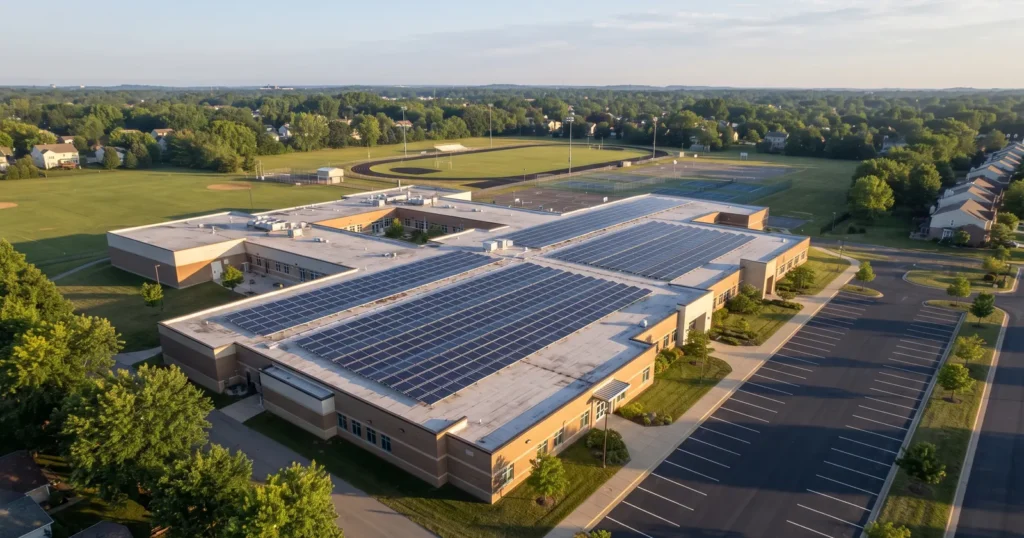
At 100 kilowatts, solar stops being an equipment purchase and becomes a small construction project. The buyers are organizations with big roofs and big daytime bills: distribution warehouses, K-12 schools, food processors, machine shops and the groups behind small community solar projects.
The questions change at this size too: whether the building’s service can accept the power, whether the utility will want a study, and whether the price per watt works at a commercial or industrial rate. This guide answers each with worked figures.
What does a 100 kW solar array actually produce in a year?
SolarCalcLab plans every system with the same assumptions: 80% system efficiency to cover heat, dust, wiring and inverter losses, and 4.5 peak sun hours as a US middle value. Yearly energy for 100 kW of panels is then:
Example: 100 × 4.5 × 0.80 × 365 = 131,400 kWh, about 131 MWh a year (360 kWh a day)
Commercial buyers usually compare output with their own monthly use, so the last column below shows how much of a building using 12,000 kWh a month (144,000 kWh a year) the array would cover.
| Climate | Peak sun hours | Per day | Per year | Share of a 144,000 kWh building |
|---|---|---|---|---|
| Cloudier north (Pacific Northwest, Great Lakes) | 3.8 | 304 kWh | 110,960 kWh | 77% |
| US middle value | 4.5 | 360 kWh | 131,400 kWh | 91% |
| Southeast and Texas | 5.0 | 400 kWh | 146,000 kWh | 101% |
| California and the Southwest | 5.5 | 440 kWh | 160,600 kWh | 112% |
These figures match the site’s rule of thumb that 1 kW of panels makes 1,100 to 1,600 kWh a year in most of the country. Desert sites with tracking racks can go higher. Look up the sun hours for your address with the peak sun hours calculator before you trust any single number.
For scale, an average US home uses about 10,500 to 10,800 kWh a year, so 100 kW at the middle value covers roughly 12 typical homes.
Which buildings and projects suit 100 kW?
The best fit is a site that uses most of its energy while the sun is up:
Warehouses and distribution centers
A large flat roof is the main asset. Lighting, dock doors, battery chargers for forklifts and, in cold storage, refrigeration compressors run all day.
Schools
Schools use power mainly on weekday daylight hours, which lines up well with solar. The catch is summer break, when production peaks and the building is quiet, so export credits matter more for a school than for a factory. The Department of Energy’s solar cost benchmarks model their commercial rooftop case on a school roof for exactly this reason.
Manufacturers
Machine shops, food processors and small plants often run one or two shifts with motors, compressors and process heat. They tend to pay lower energy rates but higher demand charges, which changes the payback math covered below.
Community solar projects
Many state community solar programs are built around projects of several hundred kilowatts to a few megawatts, so 100 kW sits at the small end. It can work for a co-op, church or neighborhood group sharing credits from one site, if the program allows projects this small.
How many panels and how much space does 100 kW take?
Divide the target size by the panel rating and round up. Commercial installers often choose 540 W to 600 W modules for flat roofs and ground mounts to cut the number of pieces they handle.
Example: 100,000 ÷ 430 = 232.6, so 233 panels (100.2 kW)
| Panel rating | Panels needed | Array size | Panel area | Typical flat roof needed |
|---|---|---|---|---|
| 430 W | 233 | 100.2 kW | about 4,900 sq ft | 7,000 to 10,000 sq ft |
| 550 W | 182 | 100.1 kW | about 5,050 sq ft | 7,000 to 10,000 sq ft |
| 600 W | 167 | 100.2 kW | about 5,000 sq ft | 7,000 to 10,000 sq ft |
The panel area hardly moves because modern modules all convert about 21% to 22% of sunlight. The roof figure is larger than the panel area because of fire code access paths, roof edges, HVAC units and the gaps between tilted rows that stop one row shading the next in winter. The exact count also bends to string design, so a final layout might hold 228 or 240 panels. Run your own wattage through the how many solar panels calculator.
How many acres for a ground mount?
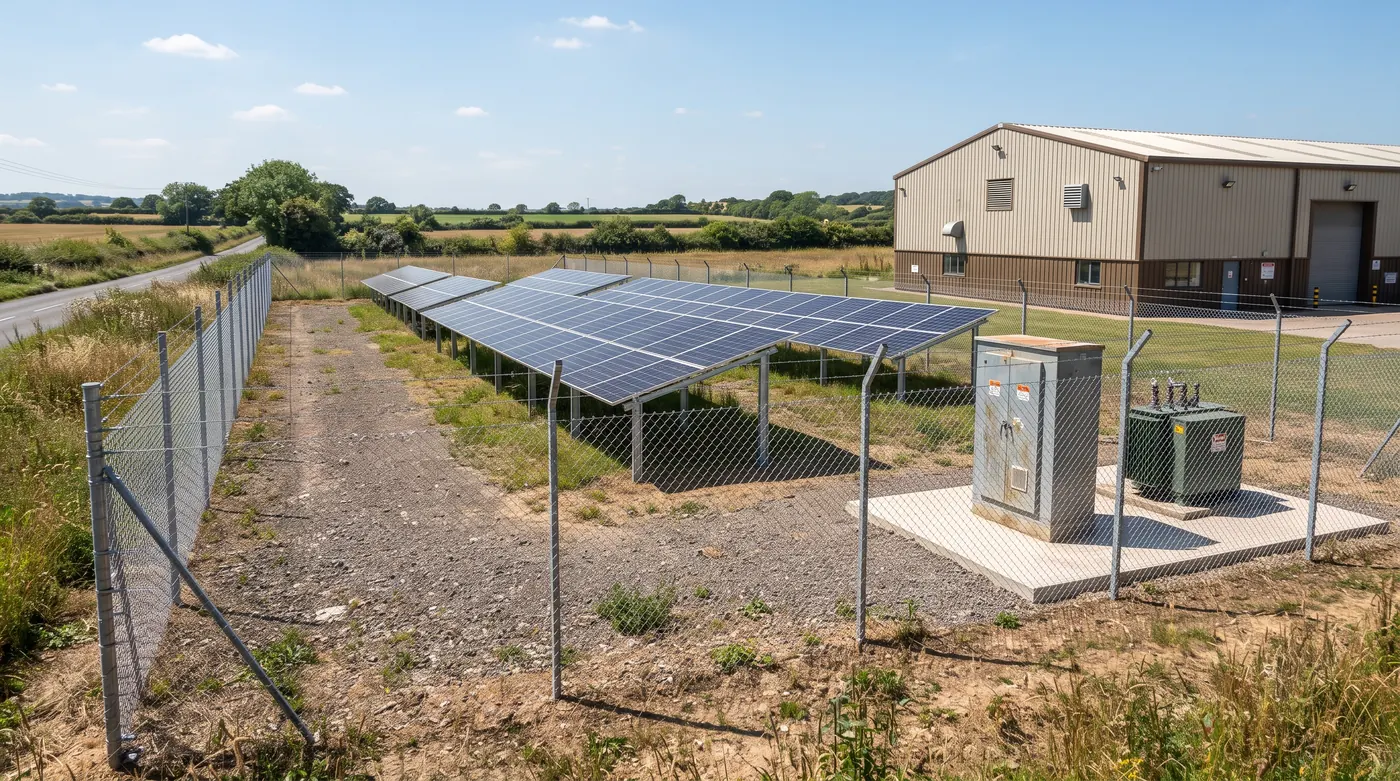
Lawrence Berkeley National Laboratory’s study of US solar plants suggested national benchmarks of about 0.35 MWdc per acre for fixed-tilt arrays and 0.24 MWdc per acre for single-axis tracking.
Fixed tilt: 0.1 ÷ 0.35 = 0.29 acre (about 12,400 sq ft). Tracking: 0.1 ÷ 0.24 = 0.42 acre (about 18,200 sq ft)
Those densities come from large plants. A 100 kW site has proportionally more fence line, an access lane and an equipment pad, so budget roughly 0.4 to 0.7 acre. Long trenches back to the building also add cost and voltage drop.
Can your building’s electrical service handle 100 kW?
This is the question that separates a 100 kW project from a house-sized one. Almost every commercial building of this size has three-phase service, usually 208 V or 480 V. A 100 kWdc array is commonly paired with about 80 to 85 kW of three-phase inverter capacity, a DC to AC ratio near 1.2, often split across three or four string inverters so a single failure does not stop the whole site.
At 480 V: 83,000 ÷ (1.732 × 480) = 100 A. At 208 V: 83,000 ÷ (1.732 × 208) = 230 A
The solar breaker is sized at 125% of that continuous current, so roughly 125 A at 480 V or about 290 A at 208 V. You can check other voltages with the watts to amps calculator.
The 120% busbar check
For a load-side connection, the electrical code limits how much backfed current a switchboard busbar can carry. A common form of the rule: the main breaker plus 125% of the inverter current must not exceed 120% of the busbar rating.
| Service | Busbar and main | Room for solar (120% minus main) | Solar breaker needed | Result |
|---|---|---|---|---|
| 480 V three-phase | 800 A / 800 A | 160 A | 125 A | Fits |
| 208 V three-phase | 800 A / 800 A | 160 A | about 290 A | Does not fit |
When the numbers do not fit, the usual fixes are a supply-side connection ahead of the main breaker, a smaller main breaker if the building’s load allows, or a switchboard upgrade. Your electrical engineer and inspector make the final call.
Will the utility require an interconnection study?
Possibly, and you should plan as if it might. In many states the simplest Level 1 review only covers small inverter systems, often up to about 10 kW to 25 kW. A 100 kW project usually goes into a fast track or Level 2 process, where the utility runs a set of technical screens on your feeder. A typical screen asks whether total generation on that section of line stays below about 15% of its annual peak load.
If the project passes, approval can come in weeks. If it fails a screen, the utility moves to supplemental review or a full study, which can add months and may end with a bill for upgrades such as a larger transformer or protective relaying. What to have ready:
- A one-line electrical diagram and site plan.
- Inverter spec sheets showing certification to the grid-support standards your utility requires.
- The application fee and any study deposit.
Ask for a hosting capacity map or pre-application report before you sign. It is the cheapest way to learn whether your feeder is already crowded.
What does a 100 kW system cost per watt?
The DOE benchmark for a 250 kW commercial rooftop put the modeled market price at about $1.98 per watt in early 2025. A 100 kW project carries similar permitting, engineering and interconnection work over fewer watts, so it usually lands a little higher per watt, though clearly below the price of a 50 kW job. Typical US ranges in late 2026:
| Installed cost per watt | 100 kW total | Typical situation |
|---|---|---|
| $1.80 | $180,000 | Open flat roof or simple ground mount, 480 V service, competitive market |
| $2.20 | $220,000 | Typical commercial rooftop |
| $2.75 | $275,000 | Roof work, switchboard upgrade, long trenching or utility upgrade costs |
If you are also weighing a 50 kW array, the 50kW solar system guide shows how the per-watt price rises as projects get smaller.
Ownership, PPAs and tax rules
The 30% residential credit for homeowner-owned systems ended after December 31, 2025, but a 100 kW system is almost always owned by a business, a public entity or a third party. Business-owned solar falls under separate federal credits and depreciation rules that the 2025 tax law changed, including tighter construction and in-service deadlines and limits on equipment from certain foreign suppliers. Schools and nonprofits without tax liability often use a power purchase agreement, explained in our solar PPA vs lease guide, or check whether direct-payment options apply to them. Confirm eligibility and timing with a tax adviser before signing.
How fast does a 100 kW system pay back at commercial and industrial rates?
The EIA Electric Power Monthly reports a US average of 14.53 cents per kWh for commercial customers and 9.77 cents for industrial customers in July 2026. The table holds cost at $220,000 and varies the rate. It assumes the middle output of 131,400 kWh a year, all used on site, and about $2,000 a year for monitoring, cleaning and an inverter replacement reserve.
Simple payback = $220,000 ÷ net yearly savings
| Energy rate | Typical buyer | Net yearly savings | Simple payback |
|---|---|---|---|
| $0.10 per kWh | Manufacturer on an industrial tariff | $11,140 | 19.7 years |
| $0.145 per kWh | Average commercial building | $17,053 | 12.9 years |
| $0.20 per kWh | High-cost state, warehouse or school | $24,280 | 9.1 years |
| $0.25 per kWh | California or New England commercial rate | $30,850 | 7.1 years |
Any business credit or depreciation the owner can use shortens these figures. Low export credits lengthen them, which hits schools hardest because of summer break. Model your own case in the solar payback calculator.
Why demand charges complicate the math
Many commercial and industrial bills include a demand charge based on the highest 15 or 30 minute power draw of the month. Solar output dips whenever a cloud passes, so it rarely lowers that peak reliably. Sites with heavy demand charges sometimes add storage for peak shaving; our 100kWh battery guide covers what a battery of that size can and cannot do.
Frequently asked questions
How many homes can a 100kW solar system power?
At the US middle value of 4.5 peak sun hours, 100 kW makes about 131,400 kWh a year. An average US home uses about 10,500 to 10,800 kWh a year, so the array covers the yearly use of roughly 12 homes. It cannot run them at night without the grid or batteries.
Does a 100 kW solar system need 480 V three-phase power?
Not strictly, but it helps. At 480 V the inverter output is about 100 A, which usually fits on an existing switchboard. At 208 V the same power is about 230 A, which often fails the 120% busbar check and needs a supply-side connection or upgrade. Single-phase service is rarely practical at this size.
How long does utility approval take for a 100 kW system?
If the project passes the fast track screens, often a few weeks to a couple of months. If it fails a screen and needs supplemental review or a full interconnection study, it can take several months or longer, and the utility may charge for upgrades. Ask for a pre-application report early.
Is a 100 kW system big enough for community solar?
It can be, but it is small for most state programs, which commonly involve projects of several hundred kilowatts to a few megawatts. A 100 kW array produces enough for about 12 average homes. Check your state program’s minimum project size and subscriber rules before planning around it.
What is a 100kW solar system’s cost per watt in 2026?
Typical US installations run about $1.80 to $2.75 per watt in late 2026, so $180,000 to $275,000 before incentives. Simple ground mounts and open 480 V sites sit at the low end. Roof repairs, switchboard upgrades and utility upgrade charges push projects toward the top of the range.


