Difference Between Volts and Amps (With Examples)

Short answer
Volts measure electrical pressure, the push that drives charge through a circuit. Amps measure current, how much charge actually flows past a point each second. Voltage is set by the source, current is set by the load. Multiply them and you get watts: a 1,500 W heater on a 120 V outlet draws 12.5 amps.
Volts and amps show up on every label, breaker and battery. One describes how hard electricity is being pushed, the other describes how much of it is moving. Knowing the difference between volts and amps tells you why a 12 V battery needs thick cables, why your dryer runs on 240 V, and what a breaker is actually protecting.
Volts vs amps at a glance
| Volts (V) | Amps (A) | |
|---|---|---|
| What it measures | Electrical pressure (potential difference) | Rate of current flow |
| Formula symbol | V or E | I |
| Definition | 1 volt = 1 joule of energy per coulomb of charge | 1 amp = 1 coulomb of charge per second |
| What sets it | The source: utility, battery, solar panel | The load: how much the device draws |
| Measured with a meter | Across two points (in parallel) | Through the circuit (in series) or with a clamp meter |
| Typical US home values | 120 V outlets, 240 V large appliances | 15 A and 20 A branch circuits, 100 to 200 A service |
| What it decides in design | Insulation rating, shock risk, equipment compatibility | Wire size, breaker size, heat in conductors |
What is a volt?
A volt is a unit of electrical potential difference. It tells you how much energy each unit of charge gains or loses between two points. One volt equals one joule of energy per coulomb of charge. Voltage always describes a difference between two points, which is why a meter needs two probes to read it.
In practice, voltage is the “push” a source supplies. A US wall outlet delivers a nominal 120 V, a dryer or range circuit delivers 240 V, a car battery sits around 12.6 V when charged, and a home solar battery bank is often built at 48 V. The ANSI C84.1 standard allows a 120 V service to range from 114 V to 126 V, so a reading of 118 V is normal.
Voltage can exist with no current at all: a battery on a shelf has 12 V across its terminals, but zero amps flow until you connect something.
What is an amp?
An amp, short for ampere, measures electric current: the amount of charge passing a point each second. One amp equals one coulomb of charge per second, which is roughly 6.24 quintillion electrons.
Current is what does the work and what makes heat. When current flows through a wire, the wire warms up in proportion to the current squared. That is why wires and breakers are rated in amps, not volts. A 14 AWG copper circuit is protected at 15 A and a 12 AWG circuit at 20 A, regardless of whether the circuit runs at 120 V or 240 V. For bigger loads, our guide to wire size for a 40 amp breaker shows how the amp rating drives the gauge.
A source does not “push out” a fixed number of amps. A 20 A outlet can supply up to 20 A, but a phone charger plugged into it may draw less than half an amp.
The water pipe analogy
The most common way to picture the difference is a water system:
- Voltage is water pressure (psi). It is the force available to push water through the pipe.
- Current is the flow rate (gallons per minute). It is how much water actually moves.
- Resistance is the pipe size or a partly closed valve. It limits flow for a given pressure.
- Power is the work the water does, like turning a water wheel. You need both pressure and flow to get work done.
Electricity behaves the same way, which is why the same 1,800 W of power can be delivered as 15 A at 120 V or 150 A at 12 V.
How volts, amps, watts and ohms connect
Two short formulas tie everything together. Ohm’s law links voltage, current and resistance, and the power formula links voltage, current and watts.
Power: P (watts) = V × I so I = P ÷ V
Example: 1,500 W ÷ 120 V = 12.5 A, and R = 120² ÷ 1,500 = 9.6 Ω
With any two of the four values you can find the other two. The Ohm’s law calculator handles all four, and the watts to amps calculator is the fastest way to check what a specific appliance draws.
Worked example 1: space heater
A 1,500 W space heater on a 120 V outlet draws 1,500 ÷ 120 = 12.5 A. That is fine on its own 15 A circuit, but add a 600 W microwave on the same circuit and you reach 2,100 ÷ 120 = 17.5 A, which trips a 15 A breaker.
Worked example 2: water heater element
A 4,500 W water heater element on 240 V draws 4,500 ÷ 240 = 18.75 A. The same element design at 120 V would need 37.5 A, double the current, for the same heat. This is why large appliances are wired for 240 V.
Worked example 3: solar panel label
A 400 W panel with a maximum power voltage (Vmp) of 31 V produces 400 ÷ 31 = about 12.9 A at peak. Wire two in series and the voltage doubles to 62 V while current stays at 12.9 A. Wire them in parallel and current doubles to 25.8 A while voltage stays at 31 V. Our guide on how to wire solar panels in series vs parallel covers this in detail.
Same watts, different volts: why current changes
For a fixed amount of power, higher voltage means lower current. The table shows what an 1,800 W load draws at common voltages:
| System voltage | Where you see it | Current for 1,800 W |
|---|---|---|
| 12 V | Car, RV, small off-grid battery | 150 A |
| 24 V | Boats, mid-size off-grid systems | 75 A |
| 48 V | Home solar battery banks | 37.5 A |
| 120 V | Standard US outlet | 15 A |
| 240 V | Dryer, range, EV charger | 7.5 A |
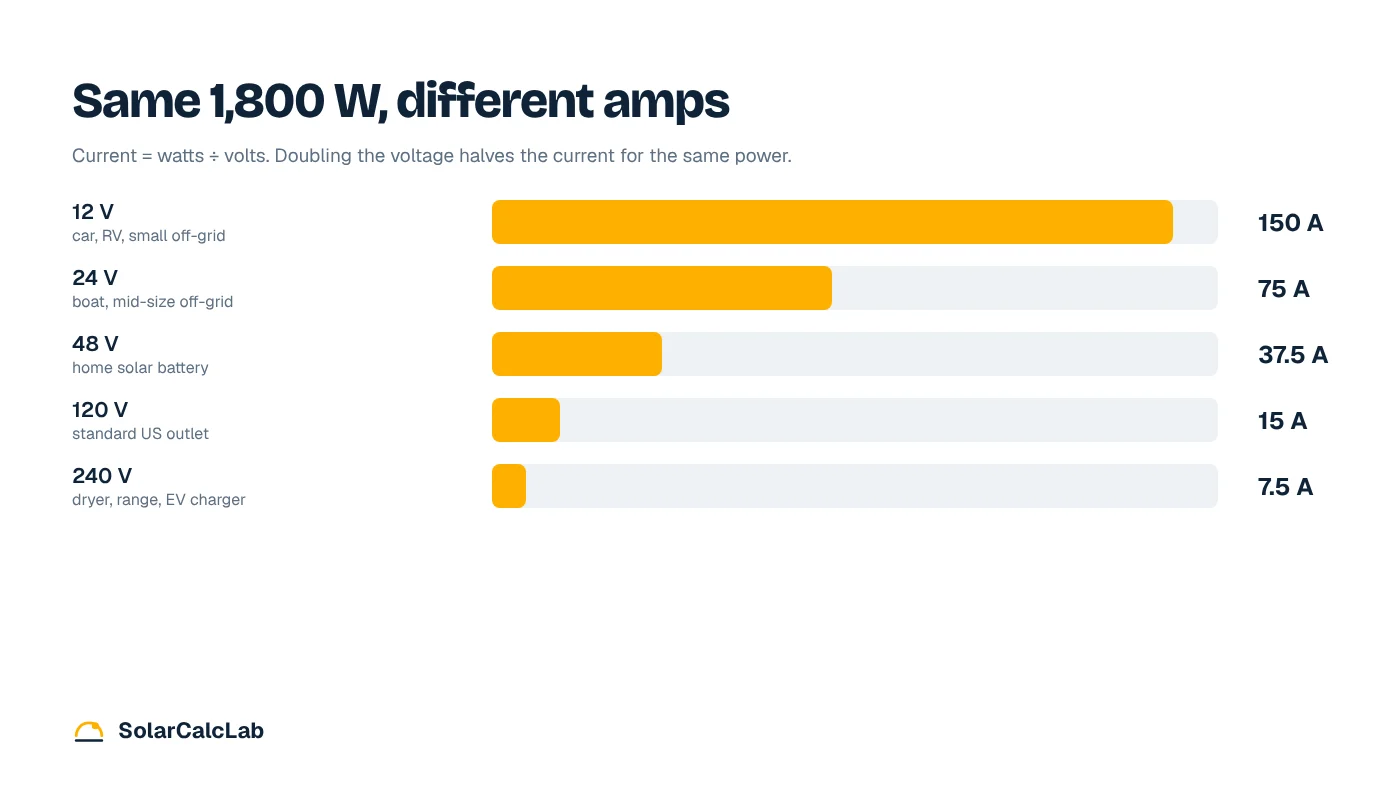
This matters because wire heating and power loss depend on current squared (P = I² × R). A 3,000 W inverter on a 12 V battery pulls 250 A before inverter losses, or about 278 A at 90% efficiency. The same inverter on a 48 V battery pulls 62.5 A, or about 69 A with losses. Quartering the current cuts resistive loss in the same cable to one sixteenth. That is the main reason home solar storage has moved to 48 V, and why the wire size calculator asks for both voltage and current.
Higher voltage does not make a device use less energy. The heater still uses 1.5 kWh per hour whether it runs at 120 V or 240 V. Your utility bills you for kilowatt-hours, not volts or amps, as the EIA explains in its guide to measuring electricity.
Volts and amps in a typical US home
| Circuit or device | Voltage | Typical amps |
|---|---|---|
| General outlets and lights | 120 V | 15 A circuit |
| Kitchen countertop outlets | 120 V | 20 A circuit |
| Electric clothes dryer | 240 V | 30 A circuit |
| Electric range | 240 V | 40 to 50 A circuit |
| Level 2 EV charger (48 A) | 240 V | 60 A circuit, 11.5 kW |
| Whole-house service | 120/240 V | 100 to 200 A |
Notice that the voltage is nearly fixed at 120 V or 240 V, while the amps vary widely. If you know an appliance’s amps and voltage, the volts to watts calculator gives its power.
Which is more dangerous, volts or amps?
Current through the body is what causes injury, but voltage decides how much current can be forced through you. Your body has resistance, so by Ohm’s law higher voltage drives more current through the same path.
- Dry skin can have a resistance near 100,000 Ω. At 120 V that allows about 1.2 mA, roughly the level you can just feel.
- Wet skin can drop to about 1,000 Ω. The same 120 V then pushes about 120 mA, which can stop the heart.
Currents above roughly 10 mA can make it hard to let go of a conductor, and currents near 100 mA across the chest can trigger ventricular fibrillation, according to OSHA electrical safety guidance. That is why a 20 A outlet is dangerous even though you only need a tiny fraction of its current to be hurt, and why GFCI outlets trip at about 5 mA of leakage. A 12 V battery rarely shocks you, yet it can deliver hundreds of amps into a short circuit and melt a wrench.
How to measure volts and amps
- Voltage: set a multimeter to AC or DC volts and touch the probes across the two points.
- Current with a multimeter: place the meter in series so current flows through it. Most meters handle only 10 A this way.
- Current with a clamp meter: clamp around a single conductor. This is safer and works for high currents.
Never touch the probes across an outlet with the meter in amp mode. It acts as a short circuit and can fail violently.
Frequently asked questions
What is the main difference between volts and amps?
Volts measure electrical pressure, the potential difference that pushes charge. Amps measure current, the rate at which charge flows. Voltage is set by the power source, and current is set by the load connected to it. Multiplying volts by amps gives power in watts.
How many amps is 120 volts?
Voltage alone does not tell you the amps. Current depends on the device: amps = watts ÷ volts. A 60 W bulb at 120 V draws 0.5 A, a 1,200 W microwave draws 10 A and a 1,500 W heater draws 12.5 A. A standard 120 V circuit is protected at 15 A or 20 A.
Can you convert volts to amps?
Not directly, because they measure different things. You need a third value. With watts, amps = watts ÷ volts. With resistance, amps = volts ÷ ohms. For example, 240 V across a 9.6 Ω heating element draws 25 A.
Is higher voltage or higher amperage more dangerous?
Current through the body causes harm, but voltage determines how much current can flow through your skin and tissue. That is why high voltage is the main shock hazard. Even 120 V can push a lethal current through wet skin, while 12 V usually cannot be felt. High current sources like batteries are still a burn and fire risk in a short circuit.
Does a higher voltage system use less electricity?
No. Energy use depends on watts and hours, so a 1,500 W heater uses 1.5 kWh per hour at 120 V or 240 V. Higher voltage lowers the current, which allows thinner wire and reduces heat losses in the wiring, so it can save a small amount of energy on long runs.


