Aluminum Wire Ampacity Chart: 1/0, 2/0 and #2
Short answer
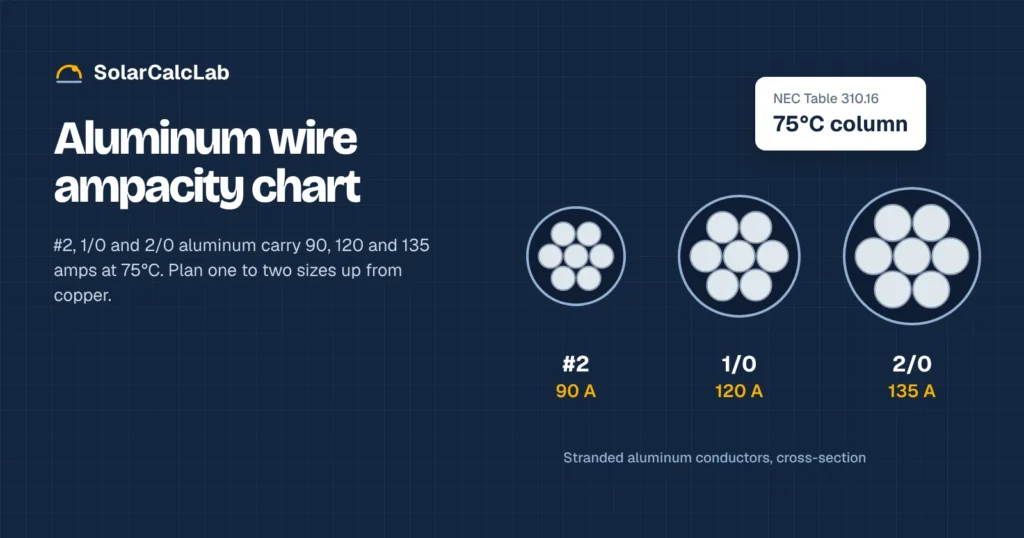
Under NEC Table 310.16 at the 75°C column, #2 aluminum wire is rated 90 amps, 1/0 aluminum is rated 120 amps and 2/0 aluminum is rated 135 amps. At the 60°C column the same sizes carry 75, 100 and 115 amps. Aluminum needs roughly one to two sizes larger than copper for the same current.
Aluminum is the standard choice for service entrance cable, feeders to subpanels and long runs to outbuildings, because it costs far less than copper at the large sizes where wire gets expensive. The catch is that aluminum carries less current than copper of the same gauge, so you need an accurate aluminum wire ampacity chart before you pick a size.
The chart below lists every common aluminum size from 12 AWG to 500 kcmil, then explains which temperature column applies, how the dwelling service rule lets you use a smaller wire, and when voltage drop should push you up a size. Values come from Table 310.16 in NFPA 70, the National Electrical Code.
Aluminum wire ampacity chart
Ampacity is the current a conductor can carry continuously without exceeding its temperature rating. These values assume no more than three current-carrying conductors in a raceway or cable and an ambient temperature of 86°F (30°C).
| Aluminum size | 60°C (140°F) | 75°C (167°F) | 90°C (194°F) |
|---|---|---|---|
| 12 AWG | 15 A* | 20 A* | 25 A* |
| 10 AWG | 25 A* | 30 A* | 35 A* |
| 8 AWG | 35 A | 40 A | 45 A |
| 6 AWG | 40 A | 50 A | 55 A |
| 4 AWG | 55 A | 65 A | 75 A |
| 3 AWG | 65 A | 75 A | 85 A |
| 2 AWG | 75 A | 90 A | 100 A |
| 1 AWG | 85 A | 100 A | 115 A |
| 1/0 AWG | 100 A | 120 A | 135 A |
| 2/0 AWG | 115 A | 135 A | 150 A |
| 3/0 AWG | 130 A | 155 A | 175 A |
| 4/0 AWG | 150 A | 180 A | 205 A |
| 250 kcmil | 170 A | 205 A | 230 A |
| 300 kcmil | 195 A | 230 A | 260 A |
| 350 kcmil | 210 A | 250 A | 280 A |
| 400 kcmil | 225 A | 270 A | 305 A |
| 500 kcmil | 260 A | 310 A | 350 A |
*Section 240.4(D) limits the breaker on small aluminum conductors to 15 A for 12 AWG and 25 A for 10 AWG, whatever the table column says. The same values appear in wire makers’ published tables, such as the Cerrowire ampacity chart.
#2 aluminum wire ampacity
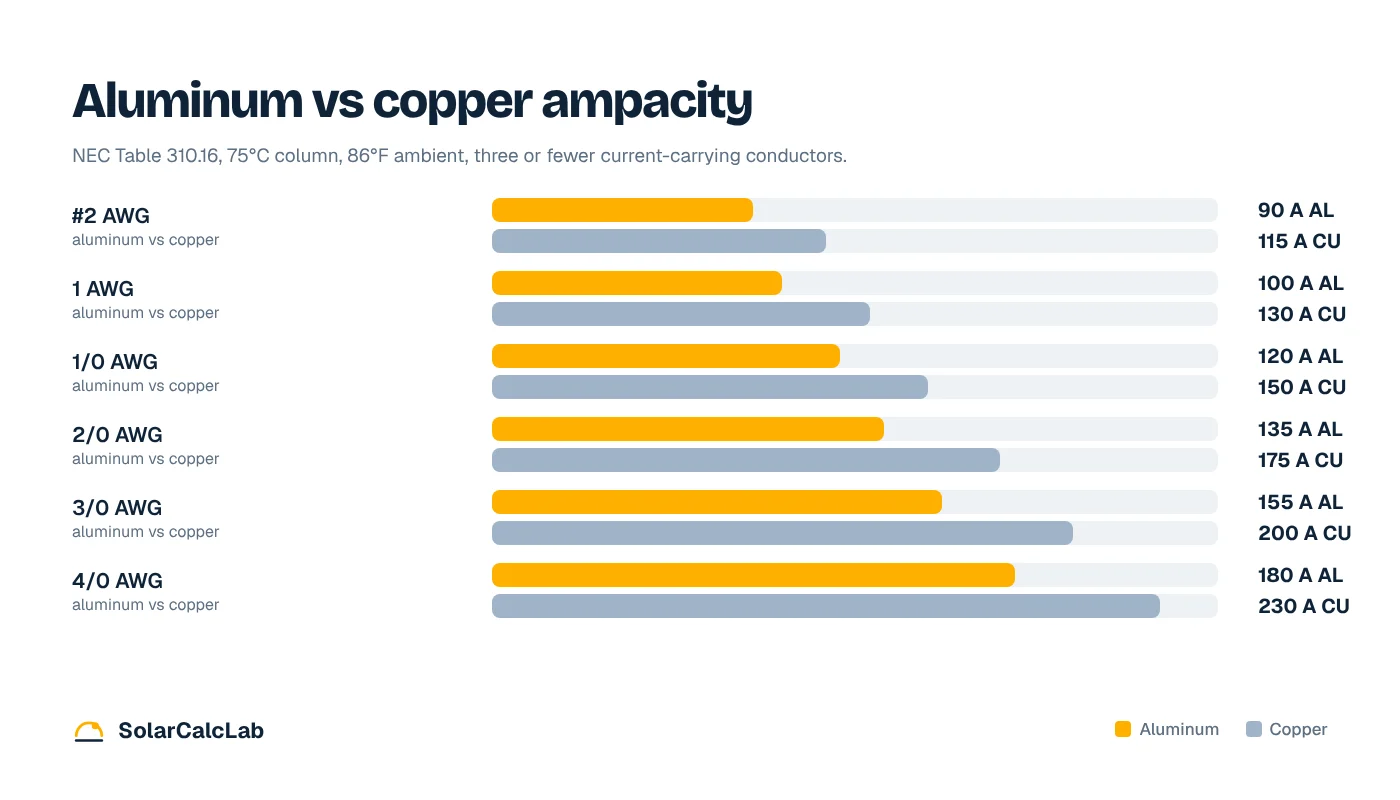
#2 aluminum is rated 75 A at 60°C, 90 A at 75°C and 100 A at 90°C. In practice it is sized from the 75°C column when the breaker and lugs are marked 75°C, which most modern equipment is, so it is a 90 amp conductor. That makes it a common feeder for a 90 amp breaker and, under the dwelling service rule covered below, a 100 amp residential service.
On a standalone 100 amp feeder to a subpanel or a garage, #2 aluminum falls short. You need 1 AWG aluminum at the 75°C column, and many electricians simply use 1/0 for the extra margin.
1/0 aluminum wire ampacity
1/0 aluminum carries 100 A at 60°C, 120 A at 75°C and 135 A at 90°C. Because it is larger than 1 AWG, Section 110.14(C) lets you use the 75°C column as long as the terminations are rated 75°C, giving it a working ampacity of 120 amps. It is a standard choice for 100 amp subpanel feeders, and it covers a 125 amp dwelling service.
2/0 aluminum wire ampacity
2/0 aluminum is rated 115 A at 60°C, 135 A at 75°C and 150 A at 90°C. At the 75°C column it suits a 125 amp feeder, and the next standard breaker size up rule in Section 240.4(B) can allow a 150 amp breaker for feeders that are not continuous loads. Under the dwelling service rule, 2/0 aluminum is the usual conductor for a 150 amp home service.
Which temperature column should you use?
A circuit is limited by its lowest-rated part: the wire insulation, the cable type or the terminals at either end. Use these rules to pick the column:
- Terminations rated 100 amps or less, or wire from 14 AWG to 1 AWG, default to the 60°C column unless the equipment is marked for 75°C, under Section 110.14(C)(1)(a).
- Terminations rated above 100 amps, or wire larger than 1 AWG, use the 75°C column.
- The 90°C column is only a starting point for derating when wires run through hot spaces or share a crowded conduit. You can derate from the 90°C value, but the final ampacity can never exceed the termination rating.
- SE cable run inside a building using the wiring methods for NM cable must be sized from the 60°C column, under Section 338.10(B)(4)(a).
The 83% rule for dwelling services
For a single-family home, Section 310.12 lets the service conductors and the main feeder carry as little as 83% of the service rating, because a whole house never draws its full rating for long. This rule applies only to the main service or the feeder that carries the entire dwelling load, not to subpanels.
| Service rating | Minimum ampacity (83%) | Aluminum size | Copper size |
|---|---|---|---|
| 100 A | 83 A | 2 AWG | 4 AWG |
| 125 A | 104 A | 1/0 AWG | 2 AWG |
| 150 A | 125 A | 2/0 AWG | 1 AWG |
| 175 A | 145 A | 3/0 AWG | 1/0 AWG |
| 200 A | 166 A | 4/0 AWG | 2/0 AWG |
This is why 4/0 aluminum is the familiar wire on a 200 amp home service even though its 75°C ampacity is only 180 amps. Your utility and local inspector may have their own requirements, so confirm before you buy.
Aluminum vs copper: size equivalents
As a rule of thumb, aluminum needs to be about two AWG sizes larger than copper to carry the same current. Here is how they compare at the 75°C column:
| Ampacity needed | Copper | Aluminum |
|---|---|---|
| 65 A | 6 AWG | 4 AWG |
| 85 to 90 A | 4 AWG | 2 AWG |
| 100 A | 3 AWG | 1 AWG |
| 115 to 120 A | 2 AWG | 1/0 AWG |
| 130 to 135 A | 1 AWG | 2/0 AWG |
| 150 to 155 A | 1/0 AWG | 3/0 AWG |
| 175 to 180 A | 2/0 AWG | 4/0 AWG |
Aluminum is lighter and much cheaper per foot, which matters on a 150 foot run to a detached garage. Copper is smaller, more flexible and less sensitive to poor terminations. For the same job, the copper version of the circuit is usually easier to pull but costs two to three times as much in wire.
Voltage drop on long aluminum runs
Ampacity keeps the wire from overheating. It does not account for the voltage lost over distance. The NEC suggests, in an informational note, keeping feeder voltage drop to about 3%. Using resistance values from NEC Chapter 9, Table 8 (0.319 ohms per 1,000 feet for #2 aluminum, 0.201 for 1/0 and 0.159 for 2/0), an 80 amp load at 240 V works out like this:
| One-way distance | #2 aluminum | 1/0 aluminum | 2/0 aluminum |
|---|---|---|---|
| 50 ft | 2.6 V (1.1%) | 1.6 V (0.7%) | 1.3 V (0.5%) |
| 100 ft | 5.1 V (2.1%) | 3.2 V (1.3%) | 2.5 V (1.1%) |
| 150 ft | 7.7 V (3.2%) | 4.8 V (2.0%) | 3.8 V (1.6%) |
| 200 ft | 10.2 V (4.3%) | 6.4 V (2.7%) | 5.1 V (2.1%) |
Example: 2 × 150 ft × 80 A × 0.000201 Ω/ft = 4.8 V, or 2.0% of 240 V
Past about 140 feet, #2 aluminum at a heavy load goes over 3%, so 1/0 is the better choice. Enter your exact distance and load in the voltage drop calculator, or let the wire size calculator choose a gauge for both ampacity and voltage drop.
Installing aluminum wire safely
The aluminum wire problems of the 1960s and 1970s involved small branch-circuit conductors on devices made for copper. Modern building wire uses AA-8000 series alloy, and large aluminum feeders have a long safety record when they are terminated correctly:
- Use lugs and breakers marked AL or CU/AL. Never land aluminum on a copper-only terminal.
- Torque every connection to the manufacturer’s value with a torque screwdriver or wrench. Section 110.14(D) now requires a calibrated tool where a torque value is marked.
- Brush the strands and apply antioxidant compound when the lug maker calls for it.
- Do not nick the strands when stripping, since that reduces the conductor’s capacity.
- Derate for heat and bundling. More than three current-carrying conductors in one conduit, or a run across a hot rooftop, lowers the allowed ampacity.
Service and feeder work needs a permit in most jurisdictions. If you are unsure about any part of the job, hire a licensed electrician.
Frequently asked questions
How many amps can 1/0 aluminum wire carry?
1/0 aluminum is rated 100 amps at 60°C, 120 amps at 75°C and 135 amps at 90°C under NEC Table 310.16. With 75°C rated terminals, which most modern breakers and lugs have, it is used as a 120 amp conductor.
What is the ampacity of 2/0 aluminum wire?
2/0 aluminum carries 115 amps at 60°C, 135 amps at 75°C and 150 amps at 90°C. At the 75°C column it suits a 125 amp feeder, and under the 83% dwelling service rule it is the standard conductor for a 150 amp home service.
Is #2 aluminum wire good for 100 amps?
Only as the main service or whole-house feeder of a single-family home, where Section 310.12 allows 83% of the rating. For a 100 amp subpanel or any other feeder, #2 aluminum is limited to 90 amps, so use 1 AWG or 1/0 aluminum instead.
What size aluminum wire do I need for a 100 amp subpanel?
Use at least 1 AWG aluminum, which is rated 100 amps at 75°C, with breakers and lugs rated for 75°C and aluminum. Many installers choose 1/0 aluminum for extra headroom and lower voltage drop, especially on runs over 100 feet.
Why is 4/0 aluminum used for 200 amp service?
4/0 aluminum is rated 180 amps at 75°C. The NEC lets dwelling service conductors carry 83% of the service rating, which is 166 amps for a 200 amp service, so 4/0 aluminum meets the requirement. This rule does not apply to a 200 amp subpanel feeder, which needs 250 kcmil aluminum.


