40kW Solar System: Yearly Output, Panels Needed and 2026 Cost
Short answer
A 40kW solar system makes about 44,000 to 64,000 kWh a year in most of the US, or roughly 120 to 175 kWh a day. At 4.5 peak sun hours that is about 52,600 kWh a year. It takes about 94 panels at 430 W, around 2,000 square feet of panel area, and typically costs $84,000 to $124,000 installed in late 2026.
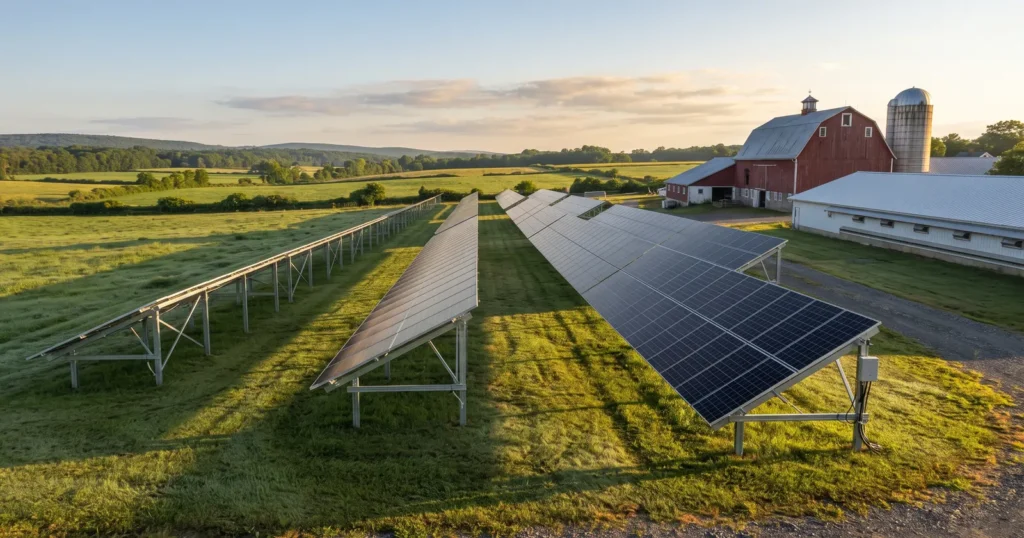
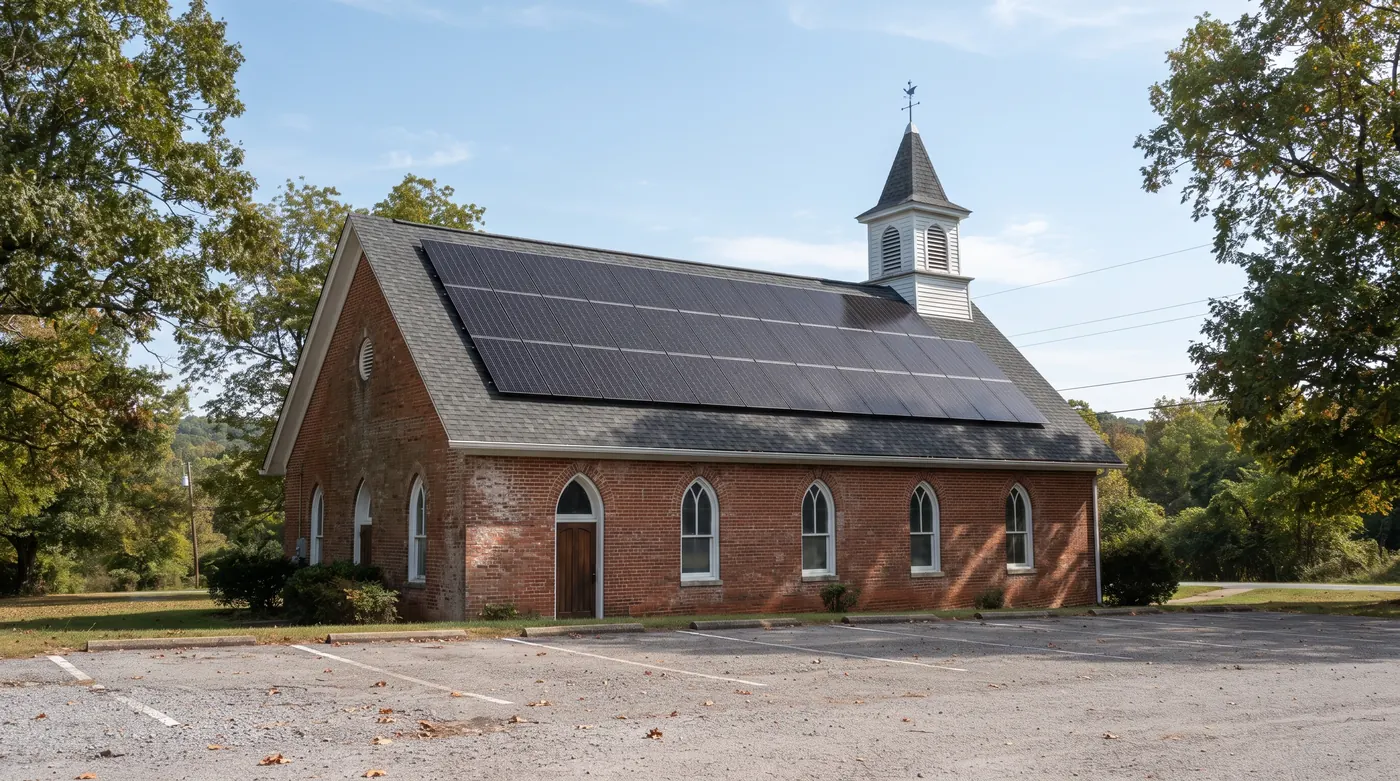
Forty kilowatts is the size where solar starts to make sense for a building that pays a commercial or farm electricity bill. It is too much for nearly any house, yet small enough to fit on one church roof, a restaurant with a decent flat roof, or a quarter-acre corner of a farm field.
The questions at this size are less about the panels and more about the bill. Does the building use power while the sun is up? Is part of the bill a demand charge? Is there enough roof, or does a ground mount make more sense? This guide answers those with worked numbers.
Which buildings is a 40kW solar system the right size for?
At the US middle value of 4.5 peak sun hours and 80% system efficiency, 40 kW makes about 4,380 kWh in an average month. The quickest test is to compare that with the kWh line on 12 months of your bills. The table uses example monthly usage figures, not national averages, so swap in your own.
| Building (example usage) | Monthly use | 40 kW average output | Share covered |
|---|---|---|---|
| Church with weekday office | 2,500 kWh | 4,380 kWh | about 175% (oversized) |
| Small professional office | 4,000 kWh | 4,380 kWh | about 110% |
| Poultry houses (fans and lights) | 5,000 kWh | 4,380 kWh | about 88% |
| Dairy (milk cooling, vacuum pumps) | 6,000 kWh | 4,380 kWh | about 73% |
| Full-service restaurant | 9,000 kWh | 4,380 kWh | about 49% |
Two patterns stand out. A church often uses less energy than people expect, so 40 kW can overshoot, and a 20 to 25 kW array may be the better match (see the 20kW solar system guide). A busy restaurant is the opposite: 40 kW covers about half its energy, and the timing of its use matters as much as the total.
Irrigation pumps
Pumps are a natural fit because they run in the sunniest months. A motor’s electrical draw is roughly its horsepower times 0.746, divided by motor efficiency:
Example: 25 hp × 0.746 ÷ 0.90 = 20.7 kW; 8 hours a day for 30 days = 4,970 kWh a month
A 40 kW array covers most of that 25 hp pump’s use in a typical month, and more in midsummer when sun hours run higher. A 40 hp pump draws about 33 kW, so the same array covers roughly half of an 8-hour daily run.
How many kWh does a 40kW solar system produce?
The nameplate rating is set in lab conditions. SolarCalcLab plans every size with 80% system efficiency to cover heat, wiring, dust and inverter losses:
Example: 40 × 4.5 × 0.80 = 144 kWh a day, or 52,560 kWh a year
| Peak sun hours | Typical areas | Per day | Per year |
|---|---|---|---|
| 3.5 | Cloudy northern areas such as the Pacific Northwest | 112 kWh | 40,880 kWh |
| 4.0 | Upper Midwest, interior Northeast | 128 kWh | 46,720 kWh |
| 4.5 | US middle value | 144 kWh | 52,560 kWh |
| 5.0 | Texas, Florida | 160 kWh | 58,400 kWh |
| 5.5 | Southern California, Colorado | 176 kWh | 64,240 kWh |
| 6.0 | Desert Southwest | 192 kWh | 70,080 kWh |
That matches the site rule of 1,100 to 1,600 kWh per kW each year in most of the country. Output swings with the seasons: a northern array might make twice as much in June as in December. Model your own tilt and direction in the solar panel output calculator.
How many panels and how much space does 40 kW take?
Example: 40,000 ÷ 430 = 93.02, so 94 panels (40.4 kW)
| Panel rating | Panels | Array size | Panel area |
|---|---|---|---|
| 400 W | 100 | 40.0 kW | about 2,000 sq ft |
| 430 W | 94 | 40.4 kW | about 2,000 sq ft |
| 550 W | 73 | 40.2 kW | about 2,000 sq ft |
| 600 W | 67 | 40.2 kW | about 2,000 sq ft |
Panel area stays near 2,000 square feet whatever the wattage, because it follows efficiency: 40,000 W ÷ (1,000 W/m² × 0.215) is about 186 m². Bigger modules simply mean fewer pieces to rack and wire. String design may nudge the count to 90 or 96 so every inverter input gets equal strings; the how many solar panels calculator handles other wattages.
Roof or ground mount: which suits a 40kW array?
Usable roof needs to be larger than panel area once fire setbacks, vents and edges are subtracted. Plan on about 2,400 to 3,200 square feet of clear sloped roof, or 3,200 to 4,000 square feet on a flat roof with tilted rows. Check your own outline with the solar panel roof area calculator.
| Factor | Roof mount | Ground mount |
|---|---|---|
| Space | 2,400 to 4,000 sq ft of clear roof | about 0.15 to 0.3 acre including access |
| Orientation | Fixed by the roof | Can face due south at the best tilt |
| Extra costs | Structural check, possible reroof | Piles or footings, fencing, trenching |
| Maintenance | Roof access needed | Easy cleaning; mowing or gravel underneath |
| Best for | Churches, offices, restaurants | Dairies, poultry farms, pump sites |
Churches often have large sloped roofs, but steep or ornate sections and older shingles can rule parts out. Replace a roof with less than about 10 years of life left before installing. Restaurants must keep panels clear of kitchen exhaust fans and HVAC units, and grease from exhaust can coat nearby modules. Farms usually choose a ground mount, but long runs from the field to the service panel need careful conductor sizing. A 150 ft trench is common, so run the numbers in the voltage drop calculator before choosing wire.
Will a 40kW system cut demand charges on a commercial bill?
Many commercial and farm tariffs bill in two parts: an energy charge per kWh, and a demand charge per kW based on the highest 15 or 30 minute average power you drew during the month. Solar reduces the first reliably. It reduces the second only when your peak happens during strong sun.
Example: 45 kW peak × $15 per kW = $675 a month, whether that peak lasted 15 minutes or all day
Take a restaurant whose peak hits at 6:30 pm during the dinner rush. A 40 kW array is producing very little at that hour, so the $675 stays. An office that peaks at 2 pm when the air conditioning works hardest may shave a few kW, but one cloudy afternoon at the wrong moment sets the peak for the whole month.
The rates are not trivial. An NREL survey of US demand charges found nearly 5 million commercial customers could subscribe to tariffs with demand charges above $15 per kW, with the highest above $50 per kW in parts of New York. Where demand charges are large, a battery that discharges during the peak does more for the bill than extra panels. Ask for 12 months of interval data from your utility to see exactly when your peaks happen.
How much does a 40kW solar system cost in 2026?
Price per watt falls as systems grow, so 40 kW sits between residential pricing and small commercial jobs. Typical US installed ranges in late 2026, before incentives:
- Lower end, about $2.10 per watt ($84,000): open ground mount or simple flat roof, competitive market.
- Middle, about $2.60 per watt ($104,000): typical rooftop on a church, office or restaurant.
- Upper end, about $3.10 per watt ($124,000): complex roof, long trenching or a service upgrade.
Tax credits for businesses, farms and churches
The 30% residential credit ended for homeowner-owned systems installed after December 31, 2025, so it does not apply here. Businesses and farms fall under separate commercial credit and depreciation rules, which the 2025 tax law tightened with new construction and in-service deadlines. Tax-exempt groups such as churches have used elective pay for some clean energy credits. Rules and deadlines are changing, so confirm eligibility with a tax adviser before signing.
How long does a 40 kW system take to pay back?
Payback depends on what each solar kWh is worth on your tariff. The EIA reports a US average commercial price of 14.53 cents per kWh for July 2026. That average is revenue divided by kWh sold, so it blends in demand charges. On a demand tariff, solar may only save the lower energy charge.
Payback (years) = installed cost ÷ net yearly savings
The $840 is an assumed budget of $21 per kW a year for monitoring, cleaning and an inverter replacement reserve.
| Value per kWh | Net savings a year | $84,000 system | $104,000 system | $124,000 system |
|---|---|---|---|---|
| $0.10 (energy charge only, demand unchanged) | $4,416 | 19.0 years | 23.6 years | 28.1 years |
| $0.145 (US commercial average) | $6,781 | 12.4 years | 15.3 years | 18.3 years |
| $0.20 | $9,672 | 8.7 years | 10.8 years | 12.8 years |
| $0.25 | $12,300 | 6.8 years | 8.5 years | 10.1 years |
The spread shows why reading the tariff matters more than the panel brand. Any business credit or depreciation shortens these figures; low export credits for surplus power lengthen them. Test your own numbers in the solar payback calculator.
Can a 40kW system connect to single-phase service?
This is the question that separates 40 kW from smaller jobs. Rural churches, small farms and older shops often have 240 V single-phase service, not three-phase. With a DC to AC ratio near 1.2, a 40 kW array pairs with about 33 kW of inverter output:
Three-phase 208 V: 33,000 ÷ (1.732 × 208) = 92 A. At 480 V: 33,000 ÷ (1.732 × 480) = 40 A
A 138 A backfeed is far more than a typical panel busbar can accept under the common 120% rule, so single-phase sites usually need a supply-side connection, a larger service, or a smaller array. Several single-phase string inverters can share the output, but the utility transformer must also handle the export, and that can trigger an upgrade at your cost. Three-phase buildings have it easier: two 15 to 17 kW three-phase inverters is a common layout. At the next size up, the 50kW solar system guide covers the fuller commercial interconnection process.
Frequently asked questions
How many kWh does a 40kW solar system make per month?
About 3,700 to 5,300 kWh in an average month across most of the US, and about 4,380 kWh at 4.5 peak sun hours. Summer months produce well above the average and winter months well below, especially in northern states, so compare against a full year of bills.
Is a 40kW solar system enough to run an irrigation pump?
For a 25 hp pump running about 8 hours a day, a 40 kW array covers most of its monthly use, and more in midsummer. A 40 hp pump draws about 33 kW, so the same array covers roughly half. Pumping season lines up well with peak solar output.
Can a church get a tax benefit from a 40 kW system?
Possibly. Tax-exempt organizations have used elective pay to receive some federal clean energy credits as a payment, but the 2025 tax law added construction and in-service deadlines for solar. Check current rules with a tax adviser. The homeowner credit does not apply to church-owned systems.
Does a 40 kW solar system need three-phase power?
Not strictly, but it is much easier with it. On 240 V single-phase service, about 33 kW of inverter output means roughly 138 A of current, which usually requires a supply-side connection or service upgrade. On 480 V three-phase, the same output is only about 40 A.
How much roof space does a 40kW solar system need?
The panels themselves cover about 2,000 square feet. After fire setbacks, vents and edge clearances, plan on roughly 2,400 to 3,200 square feet of clear sloped roof, or 3,200 to 4,000 square feet on a flat roof with tilted rows spaced to avoid winter shading.