50kWh Battery: Runtime, Uses and Cost
Short answer
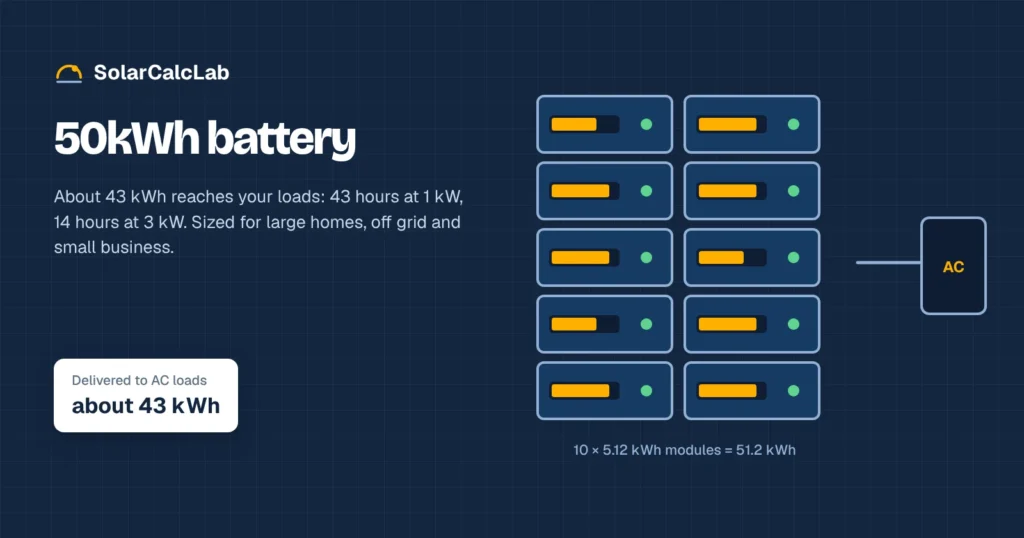
A 50 kWh battery stores about 45 kWh you can actually use, and after inverter losses it delivers roughly 43 kWh to AC loads. That runs a steady 1 kW load for about 43 hours, a 3 kW load for about 14 hours, or an average US home using 30 kWh a day for about 1.4 days. It is a size for large all-electric homes, off-grid properties and small businesses. Installed, expect roughly $28,000 to $79,000 depending on your state and the hardware, with no federal credit for homeowners in 2026.
Fifty kilowatt-hours sits in an awkward spot. It is too big to be a normal home battery and too small to be a typical commercial project. That makes it easy to oversize into, and also easy to buy for the wrong reason. The questions worth answering before you get a quote are simple: how long will it really run your loads, what does it take to build, where can it legally go, and will it earn its keep?
This guide works through each of those with real numbers. If you are still deciding on capacity in general, start with our guide on how much battery storage you need and come back once 50 kWh looks like the answer.
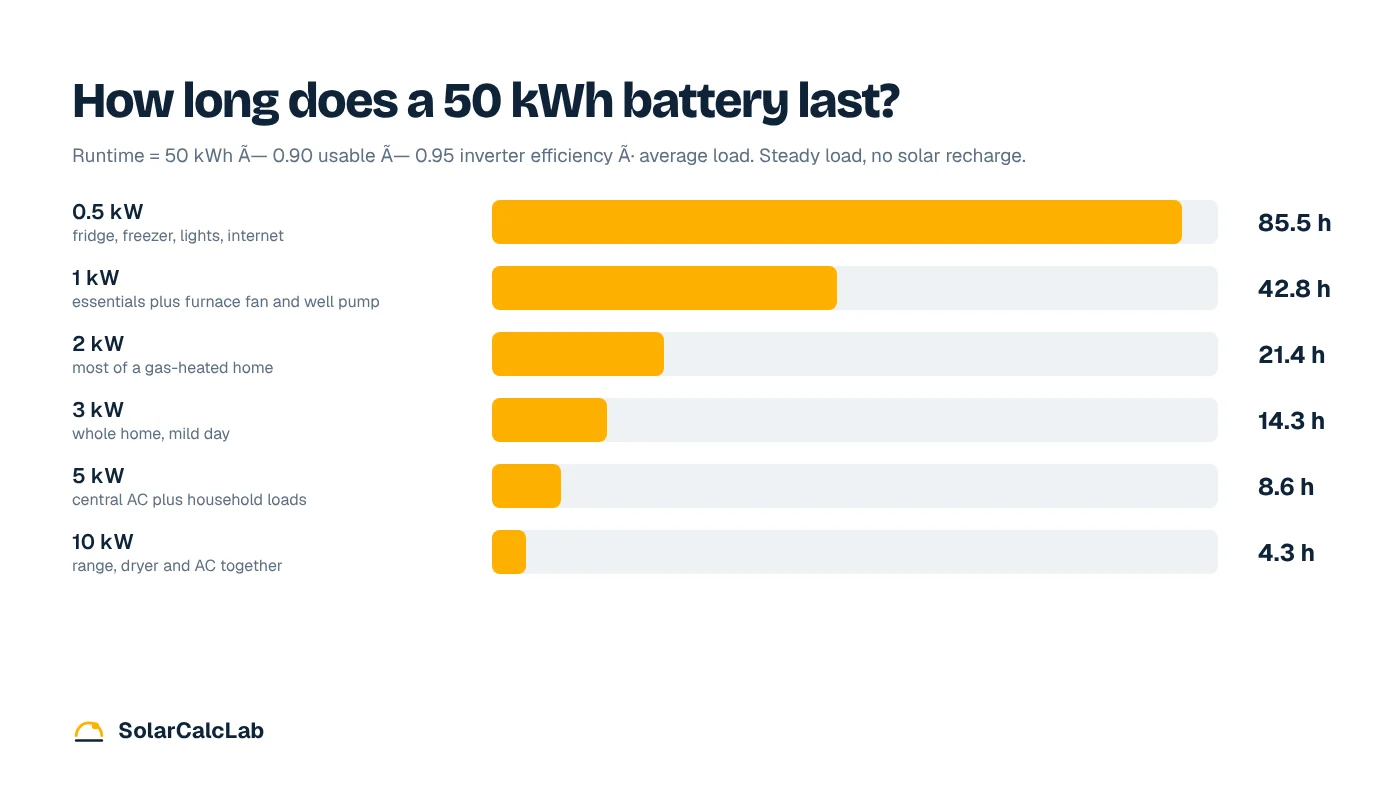
How long does a 50 kWh battery last?
Runtime depends on three things: the nameplate capacity, how deep the battery is allowed to discharge, and how much energy the inverter loses turning DC into AC. Most lithium iron phosphate (LFP) systems reserve about 10% of capacity, and a good hybrid inverter runs near 95% efficient.
50 × 0.90 × 0.95 = 42.75 kWh delivered | 42.75 ÷ 3 kW = about 14 hours
| Average load | What that looks like | Runtime from 50 kWh |
|---|---|---|
| 0.5 kW | Fridge, freezer, lights, internet, phone charging | about 85 hours (3.5 days) |
| 1 kW | Essentials plus a gas furnace blower and a well pump | about 43 hours |
| 2 kW | Most of a gas-heated home, no AC | about 21 hours |
| 3 kW | Whole home on a mild day with some cooking | about 14 hours |
| 5 kW | Central AC cycling hard plus household loads | about 8.5 hours |
| 10 kW | Electric range, dryer and AC together | about 4.3 hours |
Load is an average, not a peak. A home that hits 9 kW when the dryer and oven overlap may still average 1.5 kW across a full day. The battery life calculator lets you enter your own capacity, depth of discharge and load to check these figures for your setup.
Days of backup for different homes
An average US home uses close to 30 kWh a day, so 42.75 kWh covers about 1.4 days with no solar recharge. A large all-electric house using 45 kWh a day gets a little under one day. Cut that same house to essentials averaging 1.2 kW, and the battery stretches to about 36 hours. Add solar, and on sunny days the panels refill part or all of what you used, so a multi-day outage becomes manageable.
Who actually needs 50 kWh?
Most homes do not. One or two 13.5 kWh-class batteries handle typical backup, and our whole house battery backup guide shows why power output, not storage, is usually the limit. Fifty kWh starts to make sense in four situations:
- Off-grid homes using 15 to 20 kWh a day that want two to three days of autonomy through cloudy weather.
- Large all-electric homes with heat pumps, an EV and long outages, where 27 kWh would run out overnight.
- Rural properties with well pumps, livestock waterers or medical equipment that cannot go dark.
- Small businesses trying to cut demand charges or keep refrigeration and point-of-sale systems running.
If you only want backup for a fridge, lights and the internet during a few outages a year, 50 kWh is more battery than you will ever cycle. Compare the step down to a 30 kWh battery before you commit.
Three ways to build a 50 kWh battery
Nobody sells a single 50 kWh box for homes, because residential fire codes cap each unit at 20 kWh. Instead, 50 kWh is assembled from modules.
| Build route | Typical setup | Strengths | Trade-offs |
|---|---|---|---|
| Stacked residential batteries | Four 13.5 kWh-class units = 54 kWh | Installer support, app monitoring, warranty | Highest cost per kWh |
| 48 V server rack modules | Ten 5.12 kWh (51.2 V, 100 Ah) modules = 51.2 kWh | Lowest cost, flexible, common off grid | DIY design, needs separate inverter and heavy cabling |
| Small commercial cabinet | One outdoor cabinet, often three-phase | One enclosure, built for daily cycling | Usually needs commercial permitting and an electrician who knows it |
At 51.2 V, 50 kWh equals about 977 amp-hours, which is why off-grid builders often describe this size as roughly a 1000Ah battery bank. The kWh to Ah converter handles other voltages.
Do not forget the inverter
Capacity tells you how long. Inverter rating tells you how much at once. A 50 kWh bank on a single 8 kW inverter cannot start a 4-ton heat pump while the dryer runs, no matter how full it is. For whole-home use, plan on 15 to 25 kW of continuous inverter output, and check motor surge loads with the inverter size calculator.
Where can a 50 kWh battery be installed?
US home battery rules come from NFPA 855, adopted through state residential and fire codes. For one and two family homes, an aggregate of 40 kWh is generally allowed in a utility closet, basement or storage room, and 80 kWh in a garage, on an exterior wall or outdoors. A 50 kWh bank is over the indoor limit, so it typically goes in the garage or outside, or gets split between two locations. Our 60 kWh battery guide covers spacing and detection requirements in more detail.
For a business, the commercial chapters of the fire code apply instead, and local fire officials usually review the plan. Ask your installer about this before you pick a location, since moving a battery after the inspection is expensive.
Does a 50 kWh battery pay for itself?
Backup alone rarely pays back. A battery earns money when it cycles, ideally every day, by avoiding expensive grid power. The two common ways are demand charge reduction for businesses and time-of-use shifting for homes.
Small business: shaving demand charges
Many commercial tariffs bill a demand charge on the highest 15-minute peak of the month, on top of energy charges. An NREL survey of US demand charges found that roughly 5 million commercial customers could face rates above $15 per kW, the level where batteries start to look attractive.
Take a hypothetical restaurant with a 40 kW afternoon peak and a $15 per kW demand charge. A 50 kWh battery with a 25 kW inverter trims the peak by 15 kW:
Annual saving = $225 × 12 = $2,700
Shaving time available = 42.75 kWh ÷ 15 kW = about 2.85 hours
Assume an installed quote of $40,000. A business that owns the battery may qualify for the 30% Section 48E investment credit, which Plante Moran notes remains available for storage, subject to the foreign entity rules that began in 2026. That brings the net cost to $28,000 and the simple payback to about 10.4 years. Add $936 a year of time-of-use savings (30 kWh shifted each weekday at a 12 cent spread) and payback drops to about 7.7 years. Confirm eligibility with a tax adviser, since credit rules depend on ownership and equipment sourcing.
The catch: a demand charge is set by your single worst interval. If the peak lasts longer than the battery can cover on one hot day, that month’s saving disappears. Size from your utility’s 15-minute interval data, not monthly bill totals.
Large home: time-of-use and net billing
Under net billing tariffs like California’s NEM 3.0, solar exports may earn about 5 cents per kWh while evening imports cost far more. Storing midday solar and using it after sunset captures that gap.
Suppose a home uses 18 kWh during the evening peak and the spread is 40 cents (45 cents peak minus 5 cents export value). Shifting all 18 kWh is worth about $2,628 a year. But covering 18 kWh only takes about 21 kWh of nameplate battery. A 50 kWh unit earns no more on a normal day, because the house simply does not use more in the peak window. The extra capacity only pays off in outages or if you add a large evening load like an EV. Run your own tariff through the home battery savings calculator.
How much does a 50 kWh battery cost?
EnergySage marketplace data put installed home batteries at about $1,159 per kWh on average in the first half of 2026, with state averages from about $563 to $1,586 per kWh. Applied to 50 kWh:
| Route | Price basis | Estimated cost for 50 kWh |
|---|---|---|
| Installed, low-cost state | about $563 per kWh | about $28,150 |
| Installed, national average | about $1,159 per kWh | about $57,950 |
| Installed, high-cost state | about $1,586 per kWh | about $79,300 |
| DIY 48 V rack modules, batteries only | about $150 to $330 per kWh | about $7,500 to $16,500 plus inverters, wiring and permits |
Homeowners who buy a battery in 2026 cannot claim the 30% federal residential credit, which ended for systems installed after December 31, 2025. Some states and utilities still offer storage rebates or pay for grid services, so check local programs. Businesses follow different rules, as covered above.
Recharging it with solar
Refilling 45 usable kWh takes about 47.4 kWh of charging energy at 95% efficiency. With 4.5 peak sun hours and 80% system efficiency, each kW of panels makes about 3.6 kWh a day, so a full daily refill needs about 13 kW of solar, or around 31 panels of 430 W. Most owners do not need a full refill every day, but off-grid systems should be designed for it.
Before you buy: a quick decision check
- Pull 12 months of usage. Interval data for a business, or at least monthly kWh for a home.
- Decide what the battery is for. Backup only, daily savings, or off-grid autonomy. Each leads to a different size.
- Size the inverter for your largest simultaneous loads, including motor starting current.
- Confirm the install location against the 40 kWh indoor and 80 kWh garage or outdoor limits.
- Price two sizes. If 30 kWh covers 90% of your outages for half the cost, the last 20 kWh is expensive insurance.
The battery backup calculator is a quick way to test how many hours each size gives for the loads you listed.
Frequently asked questions
How many hours will a 50 kWh battery last?
About 42.75 kWh reaches your AC loads after a 10% reserve and 5% inverter loss. Divide that by your average load in kW: about 43 hours at 1 kW, 14 hours at 3 kW and 8.5 hours at 5 kW.
Can a 50 kWh battery run a house off grid?
Yes, for a home using 15 to 20 kWh a day it provides roughly two to three days of autonomy, as long as the solar array can refill it and the inverter can handle your peak loads. For a 30 kWh a day home it covers about 1.4 days without sun.
How many Powerwall-size batteries make 50 kWh?
Four 13.5 kWh units give 54 kWh of nameplate capacity. Three units give 40.5 kWh, which falls short. Check the maker’s limit on how many units one system supports.
Can I install a 50 kWh battery in my basement?
Usually not as a single bank. NFPA 855 generally limits batteries in a utility room or basement of a home to 40 kWh in total. Garages, exterior walls and outdoor pads allow up to 80 kWh, or you can split the bank. Local code adoption varies.
Is there a tax credit for a 50 kWh battery in 2026?
Not for homeowners who buy it, because the residential clean energy credit ended for systems installed after 2025. A business that owns the battery may qualify for the Section 48E credit, subject to sourcing rules, so ask a tax adviser before signing.