Whole House Battery Backup: Sizing and Cost

Short answer
Whole house battery backup means the battery feeds your main panel, so every circuit stays live in an outage. For a typical US home that takes 2 to 3 batteries in the Powerwall 3 class (27 to 40.5 kWh and 23 to 34.5 kW of output), because the limit is usually power, not storage. A gas-heated home with central AC can often manage with one or two units. At the 2026 average quote of about $1,159 per kWh, two units run roughly $31,000 and three about $47,000 before any state incentive.
Most battery quotes are sized around how many kWh you use in a day. For whole home backup, the question that trips people up is simpler: what happens when the AC, the oven and the dryer all ask for power in the same minute?
This guide sizes whole home backup from the panel outward. We start with the loads that can actually overload a battery, work through three different homes, and then show where load management lets you buy one fewer battery. If you only want backup for a fridge, lights and Wi-Fi, an essentials panel is cheaper, and our battery storage sizing guide covers that route step by step.
Three levels of “whole house”
Installers use the phrase loosely. Before comparing quotes, ask which of these you are being offered.
| Backup level | What stays on | How it is wired | Typical battery count |
|---|---|---|---|
| Partial home (essentials) | 10 to 16 chosen circuits | Separate backup subpanel | 1 |
| Whole home with load management | Every circuit, but big loads are paused or limited | Gateway or backup switch at the main, plus smart breakers or load controllers | 1 to 2 |
| Unrestricted whole home | Everything, at the same time | Gateway at the main, battery output sized to peak demand | 2 to 4 |
Tesla’s own Powerwall 3 datasheet shows the split clearly: a Powerwall 3 with the Backup Switch or Gateway 3 is listed as whole home backup, while the Backup Gateway 2 configuration is listed as partial home. Same battery, different wiring.
Power is the real limit
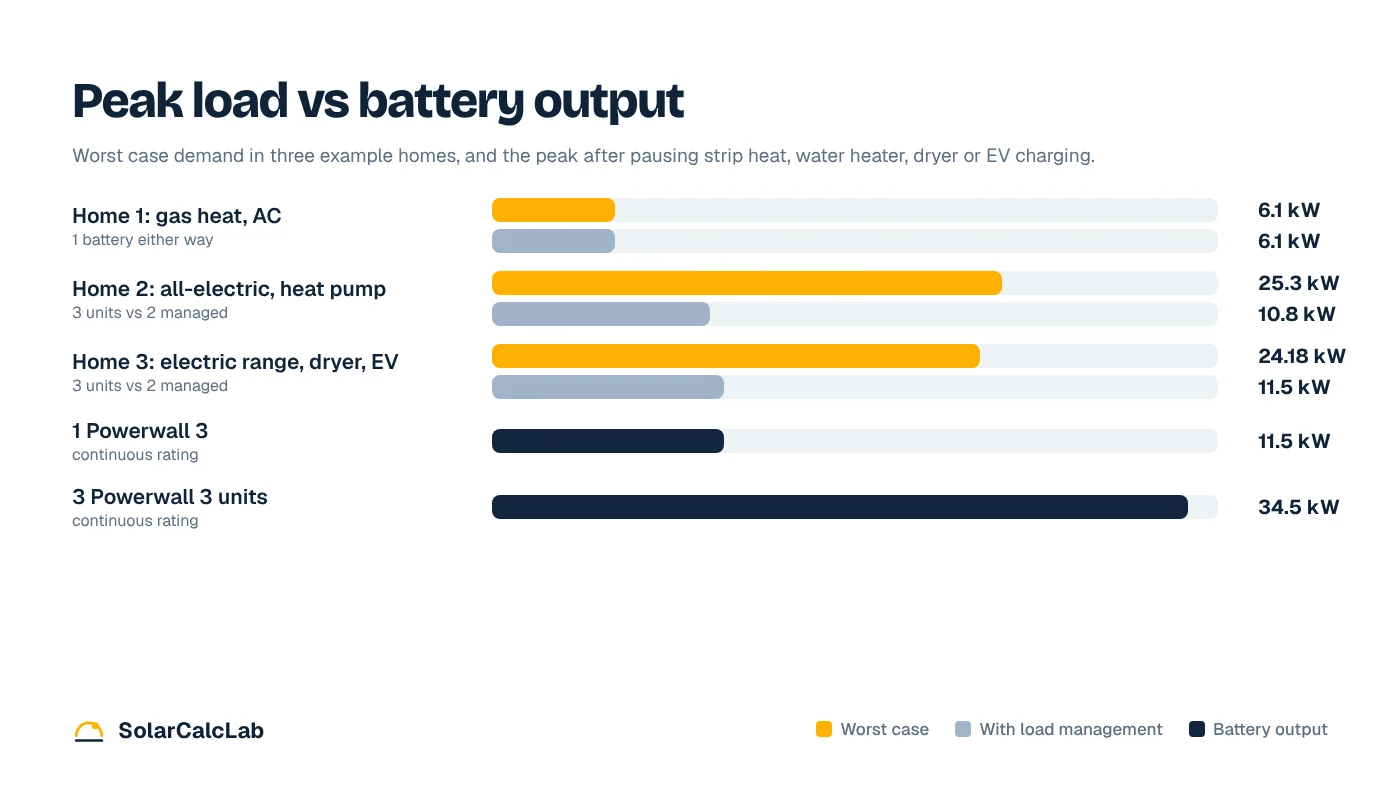
A 200 amp service at 240 volts can deliver up to 48 kW. No single home battery comes close. A Powerwall 3 is rated at 11.5 kW continuous, a FranklinWH aPower 2 at 10 kW, and an Enphase IQ Battery 5P at 3.84 kVA. Whole home backup works only because a house almost never uses its full service capacity at once.
The loads that decide the count
Small loads barely matter. The large 240 volt appliances are what force a second or third battery. These are typical running figures; your nameplates may differ.
| Load | Typical running power | Can it be paused in an outage? |
|---|---|---|
| Base loads (fridge, lights, Wi-Fi, TV, furnace blower) | 0.6 to 1.0 kW | No, this is why you bought backup |
| Central AC, 3 ton | about 3.5 kW | Yes, with a thermostat or load controller |
| Heat pump strip heat, 10 kW | 10 kW | Yes, usually the first load to lock out |
| Electric range, oven plus two burners | about 6 kW | Rarely; people cook during outages |
| Electric dryer | about 5 kW | Yes |
| Electric water heater | 4.5 kW | Yes, a full tank stays hot for hours |
| Level 2 EV charger at 32 A | 7.68 kW | Yes, most chargers can be scheduled off |
Check any of these against your own breaker sizes with the watts to amps calculator. If you want help building the list, the appliance wattage chart lists running and starting watts for common household devices.
Starting current is a separate test
Compressors and well pumps draw several times their running current for a fraction of a second. The battery has to supply that surge or it will trip offline. Look for LRA (locked rotor amps) on the outdoor condenser label and compare it with the battery’s start rating.
- Powerwall 3: 185 LRA per unit, according to the datasheet.
- Enphase IQ Battery 5P: up to 48 A LRA per unit, according to the Enphase data sheet, so a central AC usually needs several units working together.
- FranklinWH aPower 2: the company says one unit can start a 5 ton AC but does not publish an LRA number.
If your condenser is close to the limit, a soft starter installed on the compressor lowers the inrush and is far cheaper than another battery.
Sizing three real-world home types
The three homes below are examples built from the typical figures above, not measured households.
Home 1: gas heat, gas water heater, central AC
Worst case: base loads 0.8 kW + 3 ton AC 3.5 kW + microwave 1.2 kW + furnace blower 0.6 kW = 6.1 kW. One Powerwall 3 covers that with room to spare.
Energy is the tighter number here. On a hot day this house uses about 30 kWh, an average of 1.25 kW. A single 13.5 kWh battery lasts about 10.8 hours at that pace, so it gets through an evening and night only if the AC is set back. Two units (27 kWh) stretch that to about 21.6 hours, and rooftop solar can refill them the next day. Our 20 kWh battery breakdown models a similar three-night outage with solar recharging.
Home 2: all-electric with a heat pump and strip heat
Worst case on a cold morning: base 0.8 + heat pump compressor 4.0 + strip heat 10.0 + range 6.0 + water heater 4.5 = 25.3 kW. Covering that without limits takes three Powerwall 3 units (34.5 kW).
Now lock out the strip heat and the water heater during an outage. Demand falls to 10.8 kW, inside one unit’s 11.5 kW rating. Energy still pushes you to two units: at a reduced 40 kWh a day, 27 kWh lasts about 16.2 hours. Winter solar output is low, so this house gains the most from a third battery or a small generator input.
Home 3: electric range and dryer, plus an EV
Worst case: base 0.8 + 4 ton AC 4.7 + range 6.0 + dryer 5.0 + EV charger 7.68 = 24.18 kW, which again means three units. Pause the EV charger and the dryer and the peak becomes 11.5 kW, exactly one unit’s rating. That leaves no margin for an AC start, so two units is the sensible choice. At about 30 kWh a day without EV charging, 27 kWh lasts about 21.6 hours.
| Home | Worst case peak | Units, unrestricted | Peak with load management | Units, managed |
|---|---|---|---|---|
| 1: gas heat, central AC | 6.1 kW | 1 | 6.1 kW | 1 (2 for overnight AC) |
| 2: all-electric, heat pump | 25.3 kW | 3 | 10.8 kW | 2 |
| 3: electric range, dryer, EV | 24.18 kW | 3 | 11.5 kW | 2 |
To run the same math on your own load list, enter it in the battery backup calculator for runtime, then check the peak with the inverter size calculator.
What whole home backup costs in 2026
EnergySage’s marketplace data put the average quote for a 13.5 kWh battery at about $15,647 in the first half of 2026, or roughly $1,159 per kWh before incentives. State averages on the same marketplace range from about $563 to $1,586 per kWh.
27 kWh × $1,159 = about $31,300 | 40.5 kWh × $1,159 = about $46,900
| Setup | Storage | Low state average | National average | High state average |
|---|---|---|---|---|
| 1 unit | 13.5 kWh | $7,600 | $15,600 | $21,400 |
| 2 units | 27 kWh | $15,200 | $31,300 | $42,800 |
| 3 units | 40.5 kWh | $22,800 | $46,900 | $64,200 |
Two items often appear on whole home quotes that an essentials quote skips: moving the main breaker or meter base to fit the gateway, and smart breakers or load controllers. Ask for them as separate lines so you can compare installers fairly.
Homeowners who buy a battery outright in 2026 no longer get the 30% federal credit, which ended for systems installed after 2025. Leases and some state or utility programs still help, as our solar tax credit guide explains. If bill savings matter as much as backup, the home battery savings calculator shows what time-of-use shifting could add back.
Battery or standby generator?
For long outages, a whole house generator is the main alternative. Neither is better in every case.
| Factor | Whole house battery | Standby generator |
|---|---|---|
| Outage length it handles well | Hours to a few days with solar recharging | Days to weeks while fuel lasts |
| Switchover | Near instant; electronics usually stay on | Several seconds after the outage starts |
| Running cost | None; can also cut time-of-use bills | Fuel plus regular servicing |
| Noise and exhaust | Silent, none | Engine noise, exhaust clearances apply |
| Weak spot | Short winter days, high-power electric heat | Fuel supply, no value on normal days |
When whole home backup is not worth it
- Your outages are short. If the power drops a few times a year for an hour or two, one battery on an essentials panel covers almost everything you will notice.
- Your heat is electric resistance. Baseboard or strip heat in a long winter outage can drain 40 kWh in a single day. A generator or a gas backup heater may be cheaper insurance.
- You do not have solar. Without panels, a battery is a fixed tank. Whole home backup then buys you hours, not days.
- The panel needs major work. If adding a gateway means a service upgrade, price that before deciding between essentials and whole home.
If the battery will sit beside panels, read how solar behaves during a power outage first, since the wiring choice decides whether the panels can recharge the battery while the grid is down.
Frequently asked questions
How many batteries does a 200 amp house need for whole home backup?
Usually two or three units in the 10 to 11.5 kW class. The 200 amp rating is not the target, because no home runs at full service capacity. Add up the large loads that could run together and divide by one battery’s continuous rating.
Can a whole house battery run central air and an EV charger at once?
Only if combined output covers both plus base loads. A 3 ton AC and a 32 amp charger add up to about 11.2 kW, more than one Powerwall 3 can supply with anything else running. Most owners pause EV charging during outages.
Do I need a panel upgrade for whole house battery backup?
Not always. Many installs add a gateway or backup switch next to the meter without changing the panel. An upgrade comes up when the existing panel has no spare space, is near the end of its life, or its busbar rating cannot accept the extra backfed current.
What does a smart panel or load controller add?
It lets the battery system switch large circuits off automatically when demand gets close to the battery’s limit. That is what makes “whole home” possible with one or two batteries instead of three or four.
Does whole house battery backup work without solar panels?
Yes. The battery charges from the grid and takes over when the grid fails. Runtime is limited to stored energy, so a 27 kWh system that lasts about a day cannot be refilled until power returns.