What Will a 5kW Inverter Run? Appliances, Battery Size and Solar Panels
Short answer
A 5kW inverter can run up to 5,000 watts of appliances at the same moment, for example a refrigerator, a chest freezer, a microwave, a window air conditioner and lights together. Motor startup surge is the real limit, so add loads one at a time. Pair it with a 48 V battery of about 5 to 10 kWh and roughly 3 to 6 kW of solar panels.
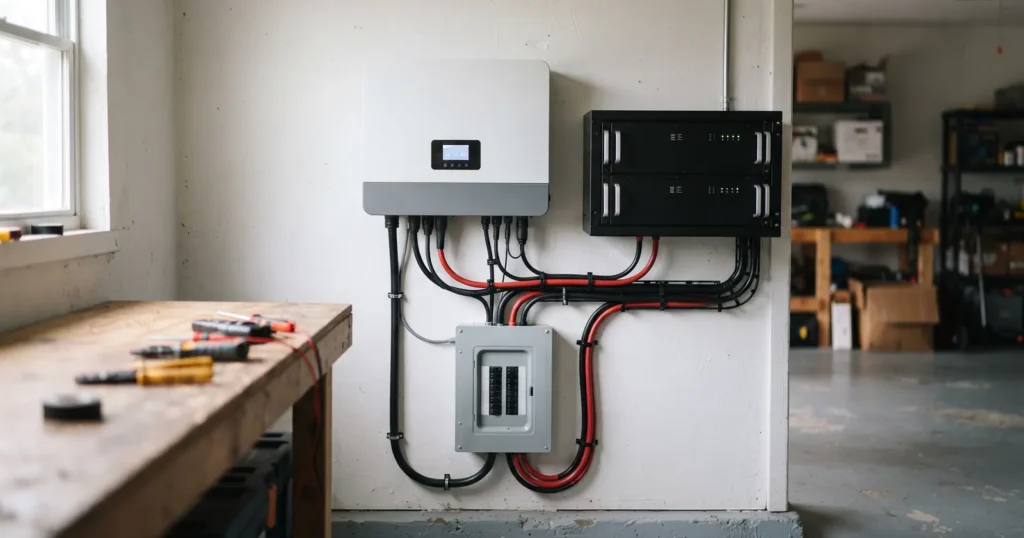
A solar power inverter 5000W unit sits in the middle of the market. It is big enough for a well-equipped RV, an off-grid cabin or a home’s essential circuits, yet small enough to hang on a garage wall.
This guide works through what 5,000 watts actually covers, how startup surge changes the picture, why nearly every 5 kW model runs on 48 volts, and how to size the battery and panels that go with it. Each number comes from a formula shown on the page.
What can a 5000 watt inverter run at the same time?
An inverter rating is a ceiling on simultaneous load. Add up the running watts of everything that is on at once and keep the total under about 80% of the rating, which is 4,000 W for a 5 kW unit.
Running watts below are typical ranges for 120 V appliances. Starting watts apply to anything with a motor or compressor. For your own appliances, multiply the nameplate amps by 120 V.
| Appliance | Running watts | Starting watts (typical) | Fits on 5 kW? |
|---|---|---|---|
| Full-size refrigerator | 100 to 250 W | 600 to 1,200 W | Yes, easily |
| Chest freezer | 80 to 200 W | 500 to 1,000 W | Yes, easily |
| Microwave, 1,000 W cooking power | 1,400 to 1,600 W | No motor surge | Yes |
| Window AC, 8,000 BTU | about 730 W | 1,500 to 2,200 W | Yes |
| Window AC, 12,000 BTU | about 1,090 W | 2,200 to 3,300 W | Yes, start it alone |
| Sump pump, 1/2 hp | 900 to 1,200 W | 2,000 to 3,000 W | Yes, check surge rating |
| Circular saw or miter saw | 1,200 to 1,800 W | 2,000 to 3,500 W | Yes, one tool at a time |
| Portable air compressor, 1.5 to 2 hp | 1,500 to 1,800 W | 3,000 to 5,000 W | Marginal, depends on surge spec |
| Electric kettle or space heater | 1,500 W | No motor surge | Yes, but it eats a third of capacity |
The window AC figures come from the efficiency rating on the unit. Most new room air conditioners sit near a combined efficiency (CEER) of 11, and you can convert BTU to watts like this:
Example: 12,000 BTU ÷ 11 = about 1,090 W
A realistic combination on one 5 kW inverter: refrigerator (200 W), chest freezer (150 W), 12,000 BTU window AC (1,090 W), lights and electronics (300 W) and a microwave (1,500 W). That totals about 3,240 W, comfortably inside the 4,000 W working limit. Fridge wattage varies a lot by age and size, so check the guide to how many watts a refrigerator uses before you finalize the list.
How much surge can a 5kW inverter handle?
Induction motors draw several times their running current for a fraction of a second while they spin up. The inverter has to supply that burst on top of everything already running, or it shuts down on overload.
Spec sheets list a peak or surge rating, often around twice the continuous rating (about 10,000 W or VA) for anything from a few hundred milliseconds to about 5 seconds. Heavier low-frequency inverters with a transformer inside usually hold a surge longer, sometimes 10 to 20 seconds. Treat these as typical patterns and read the exact figure and duration on your model’s sheet.
Example: 1,850 W already running + 3,000 W sump pump start = 4,850 W peak, well under a 10,000 W surge rating
Trouble starts when two big motors start in the same second. Practical rules:
- Start the largest motor first, then add smaller loads.
- Do not run a compressor and a table saw at once on a 5 kW unit.
- Consider a soft starter on a window or mini-split AC if it trips the inverter. These cut the inrush current and are sold as add-ons for RV air conditioners.
The inverter size calculator adds running and starting watts for you and flags combinations that exceed the surge rating.
What will a 5kW inverter not run?
Five kilowatts covers a lot of a house, but not the big electric loads that define a typical US home. The EIA reports that the average residential customer bought about 10,791 kWh a year, close to 30 kWh a day, and much of that comes from loads like these:
- Central air conditioning. A 3 to 5 ton central system typically runs at 3,000 to 5,000 W with a much larger start. Most 5 kW inverters cannot start one reliably.
- Electric tank water heater. A standard 4,500 W element would use almost the entire inverter on its own.
- Electric range or oven. A single large burner can draw 2,500 to 3,000 W, and a full range far more.
- Level 2 EV charging. A common 32 A, 240 V charger draws about 7,700 W.
- 240 V loads on a 120 V inverter. Many 5 kW all-in-one units for the US output 120 V only. A 240 V well pump or dryer needs split-phase output, which usually means two units stacked or a single model built for 120/240 V.
The fix is to wire the inverter to a critical loads subpanel that holds the fridge, freezer, lights, outlets, internet, sump pump and a room AC, and to leave the heavy loads on the grid or a generator. At 120 V the inverter’s full output is 5,000 ÷ 120 = 41.7 A. Sizing the output circuit at 125% of that gives 52 A, so the manual will often call for a 60 A breaker. Follow your model’s installation guide and local code.
Should a 5kW inverter run on 12V, 24V or 48V?
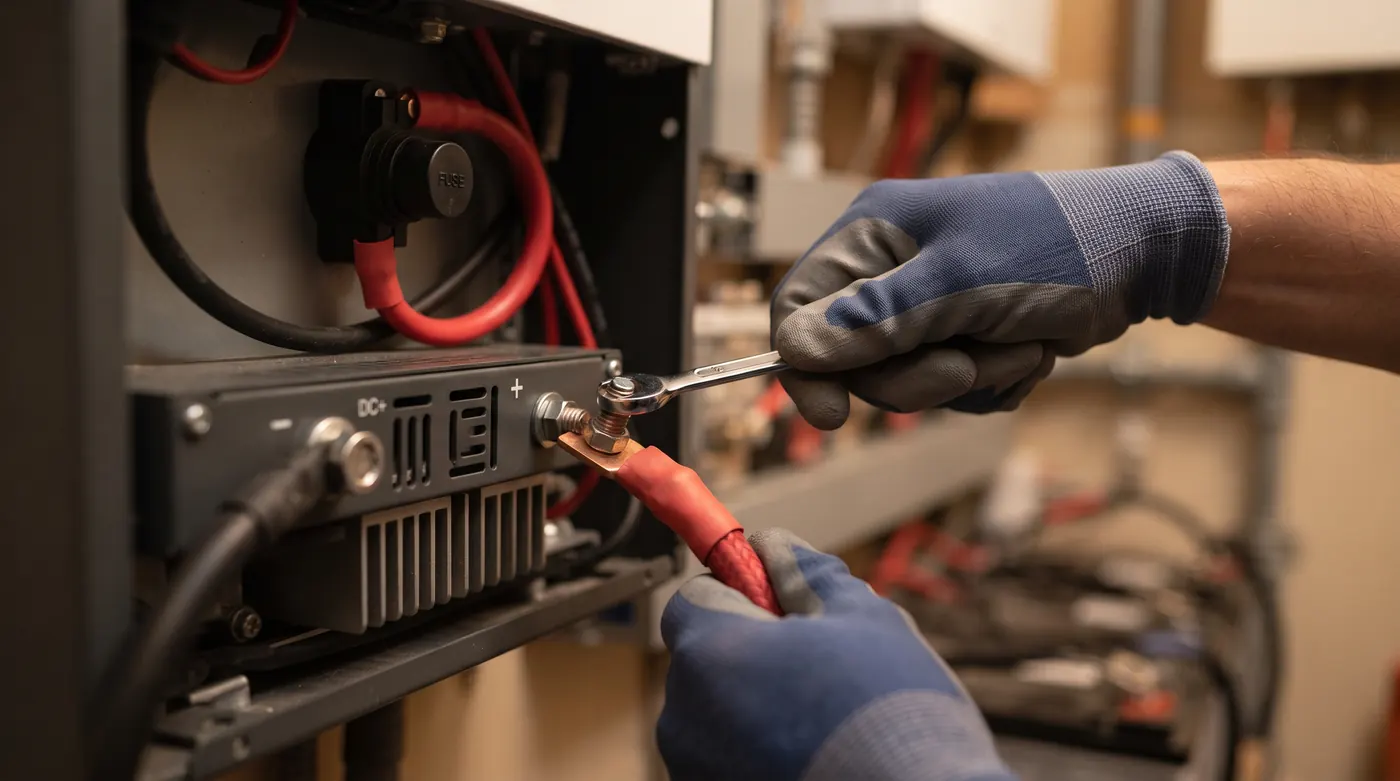
Battery voltage decides how much current flows between the battery and the inverter. Power is volts times amps, so at a low voltage the same 5,000 W needs a huge current. Assuming 90% inverter efficiency:
Example at 48 V: 5,000 ÷ (48 × 0.90) = 116 A
| Battery bank | Current at full 5,000 W | With 25% safety margin | What it means in practice |
|---|---|---|---|
| 12 V | 463 A | 579 A | Beyond a single 4/0 AWG cable; needs parallel runs and very short distances |
| 24 V | 231 A | 289 A | Heavy cable, large fuse, still workable in a van or RV |
| 48 V | 116 A | 145 A | Manageable cable around 1/0 AWG, standard fuses and breakers |
That is why 48 V dominates at this size. Lower current means thinner copper, smaller fuses, less heat and less voltage drop. Most all-in-one 5 kW hybrids are built only for 48 V batteries, and the common 51.2 V rack-mount LiFePO4 batteries are designed to match them.
A 12 V 5,000 W inverter does exist, mostly as a cheap stand-alone unit for trucks and older RVs. Running it at full load means oversized cables and batteries that can deliver over 450 A. Before you buy any of these, run your cable length through the wire size calculator to see what the current really demands.
How big a battery does a 5kW inverter need overnight?
Size the battery to your overnight energy use, not to the inverter rating. A 5 kW inverter that runs at full power for an hour pulls 5 kWh, but few homes or cabins hold that load for long after dark. The table assumes about 12 hours from evening to morning sun.
| Overnight load | Assumption | Energy |
|---|---|---|
| Refrigerator | half of 1.2 kWh a day | 0.60 kWh |
| Chest freezer | half of 0.8 kWh a day | 0.40 kWh |
| LED lights | 6 bulbs × 9 W × 5 hours | 0.27 kWh |
| TV | 80 W × 3 hours | 0.24 kWh |
| Wi-Fi router | 10 W × 12 hours | 0.12 kWh |
| Two ceiling fans | 100 W × 8 hours | 0.80 kWh |
| CPAP machine | 40 W × 8 hours | 0.32 kWh |
| Microwave | 1,500 W × 10 minutes | 0.25 kWh |
| Inverter idle draw | 50 W × 12 hours | 0.60 kWh |
| Total | 3.6 kWh |
Example: 3.6 ÷ 0.90 = 4.0 kWh minimum
Note the idle line. A 5 kW all-in-one inverter often draws somewhere around 30 to 80 W just being switched on, which can add up to a sixth of a small overnight budget. Check the “no-load consumption” figure on the spec sheet.
Four kilowatt-hours is the bare minimum for one clear night. Add a window AC running about half the night (730 W × 8 hours × 50%, or 2.9 kWh) or plan for a cloudy day, and a 10 kWh bank becomes the sensible target. Two 51.2 V, 100 Ah LiFePO4 batteries give 10.24 kWh, about 9.2 kWh usable. The 10kWh battery guide shows what that capacity runs over a full day.
Check the battery’s discharge rating too
This is a point that catches many 5 kW builds. At full output the inverter pulls about 116 A from a 48 V bank, yet many 100 Ah rack batteries are limited to around 100 A of continuous discharge. With one battery, the battery management system can cut power under heavy load. Two or more in parallel share the current. The battery calculator sizes the bank, and the battery backup calculator shows runtime at your actual load.
How many solar panels go with a 5kW inverter?
Most 5 kW hybrid inverters accept somewhere around 5,000 to 6,500 W of panels on their solar input, depending on the model. A range of 3 to 6 kW of panels covers most real uses. Using the site’s standard assumptions of 430 W panels, 4.5 peak sun hours and 80% system efficiency:
Example: 4.3 kW × 4.5 × 0.80 = 15.5 kWh per day
| Array | 430 W panels | Per day | Per month | Good fit for |
|---|---|---|---|---|
| 3.0 kW | 7 | 10.8 kWh | about 325 kWh | Weekend cabin, RV with ground panels, backup top-up |
| 4.3 kW | 10 | 15.5 kWh | about 465 kWh | Full-time cabin, essentials of a home |
| 6.0 kW | 14 | 21.7 kWh | about 650 kWh | Off-grid living with AC, fast battery recharge in winter |
A 4.3 kW array refills a 10 kWh battery and still covers the daytime loads on an average day. In winter, when sun hours can drop to 2 or 3 in northern states, the 6 kW array earns its place. For your exact site, the free NREL PVWatts calculator models output from local weather data.
Panel count is only half the job. The panels must be wired so the string voltage stays inside the inverter’s MPPT range and, on the coldest morning, below its maximum input voltage. Many 5 kW units top out between about 450 and 500 V, so check your panel’s open-circuit voltage with the solar string size calculator.
Hybrid inverter 5kW or grid-tie PV inverter 5kW?
The same “5 kW” label covers two different machines.
All-in-one hybrid (off-grid or backup)
This is the most common type at 5 kW. One box combines an MPPT solar charge controller, a battery charger, a pure sine wave inverter and an automatic transfer switch that can pass grid or generator power through. Typical US prices in late 2026 run roughly $700 to $2,000 for the inverter alone, with batteries and panels on top. Some models can export power to the grid, but many cheaper ones cannot, so check before you assume net metering will work.
Grid-tie string inverter
A grid-tie PV inverter of 5 kW turns panel power into AC and sends it to your home and the utility. It has no battery input, and for safety it shuts off when the grid goes down. It is a good choice for cutting a bill with about 5 to 6.5 kW of panels, but it will not keep the fridge running in a blackout unless the model has a dedicated backup feature.
Is a 5kW inverter right for an RV, a cabin or home backup?
RV and van
A 5 kW inverter is generous for most RVs. It earns its keep in larger fifth wheels and motorhomes that want to run a roof air conditioner and a microwave without a generator. Many RVs have a 12 V house system, and if you keep 12 V, a 3,000 W unit is often the more practical ceiling.
Off-grid cabin
This is where the size fits best. A 5 kW all-in-one, a 10 kWh battery and 4 to 6 kW of panels run a fridge, freezer, lights, a well-insulated room AC, tools and a washing machine. Plan for propane or wood for heat, hot water and cooking, which keeps the big resistive loads off the inverter. Size the whole system around your real daily kWh, not around the inverter.
Home backup
For a house on the grid, a 5 kW hybrid on a critical loads subpanel keeps the fridge, freezer, sump pump, internet, lights and a bedroom AC running through an outage, without the noise and fuel of a generator.
Frequently asked questions
Can a 5kW inverter run a whole house?
Not a typical US home with central AC, an electric water heater and an electric range, since those loads alone can exceed 5,000 W. It can run the essentials of a house, such as the refrigerator, freezer, lights, outlets, internet, sump pump and one room air conditioner, when they are wired to a critical loads subpanel.
How long will a 10 kWh battery last on a 5kW inverter?
About 9.2 kWh is usable from a 10.24 kWh LiFePO4 bank. At a full 5,000 W load that lasts under two hours, but at a typical overnight load of 300 to 500 W it lasts roughly 18 to 30 hours. Runtime depends on your average load, not the inverter’s rating.
Can a 5kW inverter run a 1.5 ton air conditioner?
Usually yes. A 1.5 ton (18,000 BTU) unit at a CEER near 11 runs at about 1,640 W, and an inverter-type mini-split starts gently. A conventional compressor may surge to three or four times its running watts, so check your inverter’s surge rating and start the AC before other large motors.
How many amps does a 5kW inverter draw from a 48V battery?
About 116 A at full 5,000 W output, assuming 90% efficiency on a 48 V nominal bank. On a 24 V bank it is about 231 A, and on 12 V about 463 A. Size the cable, fuse and battery discharge rating for that current plus a 25% margin.
How many solar panels can I connect to a 5kW hybrid inverter?
Many 5 kW hybrids accept around 5,000 to 6,500 W of panels, which is about 12 to 15 panels of 430 W. The exact limit is set by the solar input power, the MPPT voltage window and the maximum input voltage on your model’s spec sheet, so check all three.


