60kW Solar System: Yearly Output, Panels Needed and 2026 Cost
Short answer
A 60 kW solar system produces about 66,000 to 96,000 kWh a year in most of the US, or roughly 180 to 260 kWh a day, and up to about 110,000 kWh in desert climates. It needs about 140 panels at 430 W and roughly 3,000 square feet of panel area. Typical installed cost in late 2026 is $120,000 to $180,000.
Sixty kilowatts is a size that shows up again and again in quotes for roadside businesses: the motel with a laundry room running all day, the car wash with pumps and blowers, the farm with a cooler and a grain dryer. It is big enough to cut a commercial bill in half or more, yet small enough to fit on one building roof or a single row of parking canopies.
This guide covers which loads 60 kW matches well, how much of a bill it offsets, where to mount about 140 panels, whether your service can accept it, cost, financing and batteries.
Which businesses are a good fit for a 60kW solar system?
At the US middle value of 4.5 peak sun hours, 60 kW produces about 6,570 kWh a month. Solar pays back fastest when that energy is used on site the moment it is made, because self-consumed solar offsets the full retail rate while exports often earn less. So the best fit is a business whose heavy use falls between about 9 a.m. and 4 p.m.
Hotels and motels
Guest rooms use power around the clock, but laundry, pool pumps, kitchens and afternoon air conditioning run mostly in daylight. A 60 kW array suits a small or mid-size property where those loads share one meter.
Car washes
A car wash is close to an ideal solar customer. It operates mostly in daylight, and its pumps, vacuums, water heaters and dryer blowers draw heavily during exactly those hours.
Cold storage and grocery coolers
Refrigeration runs 24 hours, but compressors work hardest on hot afternoons, when solar output is still strong. Night use still comes from the grid or a battery.
Grain dryers and farm loads
Grain drying is a heavy load packed into a few weeks after harvest, when sun hours are falling. A 60 kW farm array works best when it also serves year-round loads such as shops, barns or irrigation, or when the utility credits exports fairly.
Apartment complexes
Here 60 kW usually serves the owner’s house meter: lighting, elevators, laundry rooms, pools and offices. Sharing credits with separately metered tenants depends on state virtual net metering rules, so check with your utility first.
How much of your bill can 60 kW cover?
Production is rated capacity multiplied by local sun hours and the site’s standard 80% system efficiency:
Example: 60 × 4.5 × 0.80 × 365 = 78,840 kWh a year, about 216 kWh a day
That matches the site’s rule of thumb that 1 kW of panels makes 1,100 to 1,600 kWh a year in most of the US, which gives 66,000 to 96,000 kWh for 60 kW. Regional estimates for panels tilted near latitude and facing south:
| Location | Peak sun hours | Per day | Per month (average) | Per year |
|---|---|---|---|---|
| Phoenix, AZ | 6.3 | 302 kWh | 9,198 kWh | 110,376 kWh |
| Los Angeles, CA | 5.5 | 264 kWh | 8,030 kWh | 96,360 kWh |
| Dallas, TX | 5.0 | 240 kWh | 7,300 kWh | 87,600 kWh |
| US middle value | 4.5 | 216 kWh | 6,570 kWh | 78,840 kWh |
| New York, NY | 4.4 | 211 kWh | 6,424 kWh | 77,088 kWh |
| Seattle, WA | 3.7 | 178 kWh | 5,402 kWh | 64,824 kWh |
Look up your own figure with the peak sun hours calculator. Then compare it with your bill. The table below uses the US middle output of 6,570 kWh a month against different business usage levels:
| Average monthly use | Share covered by 60 kW | What it means |
|---|---|---|
| 4,000 kWh | 164% | Oversized; a smaller array is likely a better buy |
| 6,570 kWh | 100% | Matches yearly use, though not every hour |
| 9,000 kWh | 73% | Strong offset with little export |
| 13,000 kWh | 51% | Nearly all solar used on site |
A 100% yearly match does not mean zero bills, since seasonal swings, night use and demand charges remain. That is why many businesses deliberately size for 60% to 80% of annual use. If your usage sits nearer 5,000 kWh a month, compare the numbers in our 50kW solar system guide.
How many panels does a 60kW system take, and how much space?
Example: 60,000 ÷ 430 = 139.5, so 140 panels (60.2 kW)
| Panel rating | Panels | Array size | Approx. panel area |
|---|---|---|---|
| 430 W | 140 | 60.2 kW | about 3,000 sq ft |
| 550 W | 110 | 60.5 kW | about 3,000 sq ft |
| 600 W | 100 | 60.0 kW | about 3,000 sq ft |
Panel area stays near 3,000 square feet whatever the wattage, because it follows from efficiency: 60,000 W ÷ (1,000 W/m² × 0.215) is about 279 m². Larger modules just mean fewer pieces to mount. Setbacks, walkways and row spacing push the usable surface needed to roughly 3,600 to 6,000 square feet. Test your layout with the solar panel roof area calculator.
Roof, carport or ground: where should 60 kW go?
Rooftop
The cheapest option when the roof is large, strong and has at least 10 to 15 years of life left. Flat motel and cold storage roofs often take ballasted racking with few penetrations. Get a structural review first, because reroofing later means removing the array.
Solar carports
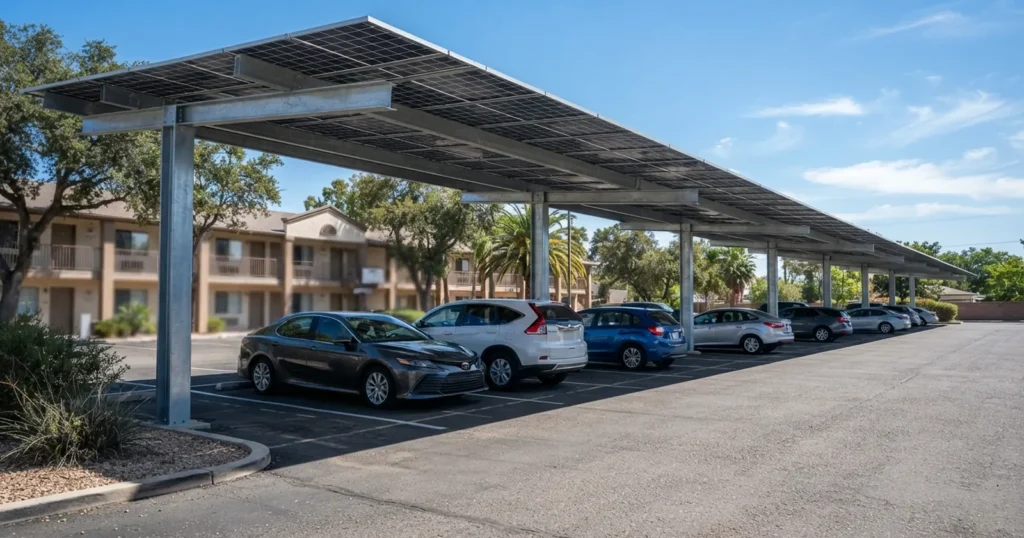
Carports turn a parking lot into the mounting surface and give shade. They suit hotels, apartment complexes and car wash vacuum bays. A typical parking stall is about 9 by 18 feet, or 162 square feet, so 3,000 square feet of panels covers roughly 20 to 25 spaces once canopy structure and aisle overhang are allowed for. Expect a higher cost per watt than a rooftop because of the steel frame, foundations and engineering, but no roof work at all.
Ground mount
Farms with spare land usually choose a ground mount. It faces due south at the best tilt and is easy to service. Budget for trenching to the service, fencing and an inverter pad.
Can your electrical service take a 60 kW system?
This is the question that most often changes a 60 kW design. Installers usually pair 60 kWdc of panels with about 50 kW of inverter capacity, a DC to AC ratio near 1.2. That could be two 25 kW three-phase inverters, or three smaller units if the array is split across roofs or canopies. The inverter size calculator shows the trade-offs.
Now check the output current against your panel. The National Electrical Code requires the solar breaker to be sized at 125% of the inverter’s continuous output current:
480 V: 50,000 ÷ (1.732 × 480) = 60 A, so an 80 A breaker
208 V: 50,000 ÷ (1.732 × 208) = 139 A, so a 175 A breaker
A common way to connect on the load side is the 120% rule: the main breaker plus the solar breaker may not exceed 120% of the busbar rating. On a 400 A busbar with a 400 A main, that leaves exactly 80 A of room.
| Service | Solar breaker for 50 kW AC | Room on 400 A busbar, 400 A main | Likely connection |
|---|---|---|---|
| 480 V three-phase | 80 A | 80 A | Load-side breaker can work |
| 208 V three-phase | 175 A | 80 A | Supply-side tap or panel upgrade |
| 240 V single-phase | Not practical | n/a | Usually needs a three-phase service upgrade |
Many motels and apartment buildings have 208 V service, so a 60 kW array there often needs a supply-side connection. Farms on single-phase lines face the largest hurdle, since extending three-phase power can cost more than the panels. Raise this with your electrician and utility before final quotes.
What does a 60kW system cost, and how can you pay for it?
The Department of Energy’s PV cost benchmarks model a 250 kW commercial rooftop at about $1.98 per watt in early 2025. A 60 kW job carries the same design, permitting and interconnection steps over fewer watts, so its cost per watt runs higher. Typical US ranges in late 2026:
| Cost per watt | 60 kW installed | Typical project |
|---|---|---|
| $2.00 | $120,000 | Ground mount or open flat roof, 480 V service |
| $2.50 | $150,000 | Typical small commercial rooftop |
| $3.00 or more | $180,000+ | Carports, roof reinforcement or service upgrades |
Financing options
- Cash or equipment loan: you own the system and any business tax benefits.
- Lease or power purchase agreement: a third party owns the array, and you pay a fixed monthly amount or a set price per kWh with little or no upfront cost. Our guide to solar PPA vs lease compares the two, including escalators and buyout terms.
- Commercial PACE: available in some states, repaid through a property tax assessment.
The residential 30% credit ended for homeowner-owned systems installed after December 31, 2025, but business-owned systems fall under separate federal rules that the 2025 tax law changed, including deadlines tied to when construction begins. Depreciation may also apply. Confirm eligibility and timing with a tax adviser before signing.
How long does a 60 kW system take to pay back?
The US average commercial electricity price was 14.53 cents per kWh in July 2026, according to the EIA Electric Power Monthly. The table assumes 78,840 kWh a year, all of it used on site, and $1,500 a year for monitoring, cleaning and an inverter reserve, with no tax credit:
Example at $0.1453: (78,840 × 0.1453) − 1,500 = $9,955 a year
| Electricity rate | Net savings a year | $120,000 system | $150,000 system | $180,000 system |
|---|---|---|---|---|
| $0.12 | $7,961 | 15.1 years | 18.8 years | 22.6 years |
| $0.1453 | $9,955 | 12.1 years | 15.1 years | 18.1 years |
| $0.18 | $12,691 | 9.5 years | 11.8 years | 14.2 years |
| $0.22 | $15,845 | 7.6 years | 9.5 years | 11.4 years |
Self-consumption matters as much as the rate. If only 75% of output is used on site and the rest is exported at 5 cents, savings at the average rate fall to about $8,077 a year and a $150,000 system takes 18.6 years. At 50% self-consumption, payback stretches past 24 years. Business tax benefits, where they apply, can shorten these figures sharply. Run your own numbers in the solar payback calculator.
Does a 60kW solar battery make sense?
For most businesses on a simple flat rate, a battery adds cost faster than it adds savings. It earns its place in three situations:
- Demand charges: many commercial tariffs bill for the highest 15 or 30 minute draw of the month. A battery can trim spikes, such as a car wash starting all its blowers at once.
- Poor export credit: where exports earn little, storing midday surplus for evening use raises self-consumption.
- Backup: refrigeration, motel front desks and well pumps can stay running in an outage if the inverter supports islanding.
A common pairing for this size is a battery around 100 kWh. At 90% usable capacity it holds about 90 kWh, which runs a 15 kW critical load for about 6 hours (90 ÷ 15). See our breakdown of a 100kWh battery for runtime and charging math at that scale.
Frequently asked questions
How many kWh a month does a 60kW solar system produce?
About 6,570 kWh in an average month at 4.5 peak sun hours, ranging from roughly 5,400 kWh in Seattle to over 9,000 kWh in Phoenix. Summer months produce well above the average and winter months well below it, so a business still draws from the grid in winter.
Is 60 kW the right size for a car wash or motel?
It is right when monthly use is roughly 7,000 to 11,000 kWh and much of it falls in daylight. Then 60 kW offsets about 60% to 95% of annual use with most energy used on site. Smaller operations using under 5,000 kWh a month are usually better served by a 30 to 40 kW array.
Do I need three-phase power for a 60 kW solar system?
In practice, yes. The roughly 50 kW of inverter output is normally delivered on three-phase service at 208 V or 480 V. Farms and small buildings on single-phase lines usually need a utility upgrade, which can be expensive and slow, so ask the utility early.
Can I get a 60 kW system with no upfront cost?
Yes, through a power purchase agreement or a lease, where a third party owns and maintains the array and you pay per kWh or a fixed monthly amount. You give up ownership of tax benefits and some long-term savings, and contracts often run 15 to 25 years, so review escalators and buyout terms.
How many parking spaces does a 60 kW solar carport cover?
About 20 to 25 standard spaces. The panels cover roughly 3,000 square feet and a typical stall is about 162 square feet, with extra allowance for canopy structure and aisle overhang. Double-row canopies covering two facing rows of stalls are the most common layout for this size.