9kW Solar System: Yearly Output, Panels Needed and 2026 Cost
Short answer
A 9kW solar system makes about 9,900 to 14,400 kWh a year in most of the US, or roughly 27 to 40 kWh a day. That takes about 21 panels at 430 W and 500 to 600 square feet of usable roof. It fully covers a 1,000 kWh a month bill only where the sun averages about 4.6 peak hours or more. Installed cost is typically $19,800 to $28,800 in late 2026.
Nine kilowatts is the size installers often quote to households that use a bit more than average: a family home with central air, an electric dryer and maybe a hot tub, using somewhere around 1,000 kWh a month. In Arizona that array would overproduce. In Buffalo or Pittsburgh it falls short.
This guide focuses on that gap. It shows how much a 9kW system makes in Northeast and Midwest cities where the sun is lower, how much of a 1,000 kWh bill it offsets in each one, what it costs, and why it usually pairs with a 7.6 kW inverter that fits a standard 200-amp electrical panel.
Does a 9kW solar system cover a 1,000 kWh a month bill?
It depends almost entirely on your peak sun hours. A home using 1,000 kWh a month needs 12,000 kWh a year. This site estimates output with 80% system efficiency, which accounts for heat, wiring, inverter and soiling losses.
Example at the US middle value: 9 × 4.5 × 0.80 × 365 = 11,826 kWh, about 99% of 12,000 kWh
Rearrange the formula and you get the break-even point: 12,000 ÷ (9 × 0.80 × 365) = 4.57 peak sun hours. Above that, 9 kW covers a 1,000 kWh home on an annual basis. Below it, you keep buying some power from the grid, mostly in winter.
| City | Peak sun hours | Per day | Per year | Share of 12,000 kWh | Size for 100% |
|---|---|---|---|---|---|
| Buffalo, NY | 4.0 | 28.8 kWh | 10,512 kWh | 88% | 10.3 kW |
| Pittsburgh, PA | 4.2 | 30.2 kWh | 11,038 kWh | 92% | 9.8 kW |
| Detroit, MI | 4.3 | 31.0 kWh | 11,300 kWh | 94% | 9.6 kW |
| Chicago, IL | 4.4 | 31.7 kWh | 11,563 kWh | 96% | 9.3 kW |
| Boston, MA | 4.6 | 33.1 kWh | 12,089 kWh | 101% | 8.9 kW |
| Minneapolis, MN | 4.6 | 33.1 kWh | 12,089 kWh | 101% | 8.9 kW |
| Dallas, TX | 5.0 | 36.0 kWh | 13,140 kWh | 110% | 8.2 kW |
| Phoenix, AZ | 6.3 | 45.4 kWh | 16,556 kWh | 138% | 6.5 kW |
Sun hours are approximate annual averages for south-facing panels tilted near latitude. Your own roof can differ by 10% or more because of shading, azimuth and local weather, so check your address with the peak sun hours calculator before you settle on a size.
The Great Lakes cities lose the most to cloud cover from late fall into winter, which is why they trail Minneapolis and Boston.
How much would 9 kW save on a 1,000 kWh bill in your state?
Lower sun does not mean lower savings. Electricity in much of the Northeast costs well above the national average, so each kWh your panels make is worth more. The table below uses approximate residential rates from EIA data for early 2026, rounded to the nearest cent, and assumes every kWh you produce is credited at the full retail rate up to your annual use.
| City | Rate (approx.) | Yearly bill at 12,000 kWh | Yearly savings from 9 kW | Simple payback at $23,400 |
|---|---|---|---|---|
| Boston, MA | $0.30 | $3,600 | $3,600 | 6.5 years |
| Buffalo, NY | $0.29 | $3,480 | $3,048 | 7.7 years |
| Detroit, MI | $0.21 | $2,520 | $2,373 | 9.9 years |
| Pittsburgh, PA | $0.21 | $2,520 | $2,318 | 10.1 years |
| Chicago, IL | $0.19 | $2,280 | $2,197 | 10.7 years |
| Phoenix, AZ | $0.16 | $1,920 | $1,920 | 12.2 years |
| Minneapolis, MN | $0.15 | $1,800 | $1,800 | 13.0 years |
Example for Buffalo: 10,512 kWh × $0.29 = $3,048; $23,400 ÷ $3,048 = 7.7 years
Buffalo gets the least sun on the list yet pays back faster than Phoenix, because New York power costs almost twice as much. Phoenix produces 4,556 kWh more than this home uses, and the table gives that surplus no value at all. These are simplified figures. They ignore fixed monthly charges, rate changes, panel degradation and any state incentives.
Export rules change the answer
Full retail credit is the best case. Many utilities now credit exported power at a lower rate than the power you buy, and a 9 kW array exports a large share of its midday output. If you are away at work, half or more of your production can leave the house. Model your own tariff with the net metering calculator, then run the result through the solar payback calculator.
What if your home uses more or less than 1,000 kWh?
Look at the last 12 months of bills, not one month. Northern homes often show a summer peak from air conditioning and a smaller winter peak from furnace fans, heat tape and lighting. Here is how a 9 kW array lines up against different usage levels in Chicago (4.4 sun hours) and at the US middle value (4.5 sun hours).
| Monthly use | Yearly use | Offset in Chicago (11,563 kWh) | Offset at 4.5 sun hours (11,826 kWh) |
|---|---|---|---|
| 800 kWh | 9,600 kWh | 120% | 123% |
| 900 kWh | 10,800 kWh | 107% | 110% |
| 1,000 kWh | 12,000 kWh | 96% | 99% |
| 1,100 kWh | 13,200 kWh | 88% | 90% |
| 1,200 kWh | 14,400 kWh | 80% | 82% |
For reference, the US Energy Information Administration puts the average residential customer at about 10,791 kWh a year, or roughly 899 kWh a month. A 9kW system is therefore a slightly oversized array for an average home and a close fit for a home 10% to 20% above average. If an electric car or heat pump is coming, the load can jump by several thousand kWh, and our 15kW solar system guide walks through that bigger case.
How many panels and how much roof does a 9kW system take?
Divide 9,000 watts by the panel rating and round up. This site uses 430 W as the standard residential panel.
| Panel rating | Panels | Actual array size |
|---|---|---|
| 400 W | 23 | 9.2 kW |
| 430 W | 21 | 9.03 kW |
| 450 W | 20 | 9.0 kW |
Example: 9,000 ÷ (1,000 × 0.22) = 40.9 m², about 440 sq ft. At 20% efficiency: 45 m², about 484 sq ft
Fire-code pathways, ridge setbacks and vents add to that, so plan on about 500 to 600 square feet of clear roof. On a typical northern gable roof, 21 panels often fit on one south face, which matters because a single south plane beats splitting the array east and west when winter sun is low. If you want to test other panel ratings, the how many solar panels calculator works backward from your yearly kWh.
Tilt and snow in northern states
Steeper roofs are an advantage in the Snow Belt. Snow slides off tilted, smooth glass faster than off a low-slope roof, and a steeper angle catches more of the low winter sun. Expect some winter days with near-zero output after heavy snowfall. With net metering, summer surplus banks credits that carry you through those months.
Why does a 9kW array usually get a 7.6 kW inverter?
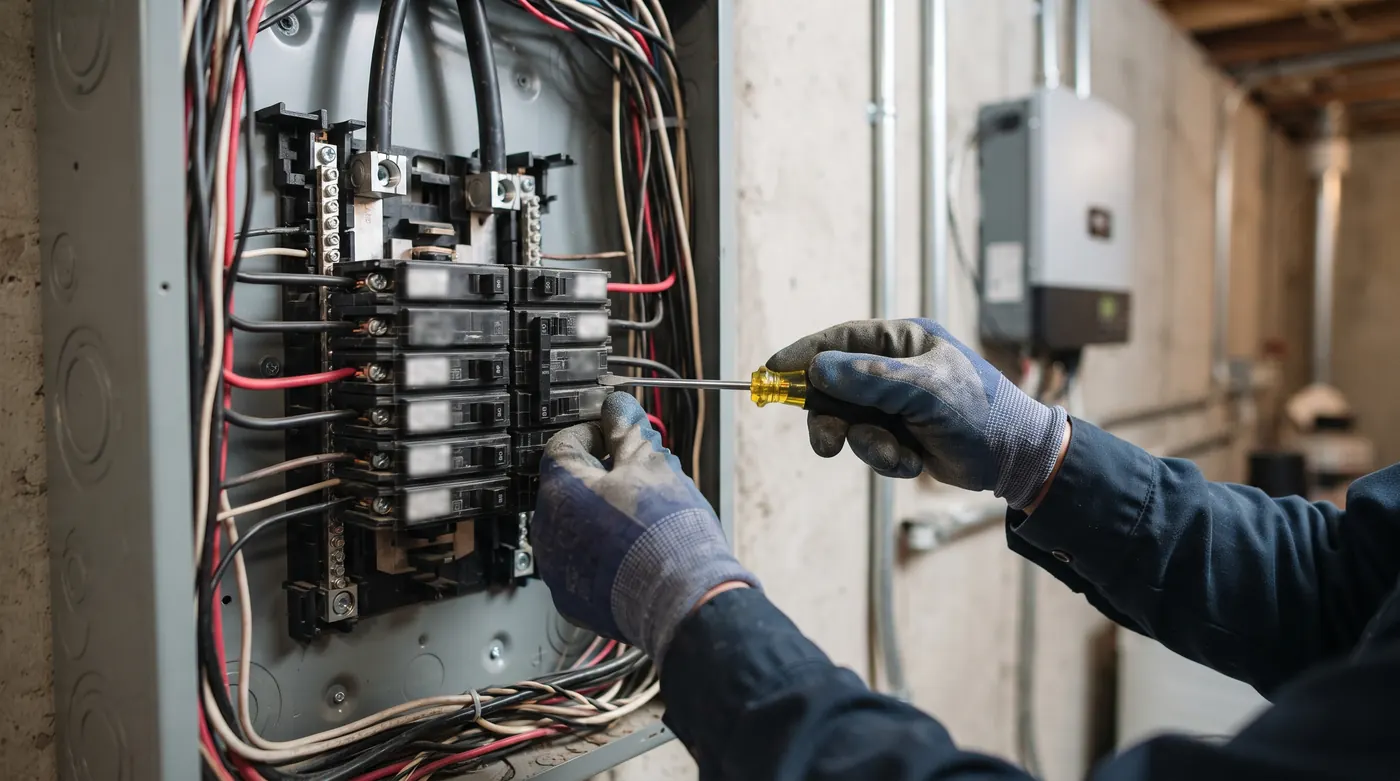
This is the part that is specific to the 9 kW size. Most US homes have a 200-amp main panel with a 200-amp main breaker, and the electrical code limits how much solar current can feed back into that panel.
Example: (200 A × 1.2) − 200 A = 40 A. A 7.6 kW inverter at 240 V: 7,600 ÷ 240 = 31.7 A × 1.25 = 39.6 A, so a 40 A breaker fits
A 7.6 kW inverter is therefore the largest common single-phase string inverter that fits a standard 200-amp panel without extra work. Paired with 9.03 kW of panels, it gives a DC-to-AC ratio of about 1.19, which is a normal range. On bright spring days the inverter may clip a little at noon, but the lost energy over a year is small. Go bigger and the installer may need a line-side tap, a derated main breaker or a panel upgrade, which adds cost.
The 40 A breaker also sets the circuit wire size; our guide to 40 amp wire size covers that run. Microinverters are the other route: 21 panels each with its own microinverter, combined on one or two branch circuits.
How much does a 9kW solar system cost in 2026?
Typical US installed prices in late 2026 run about $2.20 to $3.20 per watt before state or utility incentives. These are typical ranges, not quotes.
- $2.20 a watt: $19,800, a simple roof in a competitive market.
- $2.60 a watt: $23,400, the middle of the market and the figure used in the payback table above.
- $3.20 a watt: $28,800, premium panels, a complex roof or a high-cost labor region.
Smaller systems cost more per watt than large ones because permits, design and labor have fixed parts. Northeast labor rates often push quotes toward the upper half of the range.
The 30% federal residential clean energy credit (Section 25D) ended for homeowner-owned systems placed in service after December 31, 2025. If you buy a 9kW system in 2026, budget the full price. Several Northeast states still run their own rebates, performance payments or renewable energy certificate programs, so check what your state and utility offer.
Should you add a battery to a 9kW system up north?
For bill savings, only if your utility credits exports poorly or charges time-of-use rates with an expensive evening peak. For backup, it is worth a look in areas where ice storms and nor’easters knock out power. A standard grid-tied inverter shuts down during an outage, so panels alone will not keep the lights on.
A 9 kW array makes about 32 kWh on an average day, enough to recharge a mid-size home battery and still run the house. Our 10kWh battery guide explains what that capacity runs overnight. In December, a cloudy Great Lakes day may not refill the battery fully, so plan backup around essential loads rather than the whole house.
Is 9 kW the right size, or should you go bigger?
Use the break-even of 4.57 sun hours as a quick test for a 1,000 kWh home:
- Below about 4.3 sun hours (much of upstate New York, western Pennsylvania, Ohio, Michigan): 9 kW covers roughly 88% to 94%. Consider 10 kW if your roof and panel allow it.
- Around 4.4 to 4.7 (Chicago, Boston, Minneapolis, Philadelphia): 9 kW is a close match.
- Above 5 (Texas, the Southwest): 9 kW overproduces for this home. A 7 to 8 kW array saves nearly as much for less money unless exports earn full credit.
Going above 9 kW on a 200-amp panel often means a bigger inverter and extra electrical work, so the cost jump is not always linear. For a month-by-month view at your exact address, NREL’s PVWatts calculator uses local weather data and shows how far winter output dips.
Frequently asked questions
How many kWh does a 9kW solar system produce per month?
About 830 to 1,200 kWh a month in most of the US, based on 1,100 to 1,600 kWh per kW per year. At 4.5 peak sun hours it averages about 986 kWh a month. In northern states, long summer days run well above that average and short winter days fall well below it.
Will a 9kW system eliminate my electric bill?
Rarely all of it. Even with full net metering, most utilities keep a fixed monthly customer charge. A 9 kW array covers a 1,000 kWh a month home in places with about 4.6 or more peak sun hours. In cloudier cities like Buffalo or Pittsburgh it covers roughly 88% to 92%, so a small bill remains.
Is 9kW enough for a house in Ohio or Michigan?
For a home using 900 kWh a month or less, usually yes. With about 4.2 to 4.3 sun hours, 9 kW makes roughly 11,000 to 11,300 kWh a year. A home using 1,000 kWh a month would need about 9.6 to 9.8 kW to cover everything, so 10 kW is the safer target there.
What size inverter goes with a 9kW solar system?
Most US installers pair it with a 7.6 kW string inverter, a DC-to-AC ratio of about 1.19. That size backfeeds through a 40 A breaker, which is the most a standard 200-amp panel with a 200-amp main allows under the 120% rule. Microinverters on each of the 21 panels are the other common choice.
How long does a 9kW solar system take to pay for itself?
At a typical $23,400 price, simple payback ranges from about 6.5 years in high-rate states like Massachusetts to about 13 years where power is cheap, such as Minnesota. Export credit rules, incentives and future rate increases can move these numbers by several years in either direction.


