9kWh per Day Solar System: How Many Panels and What Size You Need
Short answer
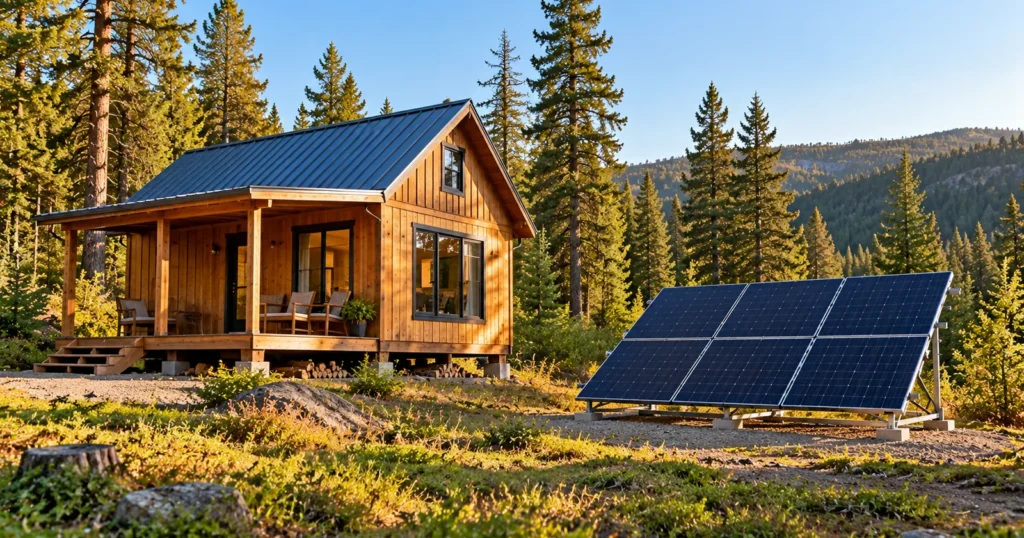
To make 9 kWh a day you need about a 2.5 kW solar array, which is 6 panels at 430 W, assuming 4.5 peak sun hours and 80% system efficiency. Six panels give 2,580 W and about 9.3 kWh on an average day. Off grid, pair them with roughly 10 kWh of lithium battery and a 60 to 70 A MPPT controller at 48 V.
Nine kilowatt-hours a day works out to about 270 kWh a month, or roughly 30% of what an average US home uses, according to EIA. That is the budget of a well-insulated cabin, a one or two person small home, or a weekend place with a full-size fridge, a freezer, a well pump and a few hours of mini-split cooling.
A quick note on the search term: a “9 kWh solar system” is often confused with a 9 kW system, which is a different thing. A 9 kW array makes about 32 kWh a day at this site’s assumptions, more than three times what this page covers, and it is explained in our 9kW solar system guide. A 9 kWh battery stores energy but makes none. Here the target is energy produced: 9 kWh every day.
How many kW and panels make 9 kWh a day?
Divide the daily target by your peak sun hours, then by system efficiency. This site uses 80% efficiency to cover heat, dirt, wiring, controller and inverter losses, and 4.5 sun hours as a US middle value.
Example: 9 ÷ 4.5 ÷ 0.80 = 2.50 kW, and 2,500 W ÷ 430 W = 5.8, so 6 panels
As a yearly check, 9 kWh a day is 3,285 kWh a year. At 1,100 to 1,600 kWh per kW per year, that takes 2.05 to 3.0 kW of panels. If your bills average closer to 10 kWh a day, our 10 kWh per day solar system guide shows how the seventh panel and the battery choice change.
| Peak sun hours | Array needed | 430 W panels | Daily output with those panels |
|---|---|---|---|
| 2.5 | 4.50 kW | 11 | 9.46 kWh |
| 3.0 | 3.75 kW | 9 | 9.29 kWh |
| 3.5 | 3.21 kW | 8 | 9.63 kWh |
| 4.0 | 2.81 kW | 7 | 9.63 kWh |
| 4.5 | 2.50 kW | 6 | 9.29 kWh |
| 5.0 | 2.25 kW | 6 | 10.32 kWh |
| 5.5 | 2.05 kW | 5 | 9.46 kWh |
| 6.0 | 1.88 kW | 5 | 10.32 kWh |
Panel counts are always rounded up. Look up your own sun hours by address with the free NREL PVWatts calculator, which uses local weather data, and use your worst month rather than the yearly average if the system is your only power source.
What can 9 kWh a day run in a cabin or small home?
Compared with a 3 or 4 kWh cabin, the extra 5 kWh pays for a chest freezer, a washing machine and a few hours of ductless mini-split cooling or heating. Here is one realistic day that totals exactly 9 kWh.
| Load | Power and use | Energy per day |
|---|---|---|
| Ductless mini-split | about 600 W average for 5 hours | 3.00 kWh |
| Full-size refrigerator | cycling, 24 hours | 1.40 kWh |
| Induction cooktop | 1,800 W for 30 minutes | 0.90 kWh |
| Chest freezer | 100 W compressor, about 8 hours of run time | 0.80 kWh |
| Well pump | 1,000 W for 30 minutes | 0.50 kWh |
| Washing machine, cold wash | 500 W for 1 hour | 0.50 kWh |
| LED lights, 10 bulbs | 9 W each for 5 hours | 0.45 kWh |
| Microwave | 1,200 W for 20 minutes | 0.40 kWh |
| TV | 100 W for 4 hours | 0.40 kWh |
| Laptop | 60 W for 6 hours | 0.36 kWh |
| Wi-Fi router | 10 W for 24 hours | 0.24 kWh |
| Phones and small chargers | a few devices | 0.05 kWh |
| Total | 9.00 kWh |
The fridge line assumes a new model at about 510 kWh a year. The mini-split is the line most likely to change, so measure it first. Swap in your own appliances with the solar load calculator.
What still does not fit: an electric water heater, electric dryer, baseboard heat or an EV. Any one of these can use 9 kWh alone, so cabins at this size use propane or skip them.
Why does an exact 2.5 kW array fall short off grid?
Six panels make about 9.3 kWh a day, only 0.29 kWh more than the load. On the grid that is fine. Off grid, it causes a problem most sizing guides skip: the battery never refills after a cloudy spell.
Example: 9 kWh ÷ 0.29 kWh = about 31 sunny days with 6 panels
Adding two panels fixes it. Eight 430 W panels (3,440 W) make about 12.4 kWh at 4.5 sun hours. The 3.4 kWh surplus refills a full day of storage in under three sunny days.
| Array | Daily output (4.5 sun hours) | Surplus over 9 kWh | Sunny days to refill 9 kWh |
|---|---|---|---|
| 6 panels, 2,580 W | 9.29 kWh | 0.29 kWh | about 31 |
| 7 panels, 3,010 W | 10.84 kWh | 1.84 kWh | about 5 |
| 8 panels, 3,440 W | 12.38 kWh | 3.38 kWh | about 3 |
For a full-time off-grid cabin, plan on 8 panels, or about 3.4 kW. For a grid-tied home or a summer-only cabin with a generator, 6 panels are enough. Our off-grid solar calculator runs this array and storage math together.
How big a battery bank do you need for 9 kWh a day?
In the sample day, the loads that run after sunset are 14 hours of fridge and freezer cycling, the lights, the TV, the router, two hours of laptop, phone charging and two evening hours of the mini-split. Together they come to about 3.65 kWh. That is the absolute minimum the battery must hold.
Example: 3.65 kWh ÷ 0.90 = 4.1 kWh for one night
Most off-grid owners want at least one full day of reserve for cloudy weather. The table converts each goal to amp-hours, using nominal voltage (Ah = Wh ÷ volts).
| Reserve | Energy from battery | Battery size (90% usable) | Ah at 24 V | Ah at 48 V |
|---|---|---|---|---|
| One night | 3.65 kWh | 4.1 kWh | 169 Ah | 85 Ah |
| One full day | 9.0 kWh | 10.0 kWh | 417 Ah | 208 Ah |
| Two full days | 18.0 kWh | 20.0 kWh | 833 Ah | 417 Ah |
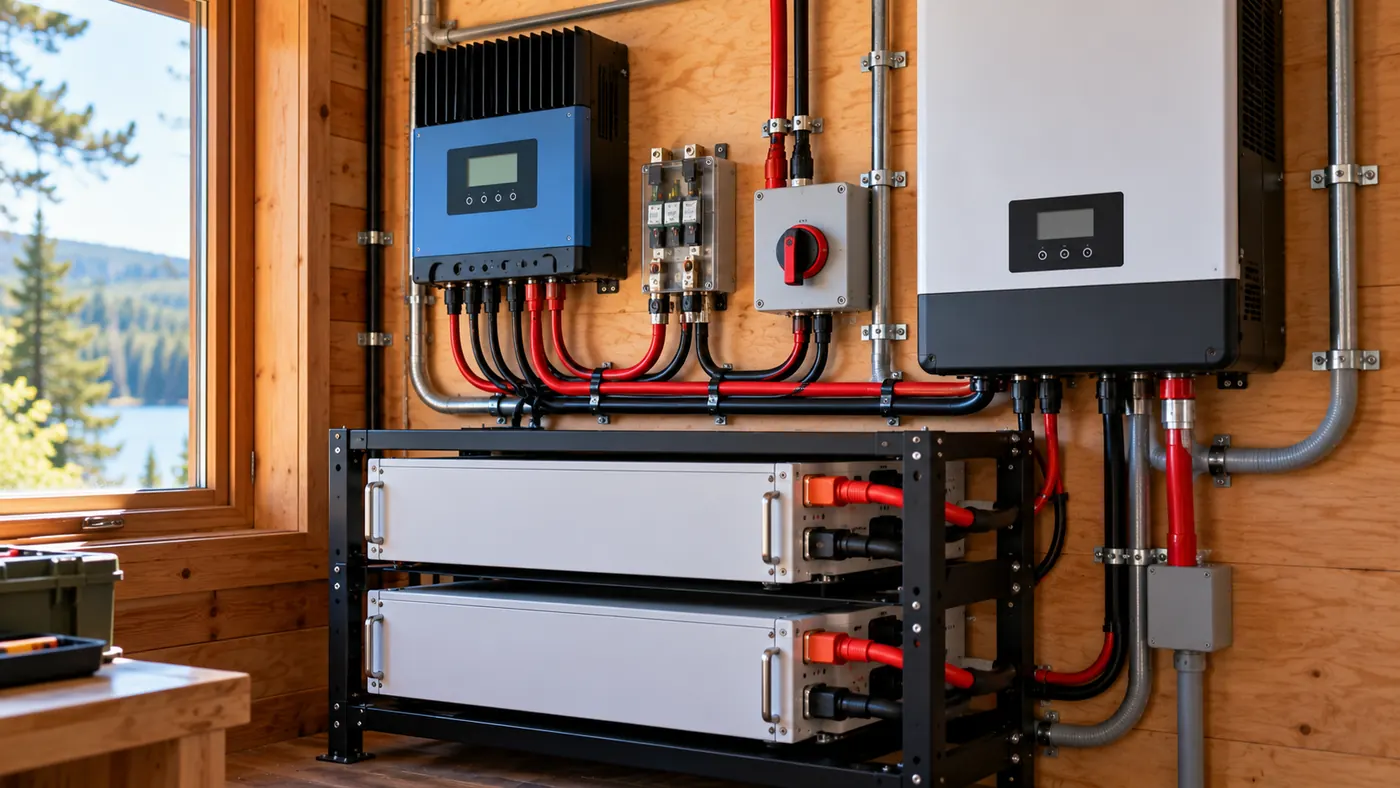
A 10 kWh battery is the natural fit: two 48 V, 100 Ah lithium iron phosphate (LiFePO4) modules give one full day of reserve. Many cabins buy one day and keep a small generator for long storms. Lead-acid batteries should only be drained to about 50%, so they need roughly 1.8 times these sizes.
Shift heavy loads into daylight
The washer, well pump, induction cooktop and microwave in the sample day add up to 2.3 kWh. Running them between late morning and mid-afternoon sends that energy straight from the panels to the load, so it never passes through the battery. If your reserve target is different, the battery bank calculator handles any days of autonomy and chemistry.
Keep LiFePO4 batteries inside the heated part of the cabin. Most models block charging below about 32°F unless they have built-in heaters.
What size charge controller do you need for 9 kWh a day?
An MPPT controller has two limits: the charging current it delivers to the battery and the maximum input voltage from the panels. Undersize the first and you lose harvest. Exceed the second and you can destroy the controller.
Step 1: check the amps
Example: 2,580 W ÷ 48 V = 54 A, × 1.25 = 67 A, so a 70 A controller
| Battery voltage | 6 panels, 2,580 W | 8 panels, 3,440 W | Practical choice |
|---|---|---|---|
| 12 V | 215 A | 287 A | Not practical at this size |
| 24 V | 108 A | 143 A | Two controllers sharing the array |
| 48 V | 54 A | 72 A | One 60 to 100 A controller |
Current figures are before the 1.25 margin. Manufacturers also publish a nominal PV power per battery voltage, which is easier to match. Victron’s SmartSolar MPPT 150/60, for example, is rated for 1,720 W of panels at 24 V and 3,440 W at 48 V, while the 150/70 is rated for 2,000 W and 4,000 W. So the same 60 A unit that handles the full 8 panel array at 48 V covers only four panels at 24 V. This is the clearest reason to build a 9 kWh system at 48 V.
Step 2: check the cold-weather voltage
Panel voltage rises as the temperature drops, so the string must stay under the controller’s limit on the coldest sunny morning. Take open-circuit voltage (Voc) and its temperature coefficient from your panel’s datasheet. The example below uses an illustrative 38 V Voc and a coefficient of minus 0.28% per °C.
Example: 38 V × (1 + 0.0028 × (25 + 20)) = 42.8 V per panel at -4°F (-20°C)
Three panels in series reach about 128 V, which stays under the 145 V operating limit on a 150 V controller. Four in series reach about 171 V, which is too high. So six panels wire as two strings of three (3S2P). For eight panels, either move to a controller with a 250 V input and wire two strings of four, or use an all-in-one inverter-charger with a higher PV input. The charge controller calculator runs the amps and volts check with your own datasheet values.
What inverter size does a 9 kWh day need?
The inverter is sized by loads running at the same moment, not by daily energy. In the sample day, the worst realistic case is the well pump, induction cooktop and mini-split running while the fridge, freezer, lights and laptop are on.
Example: 1,000 + 1,800 + 600 + 150 + 100 + 160 = 3,810 W, so at least a 4,000 W inverter
Motors also draw a brief surge at startup, so check the inverter’s surge rating, not just its continuous rating. At 48 V and 90% efficiency, a 4,000 W load pulls about 93 A of DC current, compared with about 185 A at 24 V. Many cabin builders at this size choose a 48 V all-in-one unit of 5,000 to 6,000 W that includes the MPPT controller. Size yours with the inverter size calculator.
How much does a 9 kWh per day solar system cost?
These are typical US ranges in late 2026.
- Grid-tied, installed: about 2.58 kW × $2.80 to $4.00 per watt = $7,200 to $10,300. Small systems cost more per watt because permits, design and labor are partly fixed.
- Off-grid, DIY parts: 6 to 8 panels about $800 to $2,500; 10 kWh of 48 V LiFePO4 about $1,200 to $3,600; a 48 V inverter-charger with built-in MPPT about $1,000 to $2,500; racking, wire, breakers and disconnects about $700 to $1,800. That is roughly $3,700 to $10,400 before labor and permits.
The 30% federal residential clean energy credit (Section 25D) ended for homeowner-owned systems installed after December 31, 2025, so do not count on it for a new home or cabin. Check state and utility programs instead.
For a grid-tied home, six panels make about 3,390 kWh a year. At an assumed $0.17 per kWh with full net metering, that is worth about $576 a year. Your own rate and export credit can move that number a lot.
Frequently asked questions
How many solar panels do I need for 9 kWh a day?
About six 430 W panels at 4.5 peak sun hours. They total 2,580 W and make roughly 9.3 kWh on an average day after 80% system losses. A sunny desert site can manage with five, while a cloudy northern site needs eight or nine. Off grid, eight panels are a safer choice because they leave surplus to recharge the battery.
Is a 9 kWh solar system the same as a 9 kW solar system?
No. kWh measures energy and kW measures power. A system that makes 9 kWh a day needs only about 2.5 kW of panels. A 9 kW array makes around 32 kWh a day at 4.5 sun hours and 80% efficiency, which suits a typical family home rather than a cabin or small household.
What size charge controller do I need for a 9 kWh per day system?
At 48 V, a 60 to 70 A MPPT controller handles six 430 W panels, and a 70 to 100 A unit handles eight. At 24 V the current doubles, so you would need two controllers. Also confirm the panel string’s cold-weather open-circuit voltage stays below the controller’s input limit.
How many amp-hours of battery do I need for 9 kWh a day?
For one full day of reserve with lithium at 90% usable, you need about 10 kWh, which is 208 Ah at 48 V or 417 Ah at 24 V. Covering only the night takes about 85 Ah at 48 V. Two days of reserve doubles those figures.
Can 9 kWh a day run a refrigerator and air conditioning?
Yes, if the cooling is an efficient ductless mini-split used for a few hours. A new fridge uses about 1 to 2 kWh a day, and a mini-split averaging 600 W for five hours uses 3 kWh, leaving about 4 to 5 kWh for everything else. Central air running all afternoon will not fit.


