Camper Van Solar Setup: Panels, Battery and Wiring
Short answer
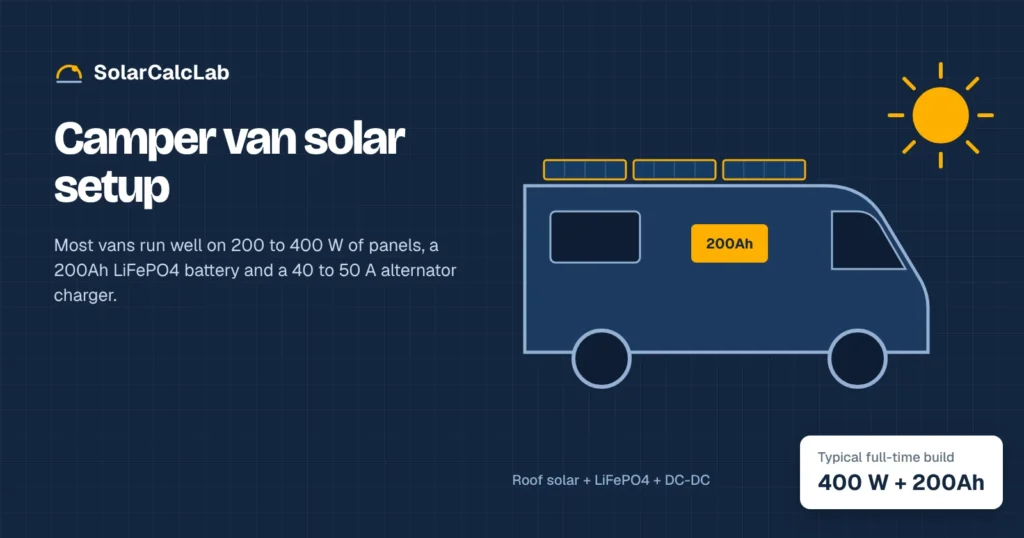
A working camper van solar setup for most people is 200 to 400 watts of roof panels, a 200Ah 12 V LiFePO4 battery (about 2.5 kWh), a 30 A MPPT charge controller, a 40 to 50 A DC-DC charger from the alternator and a 1,000 to 2,000 W inverter. That covers a compressor fridge, a roof fan, lights and a laptop workday, roughly 1,100 Wh a day. Weekend vans can stop at 200 W and 100Ah. Electric cooking pushes you to 400Ah or more and a 24 V system.
A van is not a small RV. The roof is narrow, a fan eats into it, and you probably drive most days. That last point changes the design: from November to February the alternator often charges more than the panels, so a van system is really a charging system with solar as one input.
Below, the system is built in the order that avoids expensive mistakes: daily energy, battery, the two ways of refilling it, then wiring. For a travel trailer or motorhome with a big flat roof, the RV solar sizing guide fits better.
Step one: count a real day of use
Write down what you will run on a normal day, not on your best day. Here is an example for one person living and working from a high-roof van in mild weather. The wattages are typical for these devices, so swap in the numbers from your own labels.
| Load | Power | Hours a day | Energy |
|---|---|---|---|
| 12 V compressor fridge (cycles on and off) | about 17 W average | 24 | 400 Wh |
| Laptop for a workday | 65 W | 6 | 390 Wh |
| Roof fan, medium speed | 18 W | 10 | 180 Wh |
| LED lights | 15 W | 4 | 60 Wh |
| Two phones | n/a | n/a | 30 Wh |
| Water pump | 60 W | 0.25 | 15 Wh |
| Total | 1,075 Wh |
Round that up to 1,100 to 1,200 Wh. In winter the roof fan goes off but a diesel heater’s fan and glow plug replace it, so the total barely moves.
The load that never makes the list
An inverter draws power just by being switched on. A 2,000 W unit commonly idles at roughly 10 to 25 W with nothing plugged in. Leave 20 W of idle draw on for 8 hours and you have spent 160 Wh, more than your lights. Charge the laptop from a 12 V USB-C adapter and switch the inverter on only when you need it.
Three van builds side by side
| Part | Weekend van | Full-time remote worker | Electric kitchen |
|---|---|---|---|
| Daily use | about 450 Wh | 1,100 to 1,300 Wh | 2,500 Wh or more |
| Solar on the roof | 200 W | 400 W | 600 to 800 W |
| LiFePO4 battery | 100Ah at 12 V (1.28 kWh) | 200 to 300Ah at 12 V (2.56 to 3.84 kWh) | 400 to 600Ah at 12 V, or 200 to 300Ah at 24 V |
| MPPT controller | 15 to 20 A | 30 A | 50 A or two 30 A units |
| DC-DC charger | 20 A | 40 to 50 A | 50 to 70 A, or an alternator regulator |
| Inverter | none or 300 to 500 W | 1,000 to 2,000 W | 3,000 W |
The battery column assumes you use about 90% of a LiFePO4 bank’s rated capacity. A 200Ah bank then gives 2,304 Wh, just under two days of the remote worker’s use with no charging. A 300Ah bank stretches that to almost three days, a sensible reserve for a gray week parked in the woods.
The electric kitchen build is where the 12 V choice starts to hurt. A 1,800 W induction burner draws about 167 A from a 12 V battery once you account for inverter losses. At 24 V it draws half that, so cables, fuses and bus bars shrink. If you want induction cooking, decide on 24 V before buying anything.
Solar or alternator: which one really fills the battery?
Van panels lie flat, so they lose output when the sun is low. A fair planning number is 75% of the panel rating times peak sun hours, the hours of full-strength sun the day’s light adds up to.
400 W × 2 winter sun hours × 0.75 = 600 Wh
400 W × 5 summer sun hours × 0.75 = 1,500 Wh
A DC-DC charger takes current from the alternator while the engine runs and charges the house battery at the correct LiFePO4 voltage. Its output is roughly rated amps times 14 V.
50 A × 14 V × 1 hour = 700 Wh
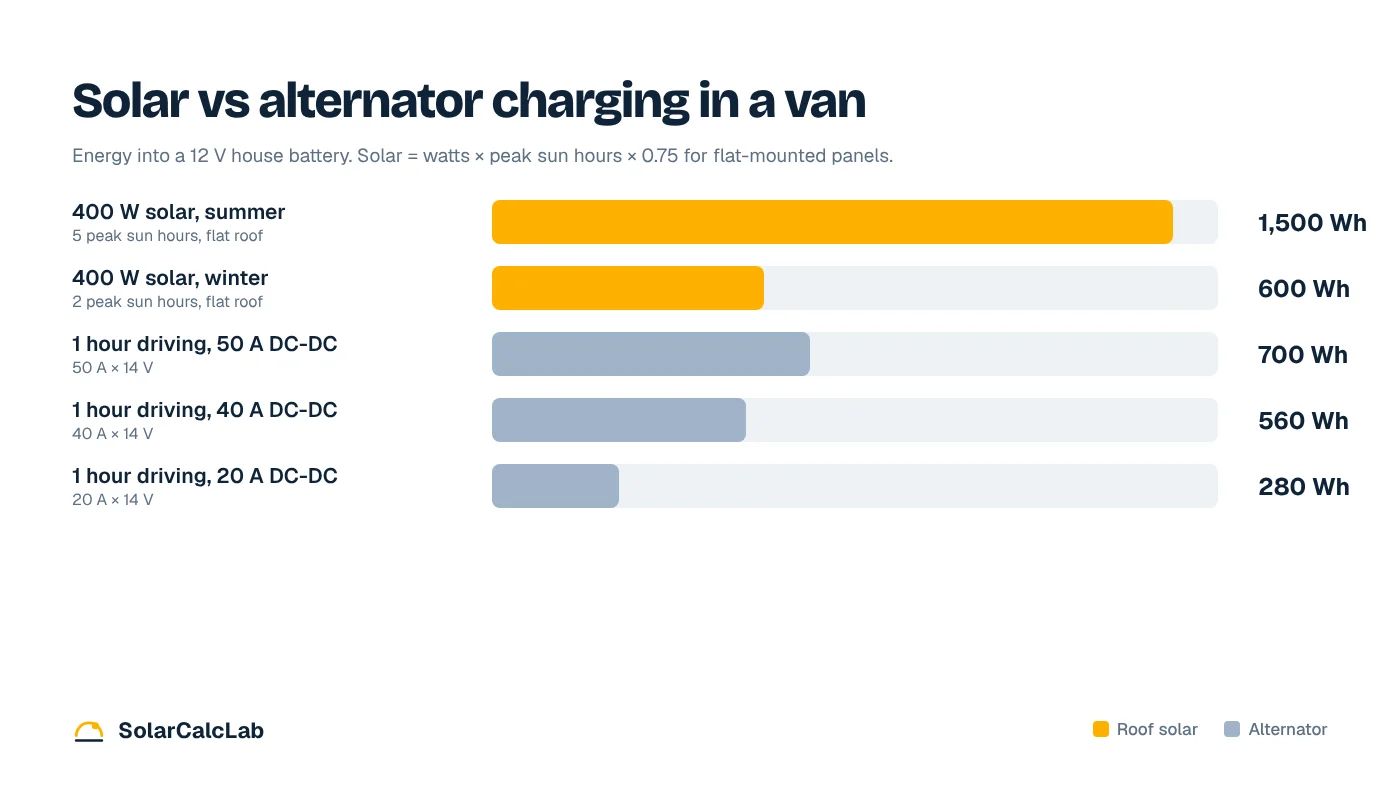
In December, an hour of driving with a 50 A charger beats a full day of 400 W of flat panels. In July the panels win easily. So a DC-DC charger belongs in any van that moves regularly, and a van parked for weeks needs more solar or battery than one that drives every second day.
Can your alternator handle it?
Many stock alternators on a Sprinter, a Transit or a ProMaster can feed a 30 to 50 A charger, but check your alternator rating and the van maker’s upfitter guidance before you count on it. Most good DC-DC chargers let you cap the current, so start at 30 A and raise it once you see how hot the alternator runs.
Fitting panels on a van roof
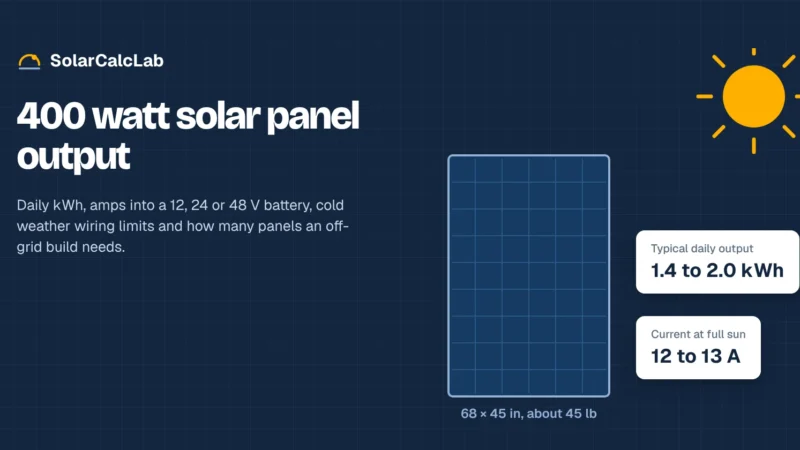
Roof space, not budget, usually sets the solar size. A common 400 W house panel measures about 67.8 by 44.6 inches, or 21 square feet, so it produces roughly 19 watts per square foot. Compact 200 W panels sold for RVs land in a similar range. Measure the clear area between the fan and rack feet, then check panel spec sheets before ordering.
- Rigid panels on a rack run cooler and last longer, but add height and wind noise.
- Flexible panels glued down are lighter and stealthier, but run hot, lose more output in summer and carry shorter warranties.
- Shade from the roof fan drags down a whole series string. On a crowded roof, wire panels in parallel so one shaded panel does not pull down the other.
Sizing the charge controller
Controllers are rated by the current they push into the battery, not by panel watts. Victron, for example, rates its 20 A SmartSolar MPPT for 290 W of panels on a 12 V battery. That works out to 14.5 W per amp of charge current.
400 W ÷ 14.5 = 27.6 A, so a 30 A controller
600 W ÷ 14.5 = 41.4 A, so a 50 A controller
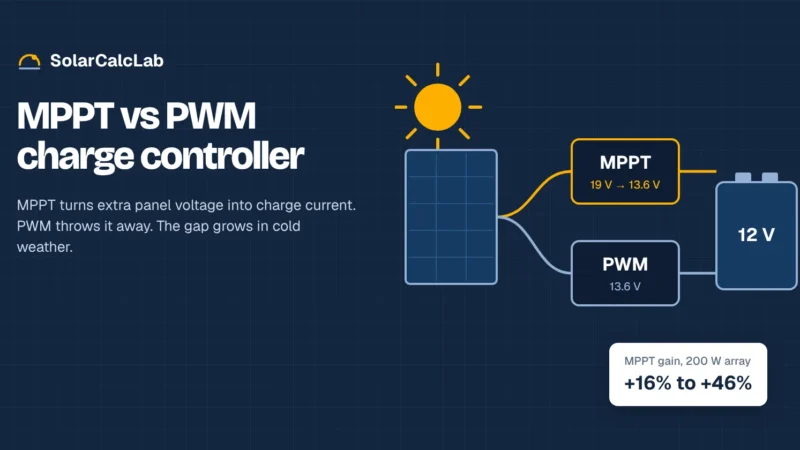
For panels in series, also check the controller’s maximum input voltage against the panels’ cold-weather open circuit voltage. The charge controller calculator runs both checks. MPPT earns its price on a van, as our MPPT vs PWM comparison explains.
The battery side: cables and fuses
Van electrical fires usually start at a loose lug or an undersized cable. Size the inverter cable first, since it carries the most current.
2,000 W ÷ (12 V × 0.90) = 185 A
Fuse at 125%: 185 A × 1.25 = 231 A, so a 250 A fuse
Five feet of cable between the battery and the inverter, at 185 A, loses 0.18 V with 2/0 AWG copper. That is 1.5% of 12 V. With 4 AWG the loss is 0.57 V, or 4.8%, and the inverter will trip on low voltage long before the battery is empty. Follow the cable size in your inverter manual if it is larger, and use the solar cable size calculator for the controller and DC-DC runs.
Where each fuse goes
- Main battery fuse on the positive terminal, as close to the battery as you can mount it. Marine practice under ABYC E-11 puts it within 7 inches. LiFePO4 banks can deliver huge short-circuit currents, so use a Class T fuse or another type rated for that interrupt current.
- DC-DC charger: a fuse at the starter battery and another at the house battery.
- Charge controller: a fuse or breaker to the battery, plus a PV disconnect for the roof.
- 12 V loads: a fuse block, each branch fused for its wire.
The solar fuse size calculator gives the rating for each of these points.
What the main parts cost right now
These are listed prices from US retailers checked in late November 2026, during Black Friday sales, so expect some movement.
| Component | Example | Listed price |
|---|---|---|
| 12 V 100Ah LiFePO4 battery | Budget to mid-range brands | $180 to $320 |
| 12 V 100Ah LiFePO4 battery | Premium brand | up to about $795 |
| 200 W rigid panel | Renogy 200 W N-type | $218 to $240 |
| DC-DC charger, 20 A / 40 A | Renogy | $141 / $187 |
| DC-DC charger, 50 A | Victron Orion XS 12/12-50A | about $328 |
| 2,000 W inverter charger, 12 V | Renogy | about $596 |
Cable, lugs, fuses, a shunt monitor and a roof rack often add several hundred dollars on top.
First-trip problems and what they usually mean
- The inverter alarms when the kettle starts at 60% charge. Suspect voltage drop: a thin cable, loose lug or warm fuse holder.
- No charging on a cold morning. LiFePO4 must not be charged below about 32°F, and most battery management systems block it. Use a self-heating battery or mount it inside the cabin.
- Solar output looks low at noon. Look for shade from the fan lid or a rack bar.
For long stays away from roads, read the off-grid solar system guide for days-of-autonomy planning, and the 2kWh battery guide if you are weighing a portable power station instead of a fixed build. For your own load list, the RV solar calculator works for vans as well: enter your daily watt-hours and sun hours, and it returns the panel watts and battery size.
Frequently asked questions
How many watts of solar do I need for a camper van?
Most vans need 200 to 400 watts. A weekend van does well on 200 W. Full-time remote work usually needs about 400 W plus a DC-DC charger, because flat panels make only around 600 Wh on a short winter day.
Is a 100Ah battery enough for van life?
For weekends, yes. A 100Ah LiFePO4 battery stores 1,280 Wh, about 1,150 Wh usable, roughly one day of remote-work use. Full-time van life usually calls for 200 to 300Ah.
Do I need a DC-DC charger if I have solar?
If you drive regularly, it is the cheapest charging you can add. A 50 A DC-DC charger puts about 700 Wh into the battery in an hour of driving, more than a 400 W flat roof array makes in a full winter day. It also keeps a smart alternator from charging lithium directly.
Should a camper van solar system be 12 V or 24 V?
Stay at 12 V unless you need a 3,000 W inverter or induction cooking. At 24 V a 3,000 W inverter draws about 139 A instead of 278 A, which makes the cables and fuses smaller.
Can I run an air conditioner in a van on solar?
Only for short periods. A 12 V van air conditioner can draw roughly 400 to 1,000 W while running, so a few hours a night can outrun a 400 W array’s best day. Hot climates need a large battery plus alternator, shore power or generator charging.