How Many Solar Panels Do I Need? Sizing Guide With Examples

Short answer
The average US home uses about 865 kWh a month, or 28.4 kWh a day. At 4.5 peak sun hours and 80% system efficiency, that takes a 7.9 kW system, which is about 19 solar panels at 430 watts. Sunny Phoenix needs about 14 panels and cloudy Seattle about 23. To size your own home, divide daily kWh by peak sun hours times 0.8, then divide by panel wattage.
Asking how many solar panels you need is really asking three smaller questions: how much electricity you use, how much sun your roof gets, and how big each panel is. Once you have those three numbers, the math takes about two minutes and lands within a panel or two of an installer’s quote.
This guide walks through the full calculation with real figures, shows panel counts for common monthly bills and US cities, and covers the things that change the answer, such as shade, roof space, batteries and a future electric car. If you want the result without the arithmetic, the how many solar panels calculator does the same steps from your bill.
The solar panel sizing formula
Every solar calculation, whether it comes from a spreadsheet or a professional design tool, follows the same chain: energy use, then system size, then panel count.
Number of panels = system size (W) ÷ panel wattage (W), rounded up
Example: 28.4 kWh ÷ (4.5 × 0.80) = 7.9 kW, and 7,900 W ÷ 430 W = 18.4, so 19 panels
The 0.80 factor covers real-world losses: inverter conversion, wiring, heat, dust and the gap between a panel’s lab rating and what it delivers on a roof. Well-designed systems in cool, clean conditions do a little better, and hot, dusty or partly shaded roofs do worse, but 80% is a sound planning figure.
Step 1: Find your daily electricity use
Pull the last 12 months of kWh from your utility bills or online account, add them up and divide by 365. Using a full year matters because a summer bill with heavy air conditioning can be twice a spring bill. The US Energy Information Administration reports that the average residential customer used 865 kWh a month in 2024, which is 10,380 kWh a year or 28.4 kWh a day. If you only have one bill, the kWh calculator can help you estimate the rest of the year from your appliances.
Step 2: Look up your peak sun hours
Peak sun hours are not daylight hours. One peak sun hour equals one hour of sunlight at 1,000 watts per square meter, so a day with weak morning and evening light might add up to only 4 or 5 peak sun hours even with 12 hours of daylight. Most of the US falls between 3.5 and 6.5 on an annual average. The peak sun hours calculator gives a figure for your location and tilt, and our breakdown of how much power a solar panel produces per day shows how those hours translate into kWh for a single panel in nine US cities, month by month.
Step 3: Choose a panel wattage
Panel wattage sets how many modules the system needs, not how much energy it makes. A 7.9 kW array produces about the same energy whether it uses 400 watt or 500 watt panels. According to EnergySage’s 2026 quote data, about 97% of home panels quoted fall between 400 and 460 watts, and 430 watts is the most common size, so this guide uses 430 W as the default.
How many solar panels to power a house: by monthly usage
The table below uses 4.5 peak sun hours, a 0.80 efficiency factor and 430 W panels. Roof area assumes about 21 square feet per panel and does not include fire setbacks or walkways.
| Monthly use | Daily use | System size needed | Panels (430 W) | Panel area |
|---|---|---|---|---|
| 500 kWh | 16.4 kWh | 4.6 kW | 11 | 231 sq ft |
| 750 kWh | 24.7 kWh | 6.8 kW | 16 | 336 sq ft |
| 865 kWh (US average) | 28.4 kWh | 7.9 kW | 19 | 399 sq ft |
| 1,000 kWh | 32.9 kWh | 9.1 kW | 22 | 462 sq ft |
| 1,250 kWh | 41.1 kWh | 11.4 kW | 27 | 567 sq ft |
| 1,500 kWh | 49.3 kWh | 13.7 kW | 32 | 672 sq ft |
| 2,000 kWh | 65.8 kWh | 18.3 kW | 43 | 903 sq ft |
For a closer look at the two most common high-usage cases, see the full breakdowns for solar for 1,000 kWh a month and solar for 2,000 kWh a month.
How many solar panels you need by location
Geography changes the panel count more than almost anything else. The same average home, using 865 kWh a month, needs very different arrays across the country:
| Location | Peak sun hours | System size | Panels (430 W) |
|---|---|---|---|
| Phoenix, AZ | 6.3 | 5.6 kW | 14 |
| Los Angeles, CA | 5.5 | 6.5 kW | 16 |
| Denver, CO | 5.3 | 6.7 kW | 16 |
| Dallas, TX or Miami, FL | 5.0 | 7.1 kW | 17 |
| New York, NY or Chicago, IL | 4.4 | 8.1 kW | 19 |
| Seattle, WA | 3.7 | 9.6 kW | 23 |
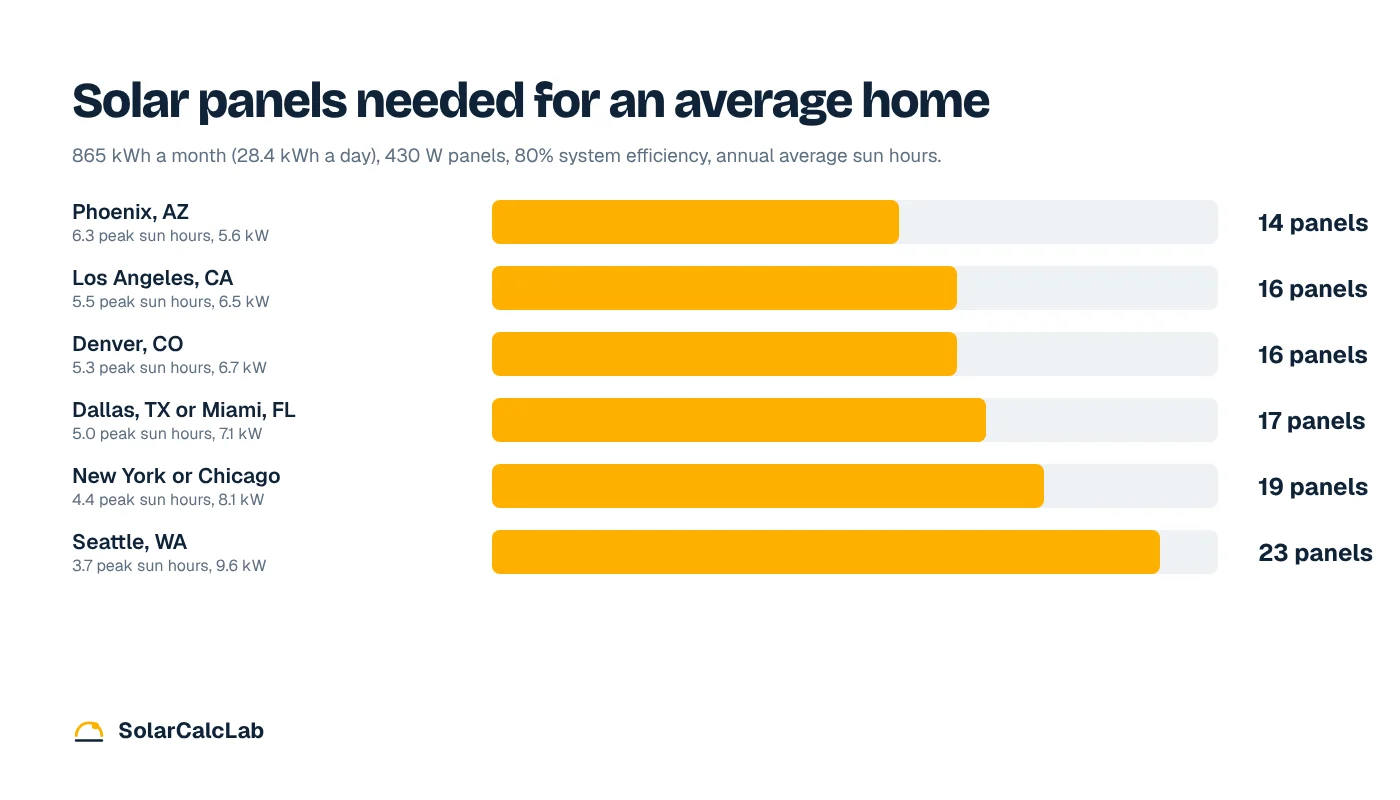
Seattle needs about 65% more panels than Phoenix for the same home, which is why the cost per kWh produced is much lower in the Southwest.
Does panel wattage change the answer?
It changes the count, not the system size. Here is the 7.9 kW average-home system built with different panels:
| Panel wattage | Panels needed | Actual system size |
|---|---|---|
| 350 W | 23 | 8.05 kW |
| 400 W | 20 | 8.00 kW |
| 430 W | 19 | 8.17 kW |
| 450 W | 18 | 8.10 kW |
| 500 W | 16 | 8.00 kW |
Higher-wattage panels help most when roof space is tight. They are physically larger, though, so check dimensions as well as watts. The solar panel roof area calculator shows how many modules fit on each roof face.
Worked examples
Example 1: Average home in Chicago
A household uses 10,400 kWh a year. Daily use is 10,400 ÷ 365 = 28.5 kWh. Chicago averages about 4.4 peak sun hours, so the system size is 28.5 ÷ (4.4 × 0.80) = 8.1 kW. With 430 W panels, 8,100 ÷ 430 = 18.8, which rounds up to 19 panels, an 8.17 kW array.
Example 2: Larger home in Denver with 440 W panels
A home with a heat pump averages 1,200 kWh a month. Daily use is 1,200 × 12 ÷ 365 = 39.5 kWh. At 5.3 peak sun hours, the system size is 39.5 ÷ (5.3 × 0.80) = 9.3 kW. With 440 W panels, 9,300 ÷ 440 = 21.1, so the home needs 22 panels.
Example 3: Covering 80% of the bill in New York
Under net billing, many owners size for less than 100% of their use, because exported power earns less than retail. Covering 80% of an 865 kWh home means 28.4 × 0.80 = 22.7 kWh a day. At 4.4 peak sun hours, that is 22.7 ÷ 3.52 = 6.5 kW, or 16 panels at 430 W, three fewer than a full offset. Smaller homes using about 450 to 650 kWh a month often land near the size covered in our 5kW solar system guide.
What else changes how much solar you need
Shade and roof direction
A south-facing roof in the US gets the most energy. East or west faces lose roughly 10% to 20%, and a north face often is not worth using. Shade from trees or chimneys can cut output far more than its footprint suggests, especially on string inverter systems. If your roof is shaded part of the day, add panels or choose microinverters or optimizers.
Future loads
Plan for changes in the next few years. An electric car driven about 1,000 miles a month at roughly 0.3 kWh per mile adds about 300 kWh, which is 7 more panels at 4.5 peak sun hours. A heat pump replacing a gas furnace can add more than that in winter. Adding panels later is possible but costs more per watt than including them up front.
Batteries and backup
A battery does not change how many panels you need to offset your annual bill. It changes when you use the energy. If you want to charge a battery fully on a winter day while also running the house, size the array for winter sun hours instead of the annual average, which can add 20% to 40% more panels.
Net metering rules
Where your utility credits exports at the full retail rate, sizing to 100% of use usually makes sense. Where exports earn a lower rate, sizing closer to your daytime use is often the better investment. The solar panel calculator lets you set a target offset below 100%.
How much will that many panels cost?
Installed residential prices in late 2026 typically run $2.20 to $3.20 per watt before incentives. The average-home system of 19 panels at 430 W is 8.17 kW, so it costs roughly $18,000 to $26,100. The federal residential tax credit for homeowner-owned systems ended after 2025, so price quotes on a cash basis and compare them per watt. Run your own numbers in the solar panel cost calculator.
Once you know your panel count, it helps to know where the energy goes. The appliance wattage chart shows which loads make up a typical bill, and trimming one big load before you buy can save several panels.
Frequently asked questions
How many solar panels do I need for a 2,000 sq ft house?
Square footage is only a rough guide, because energy use depends on climate, insulation and appliances. A typical 2,000 sq ft home uses about 900 to 1,200 kWh a month, which needs about 20 to 26 panels at 430 W with 4.5 peak sun hours. Use your actual bills for an accurate count.
How many solar panels does it take to power a whole house?
The average US home, using 865 kWh a month, needs about 19 panels at 430 W, or a 7.9 kW system, at 4.5 peak sun hours. The range runs from about 14 panels in Phoenix to about 23 in Seattle for the same usage.
How do I calculate how much solar I need?
Divide your yearly kWh by 365 to get daily use. Divide that by peak sun hours times 0.80 to get system size in kW. Then divide the system size in watts by your panel wattage and round up. For example, 28.4 kWh divided by 3.6 is 7.9 kW, or 19 panels at 430 W.
How much electricity does one solar panel produce?
A 430 W panel produces about 0.43 kW times peak sun hours times 0.80 each day. At 4.5 peak sun hours that is about 1.5 kWh a day, or roughly 565 kWh a year. In Phoenix the same panel makes about 2.2 kWh a day and in Seattle about 1.3 kWh.
Is it better to oversize a solar system?
Slight oversizing of 5% to 10% covers panel degradation and future loads, and it usually pays off where net metering credits exports at retail rates. Under net billing, where exports earn less, sizing above your use often lowers your return, so match the system to your daytime and battery needs.


