Are Solar Panels Worth It? How to Run the Numbers

Short answer
Solar panels are worth it for most US homeowners who own their roof, pay at least 12 cents per kWh and get reasonable credit for exported power. In our example, an 8 kW system bought for $20,960 at the projected 2026 average rate of 18.2 cents saves about $61,000 over 25 years, a net gain of about $37,700 after an inverter replacement. Solar is a weaker deal with cheap power, poor export credits, a shaded roof or a likely move within a few years.
The honest answer to “are solar panels worth it” depends on four numbers on your bill and your quote, not on general opinions about solar. Once you have those numbers, the math takes about ten minutes.
Below we run one realistic system through five scenarios: an average rate, a cheap rate, an expensive rate, a net billing utility and a loan. Each scenario uses the same panels on the same roof, so the differences come only from the money side.
The four numbers that decide it
- Your electricity rate. Total bill divided by kWh used, including delivery charges. The EIA projects a US residential average of 18.2 cents per kWh for 2026, up from 17.3 cents in 2025, in its Short-Term Energy Outlook.
- What your utility pays for exports. Full retail net metering, a reduced export rate or something in between.
- Your installed price. EnergySage puts the US average at about $2.60 per watt before incentives in 2026.
- How much your roof produces. This comes from peak sun hours, shading and orientation.
Notice what is missing: the federal tax credit. Homeowners who buy a system installed after 2025 no longer get the 30% credit, which our solar tax credit guide explains. Every figure below assumes no federal credit.
A 25-year example, step by step
Our example home installs 8 kW at $2.62 per watt, the average for that size in our solar panel cost guide. That is $20,960 paid in cash.
Assumptions
- Production: 8 kW × 4.5 peak sun hours × 365 days × 0.80 system efficiency = 10,512 kWh in year one.
- Panel output falls 0.5% a year, the median degradation rate found in NREL’s long-term studies.
- Electricity rates rise 2.5% a year. This is our assumption, not a forecast.
- One inverter replacement in year 13, budgeted at $2,500.
- Every kWh is worth the full retail rate unless the scenario says otherwise.
Year 1: 10,512 kWh × $0.182 = $1,913
25-year net value = sum of yearly savings − system cost − inverter replacement
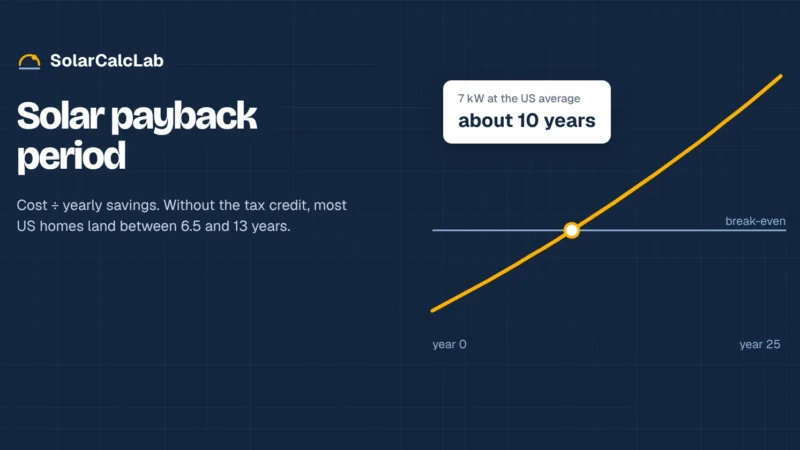
Added up over 25 years, the savings come to about $61,180. Subtract the $20,960 system and the $2,500 inverter, and the household is ahead by about $37,700. The system pays back its purchase price during year 11.
If rates never rose at all, the 25-year savings would drop to about $45,070 and the net gain to about $21,600. The project still works, just with less margin.
Your electricity rate is the biggest lever
Keep the same system and change only the starting rate:
| Starting rate | Year 1 savings | 25-year savings | Net after costs |
|---|---|---|---|
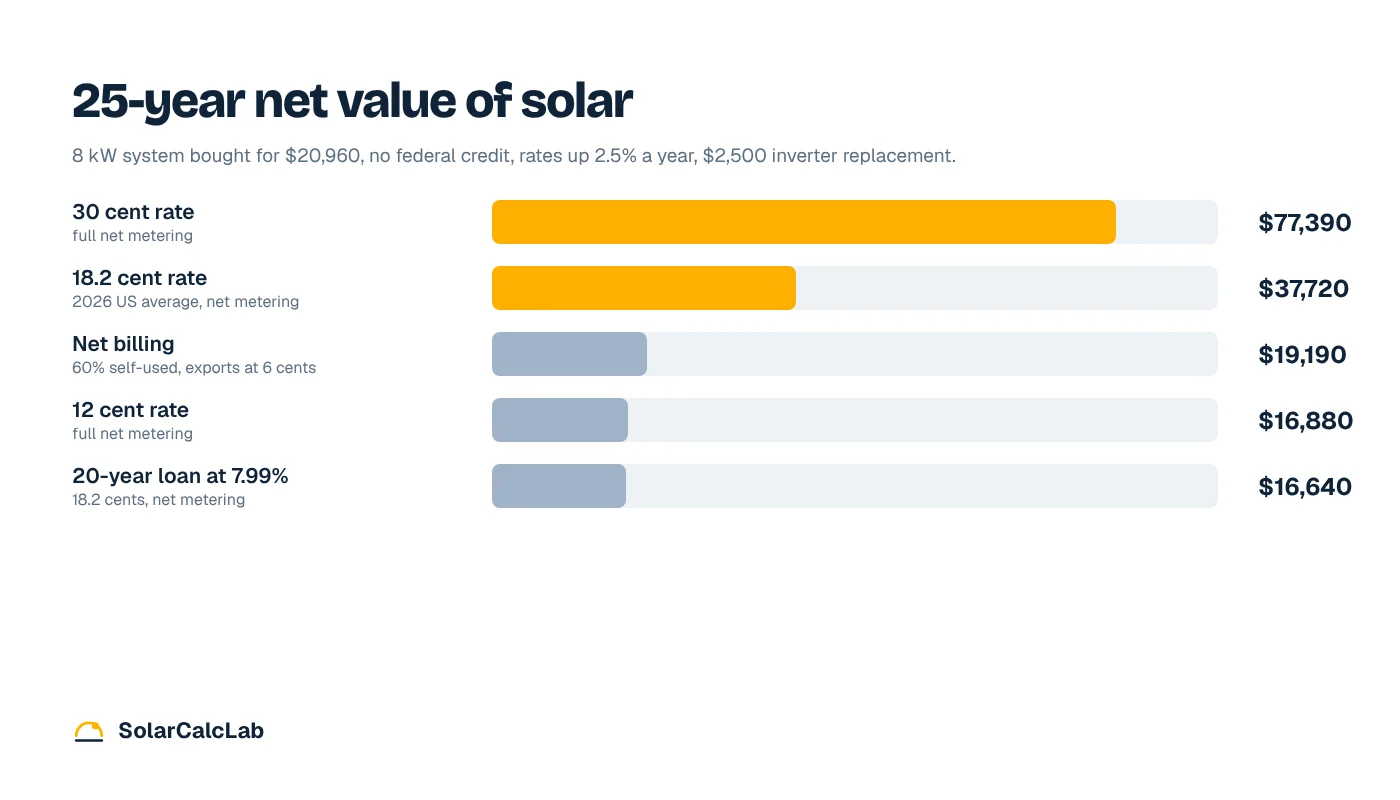
| 12 cents | $1,261 | $40,340 | $16,880 |
| 18.2 cents (2026 US average) | $1,913 | $61,180 | $37,720 |
| 30 cents | $3,154 | $100,850 | $77,390 |
The break-even point is lower than most people expect. With rates rising 2.5% a year, the system covers its full cost plus the inverter at a starting rate of about 7 cents. With flat rates, break-even is about 9.5 cents. That second figure is also the system’s lifetime cost per kWh: $23,460 spread over about 247,600 kWh comes to 9.5 cents.
Why this matters more than the panel brand
A premium panel might add a few percent to output. Moving from a 12 cent rate to an 18 cent rate adds about 50% to savings. If you are comparing quotes, spend your time on price per watt and the production estimate, not on panel marketing.
How export credits change the answer
Full retail net metering treats every exported kWh like one you used yourself. Many utilities now pay less for exports. Here is the same 18.2 cent home under a net billing plan where it uses 60% of its solar directly and exports 40% at a flat 6 cents:
| Credit method | Year 1 savings | 25-year net |
|---|---|---|
| Full net metering | $1,913 | $37,720 |
| Net billing, 60% self-used, exports at 6 cents | $1,400 | $19,190 |
Net billing roughly halves the gain in this example. The fix is to use more of your own power: run the dishwasher, laundry and EV charging during the day, or add a battery. The solar self-consumption calculator estimates your direct-use share, and the net metering calculator values your exports under your utility’s rules.
Cash or loan: does financing kill the deal?
Financing the same $20,960 over 20 years at 7.99% costs about $175 a month, or $42,045 in total. In year one the system saves about $159 a month at 18.2 cents, so the household pays about $16 a month more than before. By year 6, rising rates push monthly savings past the loan payment in this example, and after year 20 the savings are all yours.
Over 25 years the loan version still ends about $16,600 ahead, less than half the cash result. Watch the dealer fee. A loan advertised at a low rate often hides a higher system price, and the solar finance calculator shows total cost so you can compare offers side by side.
What if you move in a few years?
Our example saves about $14,200 in its first seven years, which does not cover the $20,960 price. Whether solar is worth it for a seller then depends on what buyers pay for it. A 2019 Zillow analysis found homes with solar sold for 4.1% more on average, but that figure is several years old and varies by market. Owned systems help a sale. Leased systems need the buyer to take over the contract, which can slow a closing.
If you expect to move within five years, a cash purchase is the least likely to pay off.
Solar’s return as an interest rate
Another way to judge the deal is to treat the system as an investment and calculate its internal rate of return, using the same cash flows as above:
| Scenario | 25-year net | Return per year |
|---|---|---|
| 12 cent rate | $16,880 | 4.7% |
| Net billing at 18.2 cents | $19,190 | 5.4% |
| 18.2 cent rate, net metering | $37,720 | 9.2% |
| 30 cent rate | $77,390 | 16.2% |
A 9% tax-free return compares well with most savings accounts and bonds. At 4% to 5%, solar is closer to a safe investment than a great one, and the case rests more on rate protection than on profit.
When solar is probably not worth it
- Your roof needs replacing within five years. Removing and reinstalling panels can cost thousands. Reroof first.
- Heavy shade. If trees block the roof for much of the day, production estimates fall fast.
- Power under about 10 cents with poor export credits. Returns shrink toward savings account territory.
- A quote well above $3.20 per watt for a standard roof. That is over 20% above the national average for no clear reason.
- A lease with a steep yearly escalator. A 2.9% yearly escalator on a 25-year lease can end up costing more than the utility if rates rise slowly.
How to run your own numbers
- Divide your last 12 months of bills by the kWh used to get your real rate.
- Find your utility’s export credit rule.
- Price your system size in the solar panel cost calculator and compare it with real quotes.
- Check yearly production for your ZIP code with the solar panel output calculator.
- Put it all into the solar payback calculator to see payback year and lifetime savings.
Frequently asked questions
Are solar panels worth it without the tax credit?
For many homes, yes. Our 8 kW example at $20,960 with no federal credit still nets about $37,700 over 25 years at an 18.2 cent rate with full net metering. The credit mainly shortened payback. It did not decide whether solar made money.
How much does solar save per month?
Our 8 kW example saves about $159 a month in year one at 18.2 cents per kWh. At 12 cents it saves about $105, and at 30 cents about $263. Savings grow as utility rates rise.
What electricity rate makes solar worth it?
At $2.62 per watt and 4.5 peak sun hours, a system covers its full cost at about 9.5 cents per kWh if rates never rise, or about 7 cents if rates rise 2.5% a year. Higher prices or less sun raise that threshold.
Is solar worth it with net billing?
Usually, but by less. In our example, net billing with exports at 6 cents cut the 25-year gain from about $37,700 to about $19,200. Shifting daytime use or adding a battery improves it.
Is it better to buy or lease solar panels?
Buying usually saves the most over 25 years if you have the cash or a fair loan. A lease or PPA needs no upfront money and the solar company claims any business credit, but you give up most of the long-term savings.