How Much Do Solar Panels Cost in 2026?

Short answer
Residential solar panels cost about $2.60 per watt installed in the US in 2026, before incentives. Most homes buy 6 to 14 kW, so a typical system costs $16,000 to $36,000, and the most common quote size, around 12 kW, lands near $31,000. Prices run from about $2.12 per watt in Florida to $2.93 in Illinois. Homeowners who buy no longer get the federal tax credit, which ended for systems installed after 2025.
A solar quote can look expensive or cheap depending on how it is framed. A monthly loan payment hides the total, and a total price hides the system size. The only fair way to compare is price per watt: divide the total by the system’s DC size in watts. Everything in this guide comes back to that one number, plus the extras that sit outside it.
The figures below come from installer quotes collected on the EnergySage marketplace, with state data updated in late October 2026. Your own price can be higher or lower, but these numbers tell you whether a quote is in the normal range.
Solar panel cost by system size
Bigger systems cost more in total but less per watt, because permits, design, sales and the truck roll are spread over more panels. Below about 6 kW the fixed costs bite hard.
| System size | Avg price per watt | Avg cost before incentives | Fits a home using about |
|---|---|---|---|
| 4 kW | $2.89 | $11,560 | 440 kWh a month |
| 5 kW | $2.78 | $13,900 | 550 kWh a month |
| 6 kW | $2.68 | $16,080 | 655 kWh a month |
| 7 kW | $2.62 | $18,340 | 765 kWh a month |
| 8 kW | $2.62 | $20,960 | 875 kWh a month |
| 9 kW | $2.57 | $23,130 | 985 kWh a month |
| 10 kW | $2.58 | $25,800 | 1,095 kWh a month |
| 12 kW | $2.56 | $30,720 | 1,315 kWh a month |
| 14 kW | $2.54 | $35,560 | 1,535 kWh a month |
| 15 kW | $2.47 | $37,050 | 1,645 kWh a month |
The last column assumes 4.5 peak sun hours and 80% system efficiency, so each kW makes about 110 kWh a month. In Arizona each kW makes more, and in the Pacific Northwest less. If you do not yet know your size, start with how many solar panels you need, then come back to price it.
Example: $27,000 ÷ 9,200 W = $2.93 per watt
Solar panel cost by state
Labor rates, permitting speed, local competition and sales tax rules all move the price. The state averages below are price per watt. The last column applies each state’s rate to the same 8 kW system so you can compare like with like.

| State | Avg price per watt | 8 kW system at that rate |
|---|---|---|
| Florida | $2.12 | $16,960 |
| Arizona | $2.25 | $18,000 |
| Texas | $2.25 | $18,000 |
| North Carolina | $2.46 | $19,680 |
| Washington | $2.47 | $19,760 |
| California | $2.52 | $20,160 |
| New Jersey | $2.60 | $20,800 |
| Colorado | $2.63 | $21,040 |
| New York | $2.77 | $22,160 |
| Massachusetts | $2.90 | $23,200 |
| Illinois | $2.93 | $23,440 |
A low price per watt does not mean the best deal. Massachusetts sits near the top of the price list, yet its high electricity rates give it some of the largest 25-year savings in the same EnergySage data. Price and value are different questions.
What you are actually paying for
Panels are only one part of the bill. Installed cost splits into hardware and what the industry calls soft costs.
Hardware
- Modules. The panels themselves. Premium brands with higher efficiency and longer warranties cost more per watt.
- Inverters. A single string inverter is usually cheapest. Microinverters or optimizers on every panel cost more but help on shaded or split roofs.
- Racking and electrical parts. Rails, roof attachments, wire, conduit, disconnects and monitoring.
Soft costs
- Labor for the roof crew and electrician.
- Permits, inspection and utility interconnection. Some cities approve in days, others take weeks of back and forth.
- Customer acquisition. Sales commissions and marketing. This is why door-to-door quotes often run higher than quotes you request yourself.
- Overhead and profit for the installer.
Soft costs are why US residential solar costs much more per watt than the panels alone. They are also where shopping around pays off, because hardware prices are similar across installers.
Costs that sit outside the per-watt price
Many quotes leave these out or list them separately. Ask about each one before you sign.
| Add-on | When you need it | Effect on cost |
|---|---|---|
| Home battery | Backup during outages, or net billing areas where exports earn little | EnergySage puts the typical 13.5 kWh battery at $15,647 before incentives, about $1,160 per kWh |
| Main panel upgrade | Older 100 A panels, or a large array on a 200 A panel | Varies widely by home; get it priced in writing |
| Roof repair or replacement | Roof with less than about 10 years of life left | Cheaper before panels go up than after, since removal and reinstall is paid labor |
| Ground mount | Shaded or small roof with open land | Usually higher than a roof mount because of trenching and foundations |
| Tree trimming or removal | Shade on the array | Separate contractor, separate bill |
A battery can nearly double the project: an 8 kW system at the national average plus one typical battery comes to about $36,600 before incentives.
The federal tax credit in 2026: who still gets it
Until the end of 2025, homeowners who bought a system could claim the 30% Residential Clean Energy Credit under Section 25D. The One Big Beautiful Bill Act, signed in July 2025, ended that credit, and the IRS confirms it is not available for any property placed in service after December 31, 2025. If you pay cash or take a loan for a system installed in 2026, there is no federal credit to subtract. Our breakdown of who still qualifies for the solar tax credit covers 2025 carryforwards, leases and state credits in detail.
Leases and power purchase agreements are different. The solar company owns the system and can still claim the business investment credit under Section 48E, as long as the project meets that credit’s construction and in-service deadlines. Some of that value can reach you as a lower monthly rate. Our solar PPA vs lease comparison shows how those contracts stack up against buying over 20 years.
State rebates, state tax credits, utility incentives and property tax exemptions for solar still exist in many places. They vary so much that the only reliable check is your state energy office and your utility’s website.
Cash, loan or lease: the same system, three prices
Take an 8 kW system at the national average of $20,960. How you pay changes what you spend:
- Cash: $20,960, paid once. You own the system and keep all the savings.
- 20-year loan at 7.99%: about $175 a month, or roughly $42,000 in total payments. Interest adds about $21,000. At 6.99% the payment drops to about $162.
- Lease or PPA: usually $0 down and a fixed monthly fee or price per kWh, often with a yearly escalator. You never own the panels unless you buy them out.
Watch for loans with a large “dealer fee” built into the price. A system quoted at $3.40 per watt with a low advertised rate can cost more than the same system at $2.70 per watt with a normal rate. Run both versions through the solar finance calculator to compare total cost, not monthly payment.
How long does a system take to pay for itself?
The same 8 kW system makes about 10,500 kWh a year at 4.5 peak sun hours. What that energy is worth depends on your rate and how your utility credits exports:
| Value of each kWh | Yearly savings | Simple payback on $20,960 |
|---|---|---|
| 14 cents | about $1,470 | about 14 years |
| 18 cents | about $1,890 | about 11 years |
| 25 cents | about $2,630 | about 8 years |
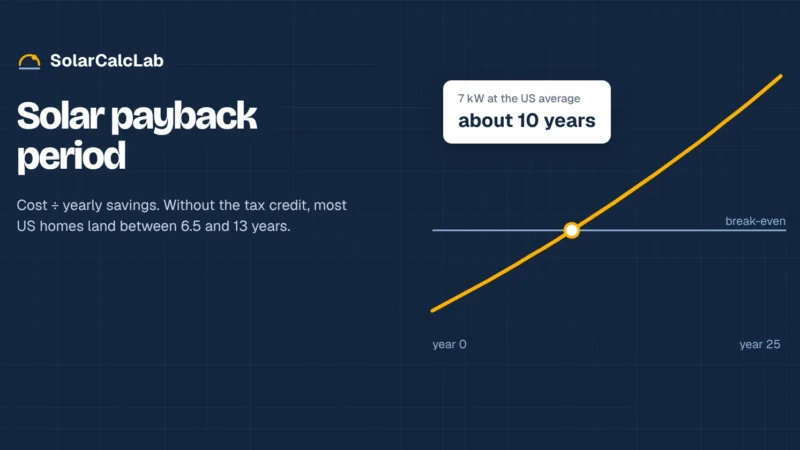
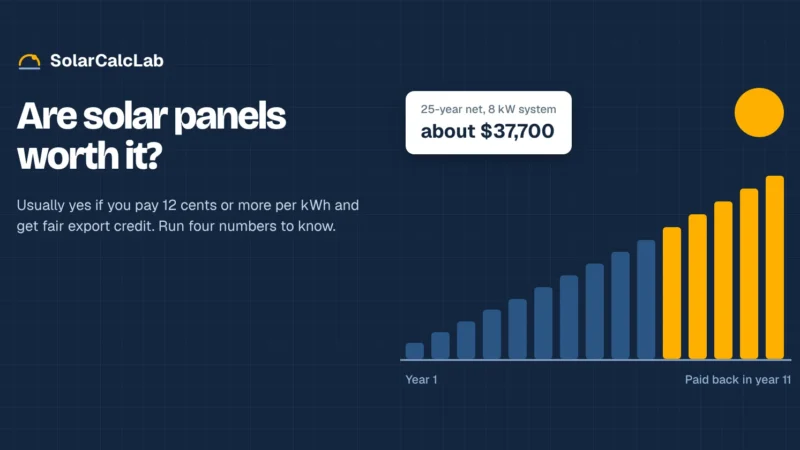
This assumes every kWh is worth your full retail rate, which is true with full net metering and less true under net billing. Plug in your own rate, export credit and rising rates with the solar payback calculator. For the full 25-year picture, including loans, net billing and selling the house early, see whether solar panels are worth it.
How to tell if your solar quote is fair
- Convert every quote to price per watt. Use the DC system size, not the inverter size.
- Compare against your state average. Within about 10% to 15% is a reasonable band. Well above that needs a reason, such as premium panels, microinverters or a hard roof.
- Check production estimates. Two quotes with the same size should predict similar yearly kWh for the same roof. A much higher number is a red flag.
- Read what is excluded. Panel upgrades, roof work and permit fees are the usual surprises.
- Get at least three quotes. Price differences of several thousand dollars for the same size are common.
For a full worked example of one common size, see the 5kW solar system guide, and use the solar panel cost calculator to price any size at your local rate.
Frequently asked questions
How much does it cost to put solar panels on a house in 2026?
Most US homes pay $16,000 to $36,000 for a 6 to 14 kW system before incentives, at an average of about $2.60 per watt. The most common quote size, around 12 kW, comes to roughly $31,000.
Is the 30% solar tax credit still available?
Not for homeowners who buy. The Section 25D credit ended for systems installed after December 31, 2025. Leased and PPA systems can still benefit indirectly, because the owning company may claim the Section 48E business credit.
Why is solar cheaper per watt for bigger systems?
Permits, design, sales, inspection and crew travel cost about the same whether you install 12 panels or 30. Spreading those fixed costs over more watts lowers the price per watt, from about $2.89 at 4 kW to $2.47 at 15 kW.
How much do solar panels cost per panel?
At $2.60 per watt installed, one 430 W panel’s share of a full system is about $1,120. That covers the panel plus its share of the inverter, racking, labor and permits. The bare panel bought alone costs much less, but it cannot produce usable power without the rest of the system.
Does adding a battery double the cost of solar?
It can come close for smaller systems. A typical 13.5 kWh battery runs about $15,647 before incentives, compared with $20,960 for an average 8 kW system. Many homes on full net metering skip the battery unless they want outage backup.