Solar for 500 kWh a Month: Panels, Cost and Payback
Short answer
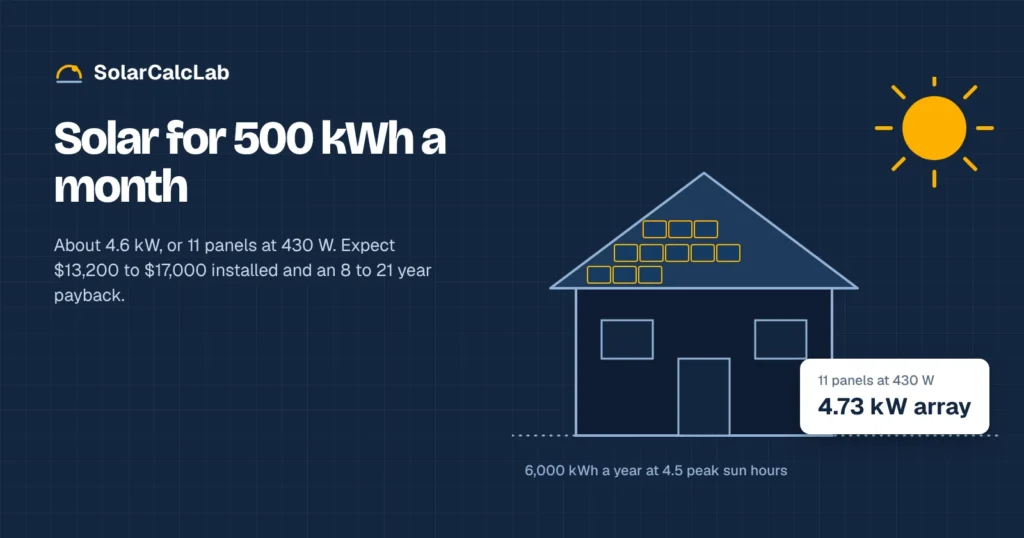
To cover 500 kWh a month (6,000 kWh a year) you need about a 4.6 kW solar system at 4.5 peak sun hours and 80% system efficiency. With 430 W panels that rounds up to 11 panels, a 4.73 kW array that makes roughly 6,200 kWh a year. Small systems cost more per watt, so expect about $13,200 to $17,000 installed and a payback of roughly 8 to 21 years depending on your electricity rate.
A 500 kWh bill is small by American standards. It usually belongs to an apartment, a condo, a compact house with gas heat and cooking, or a home that has already done the efficiency work. Sizing the array is the easy part. The harder question is whether rooftop panels make sense for a bill of about $91, or whether community solar or a plug-in kit is smarter.
If your bill is much larger, our guide to how many solar panels you need covers the same method for any usage, and the 1,000 kWh a month guide shows what doubling the bill does to the system and the payback.
Is 500 kWh a month a low bill?
Yes. A typical US home uses somewhere around 860 to 900 kWh a month, so 500 kWh is a little under 60% of average. Spread over a year, it works out to 16.4 kWh a day.
500 ÷ 30.4 = 16.4 kWh a day, or 6,000 kWh a year
At the national average price, that is not much money. The EIA’s October 2026 Short-Term Energy Outlook puts the average residential price at 18.2 cents per kWh for 2026, rising to 18.7 cents in 2027. At 18.2 cents, 500 kWh costs about $91 a month, or $1,092 a year.
If you are not sure your bill really averages 500, add up the kWh line from your last 12 statements and divide by 12. The kWh calculator helps if you only know appliance wattages and hours.
How big a system covers 6,000 kWh a year?
The sizing formula uses your yearly use, the peak sun hours at your roof and an 80% factor for heat, wiring, inverter and dirt losses.
6,000 ÷ (4.5 × 0.80 × 365) = 6,000 ÷ 1,314 = 4.57 kW
Panels = 4,570 W ÷ 430 W = 10.6, so 11 panels (4.73 kW)
Sun hours change the answer most. Here is the same 6,000 kWh home across US climates.
| Peak sun hours | Typical of | kW needed | Panels at 430 W | Yearly output of that array |
|---|---|---|---|---|
| 3.5 | Western Washington, Oregon coast | 5.87 kW | 14 | 6,150 kWh |
| 4.0 | Great Lakes, New England | 5.14 kW | 12 | 6,030 kWh |
| 4.5 | Much of the Midwest and Mid-Atlantic | 4.57 kW | 11 | 6,215 kWh |
| 5.0 | Texas, Florida, the Carolinas | 4.11 kW | 10 | 6,280 kWh |
| 5.5 | Southern California, Colorado | 3.74 kW | 9 | 6,215 kWh |
| 6.0 | Arizona, Nevada, New Mexico | 3.42 kW | 8 | 6,030 kWh |
The regions are rough guides. A shaded or east-facing roof can lose a full sun hour, so look up your own address in the peak sun hours calculator before you trust a row. Panel size only changes the count: at 4.5 sun hours you would need 12 panels at 400 W, 11 at 450 W or 10 at 500 W.
Look at your 12 months before you trust “500”
Two homes can both say “about 500 a month” and still need different systems. Under net metering with an annual true-up, only the yearly total matters, so the shape of the year decides the size.
The two patterns below are illustrative, built to show common cases. Home A is an apartment with electric baseboard heat and gas-free cooking. Home B is a small house with gas heat and central air.
| Month | Home A: winter peak (kWh) | Home B: summer peak (kWh) |
|---|---|---|
| Jan / Feb / Mar | 720 / 640 / 560 | 380 / 350 / 380 |
| Apr / May / Jun | 420 / 330 / 310 | 430 / 560 / 700 |
| Jul / Aug / Sep | 340 / 350 / 330 | 800 / 820 / 640 |
| Oct / Nov / Dec | 420 / 560 / 720 | 450 / 370 / 370 |
| Year total | 5,700 (475 a month) | 6,250 (521 a month) |
| System at 4.5 sun hours | 4.34 kW, 11 panels | 4.76 kW, 12 panels |
Home B is easy: its heaviest months line up with the sunniest ones. Home A is tricky. Its panels make most of their energy from April to September, exactly when it uses the least. That only works if the utility carries summer credits forward at full value into winter. If your utility settles credits monthly, or pays a low rate for exports, a winter-peaking home gets much less from the same array.
What does a 4.7 kW system cost, and how long is the payback?
Here is the catch with small systems. Permits, design, inspection, the electrician’s visit and sales costs are roughly the same for 11 panels as for 25, so the price per watt climbs as the system shrinks. Installer data puts the national average near $2.60 per watt, but that average is driven by systems of around 12 kW. For a system under 5 kW, budget closer to $2.80 to $3.60 per watt. Our 4kW solar system guide breaks down why that premium exists.
| Price per watt | Installed cost, 4.73 kW |
|---|---|
| $2.80 | $13,240 |
| $3.20 (planning figure) | $15,140 |
| $3.60 | $17,030 |
There is no federal tax credit to subtract. The 30% residential clean energy credit does not apply to home systems placed in service after December 31, 2025, so the figures above are what you pay unless a state or utility program helps.
Why the fixed charge matters more on a small bill
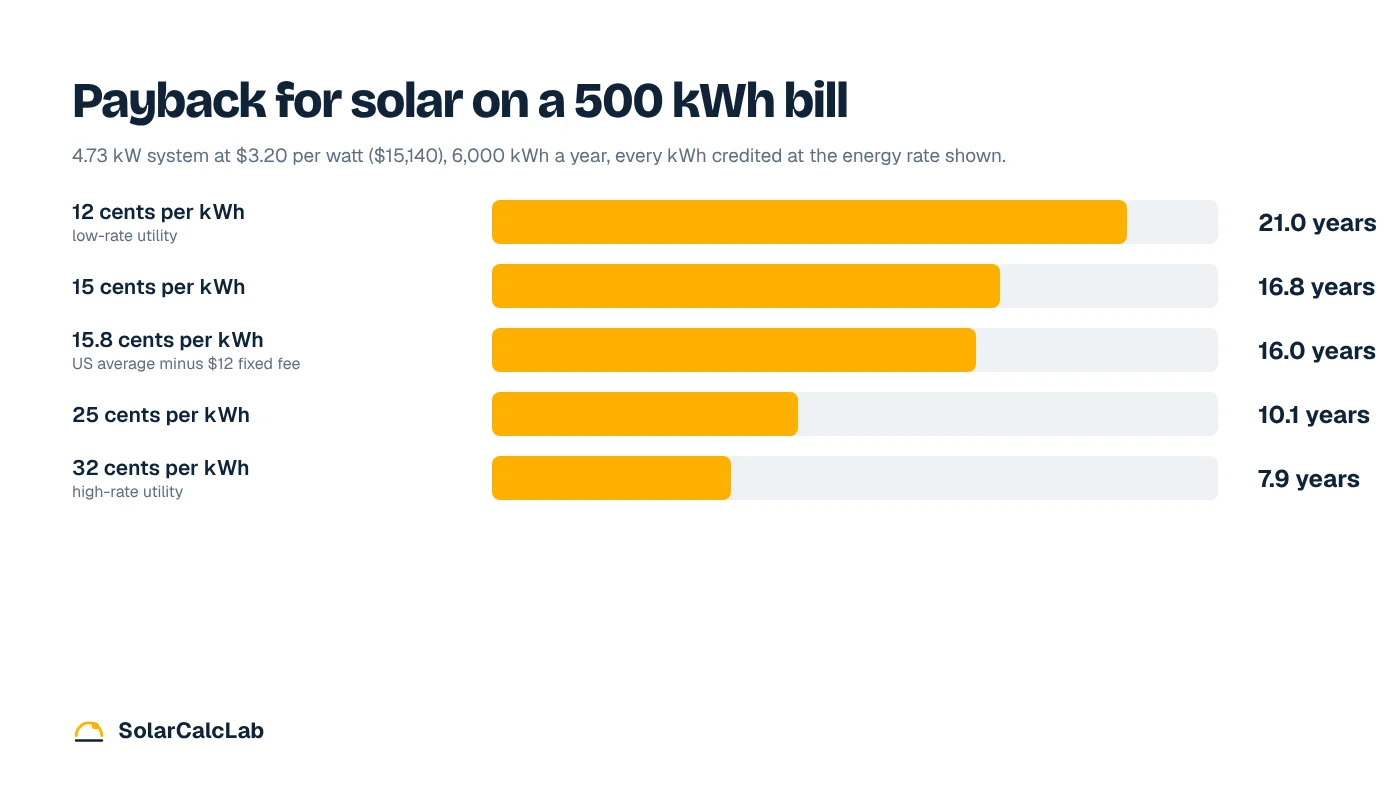
Solar can erase energy charges, not the monthly customer charge. Say your utility charges $12 a month just to stay connected. On a $91 bill, that leaves $79 of energy charges, or 15.8 cents per kWh. Solar saves about $948 a year, not $1,092.
$15,140 ÷ $948 = 16.0 years
Your energy rate moves the answer most:
| Energy rate (after fixed fees) | Yearly savings | Simple payback |
|---|---|---|
| 12 cents | $720 | 21.0 years |
| 15 cents | $900 | 16.8 years |
| 15.8 cents | $948 | 16.0 years |
| 25 cents | $1,500 | 10.1 years |
| 32 cents | $1,920 | 7.9 years |
Net billing makes it slower still
Those paybacks assume every kWh is credited at retail. Many utilities now credit exports at a lower rate. Suppose 40% of your solar is exported and earns 6 cents, while the other 60% offsets power you would have bought at 15.8 cents. Savings fall to about $713 a year and payback stretches past 21 years. Run your own utility’s rules through the net metering calculator before signing anything.
Rooftop, community solar or a plug-in kit?
For a 500 kWh home, rooftop panels are only one of three routes, and often not the best one.
| Option | Upfront cost | Share of 6,000 kWh covered | Rough yearly savings | Best for |
|---|---|---|---|---|
| Rooftop, 11 panels | $13,200 to $17,000 | About 100% | $700 to $1,900 | Owners staying 10+ years in a high-rate area |
| Community solar subscription | Usually none | Credits sized to your use | $55 to $220 | Renters, shaded roofs, condos |
| 800 W plug-in kit | Kit price only | About 12% to 18% | $130 to $190 | Apartments with a sunny balcony, where legal |
Community solar savings come from a discount on the credits you buy. EnergySage reports that most subscribers save 5% to 20% of their annual electricity costs, which on $1,092 is about $55 to $220 a year. Small, but with no install and no roof.
Plug-in solar is newer in the US. Utah allowed it first, and by July 2026 Maine, Virginia, Colorado, Maryland, New Hampshire, Connecticut, Vermont and New York had passed laws for it, with California also moving to legalize it. An 800 W kit facing south at a good tilt might make about 1,050 kWh a year at 4.5 sun hours. Hung flat on a railing, with some shade, 700 kWh is more realistic. The balcony solar calculator estimates output for your angle and direction.
A quick way to decide
- You own, plan to stay 10+ years and pay 25 cents or more: rooftop pays back in about a decade. Get quotes.
- You own but pay under 15 cents with net billing: the payback may outlast the inverter. Cut usage, then revisit.
- You rent or your roof is shaded: community solar if your state has a program, plug-in if it is legal and you have sun.
Roof space, inverters and room to grow
Eleven 430 W panels at about 21.5% efficiency cover roughly 22 square meters, about 237 square feet. After fire-code setbacks and gaps around vents, plan on 300 to 350 square feet of usable south, east or west roof.
If more load is coming, design for it. An EV adding 250 kWh a month takes the home to 750 kWh, which needs about 6.85 kW, or 16 panels at 4.5 sun hours. A string inverter sized for 4.7 kW may not have room for five more panels later, while microinverters make additions simpler because each panel runs on its own.
Does a 500 kWh home need a battery?
Not to offset the bill. With net metering, the grid stores your surplus as credits. A battery earns its place for outage backup or under time-of-use rates with an expensive evening peak. At 16.4 kWh a day, a single 10 to 13 kWh battery covers essentials overnight, and our 15kWh per day solar system guide walks through sizing storage around the evening share of your use. A battery adds thousands of dollars to a $15,000 system, so it rarely shortens the payback on a bill this size.
Frequently asked questions
How many solar panels do I need for 500 kWh a month?
About 11 panels at 430 W where you get 4.5 peak sun hours, using an 80% system efficiency factor. That ranges from 8 panels in Arizona to 14 in western Washington. With 400 W panels, plan on 12 at 4.5 sun hours.
Is solar worth it if my bill is only about $90 a month?
It depends on your rate and how long you will stay. At 25 cents or more per kWh with full net metering, an 11 panel system pays back in about 10 years. At 12 to 15 cents, payback runs 17 to 21 years, and community solar may be the better deal.
Can a 5 kW solar system cover 500 kWh a month?
In most of the US, yes. A 5 kW array makes about 6,570 kWh a year at 4.5 sun hours, about 110% of a 6,000 kWh home. It would fall short only below about 4.1 sun hours, such as in the Pacific Northwest.
Can a renter get solar for a 500 kWh apartment?
Usually not on the roof, but there are two options. A community solar subscription credits your utility bill with no installation, and in states that allow plug-in solar, an 800 W balcony kit can cover roughly 12% to 18% of 6,000 kWh a year.
Why do small solar systems cost more per watt?
Permits, design, inspection, labor to set up the job and sales costs stay about the same whether you install 11 panels or 25. Spread over fewer watts, those fixed costs push the price per watt up, often to $2.80 to $3.60 for systems under 5 kW.


