25kWh per Day Solar System: How Many Panels and What Size You Need
Short answer
A 25 kWh solar system, meaning one that makes 25 kWh a day, needs about 6.9 kW of panels at 4.5 peak sun hours and 80% system efficiency. That is 17 panels at 430 W (7.31 kW). Phoenix gets there with about 12 panels, Seattle needs about 20. To run the same home after dark, add roughly 10 to 18 kWh of battery.
Twenty-five kilowatt-hours a day sits just under the typical American home. It is the kind of number you see on a bill for a three-bedroom house with gas heat, a well-insulated home with central air, or an average household that has already switched to LED lighting and newer appliances.
This page turns that daily figure into a real system: kilowatts by city, the panel count for three common panel ratings, whether about 7 kW fits your electrical panel, how much battery covers the night, and what the whole setup costs in late 2026.
What does 25 kWh a day look like on your bill?
Utilities bill by the month, so start by converting. Multiply your daily figure by the average month length of 30.4 days, or by 365 for the year.
Example: 25 × 30.4 = 760 kWh a month, or 25 × 365 = 9,125 kWh a year
For comparison, the US Energy Information Administration reports that the average residential customer bought 10,791 kWh in 2022, or about 29.6 kWh a day. A 25 kWh home uses roughly 85% of that, about 4.6 kWh a day less than average.
If your 12-month total lands between about 8,700 and 9,500 kWh, this page fits you. If it is closer to 7,300 kWh, see our 20 kWh per day solar system guide, and near 11,000 kWh, the 30 kWh per day version.
| Period | Energy at 25 kWh a day | Bill at $0.15/kWh | Bill at $0.20/kWh | Bill at $0.30/kWh |
|---|---|---|---|---|
| Day | 25 kWh | $3.75 | $5.00 | $7.50 |
| Average month | 760 kWh | $114 | $152 | $228 |
| Year | 9,125 kWh | $1,369 | $1,825 | $2,738 |
The three rates are example assumptions, not quotes, and exclude fixed monthly fees, which solar does not remove.
What size solar system produces 25 kWh a day?
A kilowatt of panels makes about 1,100 to 1,600 kWh a year in most of the US, or 3 to 5 kWh a day. Divide 25 kWh by that range and you already know the answer falls between about 5 and 8.5 kW. To narrow it down, use your own peak sun hours and the site’s 80% efficiency factor, which covers heat, wiring, dust and inverter losses.
Example at the US middle value: 25 ÷ (4.5 × 0.80) = 25 ÷ 3.6 = 6.94 kW
Some quick guides divide daily kWh by four. That shortcut gives 6.25 kW, which only works where you get about 5 sun hours. Others divide by sun hours and skip losses entirely, which leaves the array about 20% short every day of the year.
25 kWh a day by city
Sun hours below are approximate annual averages for panels facing south and tilted near the local latitude. Panel counts are rounded up so the array meets or beats 25 kWh on an average day.
| Location | Peak sun hours | kW needed | 400 W panels | 430 W panels | 450 W panels | Average day (430 W array) |
|---|---|---|---|---|---|---|
| Phoenix, AZ | 6.3 | 4.96 kW | 13 | 12 | 12 | 26.0 kWh |
| Los Angeles, CA | 5.5 | 5.68 kW | 15 | 14 | 13 | 26.5 kWh |
| Denver, CO | 5.3 | 5.90 kW | 15 | 14 | 14 | 25.5 kWh |
| Dallas, TX | 5.0 | 6.25 kW | 16 | 15 | 14 | 25.8 kWh |
| US middle value | 4.5 | 6.94 kW | 18 | 17 | 16 | 26.3 kWh |
| Chicago, IL | 4.4 | 7.10 kW | 18 | 17 | 16 | 25.7 kWh |
| Seattle, WA | 3.7 | 8.45 kW | 22 | 20 | 19 | 25.5 kWh |
The spread is wide: a Seattle roof needs eight more 430 W panels than a Phoenix roof for the same 25 kWh. If you do not know your sun hours, the peak sun hours calculator gives a planning value, and the solar panel calculator runs the full sizing for any daily target, panel rating and location.
Is 6.6 kW or 5 kW enough for 25 kWh a day?
Installers often quote these sizes. Whether they work depends on sun hours.
Example: 6.6 × 4.5 × 0.80 = 23.8 kWh a day
- 6.6 kW falls about 1.2 kWh short at 4.5 sun hours and reaches 25 kWh at about 4.7 sun hours. It works in Texas, Colorado and most of the Southwest, not in Chicago or Seattle.
- 5 kW makes 18 kWh at 4.5 sun hours and only hits 25 kWh with about 6.25 sun hours, which means Phoenix or Las Vegas level sunshine.
- 7 to 7.3 kW is the safe size for the middle of the country, with a little margin for the slow output loss panels show as they age.
A small undersize is not a disaster on a grid-tied home. You simply buy the remaining kWh from the utility. It matters more if your goal is a near-zero bill or a battery that fills every day.
Does a 7 kW system fit your electrical panel?
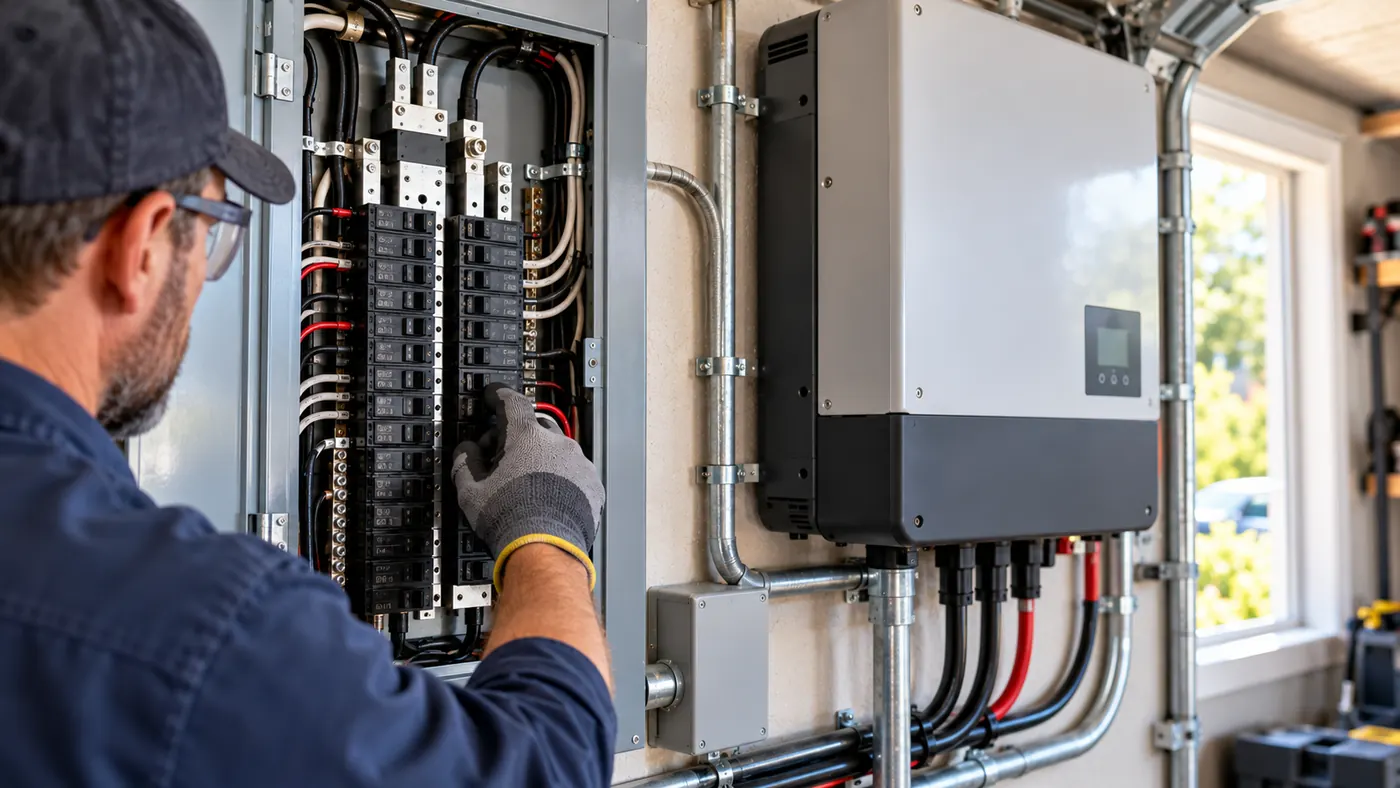
This is the question that makes 25 kWh a day a convenient size. Most grid-tied systems connect through a breaker in the home’s main panel, and the National Electrical Code limits how much solar can feed a panel’s busbar. Under the commonly used 120% rule in NEC 705.12, 125% of the inverter’s output current plus the main breaker rating must not exceed 120% of the busbar rating.
Example: (200 × 1.2 − 200) ÷ 1.25 = 32 A, and 32 A × 240 V = 7,680 W
That 7,680 W ceiling is why 7.6 kW single-phase inverters are so common. A 17-panel, 7.31 kW array pairs naturally with one, and even the 8.6 kW Seattle array works, since a DC to AC ratio of about 1.1 is normal. The inverter size calculator checks the ratio for your array.
Older homes with a 100 A panel are a different story. The same formula allows only 16 A, about 3.8 kW, so a 7 kW system there usually needs a supply-side connection, a smaller main breaker or a panel upgrade. Rules vary with the code edition your area adopted, so confirm the method with your installer and local inspector before you sign.
How much battery do you need to use 25 kWh at night?
Solar panels stop producing at sunset, but your 25 kWh does not all happen in daylight. Without a battery, a grid-tied home buys evening power and relies on net metering credits from the day. Where exports earn far less than retail, as under California’s net billing tariff, storing your own midday surplus is worth more than selling it.
Size the battery to the share of your day that runs after dark, not to the full 25 kWh. This site plans with 90% usable capacity.
Example: 25 × 0.50 = 12.5 kWh ÷ 0.90 = 13.9 kWh
| Household pattern | Share after sunset | Night energy | Battery needed |
|---|---|---|---|
| Someone home all day, laundry and dishwasher run at midday | 35% | 8.75 kWh | 9.7 kWh |
| Typical working household | 50% | 12.5 kWh | 13.9 kWh |
| Evening cooking, AC or heat pump running overnight | 65% | 16.25 kWh | 18.1 kWh |
The shares are example assumptions. Your utility’s hourly usage download shows your real split. One 10 to 13.5 kWh battery covers most homes in the first two rows, while the third needs about 18 kWh, often two smaller units. Check other combinations with the battery calculator.
Can the same panels charge the battery?
Mostly, yes. Energy you store is not extra energy: it is daytime production shifted to the evening, so the array still needs to make about 25 kWh. Charging and discharging lose some of it, though. Assuming a 10% round-trip loss on 12.5 kWh, you need about 1.4 kWh more per day. The 17-panel array averages 26.3 kWh, which covers that margin on an average day, though not on cloudy ones.
Fully off grid is a much larger job: two days of autonomy means 25 × 2 ÷ 0.90 = 55.6 kWh of storage, plus a bigger array sized for winter.
How much does a 25 kWh per day solar system cost?
Typical US ranges in late 2026 for a professionally installed, grid-tied system run about $2.50 to $3.50 per watt before any state or utility incentives. Installed home batteries run roughly $800 to $1,400 per kWh of capacity.
- 7.31 kW, 17 panels: about $18,300 to $25,600.
- Add a 10 kWh battery: about $8,000 to $14,000 more.
- Seattle-size 8.6 kW array: about $21,500 to $30,100.
The 30% federal residential clean energy credit (Section 25D) ended for homeowner-owned systems installed after December 31, 2025, so leave it out of your budget. Leases and power purchase agreements follow different rules, so confirm any claimed savings with a tax adviser.
Payback at three electricity rates
Example: $21,900 ÷ (9,125 × $0.20) = $21,900 ÷ $1,825 = 12.0 years
Using the $21,900 midpoint for the 17-panel array, payback is about 16 years at $0.15 per kWh, 12 years at $0.20 and 8 years at $0.30. These figures assume every kWh offsets a full retail kWh. Lower export credits stretch payback, which is where a battery can help. Try your own numbers in the solar payback calculator.
How much roof does 17 panels take?
Modern residential panels convert about 21% of sunlight, so area follows directly from the array size.
Example: 7,310 ÷ 210 × 10.764 = about 375 sq ft
Fire code pathways and ridge setbacks usually add 20% or more, so plan for about 450 to 500 square feet of unshaded roof facing south, east or west. The Seattle-size 20-panel array needs closer to 530 to 600 square feet.
Should you size above 25 kWh a day?
A margin of 5% to 10% is sensible. Panels slowly lose output over the years, and the rounded-up 17-panel array already gives you about 5% extra. Go further only for a load you know is coming:
- An electric vehicle: 10,000 miles a year at an assumed 0.30 kWh per mile adds about 8.2 kWh a day, pushing a 25 kWh home past 33 kWh.
- A heat pump replacing gas heat: the added winter load can be large, so get an estimate for your house before resizing.
- Low export credits: extra panels earn little if surplus sells cheaply, so a battery often beats a bigger array.
If an upgrade is likely, ask for a 7.6 kW inverter with headroom and leave roof space for three or four more panels.
Frequently asked questions
How many solar panels do I need for 25 kWh a day?
About 17 panels at 430 W, which is a 7.31 kW array, at 4.5 peak sun hours and 80% system efficiency. With 400 W panels it takes 18, and with 450 W panels 16. Sunny Phoenix needs about 12 panels at 430 W, while Seattle needs about 20.
Is 25 kWh a day a lot of electricity?
No, it is slightly below the US average. The EIA puts the average residential customer at 10,791 kWh a year, or about 29.6 kWh a day. At 25 kWh a day you use about 760 kWh a month and 9,125 kWh a year, around 85% of a typical home.
Is a 25 kWh solar system the same as a 25 kW solar system?
No. kWh measures energy and kW measures power. A system that makes 25 kWh a day is about 7 kW. A 25 kW array is roughly three and a half times larger and makes about 90 kWh a day at 4.5 sun hours, which suits a farm, small business or very large all-electric home.
Can a 6.6 kW solar system produce 25 kWh a day?
Only where you average about 4.7 peak sun hours or more. At the US middle value of 4.5 hours, 6.6 kW makes about 23.8 kWh a day after 80% system efficiency. That covers most of a 25 kWh home in Texas or the Southwest, but falls short in cloudier northern states.
How many batteries do I need for 25 kWh a day?
For a grid-tied home, size to your nighttime use. If half your 25 kWh is used after sunset, about 13.9 kWh of battery covers it at 90% usable capacity, often one large unit. Off grid with two days of autonomy, you need about 55.6 kWh plus a larger array.


