300Ah Battery: kWh, Runtime and Solar Panel Size
Short answer
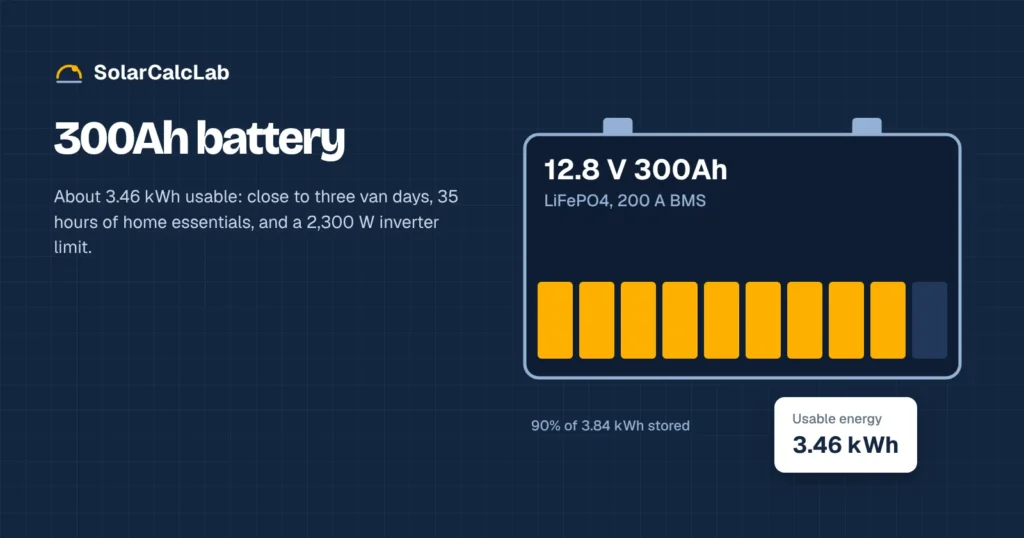
A 12 V 300Ah lithium (LiFePO4) battery stores 3.84 kWh, and about 3.46 kWh of that is usable. That covers a typical van day of fridge, fan, lights and laptop for close to three days, or a home outage kit of fridge, CPAP, router and lights for about 35 hours. Its built-in 200 A BMS caps the load at roughly 2,500 W, so it will not feed a 3,000 W inverter at full output.
A 300Ah battery sits in an awkward but popular spot. It is the biggest single 12 V lithium box most people can still lift into an RV bay or a boat locker, and it replaces the old habit of wiring three 100Ah batteries together. Most 300Ah models you will see today are 12.8 V LiFePO4 units weighing around 56 to 60 lb.
This guide answers the questions people ask right before buying one: how many days it lasts for a real setup, how fast each charging source refills it, what the BMS limit means for your inverter, and whether one big battery beats three small ones.
What 300Ah means in kWh
Amp-hours only become energy once you multiply by voltage. Lithium iron phosphate batteries are built from 3.2 V cells, so a “12 V” model is really 12.8 V. Lead-acid is 12 V nominal but should not be drained below half.
Example: 300 Ah × 12.8 V ÷ 1,000 = 3.84 kWh, and 3.84 × 0.90 usable = 3.46 kWh
| 300Ah battery or bank | Total energy | What you can plan to use |
|---|---|---|
| 12 V lead-acid (AGM or flooded) | 3.6 kWh | 1.8 kWh (50%) |
| 12.8 V LiFePO4 | 3.84 kWh | 3.46 kWh (90%) |
| 25.6 V LiFePO4 | 7.68 kWh | 6.91 kWh |
| 51.2 V LiFePO4 | 15.36 kWh | 13.82 kWh |
The rest of this page assumes the 12.8 V lithium version, since that is what nearly every 300Ah listing is. To run the conversion for any other voltage, use the Ah to kWh converter.
How many days will a 300Ah battery last?
Runtime depends far more on your daily habits than on the battery. Here are two real load lists worked out in full, followed by a quick lookup table.
Van or truck camper, no solar
Most van loads run straight from 12 V, which skips inverter losses. A small compressor fridge uses about 35 Ah a day, a roof fan on low for 10 hours about 20 Ah, LED lights for 4 hours about 12 Ah, and the water pump plus phone charging about 5 Ah. That is 72 Ah of DC loads.
Add a 65 W laptop for 4 hours through an inverter: 260 Wh ÷ 0.9 inverter efficiency ÷ 12.8 V = about 23 Ah. The day totals roughly 95 Ah, and 270 usable amp-hours ÷ 95 = 2.9 days with no charging at all.
Home outage kit
Everything here runs on 120 V through an inverter. A kitchen fridge at 1.2 kWh a day, a CPAP at 40 W for 8 hours (320 Wh, humidifier off), a router at 15 W around the clock (360 Wh), 30 W of LED lamps for 5 hours (150 Wh) and 100 Wh of phone and laptop charging add up to 2,130 Wh a day.
Dividing by 0.9 for the inverter gives 2,367 Wh drawn from the battery. With 3,456 Wh usable, the battery lasts about 1.5 days, or 35 hours. A CPAP humidifier can double that device’s draw, so check its own figure if you use one.
| AC energy used per day | Days from a full 12 V 300Ah LiFePO4 |
|---|---|
| 500 Wh (lights, router, phones) | 6.2 days |
| 1,000 Wh (add a small fridge) | 3.1 days |
| 1,500 Wh | 2.1 days |
| 2,000 Wh (kitchen fridge and essentials) | 1.6 days |
| 3,000 Wh | 1.0 day |
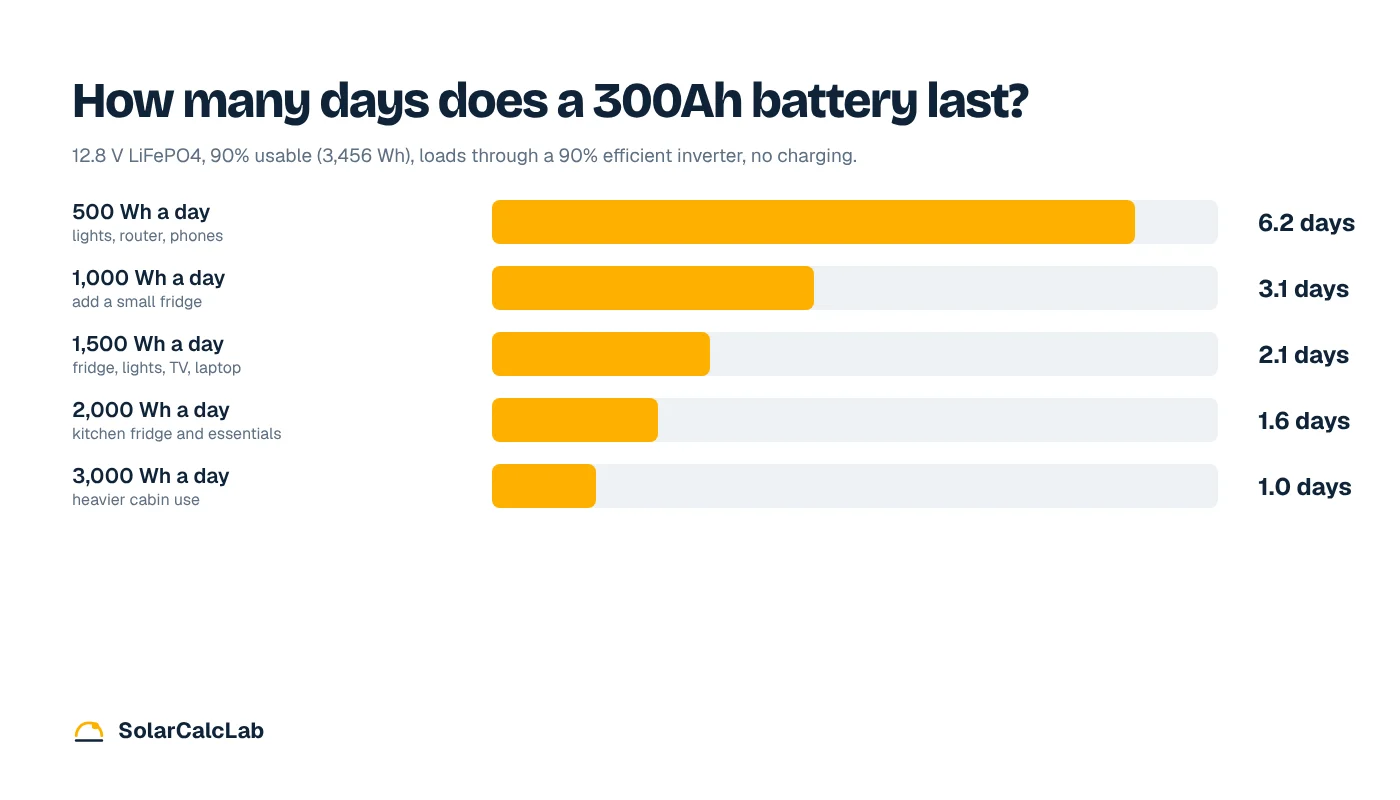
To build your own list appliance by appliance, the battery life calculator returns hours for any load in watts or amps.
Will a 300Ah battery run my inverter?
This is where many buyers get caught out. The two 12 V 300Ah LiFePO4 models we checked in November 2026, from Redodo and Vatrer, both list a 200 A continuous discharge limit. The battery management system (BMS) shuts the battery off if you pull more than that for long.
Limit: 200 A × 12.8 V = 2,560 W from the battery, or about 2,300 W of AC output
| AC load on the inverter | Current from the battery | Single 300Ah with 200 A BMS |
|---|---|---|
| 1,000 W | 87 A | Fine |
| 1,500 W (microwave) | 130 A | Fine |
| 2,000 W | 174 A | Fine, near the limit |
| 2,500 W | 217 A | BMS trips |
| 3,000 W | 260 A | BMS trips |
A 2,000 W inverter is the comfortable match for one 300Ah battery. If you want a 3,000 W inverter, put two 300Ah batteries in parallel so the bank can supply 400 A, or move to a 24 V system where the same power needs half the current. Our guide on what size inverter you need walks through surge and battery current in more detail.
How fast can you recharge it?
Refilling from 10% to full means putting back about 270 Ah, or roughly 3.46 kWh. The time depends entirely on the charging source. The manufacturers above suggest 60 A (0.2C) as the normal charge rate, even though the BMS accepts up to 200 A.
| Charging source | Charge current | Time to put back 270 Ah |
|---|---|---|
| DC-DC charger from the alternator, 20 A | 20 A | about 13.5 hours of driving |
| DC-DC charger, 30 A | 30 A | about 9 hours of driving |
| DC-DC charger, 50 A | 50 A | about 5.4 hours of driving |
| Shore power charger, 60 A | 60 A | about 4.5 hours |
| Generator through a 120 A inverter-charger | 120 A | about 2.3 hours |
These are bulk-charge times. The last few percent take a little longer as the charger tapers, so add half an hour or so. A 50 A DC-DC charger is a popular match for vans: Victron’s Orion XS 12/12-50A sells for around $330 to $390 at US dealers.
Solar: how many watts of panels?
Solar output changes with the season more than most people expect. The table below estimates daily charging energy as panel watts × peak sun hours × 0.8 for wiring, heat and controller losses, then shows how many days it takes to refill an empty 300Ah battery with nothing else running.
| Panel array | Winter, northern US (3 sun hours) | Average US (5 sun hours) | Summer, Southwest (6.5 sun hours) |
|---|---|---|---|
| 200 W | 480 Wh/day, 7.2 days | 800 Wh/day, 4.3 days | 1,040 Wh/day, 3.3 days |
| 400 W | 960 Wh/day, 3.6 days | 1,600 Wh/day, 2.2 days | 2,080 Wh/day, 1.7 days |
| 600 W | 1,440 Wh/day, 2.4 days | 2,400 Wh/day, 1.4 days | 3,120 Wh/day, 1.1 days |
| 800 W | 1,920 Wh/day, 1.8 days | 3,200 Wh/day, 1.1 days | 4,160 Wh/day, 0.8 day |
For the van day above, which uses about 1.2 kWh, 400 W of panels breaks even in an average month but falls behind in a northern winter. Look up your own location with the peak sun hours calculator, or plug your array into the solar panel charging time calculator. The charge controller calculator then sizes the MPPT controller for that array.
One 300Ah battery or three 100Ah batteries?
Both routes give about the same energy. The differences are practical.
| Factor | One 12 V 300Ah | Three 12 V 100Ah in parallel |
|---|---|---|
| Price (Nov 2026) | about $600 to $630 on sale | about $600 to $990 |
| Weight | 56 to 60 lb in one box | 57 to 78 lb in three lighter boxes |
| Continuous current | 200 A | up to 300 A if each has a 100 A BMS |
| Wiring | One pair of cables | Busbars, equal-length cables, more fuses |
| If one fails | No power | Two-thirds of capacity still works |
Pick the single 300Ah battery when space is tight, your inverter is 2,000 W or less, and you want the simplest install. Pick three 100Ah units when no one can lift 60 lb into the bay, when you want redundancy on a boat, or when you plan to run a bigger inverter. Our guide to batteries in series vs parallel covers how to wire them so they share current evenly.
Is 300Ah the right size for you?
Work backward from the number of days you want to go without charging:
Example: 1,200 Wh × 2 days ÷ 11.52 = 208 Ah
- Under about 200 Ah needed: a 300Ah battery is more than you need unless you expect to add loads. Our 200Ah battery guide shows what the smaller size handles.
- 200 to 300 Ah needed: a single 300Ah battery is the right fit.
- More than 300 Ah, or any air conditioning: step up to a bank. A rooftop RV air conditioner alone can use 120 A or more from a 12 V battery, which empties a 300Ah battery in a little over two hours. Look at a 500Ah battery bank or a 24 V system instead.
For a whole-home view across many battery sizes, see how much battery storage you need.
Cold weather check
LiFePO4 cells should not be charged below freezing (32°F). If the battery lives in an unheated van or a cabin that sits empty in winter, choose a self-heating model, which uses a small heater pad to warm the cells before it accepts charge.
Frequently asked questions
How many kWh is a 300Ah battery?
A 12.8 V LiFePO4 300Ah battery holds 3.84 kWh, with about 3.46 kWh usable at 90%. A 12 V lead-acid 300Ah battery holds 3.6 kWh but only about 1.8 kWh is usable. At 24 V the lithium figure doubles to 7.68 kWh, and at 48 V it reaches 15.36 kWh.
Can a 300Ah battery run a 3000 watt inverter?
Not at full output if it has a 200 A BMS, which most 12 V 300Ah models do. A 3,000 W load pulls about 260 A at 12.8 V. The battery can support roughly 2,300 W of AC output. Use two 300Ah batteries in parallel, or a 24 V battery, for a 3,000 W inverter.
How long will a 300Ah battery run a refrigerator?
A kitchen refrigerator using 1.2 kWh a day draws about 1,333 Wh from the battery after inverter losses. With 3,456 Wh usable, that is roughly 2.6 days for the fridge alone. A 12 V compressor fridge using 35 Ah a day would run for more than a week.
How many solar panels do I need to charge a 300Ah battery?
About 800 W of panels refills an empty 12 V 300Ah lithium battery in roughly one day of average US sun (5 peak sun hours). With 400 W it takes about two days. In a northern winter, plan on roughly double those figures.
How much does a 300Ah lithium battery weigh?
The 12 V 300Ah LiFePO4 models we checked weigh between 56 and 60 lb. A lead-acid bank with the same usable energy would need about 600 Ah of capacity and weigh several hundred pounds.