What Size Inverter Do I Need? Sizing Guide With Examples
Short answer
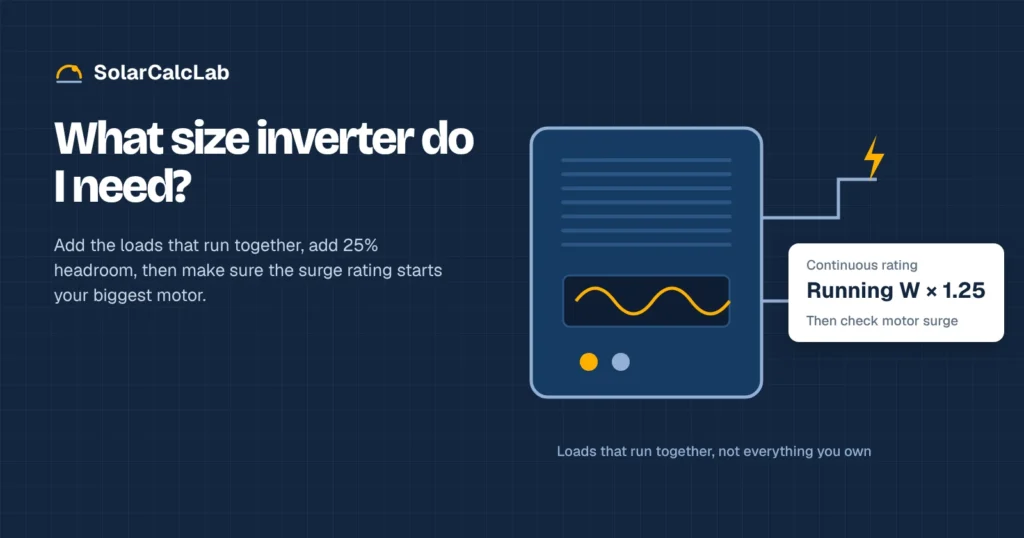
Add up the running watts of everything that will be on at the same time, multiply by 1.25 for headroom, and pick the next inverter size up. Then check surge: running watts plus the largest motor’s extra starting draw (about 2 to 3 times its running watts) must fit inside the inverter’s surge rating. A cabin running 2,525 W with a 1,000 W well pump needs about 3,200 W continuous and 4,500 W surge, so a 4,000 W inverter.
Most inverter mistakes come from sizing to the wrong number. People match it to their panels or their biggest appliance, then get a unit that trips when the fridge starts, or one so large its idle draw eats the battery.
The right size comes from three checks in a fixed order: what runs at the same time, what starts a motor, and what the battery can supply. This guide walks through each check, then sizes four real setups, from a camper van to a grid-tied roof, and covers the warning signs that an inverter is too small or too big.
Step 1: add up the loads that run together
An inverter has to carry the total of everything switched on at one moment, not everything you own. Write down each appliance’s running watts from the nameplate or a plug-in meter, then mark which ones can overlap.
A coffee maker and a microwave both pull about 1,200 to 1,500 W, but if you never run them together, only the larger one counts. A refrigerator, on the other hand, cycles on whenever it likes, so always count it. Our appliance wattage chart lists running and starting watts for over 30 household loads if you do not have nameplate figures.
The 25% headroom is a design choice, not a code rule. It keeps the inverter out of its hottest zone and leaves room for the next appliance you add.
Step 2: check the motor surge
Motors draw several times their running power for a fraction of a second to a few seconds while they spin up. Fridges, freezers, well pumps, air conditioners, furnace blowers and many power tools all do this. Resistive loads such as heaters, kettles and toasters do not.
Only the extra part of the start is added, because the motor’s running watts are already in the total. A multiplier of 3 is a reasonable default. If the motor’s label lists locked-rotor amps (LRA) and full-load amps (FLA), LRA ÷ FLA gives the real figure. Only the largest motor counts here, on the assumption that two motors rarely start in the same instant.
Surge duration matters as much as surge watts
Two inverters can both say “6,000 W peak” and behave very differently. Low-frequency inverters with heavy transformers often hold their surge for several seconds. Many lighter high-frequency units hold it for only milliseconds. A well pump that takes two seconds to reach speed will trip the second kind even when the peak number looks big enough. Look for the surge duration on the datasheet, not just the watt figure.
Step 3: check the battery current
On the DC side, a big inverter pulls a lot of current from the battery, and that current sets your cable size, fuse size and battery discharge rating.
The 0.9 stands for roughly 90% conversion efficiency. Real units vary with load, and many lose a larger share at light loads, which our guide to inverter efficiency breaks down with idle draw figures.
| Inverter load | 12 V battery | 24 V battery | 48 V battery |
|---|---|---|---|
| 1,000 W | 92.6 A | 46.3 A | 23.1 A |
| 2,000 W | 185.2 A | 92.6 A | 46.3 A |
| 3,000 W | 277.8 A | 138.9 A | 69.4 A |
| 5,000 W | 463.0 A | 231.5 A | 115.7 A |
Above about 2,000 W, 12 V gets awkward: the cables are thick, short and expensive, and many 12 V batteries cannot discharge 278 A continuously. That is why most systems of 3,000 W and up run at 24 V or 48 V. You can check cable size for any of these currents with the wire size calculator.
Four setups, sized step by step
The inverter size calculator runs these steps for you. Here is how the answer changes across four common jobs.
Camper van: one appliance decides everything
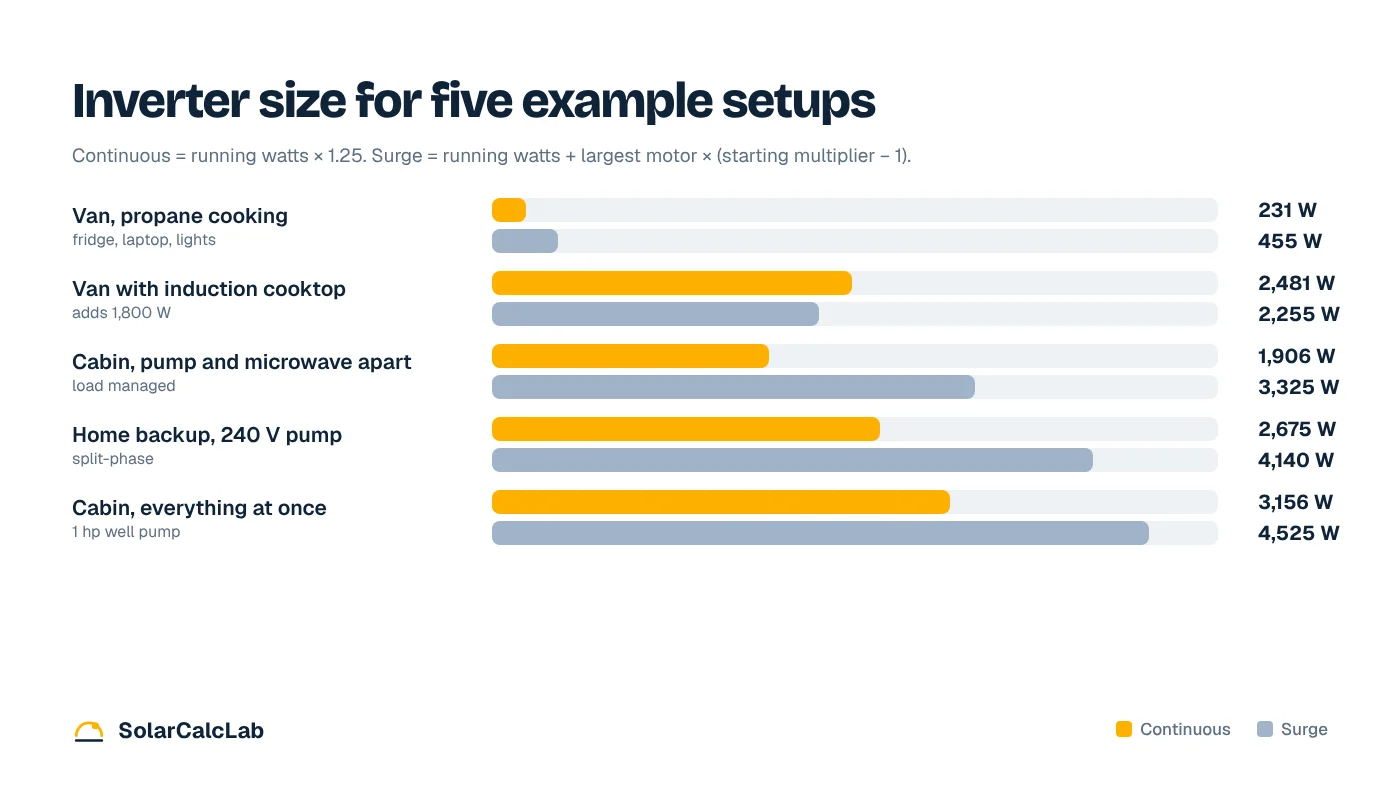
Loads: a 90 W compact fridge, 65 W laptop, 30 W of lights and an 1,800 W induction cooktop. Together that is 1,985 W, which with headroom means 2,481 W continuous. The fridge, at a 4× start, adds surge to 2,255 W, so a 3,000 W inverter fits. On 12 V it would pull about 230 A while you cook.
Now cook on propane instead. The load falls to 185 W, the continuous need to 231 W and the surge to 455 W. A 600 W pure sine inverter does the job, at a fraction of the price, weight and cable cost. When one appliance multiplies the inverter size by ten, ask whether that appliance belongs on the inverter at all.
Off-grid cabin: load management saves a size
Loads: a 1,000 W well pump (1 hp), 150 W fridge, 1,200 W microwave, 60 W of lights, 100 W TV and 15 W router. If everything can overlap, that is 2,525 W running, 3,156 W continuous and 4,525 W surge. A 4,000 W inverter with a surge rating above 4,500 W is the answer.
If you agree never to run the microwave while the pump runs, the worst case becomes the microwave plus everything except the pump: 1,906 W continuous. The pump case needs 1,656 W continuous and 3,325 W surge. A 3,000 W inverter with a few seconds of surge above 3,325 W now covers both.
Home backup: when 240 V changes the choice
Loads: fridge 200 W, chest freezer 120 W, furnace blower 600 W, lights, router and TV 220 W, plus a 240 V well pump at 1,000 W. Total running is 2,140 W, so you need 2,675 W continuous and about 4,140 W surge.
On watts alone, a 3,000 W unit would do. But the pump needs 240 V, which means a split-phase inverter, and many split-phase models start around 6 kW. A split-phase inverter also splits its rating across two 120 V legs, so balance the loads. With every 120 V load on one leg, that leg carries 1,640 W against 500 W on the other. Moving the freezer and small loads to the second leg evens it to 1,300 W and 840 W. Our 6kW inverter guide explains the per-leg limit in detail, and the battery backup calculator shows how long a battery keeps this list running.
Grid-tied solar: size by DC to AC ratio instead
A grid-tied inverter does not run appliances directly, so surge does not apply. It is sized against the solar array, and it is normal for the array to be larger than the inverter, because panels rarely hit their full rating in real conditions.
For twenty 430 W panels (8,600 W DC):
| Inverter AC rating | DC to AC ratio | What to expect |
|---|---|---|
| 8,200 W | 1.05 | Almost no clipping, inverter rarely near full load |
| 7,600 W | 1.13 | Little clipping, a common residential match |
| 7,000 W | 1.23 | Some midday clipping on cool, clear days |
| 6,000 W | 1.43 | Regular clipping that costs real energy |
Ratios of roughly 1.1 to 1.3 are common for homes. The energy lost when output hits the inverter’s ceiling is covered in our guide to inverter clipping. The string voltages also have to fit the inverter’s input window, which the solar string size calculator checks. For background on what the grid-tied inverter does beyond converting DC to AC, the Department of Energy has a short explainer on inverters and grid services.
Common inverter sizes and what they suit
| Inverter size | Typical job | Usual battery voltage |
|---|---|---|
| 300 to 1,000 W | Laptop, lights, CPAP, small fridge in a van or boat | 12 V |
| 2,000 W | Van with microwave or coffee maker, small cabin | 12 V or 24 V |
| 3,000 to 4,000 W | Cabin with a 120 V well pump, RV with roof AC | 24 V or 48 V |
| 5,000 W | Off-grid home core loads, backup panel | 48 V |
| 6,000 to 8,000 W | Split-phase home backup with 240 V loads | 48 V |
| 10,000 W and up | Whole-home off-grid, large backup, shops | 48 V |
For a closer look at specific sizes, see how a 3000 watt inverter handles an RV microwave and roof AC, what a 5kW inverter runs, or step up to our 10kW inverter guide for whole-home systems.
Signs your inverter is the wrong size
Too small
- It trips when the fridge or pump starts, but runs fine once things are going. That is a surge problem, not a continuous one. A soft starter on the motor can fix it without replacing the inverter.
- It shuts down on low voltage under heavy load even with a full battery. Often the cable is too thin or too long, so the voltage sags at the inverter terminals. Check cable size before blaming the inverter.
- The fan runs hard and output drops on hot afternoons. Many inverters reduce their output in high heat, often starting around 104°F (40°C), so a unit sized with no headroom will struggle in a hot shed.
Too big
- The battery drains overnight with almost nothing on. Large inverters often draw 20 to 50 W just sitting idle. At 30 W that is 0.72 kWh a day, more than half of what a full-size refrigerator uses. Look for a power-saving or search mode.
Frequently asked questions
What size inverter do I need to run a house?
For essential circuits such as a fridge, freezer, furnace blower, lights and internet, 3,000 to 5,000 W is usually enough. For a whole house with an electric range, dryer or central AC, plan on 8,000 to 12,000 W of split-phase output, or two stacked inverters. Add up the loads that run together before buying.
Should I size my inverter to my solar panels or my loads?
For off-grid and backup systems, size the inverter to your loads; the panels connect through a charge controller. For grid-tied systems, size it to the array using a DC to AC ratio, typically 1.1 to 1.3. Hybrid inverters need both checks.
Is it bad to oversize an inverter?
Not dangerous, but costly. A bigger inverter costs more, needs thicker battery cables and often draws more idle power. If yours draws 30 W idle, that is about 0.72 kWh a day of battery capacity spent on nothing.
What size inverter do I need for a 1 hp well pump?
A 1 hp pump runs at about 750 to 1,000 W and can draw 2,000 to 3,000 W at start. Add your other loads, then make sure the surge rating covers that start for at least a couple of seconds. In practice, 3,000 W is usually the smallest size that works reliably with a few other loads.
What does pure sine wave have to do with size?
Nothing directly, but it affects which loads run well. Motors, compressors and many chargers run cooler and quieter on pure sine output. A modified sine inverter may need to be oversized to start motors and can cause buzzing. Our guide to pure sine vs modified sine covers the differences.