2kW (2000 Watt) Inverter: Loads, Battery and Cable Size
Short answer
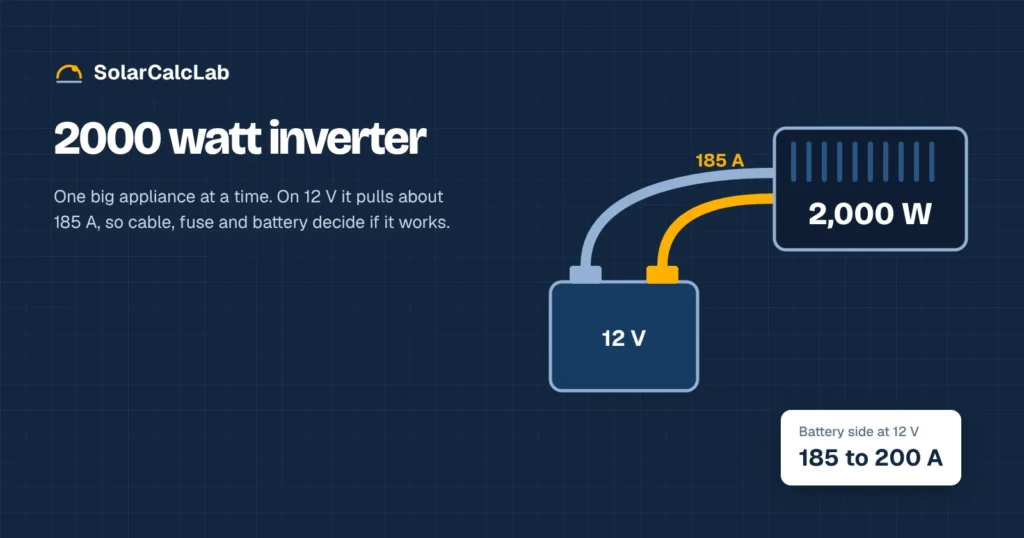
A 2000 watt inverter runs one big kitchen or bathroom appliance at a time: a 1,000 W microwave (about 1,500 W from the outlet), a coffee maker, a toaster or a hair dryer on low, plus small loads like a laptop and lights. On a 12 V battery it pulls about 185 A at full output and over 200 A as the battery sags, so it needs short 1/0 to 2/0 copper cables, a fuse around 250 A and a battery that can deliver 200 A.
Two thousand watts is the van and small-RV sweet spot: big enough to make coffee and heat lunch without a generator, small enough to run from one or two 12 V lithium batteries.
The hard part is not picking the inverter. Most 2,000 W units cost a few hundred dollars and look alike on paper. The hard part is the 12 V side: the current, the cable, the fuse and the battery that keep it from shutting down halfway through the microwave cycle. That is where this guide spends its time.
What will a 2000 watt inverter run?
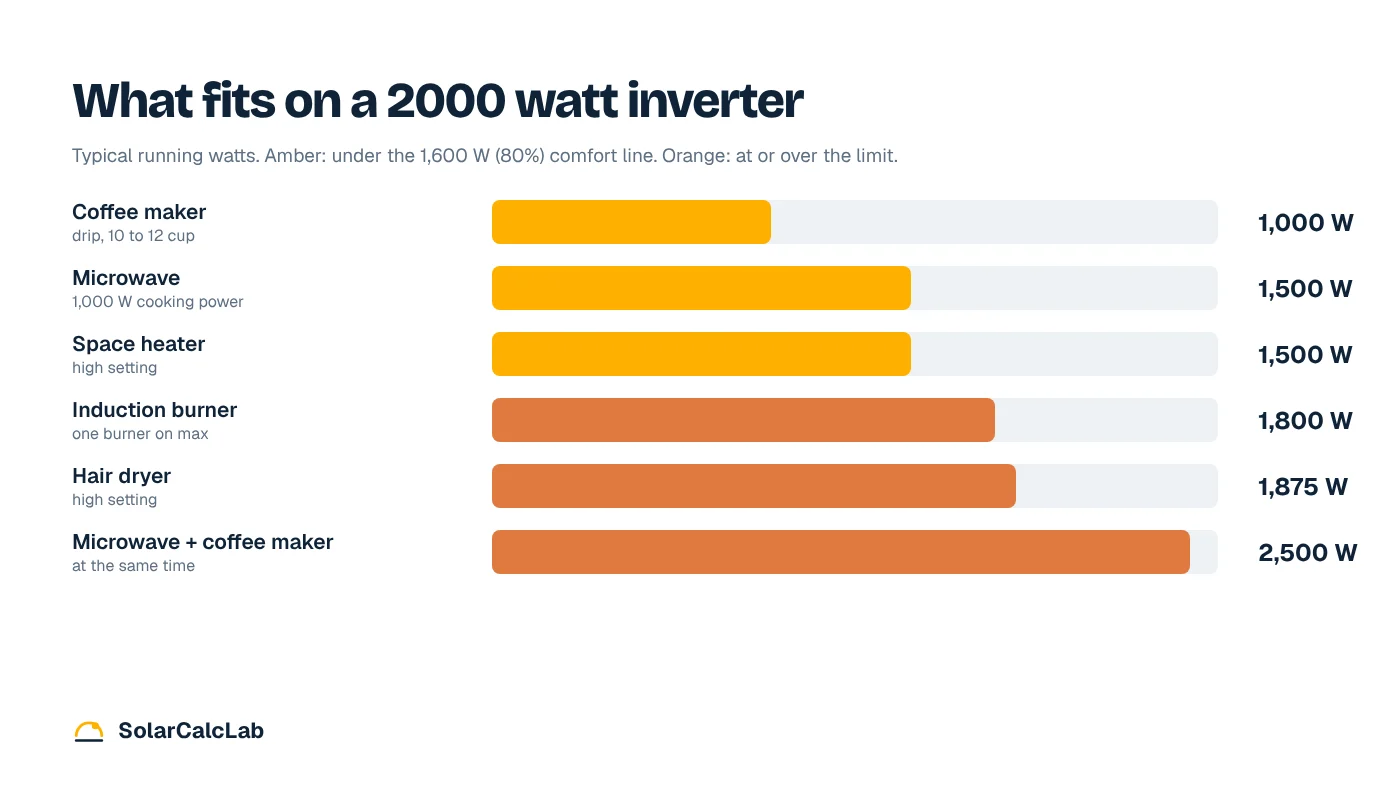
Check the label on each appliance for watts, or use our appliance wattage chart. Then see how much of the inverter each one uses. A good rule is to keep steady loads under about 80% of the rating, or 1,600 W, so the inverter is not running hot at its limit.
| Appliance | Typical draw | Share of 2,000 W | Verdict |
|---|---|---|---|
| Laptop, phone chargers, LED lights | 50 to 150 W | Under 8% | Easy, but a 300 W inverter would do |
| Blender | 300 to 1,000 W | 15 to 50% | Fine |
| Coffee maker (drip) | 900 to 1,200 W | 45 to 60% | Fine, with room for the fridge and lights |
| Toaster | 800 to 1,500 W | 40 to 75% | Fine on its own |
| Microwave, 1,000 W cooking power | About 1,500 W input | 75% | Works; run it alone |
| Hair dryer on high | 1,875 W | 94% | At the limit; use the low setting |
| Induction cooktop, one burner on max | 1,800 W | 90% | Possible but marginal; turn it down |
| Space heater on high | 1,500 W | 75% | Runs, but drains a 12 V 200Ah battery in under 1.5 hours |
| 13,500 BTU RV air conditioner | 1,300 to 1,500 W running, more to start | 65 to 75% plus surge | Not a good match |
Microwaves catch people out because the box shows cooking power, not input power. A “1,000 W” microwave pulls about 1,500 W from the outlet. Our microwave wattage guide explains the gap.
Why the RV air conditioner is a stretch
A 2,000 W pure sine inverter typically lists a 4,000 W surge for about one second. A roof AC compressor can demand more than that to start, and once running it takes 70% of the inverter, leaving little for anything else. Even if a soft starter gets it going, the 12 V battery has to supply roughly 130 A for as long as the AC runs. If air conditioning is a must, our 3000 watt inverter guide covers the size built for it.
How many amps does a 2000 watt inverter draw?
An inverter turns DC current into AC power, and it loses about 10% doing it. So the battery side always carries more power than the appliance uses.
At 12 V: 2,000 ÷ (12 × 0.90) ≈ 185 A
At a sagging 11 V: 2,000 ÷ (11 × 0.90) ≈ 202 A
At 24 V (25.6 V lithium): 2,000 ÷ (25.6 × 0.90) ≈ 87 A
That 185 to 200 A figure drives every other decision. Renogy’s own 2000 W 12 V pure sine inverter, for example, ships with 1/0 AWG cables 3 feet long, which tells you how short the cable run should be. To check other loads and voltages, use the watts to amps calculator.
Cable size and fuse for a 12 V 2000 W inverter
Thin or long cables cause the most common 2,000 W complaint: the inverter beeps and shuts off on low voltage while the battery still reads full. The cable drops voltage under load, so the inverter sees 10.5 V while the battery terminals sit at 12.5 V.
Voltage drop by cable size and length
This table assumes 185 A, copper cable, and a one-way distance from battery to inverter (the current travels there and back, so the total cable length is double).
| Cable (copper) | 3 ft one way | 10 ft one way |
|---|---|---|
| 1/0 AWG | 0.11 V (0.9%) | 0.36 V (3.0%) |
| 2/0 AWG | 0.09 V (0.7%) | 0.29 V (2.4%) |
| 4/0 AWG | 0.05 V (0.5%) | 0.18 V (1.5%) |
Values use standard DC resistance for stranded copper at 68°F (0.0983, 0.0779 and 0.0490 ohms per 1,000 ft); hot cables run a little higher. Aim for 3% or less, and less is better at 12 V because every 0.1 V counts. So:
- Inverter within about 3 to 5 feet of the battery: 1/0 AWG is fine.
- Up to about 10 feet: use 2/0, or 4/0 if you can route it.
- Longer than that: move the inverter closer to the battery and run 120 V AC wiring to the outlets instead. AC wire at 120 V carries one tenth of the current.
Run your exact length through the voltage drop calculator, and check the cable’s heat rating with the wire size calculator.
Fuse
Put a fuse or DC breaker on the positive cable as close to the battery as you can, ideally within 7 inches, which is what boat wiring standards ask for. Size it above the inverter’s maximum battery current and at or below the cable’s ampacity. For a 12 V 2,000 W unit, manufacturers commonly call for about 250 A, often a Class T or ANL fuse. Follow your inverter’s manual if it names a size, and use the fuse size calculator to cross-check.
What battery do you need for a 2000 watt inverter?
Two things matter: whether the battery can supply 185 to 200 A without its BMS cutting out, and how many watt hours your day actually uses.
Current: the BMS limit
| Battery setup | Continuous current | Full 2,000 W? |
|---|---|---|
| One 12 V 100Ah LiFePO4 (100 A BMS) | 100 A, about 1,150 W AC | No |
| Two 12 V 100Ah LiFePO4 in parallel | 200 A combined | Yes |
| One 12 V 200Ah LiFePO4 (200 A BMS) | 200 A | Yes, but near its limit |
| One 24 V 100Ah LiFePO4 (100 A BMS) | 100 A at 25.6 V | Yes, with headroom |
If you are building from scratch, 24 V is worth a look. Current halves, so cables get smaller and the inverter is easier to feed. The catch is that most vans and RVs run 12 V lights, fans and pumps, so you would need a 24 V to 12 V converter for those.
Energy: a worked van day
Here is a realistic daily load on a 12 V 200Ah LiFePO4 battery (2,560 Wh rated, about 2,304 Wh usable):
- Microwave, 1,500 W for 15 minutes: 375 Wh
- Coffee maker, 1,000 W for 10 minutes: 167 Wh
- Laptop, 60 W for 4 hours: 240 Wh
- TV or monitor, 50 W for 3 hours: 150 Wh
- Total AC: 932 Wh, or about 1,035 Wh from the battery after 90% inverter efficiency
That is about 45% of the usable battery. The big loads are brief, so the day is dominated by small things running for hours. To test your own list, the battery backup calculator does the same math.
The idle draw nobody budgets for
An inverter left on with nothing plugged in still uses power. Spec sheets for 2,000 W units list no-load draws from well under 1 A up to about 2 A at 12 V, depending on the model and whether a power-saving mode is on.
At 2 A × 12 V = 24 W: 24 × 24 = 576 Wh a day
On the 200Ah battery above, a 24 W idle draw left on around the clock would eat 25% of usable capacity, which is more than half of what the whole van day uses. Three habits fix it:
- Switch the inverter off when you are not using AC. A remote switch near the kitchen makes this easy.
- Use the search or power-saving mode if your model has one. It pulses until it senses a load.
- Run 12 V devices on 12 V. Fans, lights, the fridge and USB chargers do not need the inverter at all.
Buying checklist
Pure sine wave only
Microwaves, induction cooktops, CPAP machines and laptop chargers can run hot, hum or fail on a modified sine wave. At 2,000 W the price difference is small. Our pure sine vs modified sine comparison covers which devices are sensitive.
Inverter or inverter-charger?
An inverter-charger adds a battery charger and an automatic transfer switch, so plugging into shore power switches the outlets over and charges the battery. It costs more, but it replaces two separate boxes.
Surge rating and duration
“4,000 W surge” on a high-frequency inverter often lasts about one second. Low-frequency inverters with a heavy transformer usually hold surge longer, which helps with motors like a blender, a compressor fridge or a small pump. If a motor is your biggest load, compare surge time, not just surge watts.
When 2,000 W is the wrong size
Go smaller if your loads stop at a laptop, TV and lights; a 500 to 1,000 W inverter costs less and idles lower. Go bigger if you need air conditioning or two kitchen appliances at once. If you are unsure, run your list through the inverter size calculator or follow our step-by-step guide on what size inverter you need.
Frequently asked questions
How long will a 2000 watt inverter run on a 100Ah battery?
At full 2,000 W it will not run at all on a typical 12 V 100Ah lithium battery, because the 100 A BMS cuts out above about 1,150 W of AC. At a 1,000 W load, a 12 V 100Ah LiFePO4 with about 1,150 Wh usable lasts close to one hour after inverter losses.
Can a 2000 watt inverter run a microwave and coffee maker together?
No. A 1,000 W microwave draws about 1,500 W and a coffee maker 900 to 1,200 W, so together they exceed 2,000 W and the inverter will shut down on overload. Run them one after the other.
What size wire do I need for a 2000 watt inverter?
On 12 V, use at least 1/0 AWG copper for a run of 3 to 5 feet between battery and inverter. For runs up to about 10 feet, use 2/0 or 4/0 to keep voltage drop near 3% or less. On 24 V, current halves and smaller cable works.
Can a 2000 watt inverter run a refrigerator?
Yes. A full-size fridge uses about 100 to 250 W running and a short starting surge well inside a 2,000 W unit’s surge rating. The real limit is battery energy over 24 hours, not inverter size.
Is a 2000 watt inverter enough for a camper van?
For most vans, yes, if the plan is one high-power appliance at a time and no air conditioning. It covers a microwave, coffee maker, induction burner on medium or a hair dryer on low, as long as the battery can supply about 200 A.