1000kW Solar System: Yearly Output, Panels Needed and 2026 Cost
Short answer
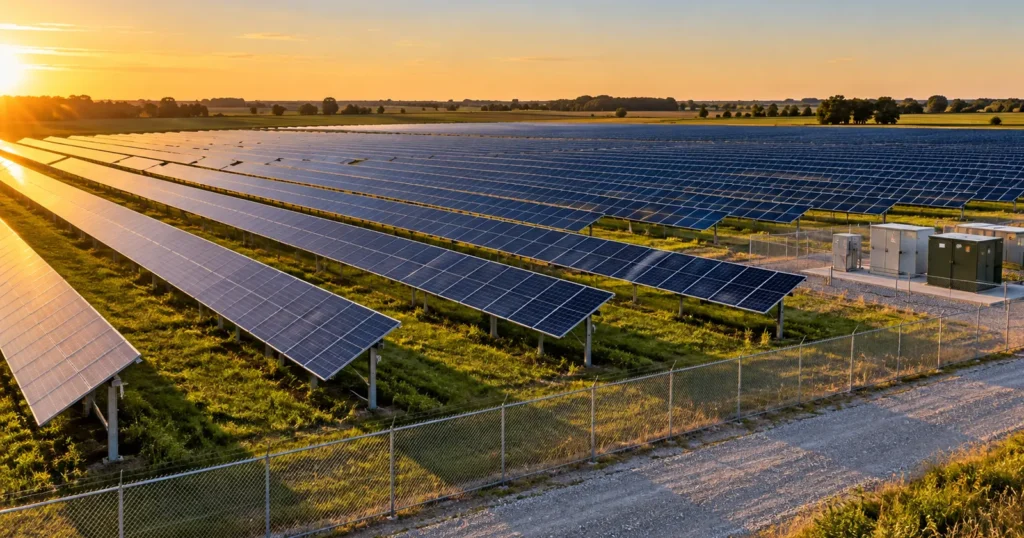
A 1000kW solar system is a 1 megawatt (MW) project, not a 1,000 watt kit. It makes about 1,100 to 1,600 MWh a year in most of the US, enough for roughly 100 to 150 average homes. It needs about 2,326 panels at 430 W, around 3 to 6 acres of land, and typically costs $1.3 to $2.1 million installed in late 2026.
One megawatt is the size where solar turns into a power plant. It is the classic size for a community solar garden, a ground array on a farm field, or a large rooftop on a distribution center, and it is usually built by a developer rather than a local roofing crew.
This guide works through the figures a landowner, business owner or community group needs before talking to developers: yearly output, panel count, acreage, grid connection, cost per watt, revenue and the 2026 tax timing.
Is a 1000 kW solar system the same as 1 MW?
Yes. 1,000 kilowatts equals 1 megawatt, or 1,000,000 watts. That is a thousand times bigger than the 1,000 watt kits sold for RVs and cabins, which are covered in our guide to the 1000 watt solar panel. Search results often mix the two, so check the unit before you trust any price.
Two other units matter at this size. MW is the power rating of the plant. MWh is the energy it makes over time. A 1 MW array running at full rating for one hour would make 1 MWh, but solar rarely runs at full rating, which is why yearly output is calculated from sun hours.
How many MWh does a 1 MW solar array make in a year?
SolarCalcLab uses the same planning assumptions on every page: 80% system efficiency for heat, dust, wiring and inverter losses, and 4.5 peak sun hours as a US middle value.
Example: 1,000 × 4.5 × 0.80 × 365 = 1,314,000 kWh, or 1,314 MWh a year
The homes column divides output by 10,791 kWh, the average yearly use of a US residential customer reported by the EIA.
| Climate | Peak sun hours | Per day | Per year | Average homes matched |
|---|---|---|---|---|
| Cloudier north (Great Lakes, Northwest) | 3.8 | 3,040 kWh | 1,110 MWh | about 103 |
| US middle value | 4.5 | 3,600 kWh | 1,314 MWh | about 122 |
| Southeast and Texas | 5.0 | 4,000 kWh | 1,460 MWh | about 135 |
| California and the Southwest | 5.5 | 4,400 kWh | 1,606 MWh | about 149 |
These figures match the site rule that 1 kW of panels makes 1,100 to 1,600 kWh a year. Single-axis trackers that follow the sun can push a sunny site higher. Developers model the exact site with hourly weather data in tools such as PVWatts, and you can check your local value first with the peak sun hours calculator.
How many panels and acres does a 1 MW array need?
Divide 1,000,000 watts by the panel rating and round up. Ground projects at this size usually use large 540 W to 600 W modules, which cut the number of pieces to unload, mount and wire.
Example: 1,000,000 ÷ 430 = 2,325.6, so 2,326 panels (1,000.2 kW)
| Panel rating | Panels needed | Array size | Panel glass area |
|---|---|---|---|
| 430 W | 2,326 | 1,000.2 kW | about 50,000 sq ft |
| 550 W | 1,819 | 1,000.5 kW | about 50,000 sq ft |
| 600 W | 1,667 | 1,000.2 kW | about 50,000 sq ft |
The glass area barely changes because modern modules all convert about 21% to 22% of sunlight. You can test other ratings with the how many solar panels calculator.
Acres for a ground-mounted megawatt
About 50,000 square feet of glass is only 1.15 acres, but rows need spacing so they do not shade each other in winter. A Lawrence Berkeley National Laboratory study of US solar plants suggested benchmarks of 0.35 MWdc per acre for fixed-tilt arrays and 0.24 MWdc per acre for single-axis tracking.
Fixed tilt: 1 ÷ 0.35 = 2.9 acres. Tracking: 1 ÷ 0.24 = 4.2 acres
Those densities come from larger plants. A single megawatt carries proportionally more fence, access road, setbacks and an equipment pad, so landowners should plan on roughly 3 to 6 acres of usable, fairly flat, unshaded ground close to a three-phase power line.
Who builds and owns 1 MW solar projects?
Very few 1 MW arrays are bought the way a home system is. The usual owners and builders are:
- Community solar developers. They lease land, build the array and sell bill credits to local subscribers. Some state programs are built around this size: Minnesota caps community solar gardens at 1 MW, and co-located gardens from one developer share that cap.
- Large energy users. Cold storage warehouses, food processors, hospitals, universities and water treatment plants can use most of 1,300 MWh on site.
- Farmers and landowners. Most lease 3 to 6 acres to a developer for a fixed yearly rent rather than owning the plant.
- Municipalities, schools and co-ops. These often own through a third party under a power purchase agreement. Our solar PPA vs lease guide explains the difference.
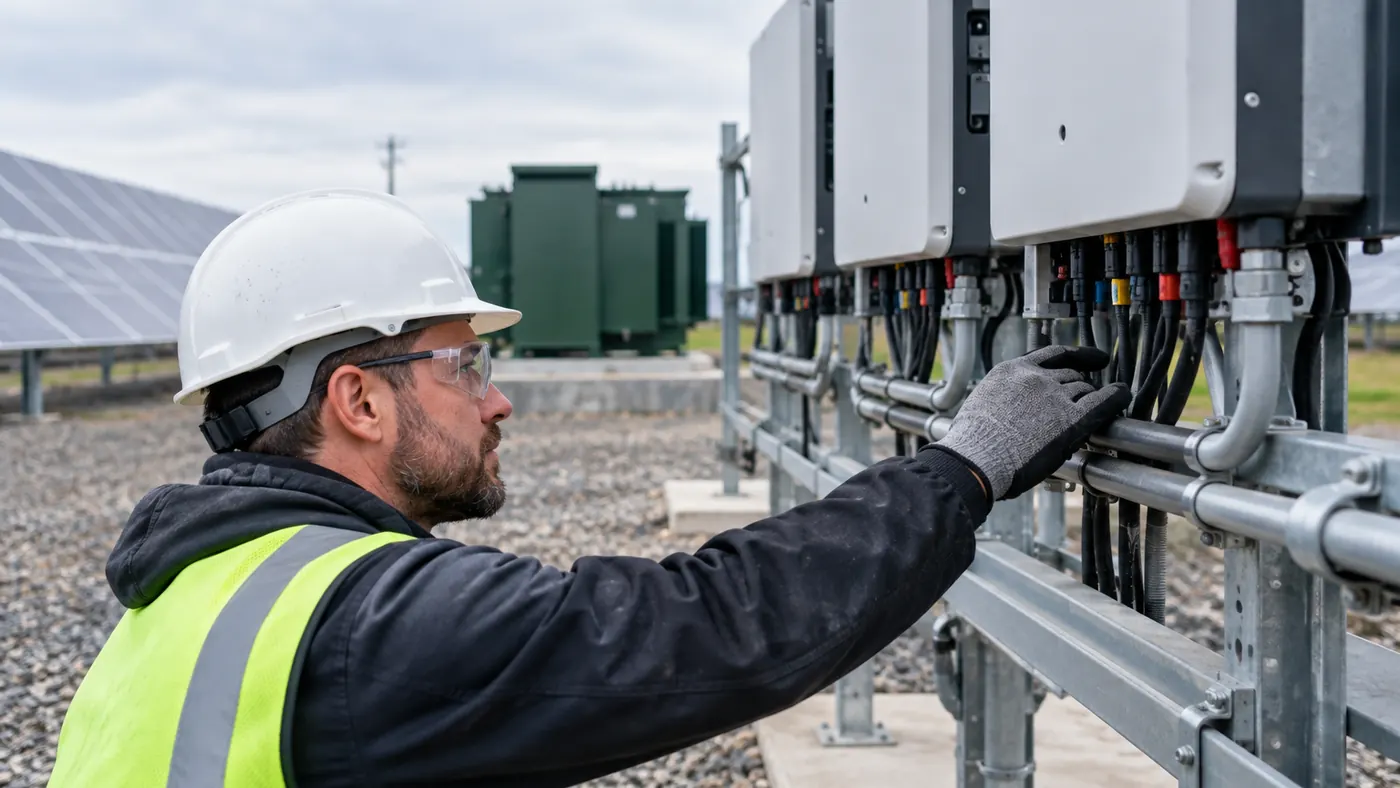
The design and construction itself is done by an EPC (engineering, procurement and construction) contractor that handles stamped drawings, racking, medium-voltage work and commissioning.
Why can a “1 MW” project have 1.3 MW of panels?
Solar plants carry two ratings. The panel rating is in MWdc. The inverter output that reaches the grid is in MWac. Developers install more panel watts than inverter watts because panels rarely hit full rating, and the extra DC fills out mornings, evenings and cloudy days.
Example: 1,000 kWdc ÷ 1.32 = 758 kWac
The 1.32 ratio is the value used in the national lab’s Annual Technology Baseline for utility solar. Program caps are often written in AC, so a project marketed as “1 MW AC” may carry about 1.3 MWdc of panels, about 3,070 panels at 430 W. Always ask which basis a quote, a land lease or a program cap uses.
How does a 1 MW project connect to the grid?
This is the step that decides whether the project happens. At about 800 kWac, a megawatt is far too large for a normal building service unless the building is already big.
At 480 V: 800,000 ÷ (1.732 × 480) = 962 A. At 12,470 V: 800,000 ÷ (1.732 × 12,470) = 37 A
That is why most standalone 1 MW sites use a step-up transformer and connect to the utility’s medium-voltage distribution line, often 12.47 kV or similar, through a recloser and a metering point.
Fast track or full study?
Many utilities model their small-generator rules on FERC’s procedures, which once limited the quick Fast Track review to projects under 2 MW and now allow some well-located inverter-based projects up to 5 MW. In practice a megawatt on a weak rural feeder often fails the screens and goes to supplemental review or a full impact study. If the study finds the line needs upgrades, the project usually pays for them, and that single bill can decide whether the site works. State rules differ, so ask the utility for a pre-application report before signing anything.
How much does a 1 MW solar project cost in 2026?
A megawatt sits between two well-tracked price points. Wood Mackenzie and SEIA put average commercial system pricing at $1.77 per watt in Q2 2026, while utility-scale plants of 100 MW or more ran $0.95 to $1.06 per watt. A 1 MW project buys equipment in bulk but still carries fixed costs for engineering, permits and interconnection. Typical US ranges in late 2026:
| Project type | Price per watt | 1 MW installed |
|---|---|---|
| Ground-mount, fixed tilt (community or C&I) | $1.30 to $1.80 | $1.3 to $1.8 million |
| Large flat commercial rooftop | $1.50 to $2.10 | $1.5 to $2.1 million |
| Reference: utility plant, 100 MW+ | $0.95 to $1.06 | $0.95 to $1.06 million per MW |
Those totals do not include land purchase, unusual site work or grid upgrades found in an interconnection study. Ongoing costs matter too: the national lab’s 2025 baseline puts utility solar operation and maintenance near $25 per kWac a year, which is about $19,000 a year for 758 kWac. Smaller sites often pay more per kW, plus insurance and land rent. Run your own figures through the solar panel cost calculator.
What does a 1 MW solar farm earn, and when does it pay back?
Revenue depends on who buys the power. The example below assumes a $1.5 million project, 1,314 MWh a year and $30,000 a year for maintenance, insurance and land rent. The prices per kWh are illustrative assumptions, not quotes.
| Business model | Value per kWh (assumed) | Yearly revenue or savings | Net after $30,000 costs | Simple payback |
|---|---|---|---|---|
| Used on site by a business | $0.13 | $170,820 | $140,820 | about 10.7 years |
| Community solar bill credits | $0.10 | $131,400 | $101,400 | about 14.8 years |
| Sold at wholesale | $0.05 | $65,700 | $35,700 | about 42 years |
The pattern is the real lesson. A lone megawatt rarely works selling power at wholesale prices, because big utility plants make energy far cheaper per watt. It works when each kWh replaces retail power or earns a state program credit. Federal credits, depreciation and state incentives can shorten these paybacks a lot. Model your own case with the solar payback calculator, and compare it with a smaller site in our 100kW solar system guide.
What tax rules apply to a 1 MW project now?
Commercial projects fall under the business clean electricity credit (Section 48E), not the residential credit that ended for homeowners after 2025. Under the 2025 budget law, wind and solar facilities placed in service after 2027 lose the credit unless construction began by July 4, 2026. IRS Notice 2025-42 also removed the old 5% cost safe harbor for starting construction, with an exception for solar facilities of 1.5 MW or less, which covers a typical 1 MW project.
Prevailing wage, domestic content and energy community rules change the credit rate. These rules are detailed and still being interpreted, so confirm eligibility and timing with a tax adviser before you count on any credit.
What are the steps from bare land to a working megawatt?
- Site screen: 3 to 6 flat acres, no wetlands or deep shade, close to three-phase lines.
- Pre-application report from the utility to learn feeder capacity.
- Land lease or option signed with the developer.
- Interconnection application and any studies, often the longest step.
- Local permits: zoning or conditional use, stormwater, decommissioning bond where required.
- Construction: piles, racking, modules, inverters, transformer and fencing.
- Utility inspection and permission to operate, then commissioning.
Frequently asked questions
How many homes can a 1000kW solar system power?
About 100 to 150 average US homes on a yearly basis. A 1 MW array makes roughly 1,110 to 1,606 MWh a year, and the average US home uses about 10,800 kWh. It covers their yearly total, not their nighttime use, since the grid supplies power after sunset.
How many acres do you need for 1 MW of solar?
About 3 to 6 acres for most small ground projects. National lab data suggests about 2.9 acres per MWdc for fixed-tilt arrays and 4.2 acres for trackers, and single-megawatt sites need extra room for fencing, roads, setbacks and equipment pads.
How much does a 1000 kilowatt solar system cost?
Typically $1.3 to $2.1 million installed in late 2026, or about $1.30 to $2.10 per watt. Ground arrays sit at the lower end and complex rooftops at the higher end. Grid upgrades, land purchase and unusual site work are extra and can change the total a lot.
How much money does a 1 MW solar farm make a year?
It depends on the buyer of the power. At 1,314 MWh a year, every cent per kWh is worth about $13,140. Bill credits of 10 cents earn about $131,000 a year, while wholesale prices near 5 cents earn only about $66,000, before operating costs.
Can I lease my farmland for a 1 MW solar project?
Often, yes, if the land is flat, unshaded, outside flood zones and near a three-phase line with spare capacity. Developers usually sign a long lease with yearly rent. Check the lease for decommissioning terms, property tax treatment and what happens if the interconnection study fails.
Is a 1 MW solar farm 1 MW AC or DC?
It can be either, so always ask. Panels are rated in DC and inverters in AC. Many projects are sold as 1 MW AC with about 1.2 to 1.35 MW of DC panels, which raises the panel count, land and cost compared with a true 1 MW DC array.


