12kWh per Day Solar System: How Many Panels and What Size You Need
Short answer
To make 12 kWh a day you need about a 3.3 kW solar system, which is 8 panels at 430 W, using 4.5 peak sun hours and 80% system efficiency. That array makes about 12.4 kWh a day and 4,500 kWh a year. Off grid, pair it with roughly 7 kWh of battery for the night, or 13 to 27 kWh to ride through one or two cloudy days.
Twelve kilowatt-hours a day is a lean but comfortable budget. It fits an efficient apartment, a small home with gas heat and cooking, a retiree living alone, or a well-planned off-grid cabin that runs a fridge, a well pump, internet and a mini-split. It is about 40% of what an average American household buys from the grid.
Because the number is small, every choice matters more: one extra appliance or one dark December week can push you past it. This guide sizes the array, compares panel counts and cities, builds two real load lists that add up to 12 kWh, sizes the battery, and shows what changes when you go off grid.
Is it a 12 kWh per day system, a 12 kW system or a 12 kWh battery?
Most results for “12 kWh solar system” are really about something else, so it is worth settling the units first. A kilowatt (kW) is power, the rate at which panels produce at one moment. A kilowatt-hour (kWh) is energy, the amount you use or store over time.
| What people say | What it means | Rough size |
|---|---|---|
| 12 kWh per day system | An array that produces 12 kWh of energy each day | About 3.3 kW of panels, 8 panels |
| 12 kW solar system | An array rated at 12 kW of power | About 28 panels, roughly 43 kWh a day |
| 12 kWh battery | Storage that holds 12 kWh | About 10.8 kWh usable at 90% |
A 12 kW array makes nearly four times what this page covers. If that is the size you are pricing, the 12kW solar system guide covers it in detail. Everything below assumes you want to produce about 12 kWh of energy a day.
How many kW of solar make 12 kWh a day?
Divide your daily energy by your peak sun hours, then by the system efficiency. A peak sun hour is one hour of full-strength sunlight at 1,000 watts per square meter. This site uses 80% efficiency to account for heat, dust, wiring and inverter losses, and 4.5 peak sun hours as a US middle value.
Example: 12 ÷ (4.5 × 0.80) = 12 ÷ 3.6 = 3.33 kW
Round up to whole panels. Eight 430 W panels give 3.44 kW, which makes 3.44 × 4.5 × 0.80 = 12.4 kWh a day, a small margin over the target. Over a year that is about 4,520 kWh, or roughly 375 kWh a month.
Panel count at common wattages
| Panel rating | Panels needed | Array size | Daily output at 4.5 sun hours |
|---|---|---|---|
| 100 W | 34 | 3.40 kW | 12.2 kWh |
| 200 W | 17 | 3.40 kW | 12.2 kWh |
| 300 W | 12 | 3.60 kW | 13.0 kWh |
| 400 W | 9 | 3.60 kW | 13.0 kWh |
| 430 W | 8 | 3.44 kW | 12.4 kWh |
Thirty-four 100 W panels is a lot of wiring and racking. At this size, full-size residential panels are almost always cheaper per watt and quicker to install, even on a cabin ground mount.
How does your location change the system size?
The same 12 kWh takes far fewer panels in Arizona than in the Pacific Northwest. The table uses approximate annual average sun hours for south-facing panels tilted near the local latitude.
| Location | Peak sun hours | kW needed | 430 W panels |
|---|---|---|---|
| Phoenix, AZ | 6.3 | 2.38 kW | 6 |
| Los Angeles, CA | 5.5 | 2.73 kW | 7 |
| Denver, CO | 5.3 | 2.83 kW | 7 |
| Dallas, TX | 5.0 | 3.00 kW | 7 |
| New York, NY | 4.4 | 3.41 kW | 8 |
| Seattle, WA | 3.7 | 4.05 kW | 10 |
For your own address, roof tilt and direction, the free NREL PVWatts calculator models production from hourly weather data. You can also find your local figure with the peak sun hours calculator and then size the array in the solar panel calculator.
What does a 12 kWh day look like?
Here are two load lists that each land near 12 kWh. Every line is watts × hours, so you can swap in your own appliances. The fridge figure assumes a modern efficient model.
| Load | Efficient small home | Off-grid cabin |
|---|---|---|
| Refrigerator | 1.3 kWh | 1.3 kWh |
| Chest freezer | None | 0.8 kWh |
| LED lights (10 × 9 W × 5 h) | 0.45 kWh | 0.4 kWh |
| Cooking (1,500 to 1,800 W × 1 h) | 1.5 kWh | 1.8 kWh |
| Microwave or kettle (1,200 W × 0.5 h) | 0.6 kWh | None |
| Heat pump water heater (500 W × 5 h) | 2.5 kWh | None (propane) |
| Mini-split, one room (600 to 700 W × 4 h) | 2.8 kWh | 2.4 kWh |
| Well pump (1,000 W × 1 h) | None | 1.0 kWh |
| Internet, TV, laptop | 1.0 kWh | 2.2 kWh |
| Dishwasher or power tools | 1.0 kWh | 1.5 kWh |
| Washer, one load | 0.3 kWh | 0.3 kWh |
| Standby and small loads | 0.7 kWh | 0.3 kWh |
| Total | 12.2 kWh | 12.0 kWh |
To check your own number, take the monthly kWh from your electric bill and divide by 30. A bill showing 360 kWh is exactly 12 kWh a day. Look at a winter and a summer bill, because a mini-split or space heater can double one season. The solar load calculator builds the same kind of list room by room.
What will not fit in 12 kWh a day?
This budget works because the big loads are missing. A few appliances can use most or all of it on their own:
- Central air conditioning: a 3 ton unit draws roughly 3,000 to 3,500 W, so six hours of cooling uses 18 to 21 kWh.
- Electric resistance heat: one 1,500 W space heater running eight hours uses 12 kWh by itself.
- Electric car charging: a 7.2 kW Level 2 charger uses 12 kWh in under two hours.
- Electric clothes dryer: a standard 5,000 W dryer uses about 5 kWh for one hour of drying.
- Resistance tank water heater: a 4,500 W element running three hours uses 13.5 kWh.
If two of these are in your home, your real usage is probably closer to 20 or 30 kWh a day. The 20 kWh per day system guide covers the next step up. With just one of them, you may land nearer 15 kWh, which our 15 kWh per day system guide sizes, including the battery for overnight EV charging.
How big a battery do you need for 12 kWh a day?
Grid-tied homes with net metering do not need a battery to use solar. Off-grid homes and anyone who wants backup do. The question is how much of your day happens after sunset and how many cloudy days you want to cover.
Example: 6 kWh used overnight ÷ 0.90 = 6.7 kWh of battery
| Goal | Energy from storage | Battery (90% usable) | Example build at 48 V |
|---|---|---|---|
| Night only (about half the day’s use) | 6 kWh | 6.7 kWh | Two 5 kWh rack batteries |
| One full day without sun | 12 kWh | 13.3 kWh | Three 5 kWh rack batteries |
| Two days without sun | 24 kWh | 26.7 kWh | Five or six 5 kWh rack batteries |
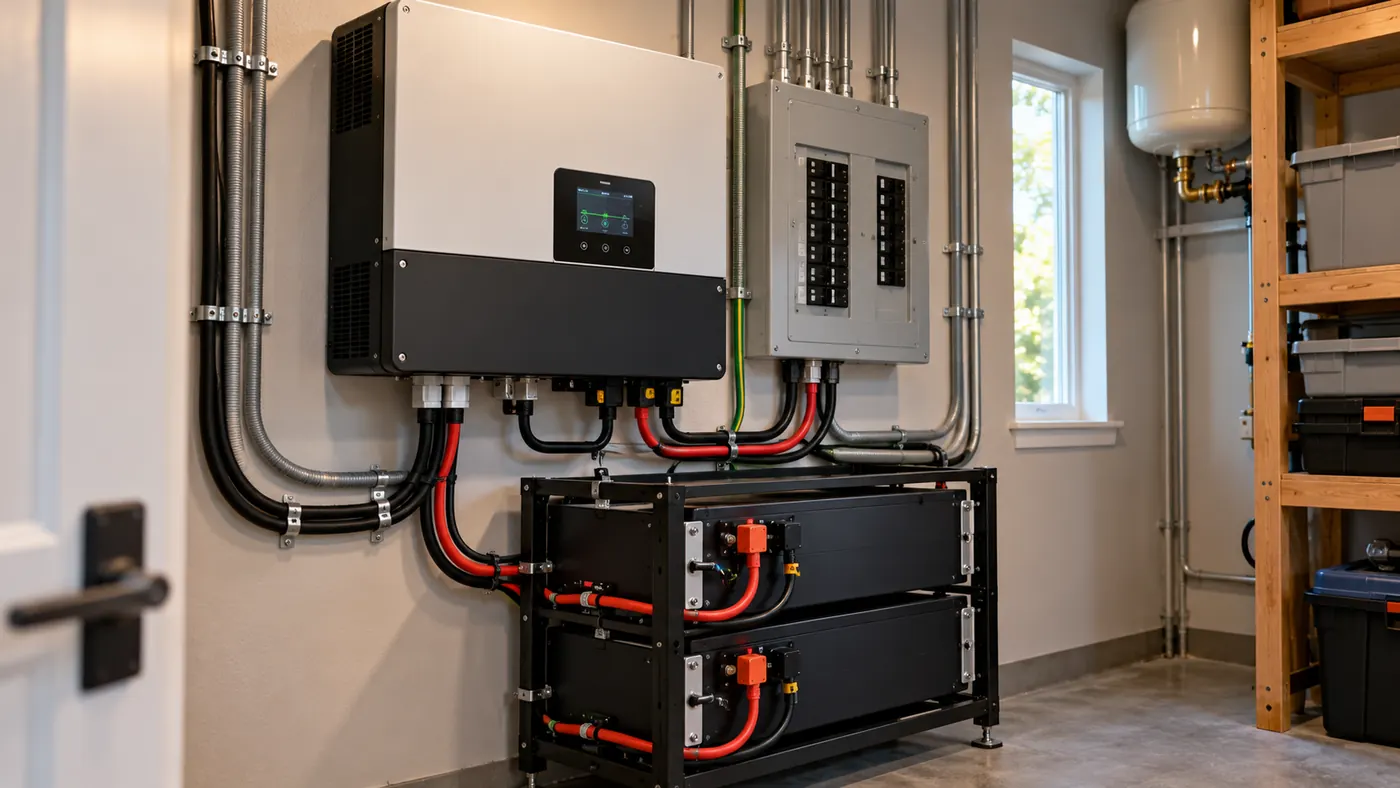
Most off-grid cabins at this size settle on 13 to 15 kWh of lithium iron phosphate (LiFePO4) storage and a small generator for long storms. That is cheaper than buying two full days of battery you only need a few times a year. Run your own numbers in the battery bank calculator.
One cold-weather warning: most LiFePO4 batteries must not be charged below freezing unless they have built-in heaters. In an unheated cabin, keep the battery indoors or buy a self-heating model.
How many panels do you need off grid in winter?
A grid-tied system can produce less in December and catch up with summer credits. An off-grid system cannot, so size it for the darkest month you plan to live there. Winter sun hours in much of the northern US fall to about 2.5 to 3.
Example: 12 ÷ (3.0 × 0.80) = 5.0 kW, about 12 panels at 430 W
| Design month sun hours | kW needed | 430 W panels | Change from 4.5 hours |
|---|---|---|---|
| 4.5 (annual average) | 3.33 kW | 8 | Baseline |
| 3.0 (mild winter) | 5.00 kW | 12 | +4 panels |
| 2.5 (northern winter) | 6.00 kW | 14 | +6 panels |
The alternative is to cut winter loads, for example by heating with wood or propane and turning off the mini-split, so the 8 panel array still covers a smaller winter budget. Tilting panels steeper in winter also helps them shed snow and catch the low sun.
Why 48 V is the right battery voltage at this size
Small RV systems run happily at 12 V. A 3.4 kW off-grid array does not, because current climbs as voltage drops. Charge controller current is roughly array watts divided by battery voltage, plus a 25% safety margin.
Example: 3,440 W ÷ 48 V × 1.25 = 90 A, so a 100 A MPPT controller
- 12 V: 3,440 ÷ 12 × 1.25 = 358 A. Impractical, with very thick cables and several controllers.
- 24 V: 3,440 ÷ 24 × 1.25 = 179 A. Possible with two controllers, but cables stay heavy.
- 48 V: 90 A. One controller, normal cable sizes and the widest choice of rack batteries and inverter-chargers.
Size the inverter for your largest combined load plus motor surge. A well pump and a microwave running together point to a 3,000 to 5,000 W pure sine inverter-charger. The charge controller calculator checks the controller against your exact panel voltage.
How much does a 12 kWh per day solar system cost?
Costs below are typical US ranges in late 2026. Small grid-tied systems cost more per watt than large ones, because permits, design, inspection and labor are partly fixed whatever the size.
- Grid-tied, installed: about 3.44 kW × $2.80 to $4.00 per watt = $9,600 to $13,800 before any state or utility rebates.
- Off-grid, DIY parts: panels about $1,000 to $2,500, 15 kWh of 48 V LiFePO4 about $1,800 to $5,400, an all-in-one inverter-charger with MPPT about $1,200 to $3,000, and racking, wire and breakers about $800 to $2,000. That is roughly $4,800 to $12,900 before labor and permits.
The 30% federal residential clean energy credit (Section 25D) ended for homeowner-owned systems installed after December 31, 2025, so do not count on it for a new home system. Check state programs instead.
On the savings side, 4,520 kWh a year at an assumed $0.17 per kWh is worth about $770 a year to a grid-tied home with full net metering. Your rate and your utility’s export credit change that number a lot.
Frequently asked questions
How many solar panels do I need for 12 kWh a day?
About 8 panels at 430 W, which is a 3.44 kW array. At 4.5 peak sun hours and 80% efficiency it makes about 12.4 kWh a day. With 400 W panels you need 9, with 200 W panels 17. Sunny Phoenix needs only 6 panels, while Seattle needs about 10.
Can a 3 kW solar system produce 12 kWh a day?
Yes, if you get 5 or more peak sun hours. A 3 kW array at 5 hours and 80% efficiency makes exactly 12 kWh. At the US middle value of 4.5 hours it makes about 10.8 kWh, so most homes need closer to 3.3 to 3.5 kW to hit 12 kWh reliably.
Is 12 kWh a day enough to live off grid?
For a small, efficient home or cabin, yes. It covers a fridge, freezer, lights, internet, induction cooking, a well pump and a mini-split for one room. It will not cover central air, electric resistance heat or an electric car, so those homes need gas, wood or a bigger system.
What size battery do I need for 12 kWh per day?
About 6.7 kWh to cover a typical night, or about 13.3 kWh to run a full day without sun, assuming 90% usable capacity. Many off-grid owners use 13 to 15 kWh of LiFePO4 at 48 V and keep a generator for long cloudy spells.
How much is 12 kWh a day per month?
About 360 to 365 kWh a month and roughly 4,380 kWh a year. That is about 40% of what the average US household buys from its utility, so it is typical of an efficient apartment, a single-person home or a house that heats and cooks with gas.


