What Will a 6kW Inverter Run? Appliances, Battery Size and Solar Panels
Short answer
A 6kW inverter runs up to 6,000 watts of appliances at once, but on most US split-phase models that is 3,000 W per 120 V leg, so balance your circuits. It can start a well pump or mini-split, not a large central AC without help. Pair it with a 48 V battery of 10 to 20 kWh and about 6 to 8 kW of solar panels.
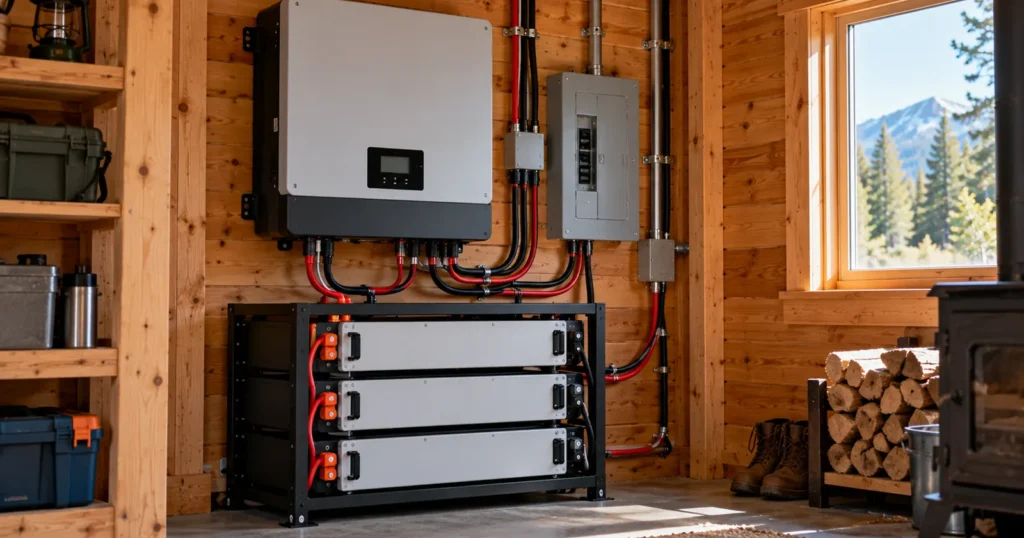
Six kilowatts is where an all-in-one solar inverter can power a whole cabin, a workshop or a family home’s essential circuits. Many units put out 120/240 V from one box, take about 8 kW of panels and charge a 48 V battery.
The spec sheet hides three limits behind the 6 kW figure: a per-leg limit, a battery current cap and a solar input ceiling. This guide uses the published specs of one popular unit, the EG4 6000XP, as its worked example.
How much can a 6kW inverter run at once?
The rating covers everything switched on at the same moment. Keep the steady load under about 80%, or 4,800 W. On a 120/240 V unit, 6,000 W equals 25 A at 240 V.
Typical running and starting watts for common loads in a cabin or home:
| Load | Voltage | Running watts | Starting watts (typical) |
|---|---|---|---|
| Refrigerator | 120 V | 100 to 250 W | 600 to 1,200 W |
| Ductless mini-split, 12,000 BTU | 240 V | 900 to 1,200 W | Low, inverter compressor ramps up |
| Well pump, 1 hp | 240 V | 1,000 to 1,500 W | 3,000 to 5,000 W |
| Microwave | 120 V | 1,200 to 1,600 W | No motor surge |
| Induction cooktop, one zone | 240 V | 1,400 to 2,000 W | No motor surge |
| Washing machine | 120 V | 400 to 800 W | 1,000 to 2,000 W |
| Table saw, 1.75 hp | 120 V | 1,500 to 1,800 W | 3,000 to 4,500 W |
| LED lights, router, laptop, TV | 120 V | 200 to 400 W | None |
For your own appliances, read the nameplate and multiply amps by volts. A realistic evening in a full-time cabin might be the fridge (200 W), the mini-split (1,100 W), the well pump cycling on (1,300 W), lights and electronics (300 W) and the microwave (1,500 W). That is 4,400 W, inside the 4,800 W comfort zone. Older fridges vary a lot, so check how many watts a refrigerator uses before you count on the low end of the range.
Why does a split-phase 6kW inverter trip at 3,000 W on one side?
A 120/240 V inverter feeds two 120 V legs, just like the utility service to a US home. The 6,000 W rating covers both legs together. Each leg can carry only half: 25 A × 120 V = 3,000 W. The EG4 6000XP sheet lists exactly that, 3,000 W maximum continuous per line, and it does not shift spare capacity from one leg to the other.
So an inverter showing 3,400 W of total load can still shut down if most of that load sits on one leg. Here is the same set of appliances wired two ways:
| Load | Watts | Poor layout | Balanced layout |
|---|---|---|---|
| Microwave | 1,500 W | Leg 1 | Leg 1 |
| Coffee maker | 1,000 W | Leg 1 | Leg 2 |
| Refrigerator | 200 W | Leg 1 | Leg 2 |
| Lights and outlets | 400 W | Leg 1 | Leg 1 |
| Freezer, TV, router | 320 W | Leg 2 | Leg 2 |
| Leg 1 total | 3,100 W (overload) | 1,900 W | |
| Leg 2 total | 320 W | 1,520 W |
A 240 V load such as a well pump draws equally from both legs. The trouble comes from heavy 120 V loads like microwaves, kettles and space heaters landing on the same leg, so alternate the big 120 V circuits across both sides of the subpanel.
Example: 6,000 W ÷ 2 = 3,000 W, or 25 A at 120 V on each leg
Some 6 kW models output 120 V only, or 230 V for export markets. A 120 V-only unit cannot run a 240 V well pump unless you stack two units, so check the output voltage first.
Can a 6kW inverter start a well pump or central air conditioner?
Starting a motor takes a short burst of power several times its running draw. The 6000XP sheet lists a surge of 12,000 W for about 3.5 seconds or 11,000 W for about 5 seconds, roughly twice its rating. Other 6 kW all-in-ones publish similar ratios with different durations, so read your own sheet.
Example: 2,200 W running + 4,500 W well pump start = 6,700 W, under a 12,000 W surge rating
- 1 hp well pump: usually fine, even with the house running.
- Mini-splits: the easiest large load, because variable-speed compressors ramp up gently.
- 3-ton central AC: runs at roughly 3,000 to 3,500 W, but a conventional compressor’s start can exceed the surge rating. A soft starter often makes it work; compare the unit’s locked-rotor amps with the surge spec first.
The inverter size calculator adds your running and starting watts and tells you whether 6 kW is enough or whether you should step up to a larger inverter size.
What size battery bank does a 6kW inverter need?
Two questions decide the battery: can it deliver the current, and does it hold enough energy for the night?
The current check
Example: 6,000 W ÷ (48 V × 0.93) = 134 A, rising to about 139 A near the 46.4 V low cutoff
That lands right at the 6000XP’s 140 A discharge limit, which is why 6 kW is the practical ceiling for this kind of box. Most 5 kWh rack batteries (51.2 V, 100 Ah) are limited to about 100 A of continuous discharge, so one module cannot carry a full 6 kW load. Two modules in parallel is the real minimum, and three give headroom. Protect the battery cable with a fuse sized at about 125% of the current, around 170 A, then pick the next standard size your manual allows. Run your cable length through the wire size calculator before you buy copper.
The energy check
Runtime depends on your average load, not the inverter’s rating. The inverter itself draws about 50 W when on, or 1.2 kWh a day. The table uses 90% usable capacity and average loads that include that idle draw.
| Battery bank (48 V LiFePO4) | Usable energy | Cabin, 300 W average | Home essentials, 600 W | Essentials plus mini-split, 1,200 W |
|---|---|---|---|---|
| 2 × 5.12 kWh = 10.24 kWh | 9.2 kWh | about 31 hours | about 15 hours | about 7.7 hours |
| 3 × 5.12 kWh = 15.36 kWh | 13.8 kWh | about 46 hours | about 23 hours | about 11.5 hours |
| 4 × 5.12 kWh = 20.48 kWh | 18.4 kWh | about 61 hours | about 31 hours | about 15 hours |
Example: 13.8 kWh ÷ 0.6 kW = 23 hours
Plan on 10 kWh for one night of essentials and 15 to 20 kWh for cloudy days. Try your own load in the battery backup calculator.
How many solar panels should go on a 6kW inverter?
More than 6 kW. The 6000XP accepts up to 8,000 W of panels through two MPPT inputs of 4,000 W each, with a 480 V maximum input and a 120 to 385 V tracking range. Real panels rarely reach nameplate output, so a larger array keeps the inverter busy mornings, evenings and in winter. A grid-tie 6 kW string inverter is usually paired with 7 to 8 kW of panels for the same reason.
Worked string design with 430 W panels
Assume a typical 430 W panel with an open-circuit voltage near 38.5 V (check your datasheet, since many sit between 37 and 40 V). Panel voltage climbs in cold weather, so allow about 15% extra for winter mornings.
Example: 9 × 38.5 V × 1.15 = 398 V, safely under the 480 V limit
Nine panels per string also gives 9 × 430 W = 3,870 W, just under the 4,000 W per-tracker cap. Two strings of nine, one on each MPPT input, makes 18 panels. The solar string size calculator runs the same check with your panel’s exact numbers and your local record low.
| Panels (430 W) | Layout | Array size | Daily energy at 4.5 sun hours, 80% | Fit on a 6 kW all-in-one |
|---|---|---|---|---|
| 12 | 2 strings of 6 | 5,160 W | about 18.6 kWh | Fine, inverter underused |
| 14 | 2 strings of 7 | 6,020 W | about 21.7 kWh | Good match |
| 16 | 2 strings of 8 | 6,880 W | about 24.8 kWh | Good match |
| 18 | 2 strings of 9 | 7,740 W | about 27.9 kWh | Best use of the input limit |
| 20 | 2 strings of 10 | 8,600 W | about 31 kWh on paper | Each string over 4,000 W, some clipping |
Example: 7.74 kW × 4.5 × 0.80 = 27.9 kWh
Over a year, the 18-panel array makes roughly 8,500 to 12,400 kWh at 1,100 to 1,600 kWh per kW. NREL’s PVWatts calculator estimates your address. Keep each string to one per MPPT input: these units allow about 17 A per tracker, and two 430 W strings in parallel would exceed it.
Cabin, home backup or workshop: what does a 6kW build look like?
Most buyers fit one of three profiles. These are starting points from the assumptions above, not quotes.
| Use | Typical daily use | Battery | Panels (430 W) | Watch out for |
|---|---|---|---|---|
| Off-grid cabin, full-time | 8 to 14 kWh | 15 to 20 kWh | 16 to 18 | Winter sun hours, generator for long cloudy spells |
| Home essentials backup, grid-tied house | 10 to 15 kWh during an outage | 10 to 20 kWh | 14 to 18 | Leg balancing in the critical loads subpanel |
| Workshop or barn | 3 to 8 kWh | 10 kWh | 12 to 14 | Saw and compressor surge, 240 V tools |
For home backup, the 6000XP passes up to 50 A of grid power through to its loads, enough for a critical loads subpanel but not a whole 200 A house. Many units in this class charge from the grid but do not export to it, so check before counting on net metering.
Many 6 kW all-in-ones fall roughly between $1,200 and $2,500 in typical US listings in late 2026, before batteries and panels. The 30% federal credit for homeowner-owned systems ended for installations after December 31, 2025.
When is a 6kW inverter too small?
The average US home bought about 10,791 kWh of electricity in 2022, according to the EIA, close to 30 kWh a day. Energy is rarely the problem. Power at the same moment is.
- Level 2 EV charging: a 32 A, 240 V charger draws 7,680 W, more than the whole inverter.
- Electric tank water heater: a 4,500 W element technically fits, but it leaves only 1,500 W for the rest of the house while it heats.
- Electric range plus central AC: two large loads together quickly pass 6,000 W.
- Everything on one leg: a microwave, kettle and space heater on one side of the panel trip the 3,000 W leg limit long before the total is reached.
The usual fix is to add a second identical unit in parallel. Two 6 kW units make 12 kW and double the per-leg limit to 6,000 W. If you are deciding between sizes from the start, compare the trade-offs in the 5kW inverter guide for lighter loads and the 10kW inverter guide for larger homes.
Frequently asked questions
Is a 6kW inverter the same as a 6kW solar system?
No. A 6kW inverter limits how much AC power you can use at once, while a 6kW solar system describes the panels’ combined rating. A 6kW inverter usually works best with 7 to 8 kW of panels, and neither number tells you how much energy a battery stores, which is measured in kWh.
How many 430 W panels can I connect to a 6kW inverter?
On an all-in-one with two 4,000 W MPPT inputs and a 480 V limit, 18 panels in two strings of nine is the practical maximum, about 7.7 kW. Fourteen to sixteen panels also work well. Always confirm the string’s cold voltage with your panel’s datasheet and local low temperature.
Can a 6kW inverter run a 3-ton central air conditioner?
It can carry the running load of about 3,000 to 3,500 W, but starting a conventional compressor may exceed the surge rating. A soft starter often solves this. A ductless mini-split of similar capacity is much easier to run because its variable-speed compressor starts gently.
Can I use a 24V battery with a 6kW inverter?
Almost never. Most 6kW all-in-one inverters require a 48 V nominal battery. At 24 V the inverter would need over 260 A at full output, which means very heavy cables and fuses. A 51.2 V LiFePO4 rack battery is the standard match, with at least two modules to share the current.
Can I connect two 6kW inverters together?
Many models allow parallel operation, and some list up to 16 units. Two units give 12 kW of output and 6,000 W per 120 V leg. Both units must be the same model and firmware, share one battery bank and use the manufacturer’s parallel cables and settings.


