3kW (3000 Watt) Inverter: What It Runs and Battery Size
Short answer
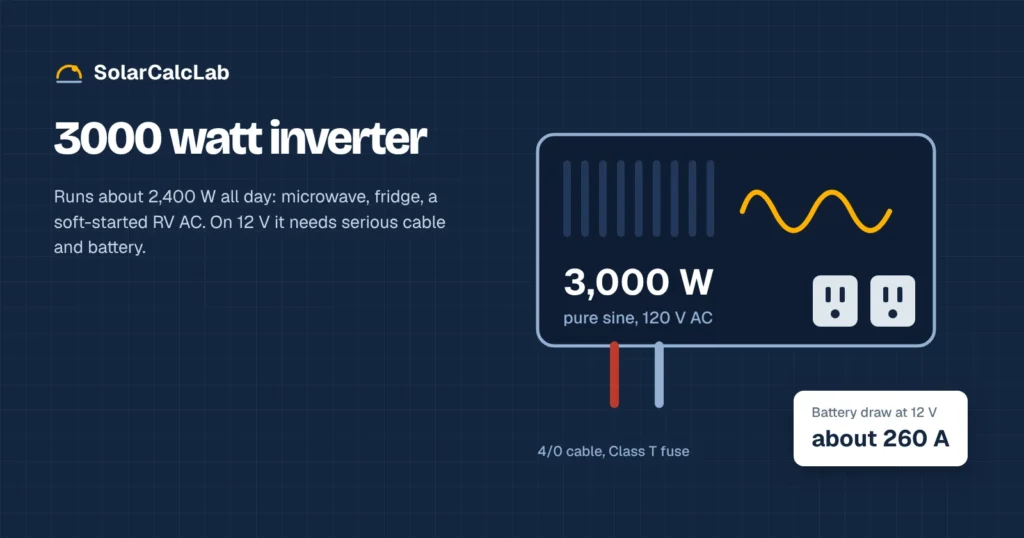
A 3000 watt inverter can run about 2,400 W of appliances comfortably and up to 3,000 W at its limit: a microwave, coffee maker, hair dryer or space heater one at a time, a residential fridge alongside them, or a 13,500 BTU RV air conditioner if the AC has a soft starter. On 12 V it pulls about 260 to 280 A, so it needs 4/0 cable, a 400 A class fuse and a battery bank that can deliver that current.
The 3000 watt inverter is the size most people land on when a 2,000 W unit is too tight for a microwave plus everything else, but a 5 kW system feels like overkill. It is the classic match for a 30-amp RV, a well-equipped van and a small cabin.
Whether it works for you depends less on the wattage than on the motor you want to start, the battery behind it and the cable between them. Here is each one with real numbers.
What will a 3000 watt inverter run?
Plan on about 80% of the rating, or 2,400 W, for anything that runs more than a few minutes. Motor loads also need a surge check, covered below.
| Appliance (120 V) | Running watts | Starting watts | On a 3,000 W inverter? |
|---|---|---|---|
| Residential refrigerator | 100 to 250 W | 600 to 1,200 W | Yes |
| Microwave, 1,000 W cooking power | 1,400 to 1,600 W | No motor surge | Yes |
| Drip coffee maker | 900 to 1,200 W | No motor surge | Yes, but not with the microwave |
| Hair dryer | 1,500 to 1,875 W | Small | Yes, on its own |
| Induction hot plate | 1,800 W | No motor surge | Yes, on its own |
| Space heater | 1,500 W | No motor surge | Yes, but drains a battery fast |
| Rooftop RV AC, 13,500 BTU | 1,300 to 1,500 W | 3,300 to 4,500 W | Usually only with a soft starter |
| Rooftop RV AC, 15,000 BTU | 1,500 to 1,800 W | 3,800 to 5,500 W | Soft starter required, tight |
| Sump pump, 1/2 hp | 900 to 1,200 W | 2,000 to 3,000 W | Often, check surge duration |
| Circular saw | 1,200 to 1,800 W | 2,000 to 3,500 W | Usually, one tool at a time |
| Level 1 EV charging at 12 A | 1,440 W | None | Yes, but it empties most battery banks in hours |
| 240 V well pump, water heater or dryer | varies | varies | No, a 120 V inverter cannot supply 240 V |
The RV air conditioner ranges come from Micro-Air’s sizing guide, which makes the EasyStart soft starter. For household appliances, our appliance wattage chart and the guide to how many watts a microwave uses list typical figures.
Two combinations that work, and one that trips
- RV evening: 13,500 BTU AC (1,400 W) + residential fridge (200 W) + TV and lights (200 W) = 1,800 W. Fits inside the 2,400 W working limit.
- Cabin morning: coffee maker (1,000 W) + fridge (200 W) + lights and router (100 W) = 1,300 W. Fits easily.
- RV evening plus the microwave: 1,800 W + 1,500 W = 3,300 W. That is over the 3,000 W rating, so the inverter shuts down. Turn the AC off while the microwave runs.
Why a 3000 watt inverter fits a 30-amp RV
A 30-amp RV pedestal supplies 30 A × 120 V = 3,600 W. A 3,000 W inverter covers 83% of that, which is close enough that most owners can live on the inverter the way they live on shore power, as long as they avoid running the AC, microwave and water heater element at once. A 50-amp RV has two 120 V legs and up to 12,000 W, which points to a larger or stacked inverter setup instead.
In an RV the inverter is usually an inverter-charger, which adds a battery charger and an automatic transfer switch. On shore power or a generator it passes power through and charges the batteries. A standalone inverter costs less but needs a separate charger and transfer switch. In November 2026, battery brands sell basic 12 V 3,000 W pure sine inverters from about $260, while a Victron MultiPlus 12/3000/120 inverter-charger lists for about $1,170 at a large US solar retailer.
The surge problem with RV air conditioners
The surge number on a box can mislead you. A typical high-frequency 3,000 W unit might advertise 6,000 W of surge, but the fine print matters. Samlex’s PST-3000-12 manual, for example, rates its 6,000 W surge for less than 8 milliseconds. A compressor needs hundreds of milliseconds to get up to speed.
That is why a roof AC with a 3,300 to 4,500 W start often trips a 3,000 W inverter even though 6,000 W looks like plenty. Two fixes work:
- Add a soft starter to the air conditioner. It ramps the compressor up gradually, and makers claim cuts of up to about 70% in starting current.
- Choose a low-frequency inverter with a heavy transformer. These often hold their surge for several seconds. Check the datasheet for the surge duration, not only the surge watts.
12 V, 24 V or 48 V for 3,000 watts?
The battery voltage decides how much current flows, and current decides the cable, the fuse and whether the battery can keep up.
Example: 3,000 W ÷ (12.8 V × 0.90) = 260 A
| Battery voltage | Current at 3,000 W | What it means in practice |
|---|---|---|
| 12 V (12.8 V lithium) | 260 to 278 A, over 330 A near low-voltage cutoff | 4/0 cable, Class T fuse, two or more batteries |
| 24 V | 139 A | Much smaller cable, one large battery may do |
| 48 V | 69 A | Thin cable, easy fusing, best for cabins and homes |
The worst case on 12 V comes when the battery sags. At 10.5 V and 85% efficiency, 3,000 W needs about 336 A. That is the number your cable and fuse must survive.
Cable and fuse on a 12 V system
Follow your inverter’s manual first. As one real example, the Samlex PST-3000-12 manual calls for 4/0 AWG cable for runs of 3 or 6 feet, two parallel 2/0 AWG cables at 10 feet, and an external fuse of no more than 400 A. It also requires a UL Class T fuse or equivalent within 7 inches of the battery positive terminal. Keep the inverter as close to the battery as you can. The voltage drop calculator shows what each extra foot of 12 V cable costs.
If you are designing from scratch and do not need 12 V for anything else, a 24 V system halves the current and usually saves more on cable than it costs in extra parts.
What battery does a 3000 watt inverter need?
Two separate checks apply: the battery must be able to supply the current, and it must hold enough energy for the hours you need.
On the current side, most single 12 V lithium batteries have a 100 A or 200 A BMS. A 200 A battery tops out at about 2,300 W of AC output. Our 300Ah battery guide shows exactly where that limit bites. For 3,000 W on 12 V you need at least two 200 A batteries in parallel.
On the energy side, here is how long common banks run three typical loads, using 90% usable capacity and a 90% efficient inverter:
| Battery bank (LiFePO4) | 500 W load | 1,400 W (roof AC running) | 2,500 W |
|---|---|---|---|
| 12 V 200Ah (2.56 kWh) | 4.1 h | 1.5 h | BMS limit |
| 12 V 300Ah (3.84 kWh) | 6.2 h | 2.2 h | BMS limit |
| Two 12 V 300Ah in parallel (7.68 kWh) | 12.4 h | 4.4 h | 2.5 h |
| 24 V 200Ah (5.12 kWh) | 8.3 h | 3.0 h | 1.7 h |
| 48 V 100Ah (5.12 kWh) | 8.3 h | 3.0 h | 1.7 h |
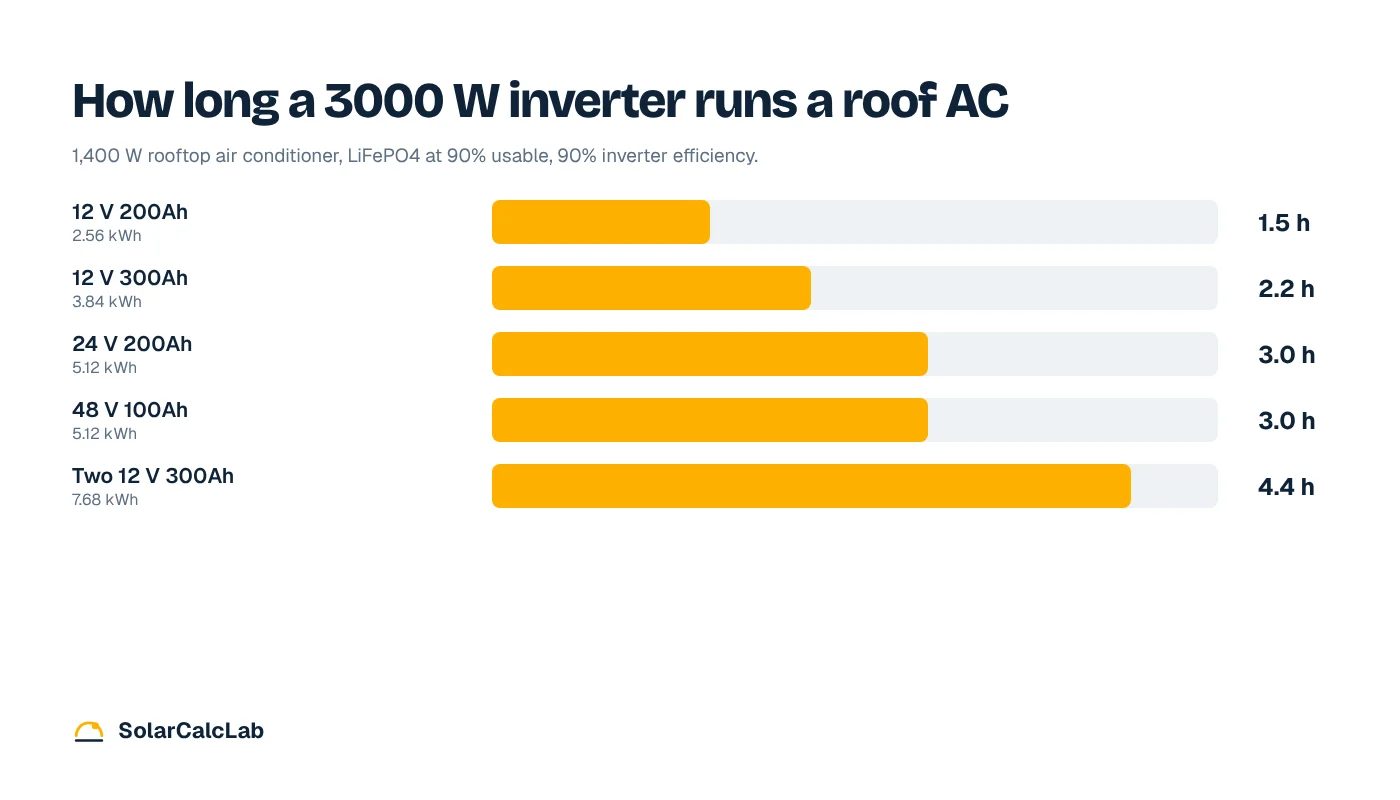
The lesson for RV owners: running air conditioning overnight on batteries takes far more storage than most rigs carry. A 3,000 W inverter can start and run the AC, but the battery decides for how long. The battery backup calculator handles your own load list.
Do not forget idle draw
A 3,000 W inverter uses power even with nothing plugged in. Victron lists 20 W at zero load for the MultiPlus 12/3000, or 8 W in search mode. Left on for 24 hours, 20 W is 480 Wh, which is 14% of a 300Ah lithium battery’s usable energy gone for nothing. Turn the inverter off, or use search mode, when you do not need AC power.
3,000 W, 2,000 W or 4,000 W?
- Choose 2,000 W if your largest load is a microwave or a coffee maker and you never need air conditioning on the inverter. You save on the inverter, the cable and the battery current, and our 2000 watt inverter guide shows what that size runs and how to wire it.
- Choose 3,000 W for a 30-amp RV, for a soft-started roof AC, or for a cabin where a 1/2 hp pump and kitchen loads may overlap.
- Choose 4,000 W or more if you need a 1 hp well pump plus kitchen loads at the same time, or you want to run a 15,000 BTU AC without load management. At that size, move to 48 V.
If you are still unsure, total the loads that run together and let the inverter size calculator add surge and headroom. Our full guide on what size inverter you need walks through that method, and the 5kW inverter guide covers the next size up.
Frequently asked questions
How many amps does a 3000 watt inverter draw at 12 volts?
About 260 to 280 A at full output, depending on battery voltage and inverter efficiency. When the battery sags toward 10.5 V the draw can pass 330 A. At 24 V the same 3,000 W takes about 139 A, and at 48 V about 69 A.
Can a 3000 watt inverter run an RV air conditioner?
Yes for running watts, since a 13,500 BTU unit uses about 1,300 to 1,500 W. The problem is the start, which can reach 3,300 to 4,500 W. Most owners add a soft starter so the inverter can handle it. Your batteries then decide how long it runs.
How long will a 3000 watt inverter run on a 100Ah battery?
A 12 V 100Ah lithium battery holds about 1,150 Wh usable. At a full 3,000 W it would last roughly 20 minutes in theory, but most 100Ah batteries have a 100 A BMS that shuts off long before 3,000 W. In practice a single 100Ah battery suits loads under about 1,000 W.
What size fuse do I need for a 3000 watt inverter?
Use the size in your inverter’s manual. For a 12 V 3,000 W model it is often around 400 A, and Samlex specifies a 400 A maximum Class T fuse within 7 inches of the battery for its PST-3000-12. A 24 V model needs roughly half that.
Can a 3000 watt inverter run a house?
It can run a home’s essentials on 120 V: refrigerator, freezer, lights, internet, a furnace blower and a microwave used on its own. It cannot run 240 V loads such as a well pump, electric water heater, dryer or central air. For those you need a split-phase inverter, usually 6 kW or larger.