Off-Grid Solar System: How to Size Panels, Batteries and Inverter
Short answer
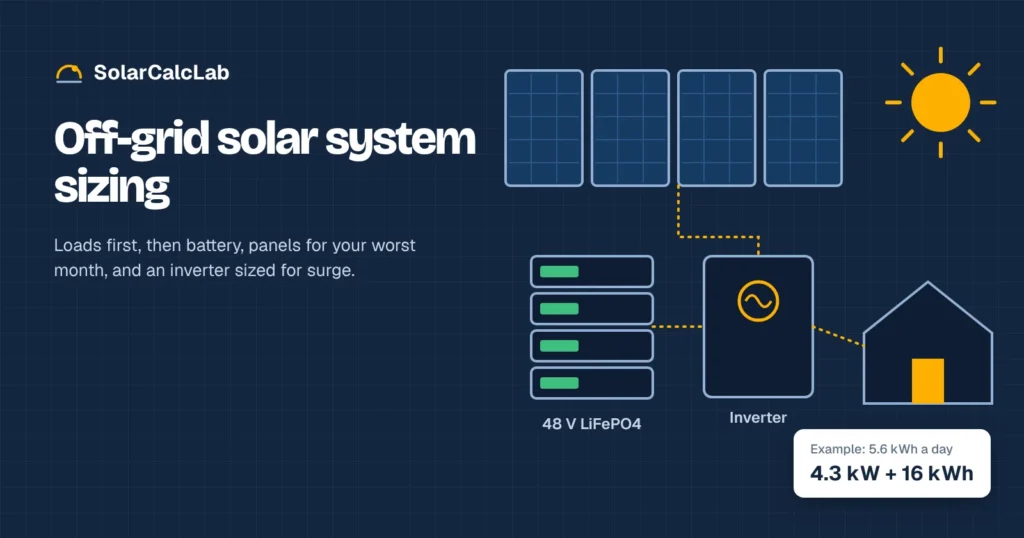
Size an off-grid solar system in four steps: add up your daily watt-hours, add the inverter’s own idle draw, size the battery for one to three days of that total, then size the panels for your worst month of sun. For a small full-time home using 5.6 kWh a day, that works out to about a 16 kWh LiFePO4 battery, 3.3 to 4.3 kW of panels at 3 winter peak sun hours, and a 6 kW 48 V all-in-one inverter.
Grid-tied solar can be sized from a year of electric bills. Off-grid solar has to be sized from the loads you will actually run, on the shortest days of the year, with the battery doing the work every night. The same method works on wheels, though an RV adds tight roof space and a fridge choice that can double the load, which our guide to how much solar an RV needs covers.
This guide walks through one complete design, from the load list to the wire between battery and inverter, so you can see where each number comes from. Swap in your own loads and sun hours, or run them through the off-grid solar calculator to check the result.
The order matters: loads first, hardware last
Many failed builds start with a kit that turns out too small for the well pump or too weak for December. The order that avoids this:
- Load audit: list every device, its watts and its hours per day.
- Battery: daily energy times days of autonomy, divided by usable depth of discharge.
- Array: daily energy divided by worst-month peak sun hours and a loss factor.
- Charge controller: array watts divided by battery voltage.
- Inverter: the loads that run at the same time, plus motor surge.
- Wiring, fusing and backup charging.
Step 1: the load audit
Here is a realistic list for a small full-time home with propane for cooking, hot water and heat. Watts times hours gives watt-hours (Wh) per day; cycling appliances are listed by daily energy.
| Load | Watts | Hours a day | Wh per day |
|---|---|---|---|
| Refrigerator, 18 cu ft Energy Star | cycles | 24 | 1,100 |
| Well pump, 1/2 hp, 240 V | 1,000 | 1 | 1,000 |
| Internet equipment | 40 | 24 | 960 |
| Chest freezer, 7 cu ft | cycles | 24 | 600 |
| Ceiling fans (2) | 60 | 8 | 480 |
| LED lights (10 bulbs) | 90 | 5 | 450 |
| Microwave | 1,200 | 0.25 | 300 |
| Laptop and phone charging | varies | varies | 300 |
| TV | 80 | 3 | 240 |
| Washing machine (3 loads a week) | varies | averaged | 214 |
| Total AC loads | 5,644 |
If you are not sure what your appliances draw, the solar load calculator has typical wattages, and a plug-in meter on the real fridge for a week beats any table.
The load nobody lists: the inverter itself
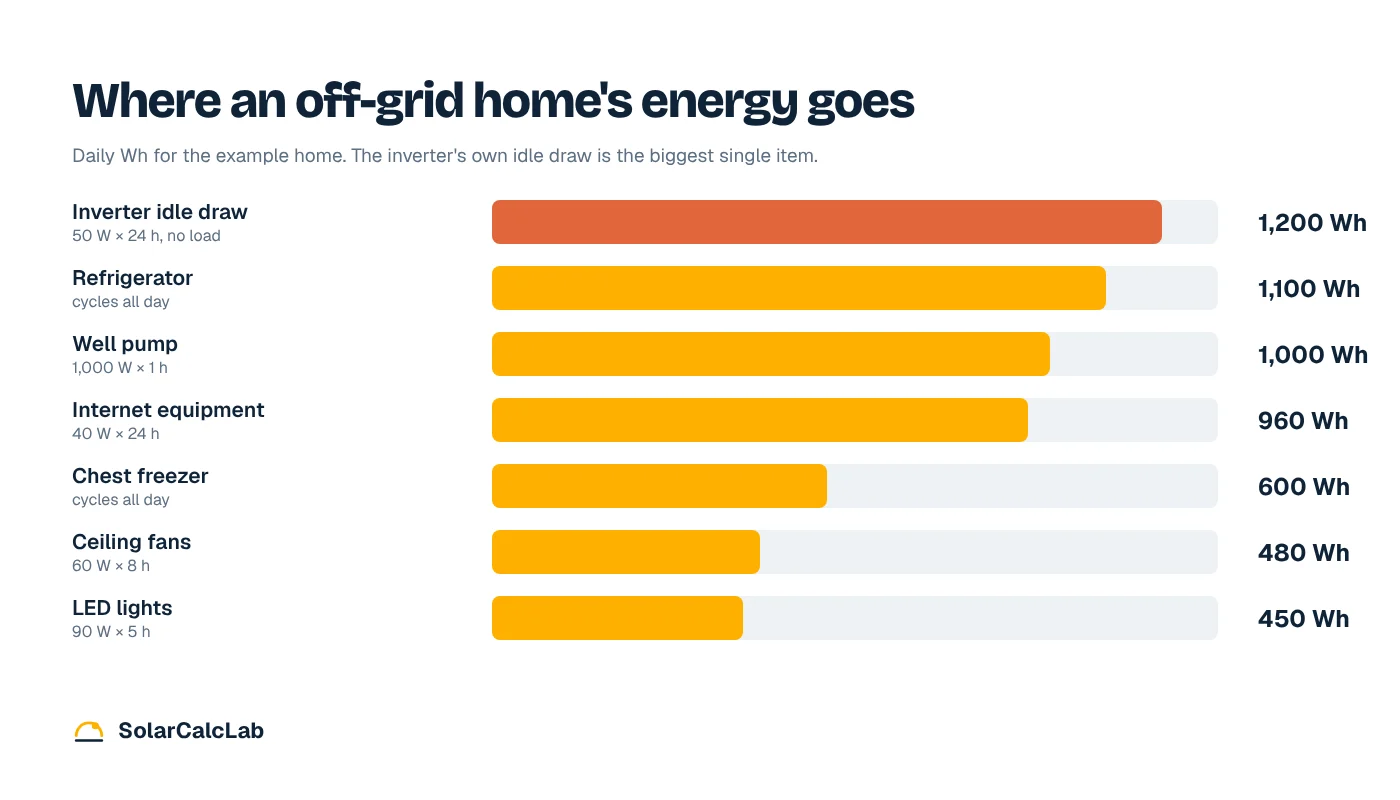
An inverter that is switched on uses power even when nothing is plugged in. A common 6 kW split-phase all-in-one, the EG4 6000XP, lists about 50 W of idle consumption. Fifty watts for 24 hours is 1,200 Wh a day, which makes it the single biggest “load” in this house, ahead of even the fridge.
Add inverter losses too. At about 92% conversion efficiency, the battery must supply more than the appliances use:
= 5,644 ÷ 0.92 + 1,200 = about 7,335 Wh
So a house whose appliances use 5.6 kWh needs about 7.3 kWh a day out of the battery. Idle draw alone is 16% of that. If your inverter has a power-saving or search mode that works with your loads, it can cut this number a lot.
Step 2: size the battery bank
Days of autonomy is how long the battery must carry the house with little or no sun. One day suits a site with a generator that starts automatically. Two days is a sensible default for full-time living. Three or more makes sense where storms park overhead for days and the generator is a long walk away.
= 7,335 Wh × 2 ÷ 0.90 = about 16.3 kWh
LiFePO4 handles 90% depth of discharge every day without much wear, which is why it has replaced lead-acid in nearly every new off-grid build. Lead-acid at 50% depth of discharge would need about 29 kWh. Our battery storage sizing guide covers backup and time-of-use cases if you are on the grid instead.
Turning kWh into real batteries
| Bank (48 V rack modules) | Total kWh | Usable kWh at 90% | Days for this home |
|---|---|---|---|
| 3 × 5.12 kWh | 15.36 | 13.8 | 1.9 |
| 4 × 5.12 kWh | 20.48 | 18.4 | 2.5 |
Three modules land just under two days; four add margin for aging and cold mornings. Server-rack LiFePO4 modules were selling for roughly $210 to $255 per kWh at one large US distributor this year, so the difference between three and four modules is about $1,000 to $1,300.
Step 3: size the array for your worst month
A grid-tied array is sized on the annual average because net metering carries summer surplus into winter. Off grid, there is no carry-over. The array must refill the battery in December, when many US sites get 3 peak sun hours or less on a tilted array.
The 0.75 factor covers heat, dirt, wiring, controller and battery charging losses. Look up your own December value with NREL’s PVWatts tool, which gives month-by-month output for any US address, or use our peak sun hours calculator.
| Worst-month sun hours | Array needed | 430 W panels |
|---|---|---|
| 5.5 (desert Southwest) | 1.78 kW | 5 |
| 4.0 | 2.44 kW | 6 |
| 3.0 | 3.26 kW | 8 |
Why the minimum is not enough
Eight panels at 3 sun hours make about 7.7 kWh a day, which barely covers the house. After two cloudy days the battery is nearly empty, and the array has almost nothing left over to refill it. With ten panels (4.3 kW), a clear December day makes about 9.7 kWh, leaving roughly 2.3 kWh of surplus. Refilling 13.8 usable kWh at that pace still takes about six clear days.
Extra panels are the cheapest fix, a generator handles the rest. Panels are cheap enough now (often $0.30 to $0.45 per watt by the pallet) that oversizing the array beats oversizing the battery. In summer the same ten panels at 5.5 sun hours make about 17.7 kWh a day, which is normal for a system sized for winter.
Step 4: charge controller and system voltage
At this size, 48 V is the right battery voltage. At 12 V, 4.3 kW of panels would push about 358 A into the battery, which is unworkable. At 48 V nominal (51.2 V for LiFePO4):
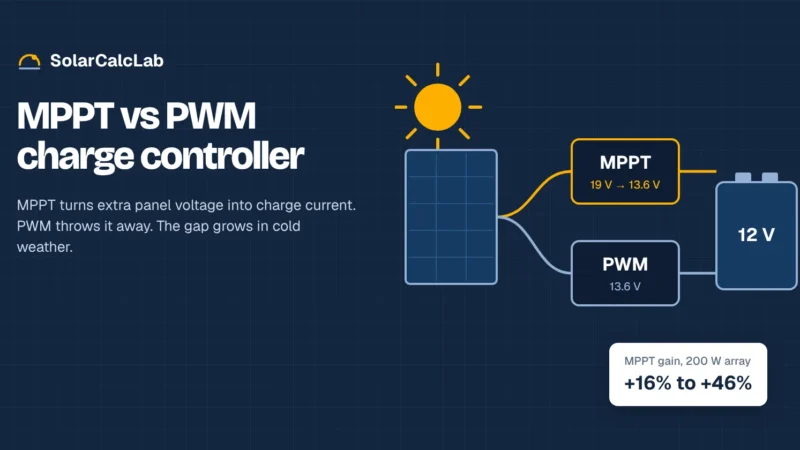
A 100 A MPPT controller, or an all-in-one inverter whose built-in MPPT accepts at least 4.3 kW and charges at 84 A or more, covers it. Also check the string voltage against the controller’s maximum input voltage on the coldest morning, since panel voltage rises in the cold. The charge controller calculator runs both checks. When the panels or battery voltage change, our guide on what size charge controller you need shows how the answer shifts, with a lookup table by array size.
Step 5: the inverter
Size the inverter for the loads that can run at the same time, not the daily total. In this house the worst realistic moment is the well pump, microwave and washer running together with the fridge, freezer, lights, fans, TV and internet:
1,000 + 1,200 + 500 + 150 + 100 + 90 + 60 + 80 + 40 = 3,220 W
Then add motor surge. A 1/2 hp well pump can pull around three times its running watts for a moment at start-up. A 3 kW inverter would trip. A 6 kW unit handles the running load with headroom and has the surge capacity for the pump. The pump runs on 240 V, so the inverter must have 120/240 V split-phase output, which rules out most 120 V-only units. Our inverter sizing guide covers surge checks in more detail.
Step 6: wiring, fusing and backup charging
Battery cable
At full 6 kW output and a low battery at 48 V, the inverter draws about 136 A. Multiply by 1.25 for continuous duty and you need conductors good for about 170 A. Under NEC Table 310.16, 2/0 copper at the 75°C column is rated 175 A, so 2/0 is the minimum here, with a matching fuse or breaker at the battery. The wire size calculator handles longer runs where voltage drop pushes you up a size.
Generator
Size the generator to run the inverter’s battery charger plus the loads that run while it charges. An 80 A charger at 56 V uses about 4.5 kW, so a 6 to 7.5 kW generator fits. Automatic generator start, if the inverter supports it, means a cloudy week does not depend on someone being home.
What this system costs
| Component | Example choice | Rough 2026 parts cost |
|---|---|---|
| Panels | 10 × 430 W (4.3 kW) | $1,290 to $1,935 |
| Battery | 3 to 4 × 5.12 kWh 48 V LiFePO4 | $3,250 to $5,200 |
| Inverter | 6 kW split-phase all-in-one | about $1,500 |
| Racking, wire, fuses, disconnects | ground or roof mount | varies widely |
| Generator | 6 to 7.5 kW | varies by fuel and brand |
That is parts for a DIY build of a small home. An average American house is a different scale: EnergySage puts professionally installed off-grid solar plus storage for an average house at $115,000 or more, mostly because of the battery capacity a full electric home needs. Moving heat, hot water and cooking to propane or wood is what keeps the example house at 5.6 kWh a day.
One tax note: the federal residential clean energy credit (Section 25D) does not apply to systems whose installation was completed after December 31, 2025, so a homeowner-owned off-grid system finished in 2026 gets no federal credit. Check for state or utility programs instead.
Three mistakes that sink off-grid systems
- Sizing the array on annual sun hours. Fine in June, short in December.
- Buying a 120 V-only inverter for a house with a 240 V well pump.
- Skipping the permit. Many US counties still require an electrical permit and inspection for off-grid systems under NEC Articles 690 and 706, and insurers may ask for it.
Frequently asked questions
How big an off-grid solar system do I need for a house?
It depends on daily use, not square footage. A small home using 5 to 6 kWh a day with propane heat and cooking needs about 3 to 4.5 kW of panels and 15 to 20 kWh of LiFePO4 battery in most of the US. A typical all-electric home using about 30 kWh a day needs roughly five times that, which is why most off-grid homes cut their electric loads first.
How many days of battery autonomy should an off-grid system have?
Two days is a good default for a full-time home with a backup generator. One day works if the generator starts automatically. Three or more days makes sense in cloudy climates or where the generator is hard to reach, but each extra day adds a full day of battery cost.
Should an off-grid system be 12 V, 24 V or 48 V?
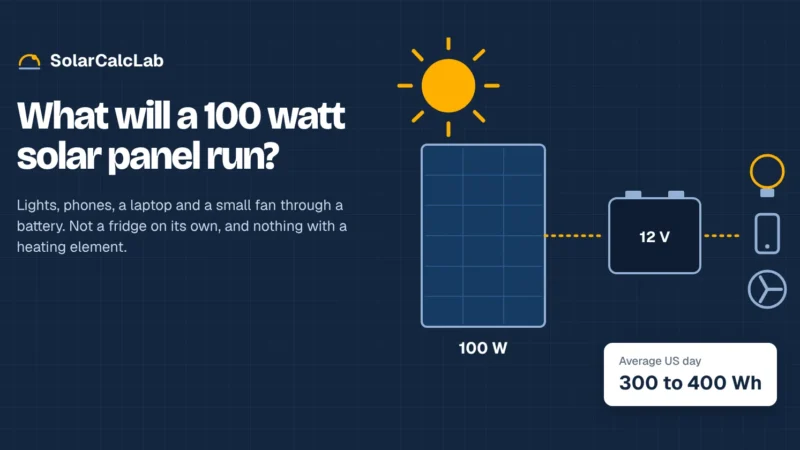
Use 48 V for anything above about 2 kW of inverter or array. Higher voltage means lower current, thinner cable and smaller fuses. 12 V still suits small RV, van and shed systems under about 1,500 W. At the very small end, this breakdown of what a 100 watt solar panel will run shows how far a single panel and a 12 V battery can go.
Can I run an off-grid home without a generator?
Yes, but only with panels and batteries sized for the worst winter week and careful load control during storms. Most full-time homes keep a generator because it costs far less than that extra battery.
Is an off-grid solar kit a good idea?
It can be good value once you know your numbers. Do the load audit and winter array math first, then check the kit’s battery, panel count, surge rating and output voltage against them.