Grid Tie vs Hybrid Inverter: Which Do You Need?
Short answer
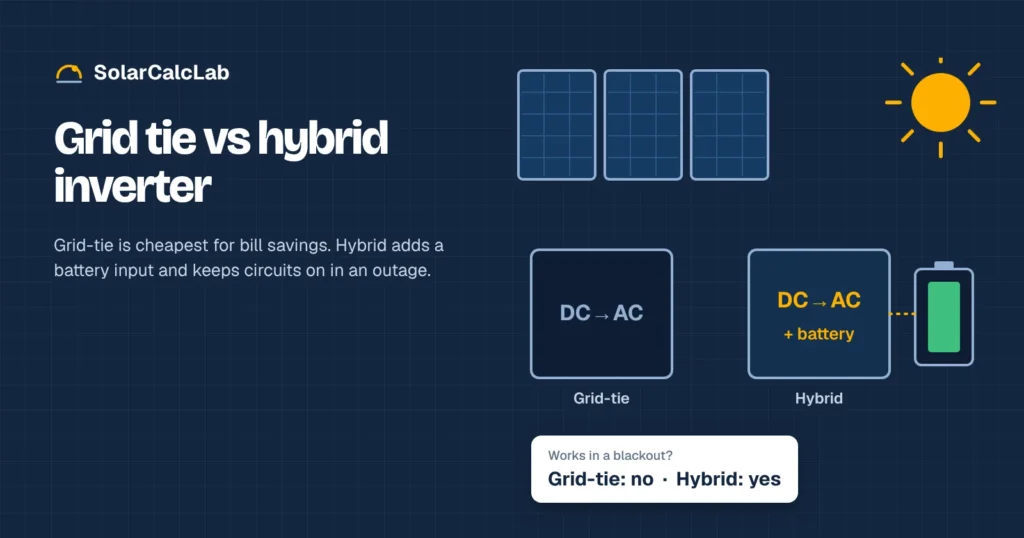
A grid-tie inverter turns solar power into AC for your home and the utility, but it has no battery input and shuts off in a blackout. A hybrid inverter does the same job and also charges and discharges a battery, so it can keep circuits running when the grid is down. Choose grid-tie if you have full net metering, a reliable grid and no battery plans. Choose hybrid if you want backup, live under net billing, or expect to add a battery within a few years.
The inverter is the one solar component you cannot easily change your mind about. Panels are panels. But the inverter decides whether a battery can ever be added cheaply, whether the house stays lit in an outage, and how much of your own solar you can use after sunset. That makes “grid tie vs hybrid inverter” less a spec question and more a question about how you want the system to behave in five years.
What each type actually does
| Grid-tie inverter | Hybrid inverter | Off-grid inverter | |
|---|---|---|---|
| Converts solar DC to AC | Yes | Yes | Yes, usually with a built-in or separate charge controller |
| Battery connection | No | Yes | Yes, required |
| Exports to the utility | Yes | Yes, on grid-interactive models | No |
| Powers the house in a blackout | No (a few models offer a daytime-only outlet) | Yes, on backed-up circuits | Yes, it is the only source |
| Typical buyer | Lowest-cost bill reduction | Backup, net billing, future battery | Cabins, rural homes, RVs |
The grid-tie category includes string inverters and microinverters. Both must shut down within seconds when grid voltage disappears, a safety rule that protects line workers. Our article on whether solar panels work during a power outage explains that shutdown and the few partial workarounds.
A hybrid inverter, sometimes sold as a “multi-mode” or “battery inverter,” puts the solar input, a battery charger and a grid connection in one box. When the grid fails, it opens an internal transfer relay, isolates the house from the utility and keeps running from panels and battery.
Four questions that decide it
1. How does your utility pay for exported solar?
Under classic one-to-one net metering, the grid works as a free battery. Excess daytime power earns a full retail credit, so storing it yourself adds cost without adding savings. Under net billing, exports earn far less than you pay for imports, and every kilowatt-hour you keep for the evening is worth more. California’s NEM 3.0 is the best-known example. If you are on net billing, a hybrid with a battery changes the economics. See net metering vs net billing for how the two credit systems compare.
2. How often does your power go out, and what does an outage cost you?
One short outage a year is an inconvenience. A rural line that drops for a day after every storm, a well pump, a sump pump, medical equipment or a home office changes the answer. Only a battery, and therefore a hybrid or an added battery inverter, keeps power flowing at night during an outage.
3. Will you add a battery later?
This is the question people skip. If a battery is likely within a few years, a hybrid now usually costs less than buying a grid-tie inverter today and then adding a second battery inverter later.
4. Are you replacing an inverter that already works?
If you already own a working grid-tie system, the choice is different. You are deciding between adding an AC-coupled battery next to the old inverter or swapping it for a hybrid. That retrofit decision is covered below.
DC coupling vs AC coupling: where the efficiency difference comes from
A hybrid inverter is DC-coupled: panel power can go straight into the battery through a DC charger, then gets converted to AC once when you use it. Adding a battery to a grid-tie system is AC-coupled: panel power is converted to AC by the solar inverter, back to DC by the battery inverter to charge, then to AC again on discharge. As EnergySage explains, AC-coupled energy is inverted three times and DC-coupled energy once.
To put a number on it, here is an illustration with typical published efficiencies. Real products vary, so treat these as example values, not specs for any one model.
AC-coupled: 0.97 (solar inverter) × 0.96 (charging) × 0.95 (battery) × 0.96 (discharging) = 0.849
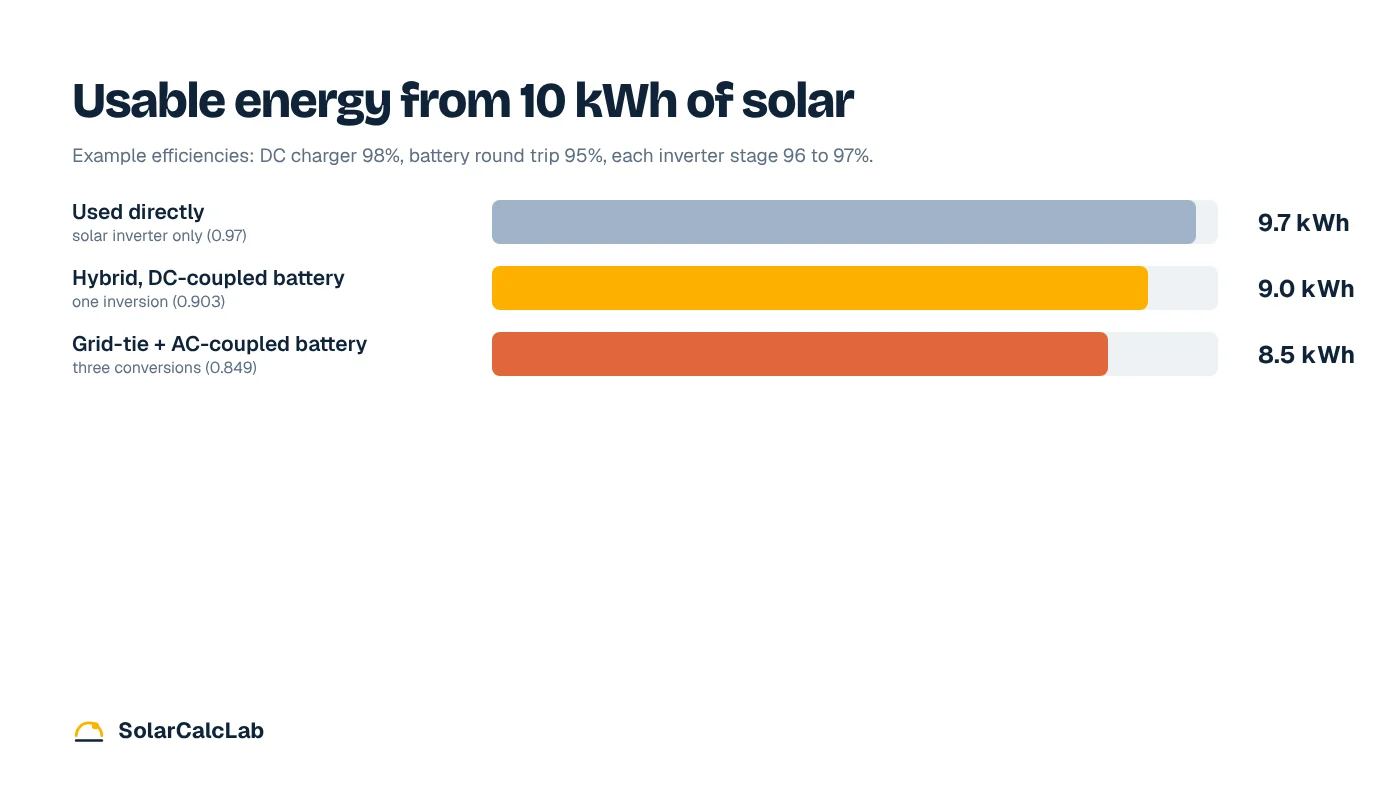
If you cycle 10 kWh through the battery every day, that gap is about 0.54 kWh a day, or roughly 196 kWh a year. At 15 to 30 cents per kWh, it is worth about $29 to $59 a year. Real, but small. It means the efficiency argument alone should not push you into tearing out a working grid-tie inverter. Installation cost and features matter far more.
Already have grid-tie solar? Three retrofit paths
| Path | What you do | Best when | Watch out for |
|---|---|---|---|
| Add an AC-coupled battery | Keep the solar inverter; install a battery with its own inverter on the AC side | Existing inverter is young and working | Battery must be able to control or curtail the old inverter during an outage (frequency shifting or a rapid shutdown signal) |
| Replace with a hybrid | Swap the string inverter for a hybrid and connect the battery on its DC side | Old inverter is near the end of its life or its warranty | String voltage and MPPT inputs must match the existing panels |
| Hybrid on new panels only | Leave the old system alone; add new panels, a hybrid and a battery | You are expanding the array anyway | Utility interconnection limits and main panel busbar capacity |
String inverters often need replacing around year 10 to 15 while panels last 25 years or more. If your inverter is already that old, the “replace with a hybrid” path stops looking like a waste of a working part.
What “battery ready” really means
Some grid-tie inverters are marketed as battery ready. Before you pay extra for that label, ask four things:
- Which batteries? Many hybrids work only with a short compatibility list. High-voltage batteries (often 200 to 500 V) and 48 V batteries are not interchangeable.
- Is backup included, or does it need an extra gateway, transfer switch or backup interface?
- Whole home or a critical-loads panel? The answer depends on the inverter’s continuous output and how much surge it can deliver.
- Can it start your largest motor? A central AC or well pump can need several times its running watts for a moment.
The battery backup calculator estimates how long a given battery keeps your chosen circuits on, and the inverter size calculator checks continuous and surge watts.
What a hybrid costs in 2026
The hybrid inverter itself is no longer the expensive part. Two popular whole-home 48 V hybrids, the EG4 18kPV (12 kW AC output, 18 kW of PV input) and the Sol-Ark 15K, were selling for roughly $4,900 and $5,200 to $5,300 this year. The battery is the larger cost. Rack-mount 48 V LiFePO4 has fallen to the low hundreds of dollars per kWh for DIY buyers, while installed branded home batteries cost several times that once labor, permits and backup hardware are included.
The federal tax credit no longer softens the decision for most homeowners. The residential clean energy credit (Section 25D) ended for systems whose installation was completed after December 31, 2025, so an owned hybrid and battery installed in 2026 gets no federal credit. Our solar tax credit article covers what changed and who still qualifies.
Three homes, three answers
Suburban home, full net metering, outages once a year
Grid-tie. The utility already stores surplus at full value, and a short annual outage does not justify a battery. Spend the difference on more panels.
Home on net billing with evening rate peaks
Hybrid with a battery sized to cover the evening peak. The battery earns money every day by shifting cheap midday solar into expensive evening hours. The self-consumption calculator shows how much more of your own solar you would use.
Rural home with storm outages and a well
Hybrid, sized for the well pump surge, with at least enough battery to get through a night. Check the inverter has 120/240 V split-phase output. Our inverter sizing guide walks through the surge math, and choosing an inverter battery covers chemistry and voltage.
Frequently asked questions
Can a grid-tie inverter work without the grid?
No. A grid-tie inverter must shut down when it loses grid voltage. A few models offer a small daytime-only outlet that runs from the panels, but they cannot power the house or work at night.
Can I add a battery to a grid-tie inverter?
Yes, through AC coupling. The battery comes with its own inverter and connects on the AC side. It works well, but energy is converted more times than in a hybrid, and the battery system must be able to control the old inverter during an outage.
Is a hybrid inverter worth it without a battery?
Only if you are fairly sure you will add one. Without a battery it works like a grid-tie inverter, usually at a higher price. The value is in avoiding a second inverter later.
Can a hybrid inverter work off grid?
Many can, but check the manual. Some grid-interactive hybrids need the grid to stay connected for normal operation and only provide backup for a short time. True off-grid use requires a model rated for it, with a battery and usually a generator input.
Which is more efficient, grid-tie or hybrid?
For solar you use as it is made, they are similar, around 96 to 98% at their best. For solar stored in a battery, a DC-coupled hybrid loses less than an AC-coupled retrofit because it converts the energy fewer times. In the example above the gap was about 5 percentage points.