2kW Solar System: Output, Panels and Best Uses
Short answer
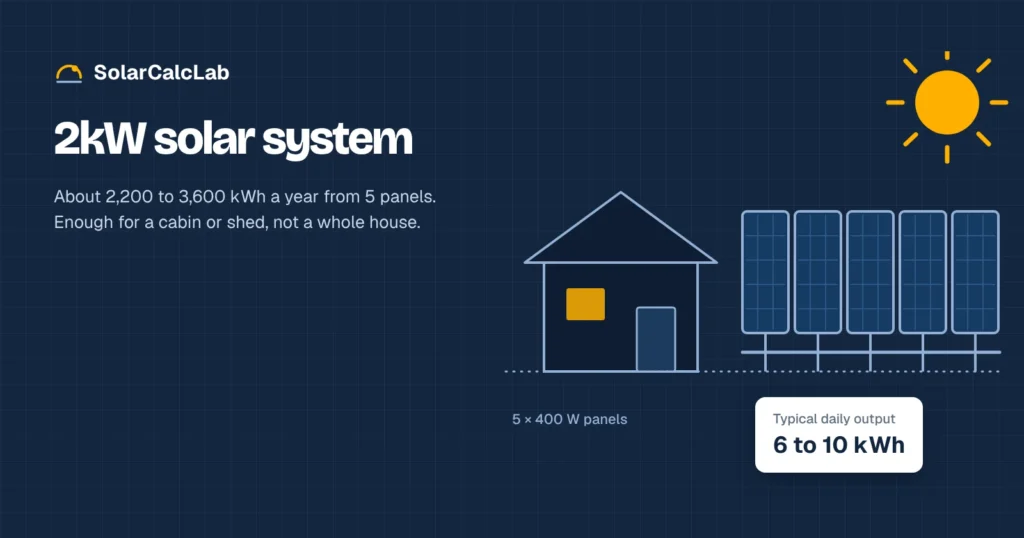
A 2kW solar system makes about 2,200 to 3,600 kWh a year in the US, or roughly 6 to 10 kWh a day on average. That takes 5 panels at 400 to 430 watts and about 105 square feet of space. It is too small to run an average home, but it suits a cabin, shed, workshop or small off-grid setup that uses 3 to 4 kWh a day. The real limit is December, when daily output can drop to 2.5 kWh in Seattle.
Two kilowatts is too big for a van roof and too small for most rooftop installers. Where it shines is a building with no utility line, or one where running a line would cost more than the panels: a hunting cabin, a backyard office, a barn with a well pump, a tiny house.
Because most 2kW systems end up off grid, the useful question is not how much they make in a year. It is how much they make on the worst day of the year, and whether your loads and battery can live with that number. Below you will find modeled output for seven US cities, a full load budget, string wiring for a common charge controller and a realistic parts list.
How much does a 2kW system produce in each season?
We modeled a 2 kW array in PVWatts, the free solar model from the National Laboratory of the Rockies (formerly NREL), facing due south with 14% system losses. The tilt is the city latitude, capped at 40 degrees.
| City | Per year | Average day | December day | June day |
|---|---|---|---|---|
| Phoenix, AZ | 3,576 kWh | 9.8 kWh | 8.7 kWh | 10.5 kWh |
| Denver, CO | 3,268 kWh | 9.0 kWh | 7.7 kWh | 9.3 kWh |
| Dallas, TX | 3,024 kWh | 8.3 kWh | 7.2 kWh | 9.2 kWh |
| Charlotte, NC | 2,922 kWh | 8.0 kWh | 6.4 kWh | 8.3 kWh |
| Chicago, IL | 2,630 kWh | 7.2 kWh | 4.5 kWh | 8.6 kWh |
| Burlington, VT | 2,504 kWh | 6.9 kWh | 3.9 kWh | 7.7 kWh |
| Seattle, WA | 2,200 kWh | 6.0 kWh | 2.5 kWh | 7.9 kWh |
In the Southwest, December output stays close to the yearly average. In Chicago and Burlington it drops to about 55% to 65% of the average, and in Seattle to about 42%. Snow on the panels can make a northern December worse than the model shows.
On a grid-tied home the utility covers that gap. Off grid, it decides everything.

What will a 2kW system actually run?
Here is a realistic daily budget for a weekend cabin or a small full-time off-grid space. The well pump runs about 30 minutes a day in total, and the lights are six 9 W LED bulbs on for five hours.
| Load | How it is used | Energy per day |
|---|---|---|
| Full-size refrigerator | Compressor cycling | 1.20 kWh |
| Well pump, 1,000 W | 30 minutes total | 0.50 kWh |
| LED lights | 6 × 9 W × 5 h | 0.27 kWh |
| TV, 90 W | 3 h | 0.27 kWh |
| Wi-Fi router, 10 W | 24 h | 0.24 kWh |
| Laptop, 50 W | 4 h | 0.20 kWh |
| Inverter idle draw, 40 W | 24 h | 0.96 kWh |
| Total | 3.64 kWh |
The line most people forget is the inverter itself. An all-in-one inverter that stays on around the clock often draws 30 to 60 W with nothing plugged in, so check the “no load” figure on the spec sheet. In this budget it uses more energy than the refrigerator.
Allowing about 10% for charge and discharge losses, the array needs to supply roughly 4.0 kWh a day. Compare that with the December column above:
- Phoenix, Denver, Dallas and Charlotte: comfortable year round, with spare energy most days.
- Chicago: 4.5 kWh against a 4.0 kWh need. It works on an average day and fails during a cloudy week.
- Burlington and Seattle: short in December. Plan on a generator, more panels or cutting the load in winter.
What a 2kW system will not run: central air, an electric water heater, an electric range or a dryer. Each of those loads can use roughly 3 to 25 kWh a day, and our appliance wattage chart lists the typical figures. A 2 kW array can carry a small mini split or a window unit in summer, when output is highest, but not much else at the same time. For very small loads like lights, a fan and a few power tools, the shed solar calculator is a fast first pass.
The battery math
To ride through two sunless days at 3.64 kWh a day, you need 3.64 × 2 ÷ 0.9 = 8.1 kWh of LiFePO4 battery at 90% usable depth. That rounds up to two 48 V 100 Ah server-rack batteries, which give 10.24 kWh in total. A single 5.12 kWh battery offers about 4.6 kWh usable, enough for roughly 1.3 days.
Now the catch. After a cloudy week in Chicago, the array has only about 0.9 kWh a day left over once the loads are covered. Refilling a drained 10.24 kWh bank at that rate takes about 10 days. In northern states, a bigger battery buys you less than you would think, because a 2 kW array cannot refill it in winter. A small generator for a few winter hours is usually the cheaper fix. The off-grid solar calculator runs this balance for your own location and loads.
Panels and string wiring for 2 kW
| Panel rating | Panels | Array size | Approx. area |
|---|---|---|---|
| 100 W (12 V style) | 20 | 2.00 kW | About 120 sq ft |
| 400 W | 5 | 2.00 kW | About 105 sq ft |
| 430 W | 5 | 2.15 kW | About 108 sq ft |
| 450 W | 4 | 1.80 kW | About 86 sq ft |
Large residential panels cost less per watt and need fewer connections. Small panels only make sense on an RV or boat where a 7 foot panel will not fit. The RV solar calculator covers that case.
A string layout that will not damage the controller
Panel voltage rises in cold weather, and the coldest sunny morning sets the maximum voltage your charge controller will see. Section 690.7 of the National Electrical Code requires you to correct for it.
Example: 49.5 V × (1 + (−20 − 25) × −0.0027) = 55.5 V per panel at −4°F
Take four 450 W panels with a 49.5 V open-circuit voltage and a −0.27%/°C coefficient (check your own datasheet; these are typical values). Three in series reach 166.5 V on a −4°F morning, which exceeds a 150 V controller. Two in series reach 111 V, which is safe. So the right layout on a 150 V controller is two strings of two panels in parallel. With a controller rated 250 V or more, three or four in series would be fine. The solar string size calculator does this check with your panel specs and record low temperature.
12 V, 24 V or 48 V battery?
Charge current is array watts divided by charging voltage. A 2,000 W array into a 48 V bank charging at about 54 V pushes 37 A. At 24 V the same array pushes about 74 A, and at 12 V about 143 A. That last figure needs heavy cable and two controllers. For 2 kW, 48 V is the easy choice, 24 V is workable, and 12 V only makes sense if you are adding to an existing 12 V RV system. The charge controller calculator sizes the controller for each voltage.
What does a 2kW off-grid build cost?
Prices below are typical US retail ranges in November 2026 for a DIY build with one battery. A boxed 2kW solar kit bundles the same parts, so compare kits against this list item by item. As one reference point, a 48 V 5.12 kWh LiFePO4 rack battery was listed at about $1,470 and a 3 kW 48 V all-in-one inverter with a built-in charge controller at about $700 at one large online solar retailer.
| Component | Typical price |
|---|---|
| Five 400 W panels | $450 to $1,100 |
| 3 kW 48 V all-in-one inverter and charge controller | $700 to $1,300 |
| One 5.12 kWh 48 V LiFePO4 battery | $1,000 to $1,900 |
| Ground mount or roof racking, wire, fuses, disconnects | $500 to $1,200 |
| Total | About $2,650 to $5,500 |
A second battery adds $1,000 to $1,900. Permits and electrician time are extra where your county requires them.
On taxes: the 30% federal residential clean energy credit (Section 25D) ended for systems paid for after December 31, 2025, so a homeowner-owned system bought in 2026 gets no federal credit. Some states and utilities still run their own rebates.
Is a 2kW grid-tied system worth it?
On a house, 2 kW covers a small share of the bill. The average US home used about 10,380 kWh in 2024, so a 2 kW array in Charlotte covers about 28% and in Seattle about 21%. At the US average rate of 18.19 cents per kWh, that is roughly $530 a year in Charlotte, $480 in Chicago and $650 in Phoenix, before local rates and net metering rules change the picture.
The problem is price per watt. Permits, design, the utility application and a crew visit cost about the same for 2 kW as for 6 kW, and many installers will not quote below 3 kW at all. If you want grid-tied solar on a house, compare the numbers in our 3kW solar system guide before settling on 2 kW. Our guide to how many solar panels you need sizes a full home from your bill.
Two grid-tied cases where 2 kW makes sense:
- A first phase. If the budget is tight now, buy an inverter big enough for the final array and add panels later.
- An EV commute. A 2 kW array in Charlotte averages 8.0 kWh a day. At about 3.5 miles per kWh, that covers roughly 28 miles of driving a day across the year.
Frequently asked questions
How many kWh does a 2kW solar system produce per day?
About 6 to 10 kWh a day on average in the US. PVWatts gives 9.8 kWh a day in Phoenix, 8.0 in Charlotte, 7.2 in Chicago and 6.0 in Seattle. December output is lower, from 8.7 kWh in Phoenix down to 2.5 kWh in Seattle.
Can a 2kW solar system run a house?
Not an average US home, which uses about 28 kWh a day. A 2 kW array covers roughly 20% to 35% of that, depending on climate. It can fully power a very small, efficient off-grid home or cabin that uses 3 to 5 kWh a day, as long as there is no electric heating, cooking or water heating.
How many batteries do I need for a 2kW solar system?
It depends on your nightly use, not on the array. For a 3.64 kWh daily load and two days of backup, you need about 8.1 kWh of LiFePO4, which is two 48 V 100 Ah batteries. One 5.12 kWh battery covers about 1.3 days of that load.
Can a 2kW solar system run an air conditioner?
A small one, in summer. A 2 kW array makes about 8 to 10 kWh on a sunny summer day in most of the US. A 5,000 BTU window unit or a 9,000 BTU mini split can run several hours on that, but central air at 3,000 W or more cannot run from 2 kW of panels for long.
How much space does a 2kW solar system need?
About 105 square feet with five 400 W panels, plus room for spacing and walkways on a roof or ground mount. Using 100 W panels raises that to about 120 square feet and adds many more connections.


