3kW Solar System: Daily kWh, Panels and Typical Cost
Short answer
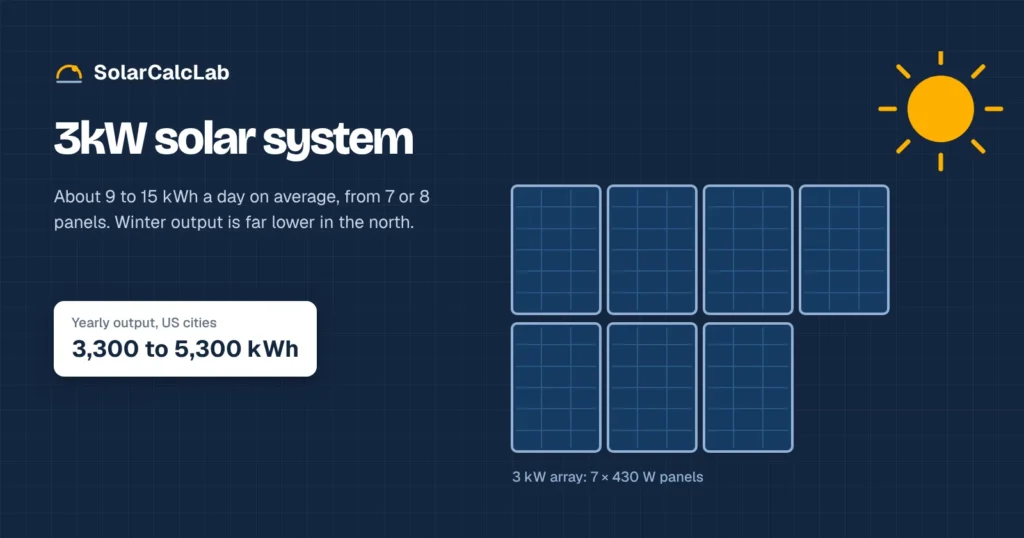
A 3kW solar system makes about 3,300 to 5,300 kWh a year in the US, which works out to roughly 9 to 15 kWh a day on average. That takes 7 or 8 panels at 400 to 430 watts. Expect winter days to fall well below the average: in Chicago a 3 kW array averages about 6 kWh a day in December and 15 kWh in July. Installed, a system this small usually costs $9,000 to $10,500, while a DIY kit runs about $5,700 to $6,200 before permits and electrician time.
Three kilowatts is about as small as rooftop solar gets before installers start turning the job down. It suits a small home that already uses little power, a backyard ADU or garage on its own meter, a ground mount someone plans to build themselves, or a first phase that will be expanded later. For an off-grid cabin or shed that needs even less, our 2kW solar system guide works through winter output, battery size and string wiring.
A single “peak sun hours” number hides what matters most at this size: how far production swings between June and December. This guide uses month-by-month modeling for seven US cities, then covers panel count, kit versus installed pricing, payback, and running a 3kW solar system off grid.
How much does a 3kW system produce, month by month?
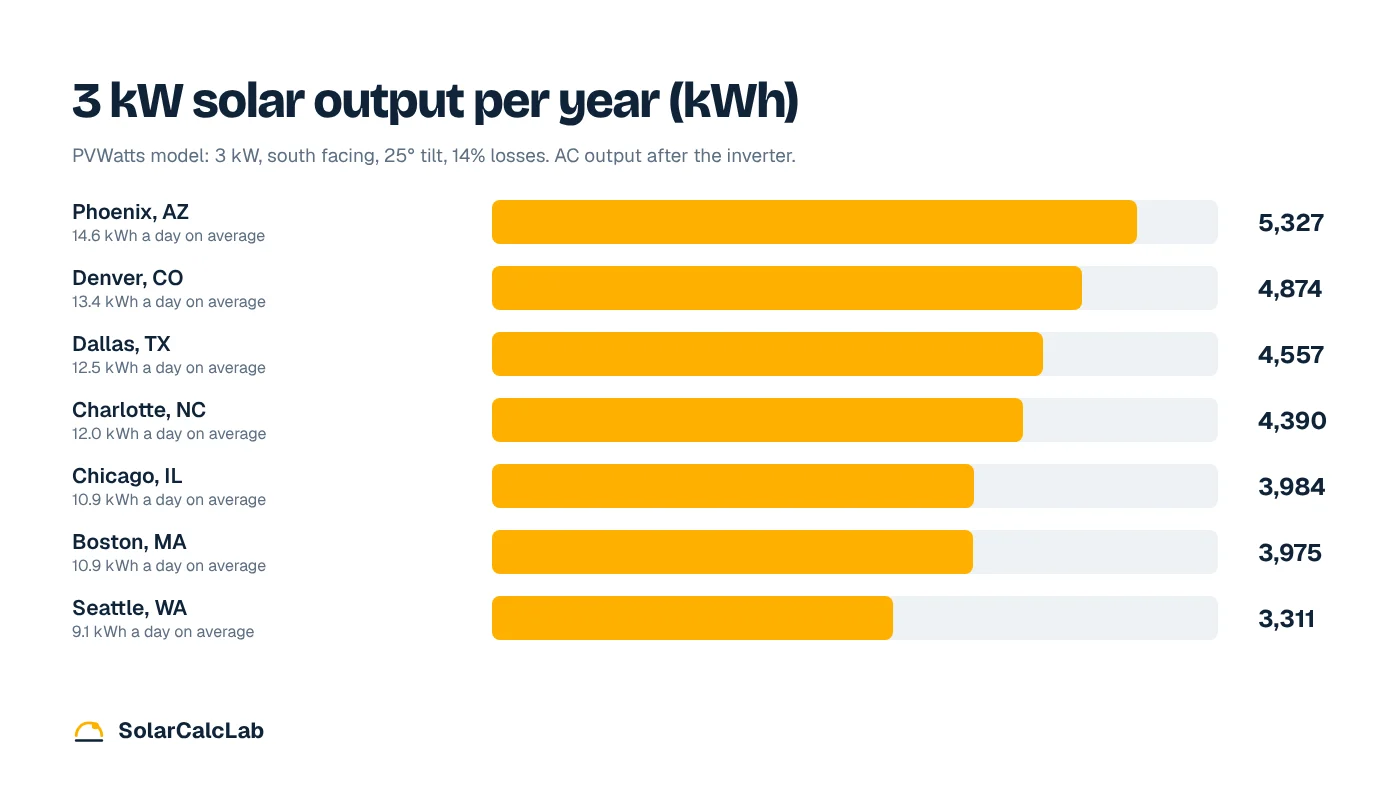
The figures below come from NREL’s PVWatts calculator for a 3 kW array of standard panels facing due south at a 25 degree tilt, with the tool’s default 14% system losses. They are AC output, so inverter losses are already taken out.
| City | Per year | Average per day | December | July |
|---|---|---|---|---|
| Phoenix, AZ | 5,327 kWh | 14.6 kWh | 372 kWh | 459 kWh |
| Denver, CO | 4,874 kWh | 13.4 kWh | 311 kWh | 466 kWh |
| Dallas, TX | 4,557 kWh | 12.5 kWh | 313 kWh | 454 kWh |
| Charlotte, NC | 4,390 kWh | 12.0 kWh | 276 kWh | 422 kWh |
| Chicago, IL | 3,984 kWh | 10.9 kWh | 185 kWh | 468 kWh |
| Boston, MA | 3,975 kWh | 10.9 kWh | 190 kWh | 423 kWh |
| Seattle, WA | 3,311 kWh | 9.1 kWh | 107 kWh | 426 kWh |
Three things the monthly data shows
Summer output is similar almost everywhere. July lands between about 420 and 470 kWh in all seven cities. Chicago in July actually beats Phoenix in July, because long northern days make up for weaker sun and hot panels lose efficiency in the desert. Phoenix peaks in May, not midsummer.
Winter is where locations split apart. Phoenix’s worst month is only about 30% below its best. In Chicago the best month is 2.5 times the worst, and in Seattle it is 4 times. A Seattle array that makes 13.7 kWh a day in July averages about 3.5 kWh a day in December.
The yearly total depends on how your utility credits exports. With annual net metering, a summer surplus can carry your winter bills. With monthly netting or a low export rate, that surplus is worth less. Our explainer on how net metering works covers the difference.
An east or west face, a flatter pitch or afternoon shade can each cut output noticeably. Enter your own tilt, direction and location in the solar panel output calculator for a site-specific number.
Who is a 3kW system actually right for?
The average US home uses about 10,791 kWh a year, according to the EIA. A 3 kW array covers 31% (Seattle) to 49% (Phoenix) of that, so this size fits a few specific situations rather than serving as a default.
- A low-use household. If your 12-month bill history totals 3,500 to 5,000 kWh, 3 kW can offset most or all of it, depending on climate. Gas heat, gas cooking and no EV are usually what put a home in this range.
- A separately metered ADU, shop or garage. A backyard unit with a mini split and modern appliances often fits this size well.
- Daytime-only offset under net billing. Where exports earn a fraction of retail, sizing to cover only what you use while the sun is up can beat a bigger array on payback.
If your bills show 700 kWh a month or more, start from your usage instead. The solar sizing guide walks through the bill-to-kW math, and the 5kW solar system guide shows the next common step up.
How many panels make 3 kW?
Divide 3,000 watts by the panel rating and round to a whole panel. Because panel sizes do not divide evenly into 3,000, the array usually ends up a little above or below 3 kW.
Example: 3,000 ÷ 430 = 6.98, so 7 panels, for a 3.01 kW array
| Panel rating | Panels | Array size |
|---|---|---|
| 370 W | 8 or 9 | 2.96 or 3.33 kW |
| 400 W | 8 | 3.20 kW |
| 430 W | 7 | 3.01 kW |
| 450 W | 7 | 3.15 kW |
Seven or eight residential panels cover roughly 150 to 175 square feet of panel surface. Once you add the fire-code walkways that most jurisdictions require, a single roof face of about 200 square feet is a realistic minimum. The how many solar panels calculator checks the count against your usage and sun hours.
3kW solar panel kit vs a professional install
DIY kits get the most attention at this size, because the equipment bill is modest and the array is small enough to handle.
| DIY grid-tie kit | Installed by a contractor | |
|---|---|---|
| Typical price | About $5,700 to $6,200 for equipment | About $9,000 to $10,500 |
| Included | Panels, inverter or microinverters, racking, often a permit plan set | Equipment, design, permit, labor, interconnection, warranty on workmanship |
| Not included | Permit fees, electrician for the panel tie-in, inspection, your labor | Usually nothing beyond optional upgrades |
| Who files with the utility | You | The installer |
The kit range reflects listed prices for 3 kW grid-tie kits with string inverters and microinverters from a major US kit seller in late 2026. For installed pricing, EnergySage marketplace data shows an average of $2.89 per watt for 4 kW quotes and $2.78 for 5 kW, with prices per watt rising as systems shrink. A 3 kW job carries the same permit, design and inspection overhead as a larger one, so $3.00 to $3.50 per watt is a reasonable planning range. Some installers set a minimum project size and will not quote 3 kW at all.
What a DIY kit does not remove
A grid-tied kit still needs a building permit, an electrical permit, a utility interconnection agreement and an inspection before you switch it on. Many jurisdictions also require a licensed electrician for the connection at the main panel. Rooftop work also adds rapid shutdown and fall safety, which is one reason many DIY buyers choose a ground mount.
The 30% federal Residential Clean Energy Credit no longer helps here. It ended for systems paid for by homeowners after December 31, 2025, so budget either route at full price unless your state or utility offers a rebate.
How long does a 3kW system take to pay back?
The EIA reported an average US residential price of 18.16 cents per kWh in August 2026. Using that rate and the PVWatts output, here is simple payback for an installed system at $10,500 and a DIY build at $7,500, which assumes $1,300 to $1,800 on top of the kit for permits, an electrician and inspection.
Example for Charlotte: 4,390 kWh × $0.1816 = $797 a year; $10,500 ÷ $797 = 13.2 years
| City | Yearly savings at $0.1816 | Installed at $10,500 | DIY at $7,500 |
|---|---|---|---|
| Phoenix | $967 | 10.9 years | 7.8 years |
| Charlotte | $797 | 13.2 years | 9.4 years |
| Chicago | $723 | 14.5 years | 10.4 years |
These assume every kWh is worth the full retail rate, which holds only for power you use yourself or under full net metering. Rates also vary: Arizona and North Carolina sit near 15 cents, Massachusetts above 30. Run your own tariff, export rate and fixed charges through the solar payback calculator.
Running a 3kW array off grid
Off grid, the December column in the first table is the number that matters, because there is no utility to cover the gap. In Charlotte, a 3 kW array averages about 8.9 kWh a day in December. In Seattle it drops to about 3.5 kWh. Battery charging losses push real usable energy a little lower still.
Charge controller size
An off-grid array charges batteries through a charge controller, and its current rating depends on the battery bank voltage.
Example at 48 V: 3,000 ÷ 48 = 62.5 A, × 1.25 = 78 A, so an 80 A MPPT controller
At 24 V the same array pushes 125 A, or about 156 A with the safety margin, which usually means two controllers. That is why 48 V is the normal choice at this size. The charge controller calculator also checks the panel voltage against the controller’s input limit on cold mornings.
Battery size
Size the battery to what you use between sunset and sunrise, plus any days of cloudy weather you want to ride through. A cabin that uses 5 kWh overnight needs about 5.6 kWh of lithium battery at 90% usable depth. Two days of autonomy pushes that past 11 kWh, and a 3 kW array in a northern winter may not refill a bank that size in one short day.
Before you sign: two common surprises
Owners in northern states often see a December bill that barely changed and assume something is broken. Check the December figure for your area first. And a string inverter sized for 3 kW leaves little room for more panels, so if an EV or heat pump is coming, ask for a larger inverter or microinverters now.
Frequently asked questions
How many kWh does a 3kW solar system produce per day?
On average about 9 to 15 kWh a day, depending on location. PVWatts modeling gives 14.6 kWh a day in Phoenix, 12.0 in Charlotte, 10.9 in Chicago and 9.1 in Seattle. Winter days fall well below these averages in northern cities.
Can a 3kW solar system run a house?
It can cover a small, efficient home that uses about 3,500 to 5,000 kWh a year, or roughly 300 to 400 kWh a month. For an average US home using about 900 kWh a month, it covers about a third to a half of the bill, depending on climate.
How many panels are in a 3kW solar panel kit?
Usually 7 or 8. Seven 430 W panels give 3.01 kW and eight 400 W panels give 3.2 kW. Check the kit’s total wattage, not just the panel count.
Is a 3kW solar kit worth it compared with hiring an installer?
It can be if you are comfortable with permits, racking and utility paperwork. A kit costs about $5,700 to $6,200 for equipment, and permits, an electrician and inspection usually add $1,300 to $1,800. That can shorten payback by three to four years compared with an installed system, but you take on the labor and the warranty claims yourself.
What size inverter does a 3kW solar system need?
A grid-tied array of 3.0 to 3.3 kW usually pairs with a 3.0 kW string inverter or one microinverter per panel. A DC-to-AC ratio up to about 1.2 is normal. Off grid, choose the inverter by your largest combined load instead.


